

History is rarely created in a single sweeping moment; rather, it is forged day by day, layer by layer, through the actions of ordinary people, world leaders, artists, and revolutionaries. When we look at On This Day: August 17, we uncover a fascinating timeline of human triumph, tragedy, and transformation.
From the shifting of geopolitical borders in the Indian subcontinent and the publication of literary masterpieces to the birth of cinematic legends and the dawn of the digital music era, August 17 has left an indelible mark on the global calendar.
Whether you are a trivia enthusiast, a history buff, or a student researching the past, this comprehensive guide will walk you through the monumental events, famous birthdays, heartbreaking deaths, and global observances that occurred on August 17. Let us dive into the archives.
The Bangalee Sphere
The history of Bengal—encompassing modern-day Bangladesh and the Indian state of West Bengal—is rich with cultural awakenings, anti-colonial resistance, and heartbreaking divisions. August 17 holds immense weight for this region, particularly concerning the partition and its literary heritage.
Historical Events: The Line That Divided a People
-
1947 – The Publication of the Radcliffe Line: While India and Pakistan officially gained independence on August 14 and 15, 1947, the actual borders dividing the two new nations were not revealed until August 17. Drawn by British lawyer Sir Cyril Radcliffe—who had never visited the subcontinent before his assignment—the boundary sliced mercilessly through the provinces of Bengal and Punjab.
-
Significance: The delayed publication meant that for two whole days, millions of people did not know which country they belonged to. Border towns like Nadia and Malda were thrown into geopolitical limbo. The hasty demarcation ignored local infrastructure, dividing communities, rivers, and even individual homes. It triggered one of the largest mass migrations in human history, forever altering the socio-political landscape of South Asia. To this day, some towns in Nadia technically celebrate their independence on August 18 because the news of their inclusion in India arrived late.
-
-
2005 – Nationwide Coordinated Bombings in Bangladesh: In a shocking display of terrorism, the banned militant group Jamaat-ul-Mujahideen Bangladesh (JMB) set off near-simultaneous bomb blasts in 63 out of 64 districts across the country between 11:00 AM and 11:30 AM.
-
Significance: Targeting courts, press clubs, and government buildings, this event was a violent wake-up call regarding the rise of religious extremism. It permanently changed Bangladesh’s domestic security policies, leading to the creation of elite anti-terrorism units and a nationwide crackdown on militant factions that stabilized the country in the subsequent decade.
-
Famous Births
-
William Carey (Born 1761): Often referred to by Rabindranath Tagore as the “father of modern Bengal”, William Carey was an English Baptist missionary whose impact on Bengali language and culture cannot be overstated. Arriving in British India, he established the Serampore Mission Press. He translated the Bible and numerous Indian classics into Bengali, authored the first comprehensive Bengali grammar book, and was instrumental in shaping the modern Bengali prose we know today.
Famous Deaths
-
Shamsur Rahman (Died 2006): One of the most revered and influential poets in modern Bengali literature. Often called the “unofficial poet laureate” of Bangladesh, Rahman was a fierce advocate for secularism, human rights, and democracy. His iconic poem Swadhinata Tumi (Freedom, You Are) became a rallying cry during the 1971 Liberation War. Passing away on August 17 at the age of 77, he left behind an enduring legacy of over 60 poetry collections that beautifully captured the urban middle-class reality, earning him the title of Nagorik Kabi (Urban Poet).
-
Madan Lal Dhingra (Died 1909): Though a Punjabi student, Dhingra’s assassination of British official Curzon Wyllie and his subsequent execution at Pentonville Prison on August 17 sent shockwaves through the subcontinent. His martyrdom profoundly influenced Bengali revolutionary groups like the Jugantar and Anushilan Samiti, fueling the fire of armed anti-colonial resistance across Bengal.
International Observances & Holidays
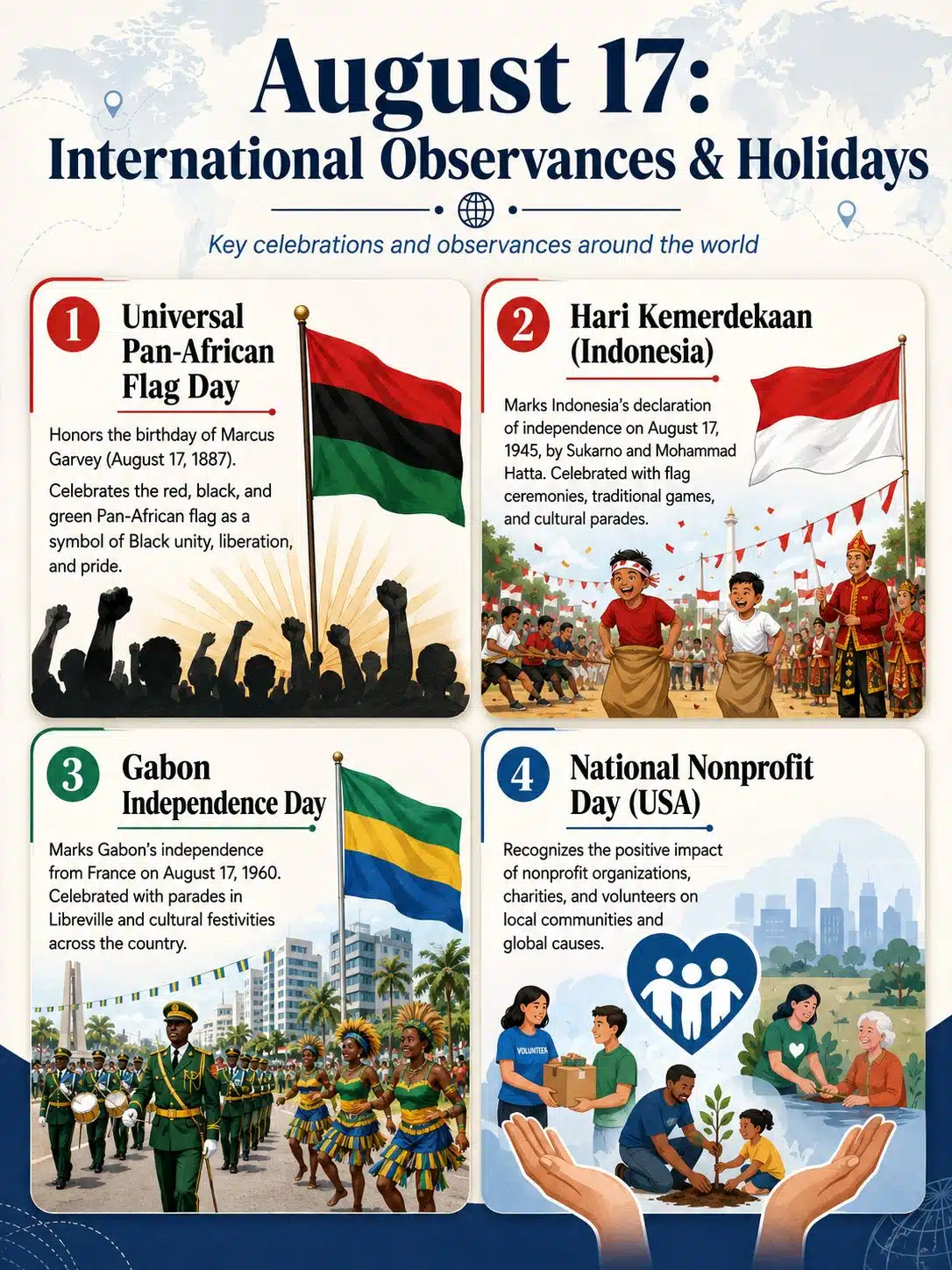
Across the globe, August 17 is marked by vibrant national celebrations and poignant observances.
-
Universal Pan-African Flag Day: This day honors the birthday of Jamaican visionary Marcus Garvey (born August 17, 1887). Garvey popularized the iconic red, black, and green Pan-African flag, which stands as a universal symbol of Black liberation, unity, and pride.
-
Hari Kemerdekaan (Indonesia’s Independence Day): A day of massive, joyous celebration across the archipelago. On August 17, 1945, nationalist leaders Sukarno and Mohammad Hatta declared Indonesia’s independence from Dutch colonial rule. Today, it is celebrated with flag-hoisting ceremonies, traditional games like Panjat Pinang (climbing a greased pole), and cultural parades.
-
Gabon Independence Day: Gabon gained its full independence from France on August 17, 1960. The day is celebrated with military parades in the capital city of Libreville and cultural festivities showcasing the nation’s diverse ethnic heritage.
-
National Nonprofit Day (USA): A day dedicated to recognizing the positive impacts that charitable organizations, volunteers, and non-profits have on local communities and global causes.
Global History
History is a tapestry woven from politics, warfare, artistic milestones, and scientific breakthroughs. Here is how August 17 played out across different continents.
United States
-
1998 – The Clinton Testimony: President Bill Clinton became the first sitting US president to testify before a grand jury as a subject of an investigation. Later that evening, he addressed the nation on live television, admitting to an “improper physical relationship” with White House intern Monica Lewinsky. The scandal reshaped American political journalism and culminated in his impeachment.
-
1859 – The First Airmail Delivery: Long before the Wright Brothers took to the skies, aeronaut John Wise piloted a hot air balloon named Jupiter, carrying 123 letters from Lafayette, Indiana, to Crawfordsville. This marked the very first official airmail flight in US history.
Russia
-
1998 – The Ruble Crisis: The Russian government sent shockwaves through global markets by devaluing the ruble, defaulting on its domestic debt, and declaring a moratorium on foreign debt payments. This catastrophic financial meltdown wiped out the savings of millions of Russians and created a political vacuum that eventually facilitated Vladimir Putin’s rise to the presidency.
China
-
1982 – The August 17 Communiqué: The United States and the People’s Republic of China issued a joint communiqué—one of the three foundational documents guiding their modern diplomacy. In it, the US pledged to gradually reduce its arms sales to Taiwan, an agreement that remains highly relevant (and debated) in today’s tense geopolitical climate.
United Kingdom
-
1945 – The Publication of Animal Farm: George Orwell published his searing allegorical novella Animal Farm. A brilliant critique of the Russian Revolution and the descent of Soviet Communism into Stalinist totalitarianism, the book permanently introduced phrases like “All animals are equal, but some animals are more equal than others” into the global lexicon.
Europe
-
1962 – Tragedy at the Berlin Wall: In one of the most heartbreaking moments of the Cold War, 18-year-old Peter Fechter was shot by East German border guards while attempting to flee to West Berlin. He fell into the “death strip” and bled to death over an hour while Western media, soldiers, and onlookers watched helplessly. His death became an international symbol of the Iron Curtain’s cruelty.
Australia
-
1980 – The Azaria Chamberlain Case: A two-month-old baby, Azaria Chamberlain, vanished from a campsite near Uluru. Her mother, Lindy, claimed a dingo had taken her baby. The ensuing trial became a media circus, leading to Lindy’s wrongful conviction for murder and her eventual exoneration years later. The case profoundly changed Australia’s legal landscape and media ethics.
Canada
-
1896 – The Klondike Gold Rush Begins: Prospectors George Carmack, Kate Carmack, and Skookum Jim discovered gold at Bonanza Creek in the Yukon. When word reached the outside world, it sparked the legendary Klondike Gold Rush. Over 100,000 stampeders rushed to the frozen north, rapidly developing the region but causing irreversible harm to local Indigenous populations and ecosystems.
Rest of the World (Middle East, Asia & South America)
-
1999 – The İzmit Earthquake (Turkey): A devastating 7.6 magnitude earthquake struck northwestern Turkey on this day. It lasted for 37 seconds but claimed over 17,000 lives and left half a million people homeless, exposing severe flaws in the region’s building codes.
-
1988 – General Zia-ul-Haq’s Plane Crash (Pakistan): Pakistan’s President and military dictator General Zia-ul-Haq, along with US Ambassador Arnold Raphel and several top military officials, was killed when their C-130 Hercules aircraft mysteriously crashed shortly after takeoff in Bahawalpur. The cause remains one of South Asia’s most enduring political mysteries.
Notable Births & Deaths (Global)
August 17 has welcomed brilliant minds and bid farewell to extraordinary talents. Here are the most prominent global figures born or lost on this day.
Famous Births
-
Pierre de Fermat (1601 or 1607, French): A brilliant mathematician whose “Last Theorem” puzzled the greatest minds in mathematics for over 350 years before finally being proven in 1994.
-
Marcus Garvey (1887, Jamaican): A towering figure in political activism and founder of the Universal Negro Improvement Association (UNIA). He was a leading voice for Black nationalism and the Pan-African movement.
-
Mae West (1893, American): An iconic actress, playwright, and sex symbol of early Hollywood, known for her sharp wit, double entendres, and unapologetic independence in an era dominated by men.
-
V.S. Naipaul (1932, Trinidadian-British): Nobel Prize-winning author renowned for his razor-sharp novels (A House for Mr Biswas) that explored the lingering traumas, displacement, and complexities of colonialism.
-
Robert De Niro (1943, American): Two-time Academy Award-winning actor and producer. Known for his intense, method-driven portrayals in cinematic masterpieces like Taxi Driver, Raging Bull, and The Godfather Part II.
-
Sean Penn (1960, American): Acclaimed actor, director, and political activist who has won two Academy Awards for Best Actor (Mystic River, Milk).
-
Thierry Henry (1977, French): One of the greatest football (soccer) strikers in history, celebrated for his legendary, record-breaking tenure at Arsenal FC and his role in France’s 1998 World Cup victory.
Famous Deaths
-
José de San Martín (1850, Argentine): The great revolutionary general who orchestrated brilliant military campaigns across the Andes, liberating Argentina, Chile, and Peru from the Spanish Empire. His selflessness in stepping away from power cemented his legacy as a true patriot.
-
Otto Stern (1969, German-American): Nobel laureate in Physics, celebrated for his groundbreaking work in experimental quantum mechanics and the discovery of the magnetic momentum of the proton.
-
Ira Gershwin (1983, American): Legendary Broadway lyricist. Working alongside his composer brother George Gershwin, he penned the words to some of the 20th century’s most enduring music, including the opera Porgy and Bess.
-
Rudolf Hess (1987, German): Adolf Hitler’s former Deputy Führer. He flew to Scotland in 1941 on a bizarre, unauthorized peace mission and spent the rest of his life in prison, eventually dying by suicide in Spandau Prison at age 93.
“Did You Know?” Trivia
History isn’t just about treaties and wars; it’s also full of quirky, fascinating moments. Here are three lesser-known facts about August 17 to share at your next dinner party:
-
The Dawn of the CD Era: If you ever owned a CD collection, you have August 17 to thank. The world’s very first commercial compact disc (CD) was pressed at a Philips factory in Langenhagen, Germany, on this day in 1982. The first album to be immortalized on this shiny new tech? ABBA’s The Visitors.
-
The Delayed Border Flags: Because the Radcliffe Line dividing India and Pakistan was kept a secret until August 17, 1947, there was mass confusion on the ground. For 48 hours post-independence, several districts in Bengal and Punjab accidentally flew the flag of the “wrong” nation, completely unaware of which country they actually belonged to until official maps finally arrived.
-
The Black Cat Crossing: In an odd cultural superstition, August 17 is celebrated in some internet circles and animal shelters as Black Cat Appreciation Day. It was created to dispel the centuries-old myths that black cats bring bad luck and to encourage their adoption from animal rescues.
Quote of the Day
To encapsulate the spirit of August 17, we look to the brilliant mind of one of the literary giants lost on this very day.
“We are all citizens of the world, and our hearts should beat in unison with the heartbeat of humanity.”
— Shamsur Rahman, Bangladeshi poet, journalist, and human rights advocate (Died August 17, 2006).
Final Thoughts
From the shifting of empires to the publication of groundbreaking literature, August 17 is a day heavily weighted with historical significance. It is a date that reminds us of the profound consequences of geopolitical decisions—like the drawing of the Radcliffe Line—as well as the enduring power of the human spirit, seen in the independence movements of nations like Indonesia and Gabon.
Looking back “On This Day” allows us to reflect on where we have been, understand the roots of our modern societal structures, and appreciate the artists, scientists, and revolutionaries who shaped our world. History is never truly in the past; its echoes are felt in the borders we cross, the books we read, and the freedoms we enjoy today.





















