Effective email subject line formulas give high-converting ideas a clear structure, directly shaping how recipients judge an email’s value in a crowded inbox. Even well-crafted offers fail when paired with vague or overly dramatic subject lines that discourage opens.
Proven subject line formulas work by forcing writers to clarify the primary benefit, context, or call to action instead of relying on generic announcements. While elements like sender reputation, list quality, and timing heavily influence deliverability, using tested frameworks ensures your message communicates immediate relevance.
The following 11 formulas provide practical starting points—from direct benefit hooks to curiosity gaps—to help you optimize open rates and improve campaign performance across every send.
What Subject-Line Advice Often Misses
Open rate is no longer a clean count of how many people read an email. Apple’s Mail Privacy Protection can download remote content in the background rather than waiting for the recipient to view the message. Because open tracking commonly relies on a downloaded image, some recorded opens may reflect privacy technology instead of reader activity. Images being blocked can create the opposite problem by leaving a real open unrecorded.
Use open rates as a trend, not a final verdict. The metric that matters most should follow the job of the email:
- Clicks for newsletters and content promotions
- Replies for sales and relationship emails
- Registrations for event invitations
- Purchases or qualified leads for commercial campaigns
- Unsubscribes and complaints as warnings that the targeting or promise is wrong
There is no subject-line length that should be treated as correct for every audience. Put the most useful words early, then check the sender name, subject line and preview text together on mobile and desktop. The preview text should extend the idea rather than repeat the subject line.
Honesty is not optional. US commercial-email rules prohibit deceptive subject lines, including in business-to-business messages. Senders reaching other countries also need to check the rules that apply to their recipients and campaigns.
11 Email Subject Line Formulas to Adapt
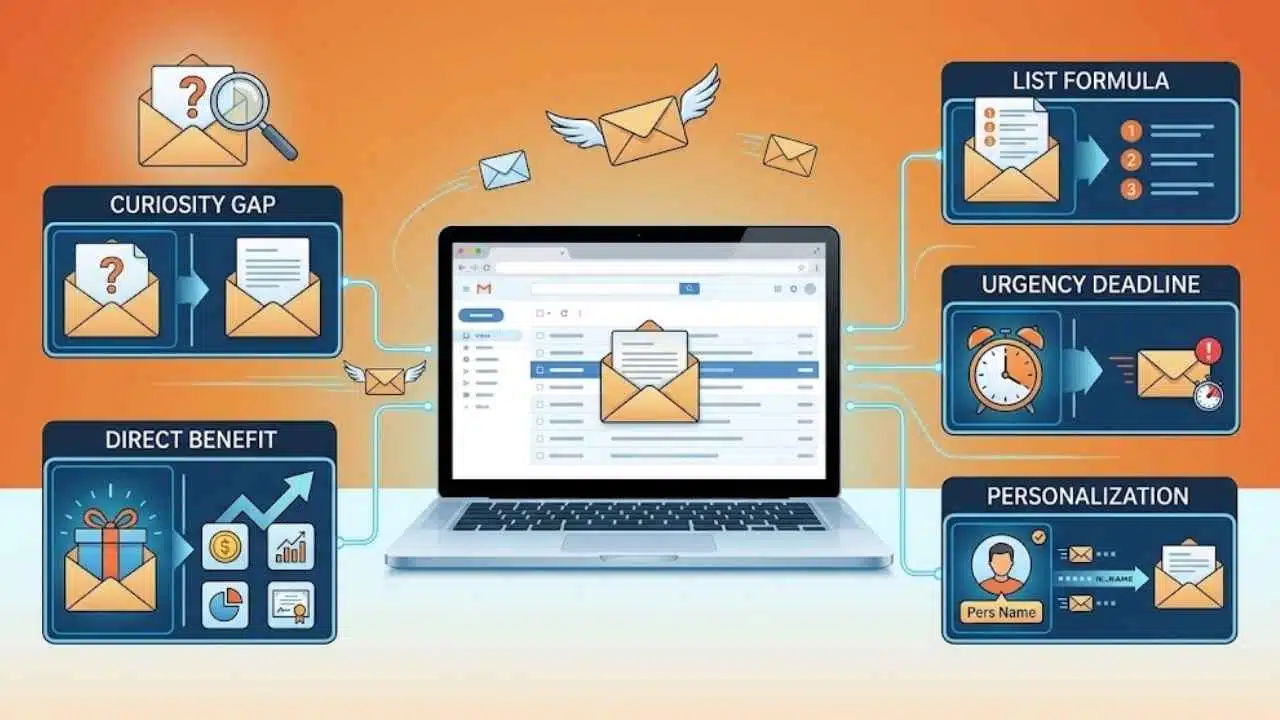
1. The Clear Benefit Formula
Formula: [Useful outcome] without [specific difficulty]
For most campaigns, this is the strongest place to start. It answers the inbox question that matters: what will the reader gain by opening?
Compare “Improve your content workflow” with “Plan next month’s content without another spreadsheet.” The first could describe almost any product or article. The second names the task and the inconvenience being removed.
Other versions might include:
- Reduce checkout friction without rebuilding your store
- Organize client feedback without another weekly meeting
- Prepare campaign reports without copying data by hand
The limitation is the promise itself. If the email contains only a sales pitch or asks readers to book a demonstration before receiving useful advice, it should not imply that the solution is already inside.
2. The Practical How-To Formula
Formula: How to [complete a task] without [common problem]
This formula fits tutorials, onboarding emails, educational newsletters and lead-nurture campaigns. Specific tasks give it credibility: “How to follow up after a sales call without sounding impatient” sets a clearer expectation than “How to grow your business.”
The email must teach something. Adding “how to” to a product announcement does not turn it into useful instruction. If most of the promised method sits behind a form or sales call, use a more accurate subject line.
3. The Specific List Formula
Formula: [Number] [items] for [audience, problem or outcome]
Numbers show readers how much material to expect. “7 abandoned-cart fixes for small online stores” defines the topic, audience and scope. “Marketing tips for businesses” does none of those jobs particularly well.
More is not automatically better. A promise of 101 ideas can sound exhausting, and readers may expect a long collection of shallow points. Use the number the email can support. Do not split six substantial recommendations into 15 thin ones merely to make the subject line look more impressive.
4. The Useful Curiosity Gap
Formula: The [detail, mistake or change] most [audience] overlook
Curiosity works when the reader understands the subject but still needs one meaningful piece of information:
- The pricing-page detail many SaaS teams overlook
- The welcome-email mistake that weakens the next send
- What changed after we removed half the signup fields
“You need to see this” and “We could not believe what happened” withhold so much that the reader has no reason to care. They also resemble low-quality promotional mail.
Resolve the promised question early in the email. Burying the answer beneath a long introduction may win an open while making the reader less willing to trust the next subject line.
5. The Relevant Question Formula
Formula: Are you [missing, making or dealing with a specific issue]?
A precise question encourages an immediate mental answer. “Are inactive subscribers distorting your reports?” can lead naturally into a list-cleaning guide. “Still approving every social post through email?” fits a workflow product or process article.
Broad questions such as “Do you want more sales?” apply to almost everyone and reveal nothing about the message. Accusatory wording is worse. A question should show that the sender understands the problem, not make the recipient feel blamed for it.
6. The Contextual Personalization Formula
Formula: [Name, company or relevant context]: [specific next step]
Personalization can refer to a genuine relationship or action rather than inserting a first name into every campaign:
- Maya, your webinar worksheet is ready
- A launch-planning idea for Northwind
- Based on your last order: care tips for your new boots
A randomized field experiment published in 2018 found that adding the recipient’s name increased detected open probability by 20% relative to the control, from 9.05% to 10.80%. The research involved millions of emails across three companies. It remains useful evidence, but it is not a current universal benchmark. The campaigns, audiences and tracking conditions were specific, and the study predated Apple’s Mail Privacy Protection.
Data quality is the immediate risk. Check fallbacks, capitalization, company fields and imported values before sending. A correct but overly sensitive reference can also feel intrusive. Use known context to make the email more relevant, not to demonstrate how much information the business has collected.
7. The Honest Deadline Formula
Formula: [Benefit or offer] ends [real date or time]
Urgency is appropriate when the deadline genuinely changes what the recipient can do: “Early registration closes Friday” or “Last day to choose your workshop session.” Concrete timing helps readers decide whether to act now or return later.
The same formula becomes damaging when every promotion is a final chance and the offer reappears the following week. Subscribers learn that waiting has no consequence. Reserve deadline language for real event cutoffs, expiring access, limited appointment windows and offers that will end as stated.
8. The Meaningful Update Formula
Formula: [Product, service or topic] update: [what changed]
“Big news” expresses the company’s excitement. “Billing update: invoices now show project names” explains why a customer might care.
This approach works well for product and account communication because the message remains easy to find later. It also forces the team to distinguish a useful change from routine maintenance. If an update does not alter what customers can do, it may belong in a release digest rather than a dedicated campaign.
9. The Status-and-Next-Step Formula
Formula: [Action or status] confirmed—[next step]
Transactional messages rarely benefit from mystery:
- Your booking is confirmed—add it to your calendar
- Payment received—download your receipt
- Password changed—review your account activity
- Application saved—complete the final section
The recipient is looking for confirmation, reassurance or an immediate task. Put that information first. “We have an update” may earn an open, but it forces the reader to identify the transaction manually.
Promotional material requires care here. In the United States, mixing transactional and commercial content can affect how an email is classified under CAN-SPAM, depending partly on the subject line and where the promotional content appears.
10. The Verified Result Formula
Formula: How [relevant peer] achieved [credible result]
Case-study subject lines should identify both the subject and the outcome: “How a small agency shortened client review cycles” is more informative than “See our latest customer success story.”
Use numbers only when the evidence supports them and the baseline is not misleading. A 200% increase may represent movement from one conversion to three. Technically accurate does not always mean editorially honest.
Relevance matters more than fame. A local service company may learn little from a global marketplace with a much larger budget and a different sales cycle. Choose a case the recipient can reasonably compare with their own situation.
11. The Direct Invitation or Request Formula
Formula: [Clear invitation or small request] + [date or context]
Some emails need no clever framing:
- Join the customer workshop on September 18
- Can you review the proposal by Thursday?
- Choose your preferred demonstration time
- Share one question before tomorrow’s session
This style suits events, account management, sales follow-ups and internal communication. Match the size of the request to the relationship. A cold prospect may ignore a demand for a 30-minute meeting, while confirming interest or answering one relevant question creates less friction.
A direct subject line also makes the email easier to decline. That is often more useful than an open produced by vague curiosity.
How to Test Subject Lines Without Chasing Noise
When comparing email subject line formulas, test a meaningful difference. A clear-benefit line against a curiosity-based line can reveal something about audience preference. A period against no period is unlikely to guide future strategy.
Keep the content, audience and send conditions consistent where possible. If one version reaches loyal customers in the morning and another goes to new subscribers at night, the subject line is no longer the only meaningful variable.
Choose the winning measure before sending. Clicks may matter for a newsletter, replies for outreach, registrations for events and purchases for commercial campaigns. Monitor unsubscribes and complaints too; a line that attracts attention by setting the wrong expectation is not a useful winner.
Email platforms including Mailchimp can test subject-line variations, although access depends on the product and plan. Teams without built-in testing can review patterns across comparable campaigns, but two unrelated sends should not be presented as a controlled experiment.
Small lists may not produce a clear answer from one campaign. Build evidence across several similar sends before turning a narrow result into a permanent writing rule.
Final Thoughts
These email subject line formulas are most useful when they force a vague campaign idea into a specific promise. Start with the clear benefit, how-to, update or direct-request format. Each makes the writer state what the email offers and gives the reader a fair reason to open it.
Use curiosity, urgency and personalization more selectively. They need accurate data, credible context and a message that delivers exactly what the subject line suggests. The strongest line is rarely the cleverest. It is the one that attracts the right reader without creating regret after the click.