

Cryptocurrency has taken the financial world by storm, with Bitcoin leading the charge as the first and most valuable digital currency. However, as the market evolved, thousands of alternative cryptocurrencies—commonly referred to as altcoins—emerged, each attempting to improve upon or differentiate from Bitcoin in various ways.
Understanding the 5 key differences between Bitcoin and Altcoins is essential for anyone looking to invest in, trade, or utilize digital assets effectively. Bitcoin’s dominance in the crypto market has been challenged by altcoins that introduce innovative features, faster transaction speeds, and improved security mechanisms.
While Bitcoin remains the most recognized and widely adopted cryptocurrency, altcoins provide solutions tailored to specific industry needs. This guide will break down these differences, helping you determine which digital asset aligns with your goals.
In this article, we will explore the 5 key differences between Bitcoin and Altcoins, covering aspects such as technology, transaction speed, use cases, market adoption, and security. Whether you’re a beginner or an experienced crypto enthusiast, this in-depth guide will provide valuable insights into how Bitcoin and Altcoins compare and contrast.
What Are Bitcoin and Altcoins?
Cryptocurrencies can be broadly classified into two categories: Bitcoin and altcoins. Bitcoin, the first cryptocurrency, was designed as a decentralized digital currency. Altcoins, on the other hand, emerged later with the goal of improving Bitcoin’s technology or addressing its limitations.
Some altcoins introduce new consensus mechanisms, while others focus on providing additional functionality such as smart contracts, privacy, or scalability enhancements.
Understanding these differences is crucial for investors, developers, and users who want to explore the vast world of digital assets.
What Is Bitcoin?
Bitcoin, created in 2009 by an anonymous entity known as Satoshi Nakamoto, is widely considered the gold standard of cryptocurrencies. It was designed as a decentralized digital currency that allows peer-to-peer transactions without the need for intermediaries like banks.
The primary purpose of Bitcoin is to serve as a store of value and a medium of exchange, often referred to as “digital gold.
Key Features of Bitcoin:
- Fixed Supply: Limited to 21 million coins, ensuring scarcity.
- Decentralization: No central authority controls Bitcoin transactions.
- Security: Protected by a vast mining network using PoW.
- Adoption: Recognized as legal tender in some countries, like El Salvador.
What Are Altcoins?
Altcoins, or alternative coins, refer to all cryptocurrencies that are not Bitcoin. These include Ethereum, Litecoin, Cardano, and thousands of others, each with unique functionalities and technological innovations.
While some altcoins aim to improve Bitcoin’s scalability and speed, others focus on smart contracts, privacy, or industry-specific applications.
Types of Altcoins:
- Stablecoins: Pegged to fiat currencies [e.g., USDT, USDC].
- Utility Tokens: Used within a specific ecosystem [e.g., Binance Coin, Chainlink].
- Privacy Coins: Focused on anonymity [e.g., Monero, Zcash].
- Smart Contract Platforms: Enable decentralized applications [e.g., Ethereum, Solana].
5 Key Differences Between Bitcoin and Altcoins
Bitcoin and altcoins differ in several fundamental ways, shaping how they function, their level of adoption, and their overall impact on the cryptocurrency landscape.
While Bitcoin remains the pioneer and most recognized cryptocurrency, altcoins have introduced innovations that seek to improve or expand on Bitcoin’s functionality.
Here, we explore the five most significant differences between Bitcoin and altcoins to help you better understand their roles and benefits in the evolving crypto ecosystem.
1. Technology and Consensus Mechanism
Bitcoin operates on a Proof-of-Work [PoW] consensus mechanism, which requires miners to solve complex mathematical problems using high-powered computing devices to validate transactions. This process, known as mining, ensures security by making it extremely difficult for bad actors to alter transaction history.
However, PoW is highly energy-intensive due to its reliance on computational power and consumes significant electricity, leading to environmental concerns.
Additionally, Bitcoin’s network can only process about 7 transactions per second, making it much slower compared to newer blockchain technologies that focus on scalability and efficiency. This limitation has sparked the development of altcoins that implement alternative consensus mechanisms to enhance speed and reduce energy consumption.
On the other hand, many altcoins use alternative consensus mechanisms like Proof-of-Stake [PoS], Delegated Proof-of-Stake [DPoS], or hybrid models, which are more energy-efficient and scalable.
Bitcoin vs. Altcoins – Consensus Mechanism Comparison
| Feature | Bitcoin | Altcoins |
| Consensus | Proof of Work [PoW] | PoW, PoS, DPoS, Hybrid |
| Energy Consumption | High | Low to Moderate |
| Scalability | Limited | More flexible |
| Mining Requirement | Specialized hardware [ASIC] | Varies [ASIC, GPU, Staking] |
| Environmental Impact | High | Lower for PoS models |
2. Transaction Speed and Scalability
Bitcoin’s transaction speed is relatively slow due to its block time of approximately 10 minutes and a maximum capacity of around 7 transactions per second. This limitation arises because Bitcoin processes transactions in blocks, each containing a fixed amount of data, and the network’s decentralized nature requires each transaction to be verified by miners.
As a result, during periods of high demand, Bitcoin’s network often becomes congested, leading to slower transaction confirmations and significantly higher fees.
This has spurred the development of scaling solutions like the Lightning Network, which enables off-chain transactions to process more efficiently, reducing fees and improving transaction speed. Altcoins have introduced several innovations to improve transaction speed and scalability, such as:
- Faster block times [e.g., Litecoin: 2.5 minutes, Solana: sub-second]
- Layer 2 solutions [e.g., Ethereum’s Optimistic Rollups, Bitcoin’s Lightning Network]
- Different consensus mechanisms that allow for quicker validations
Bitcoin vs. Altcoins – Transaction Speed Comparison
| Cryptocurrency | Block Time | Transactions Per Second [TPS] |
| Bitcoin | ~10 minutes | 7 |
| Ethereum | ~12 seconds | 30+ [Ethereum 2.0 aims for 100,000] |
| Solana | <1 second | 65,000 |
| XRP | 4 seconds | 1,500 |
3. Use Cases and Smart Contracts
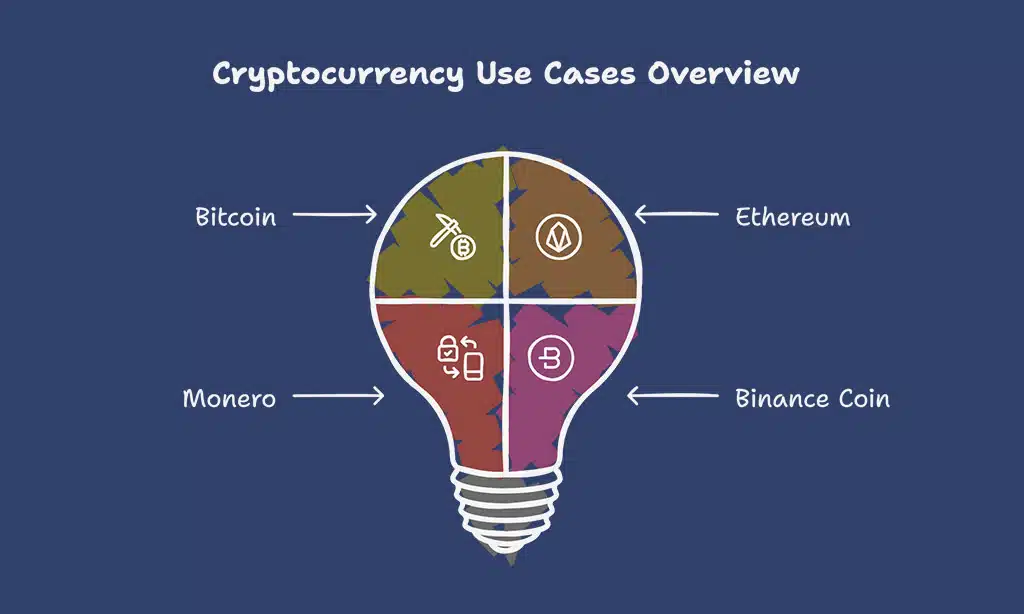
Bitcoin was primarily designed as a decentralized currency and a store of value, often referred to as “digital gold.” Its primary function is to facilitate peer-to-peer transactions without intermediaries, making it a reliable medium of exchange. However, many altcoins have evolved to serve a variety of purposes beyond just payments.
For example, Ethereum introduced smart contracts, which allow developers to build decentralized applications [DApps] that automate complex financial transactions, gaming ecosystems, and supply chain management without the need for a third party.
Other altcoins focus on areas such as privacy, interoperability, and scalability, further diversifying their role in the cryptocurrency space.
Bitcoin vs. Altcoins – Use Case Comparison
| Cryptocurrency | Primary Use Case |
| Bitcoin | Store of value, digital gold |
| Ethereum | Smart contracts, DeFi, NFTs |
| Monero | Privacy transactions |
| Binance Coin | Exchange trading, reduced fees |
Case Study: Ethereum’s Smart Contracts in Finance
Ethereum’s smart contracts power most decentralized finance [DeFi] applications, enabling lending, borrowing, and trading without intermediaries. Platforms like Aave and Uniswap operate using these automated contracts, reducing costs and increasing transparency.
4. Market Adoption and Stability
Bitcoin enjoys higher market adoption and stability compared to most altcoins due to its strong brand recognition, long-standing reputation, and institutional investment. As the first cryptocurrency, Bitcoin has built trust among investors, businesses, and governments, leading to widespread adoption.
Major financial institutions, including Tesla, MicroStrategy, and Square, have invested heavily in Bitcoin, further solidifying its role as a digital asset.
Additionally, Bitcoin’s limited supply of 21 million coins and increasing regulatory clarity contribute to its relative stability, making it a preferred choice for long-term investors over more volatile altcoins.
Factors That Boost Bitcoin’s Stability:
- Limited supply of 21 million coins
- Institutional adoption by companies like Tesla and MicroStrategy
- Regulatory recognition in multiple countries
On the other hand, many altcoins experience extreme volatility and rely on niche communities for adoption.
| Metric | Bitcoin | Altcoins |
| Market Capitalization | ~50% of total crypto market | Remaining 50% |
| Institutional Investment | High | Moderate to Low |
| Adoption as Legal Tender | Yes [El Salvador] | Rare |
| Volatility | Lower | Higher |
5. Security and Decentralization
Bitcoin remains the most secure and decentralized cryptocurrency due to its robust Proof-of-Work [PoW] network and widespread mining distribution. Its vast network of miners makes it nearly impossible for any single entity to manipulate transactions or take control of the network.
This high level of security is a significant reason why Bitcoin is often considered the safest cryptocurrency to store value over the long term.
In contrast, many altcoins sacrifice decentralization for efficiency by adopting alternative consensus mechanisms like Proof-of-Stake [PoS] or Delegated Proof-of-Stake [DPoS]. While these models enhance transaction speed and reduce energy consumption, they often result in a more centralized network, where fewer validators control a large portion of the system.
Additionally, some altcoins have experienced security vulnerabilities due to smart contract exploits or governance centralization, making them riskier in terms of network integrity.
Security Risks in Altcoins:
- Centralization in staking-based networks
- Higher susceptibility to 51% attacks in low-hashrate blockchains
- Vulnerabilities in smart contracts leading to exploits
List of the Most Secure Cryptocurrencies After Bitcoin:
- Ethereum [ETH]: Large developer base and PoS transition
- Monero [XMR]: Enhanced privacy features
- Zcash [ZEC]: Advanced cryptographic security
Takeaways
The 5 key differences between Bitcoin and Altcoins revolve around their underlying technology, transaction efficiency, range of use cases, level of adoption, and security mechanisms. Bitcoin remains the most dominant cryptocurrency, thanks to its first-mover advantage, decentralized nature, and strong network security.
However, altcoins continue to push innovation by introducing advanced consensus mechanisms, faster transaction speeds, smart contract functionality, and specialized applications tailored for different industries.
While Bitcoin is widely regarded as the safest investment due to its stability and institutional adoption, altcoins offer more diverse opportunities with varying risk-reward profiles. Understanding these core differences helps investors and users make informed decisions based on their specific needs in the evolving crypto landscape.
Whether you prefer Bitcoin’s stability or the diverse functionalities of altcoins, both play a crucial role in the evolving cryptocurrency landscape. Understanding these differences can help you make informed investment decisions and navigate the crypto market effectively.





















