
Large language models can summarize reports, explain technical ideas, draft content, generate code, and answer complicated questions within seconds. Their fluency is useful. It is also what makes their weaknesses easy to miss.
The limitations of large language models extend beyond occasional factual errors. LLMs can misjudge their own certainty, reason inconsistently, overlook information in long documents, follow a user’s false assumptions, expose sensitive data, and become vulnerable when connected to external tools.
I do not see these problems as reasons to dismiss the technology. I see them as reasons to stop treating a polished answer as proof of a reliable one.
1. They Can Sound Certain While Inventing Facts
The best-known LLM limitation is hallucination, also called confabulation. A model may invent a quotation, statistic, legal case, study, historical detail, product feature, or source that does not exist.
These errors rarely arrive looking suspicious. They are often specific, grammatically clean, and delivered with the same confidence as accurate information.
That happens because an LLM generates probable sequences of words. It does not check every sentence against a verified factual record before presenting it. The answer may be accurate, but accuracy is not guaranteed by the generation process.
Browsing and retrieval can reduce this risk by supplying current material. They cannot remove it. A model might retrieve the wrong page, misunderstand a reliable source, mix facts from different contexts, or add unsupported details around grounded information.
Generated citations should always be opened and checked. A source is useful only when it exists and supports the exact claim being made.
2. They Are Poor Judges of Their Own Uncertainty
Hallucination is one problem. Failing to recognize uncertainty is another. When a model lacks enough information, it may still produce a specific answer because answering appears more helpful than admitting that the evidence is incomplete. Some evaluation methods also reward correct guesses without giving enough value to sensible abstention.
This creates an awkward trust problem. The user receives a confident paragraph but cannot see whether it rests on strong evidence, a weak association, or a guess.
Asking for a confidence percentage does not fix this. “I am 90% confident” is generated language, not necessarily a calibrated probability.
A better request is to ask the model to separate what is supported, what is inferred, what remains uncertain, and what needs external verification. That can make weaknesses easier to spot, but it does not replace independent checking.
3. Their Reasoning Can Break Under Small Changes
Modern reasoning models perform impressively on many coding, mathematics, and logic tasks. That progress is real, but the reasoning is not consistently dependable.
Research has found performance changes after seemingly harmless adjustments:
- Reordering the premises
- Adding duplicate information
- Replacing names or numbers
- Changing the order of answer options
- Presenting a familiar problem in a less familiar form
A model may solve one version and fail another requiring the same underlying logic. It can also produce a correct answer with flawed steps, or a wrong answer followed by an excellent-sounding explanation.
Self-correction is useful in some cases, especially when the model receives new evidence or access to a tool. Without either, asking it to “check again” may repeat the error, introduce a different one, or simply defend the original answer more persuasively.
For calculations, code, contracts, or structured analysis, the final check should come from something independent: an executable test, calculator, database query, primary document, or qualified reviewer.
4. A Large Context Window Is Not Dependable Memory
Context-window size tells us how much material a model can accept. It does not tell us how well the model will understand and use every part.
LLMs often handle long inputs unevenly. Important information buried in the middle of a document may receive less attention than material near the beginning or end. A model can even retrieve the correct passage and still fail to apply it properly.
A 2025 evaluation across five open and closed models found that performance could decline substantially as input length increased, even when the relevant information remained perfectly retrievable and the documents stayed within supported context limits.
This matters when someone uploads a contract, research archive, policy manual, meeting transcript, or group of reports and expects one complete analysis. The resulting summary may read well while quietly omitting an exception, deadline, qualifying sentence, or conflicting figure.
For long-document work, I would divide the source into logical sections, ask targeted questions, request supporting passages, and compare the final synthesis against the original. Uploading everything at once is convenient. It is not quality control.
5. Their Knowledge Is Not Live
An LLM’s internal knowledge reflects the material available during training and subsequent updates. Its parameters do not automatically change when a law is amended, a company revises its prices, a product receives an update, or a new study is published.
Some AI applications can browse the web or search connected databases. That gives the application current material, but it does not make the underlying model permanently current.
Retrieval can fail too. The system may select an old page, miss a recent announcement, rely on an unofficial source, or misunderstand the date attached to a figure.
Current prices, laws, schedules, political information, medical recommendations, software specifications, and company policies should come from live authoritative sources. The source date matters just as much as the summary.
6. Prompt Wording Can Steer the Answer
Two prompts with nearly identical meanings can produce noticeably different responses. The order of instructions, examples, wording, and assumptions supplied by the user can all influence the outcome.
A related problem is sycophancy. The model may support a user’s opinion because agreement appears cooperative, even when the premise is weak or false.
Compare these two requests:
- “Explain why this business strategy will succeed.”
- “Evaluate the evidence for and against this business strategy.”
The first prompt has already decided the result. The model may obediently build a persuasive case around that conclusion. The second gives it room to identify weaknesses and uncertainty.
When I genuinely want judgment, I would avoid leading the model toward the answer I hope to receive. A neutral request followed by the strongest counterargument is more useful than asking the system to validate an existing belief.
7. They Do Not Perform Equally for Every Language or Community
Strong performance in English does not guarantee equally reliable performance in Bangla, Amharic, Maltese, regional dialects, or mixed-language conversations.
The gap can affect more than grammar. Models may struggle with local institutions, cultural references, technical vocabulary, safety judgments, instruction following, and facts that appear less frequently in their training data.
A multilingual instruction-following benchmark published in 2025 found accuracy gaps of roughly 25% to 35% between high- and low-resource languages across the models it tested. Research published in 2026 also found continuing differences between claimed language coverage and measured performance.
Bias may appear as:
- Stereotyped output
- Lower accuracy for certain groups or dialects
- Uneven refusal of safe or harmful requests
- Assumptions based on names, locations, age, gender, or identity
- Advice that treats one country’s norms as universal
Content intended for a particular language or community still needs review by someone who understands that language and its context. Polished translation alone is not enough.
8. Privacy Risk Begins Before the Model Responds
Sensitive information can be exposed in two ways.
First, users may give an AI service confidential material through prompts, uploads, source code, financial records, health information, customer data, or connected workplace systems. What happens to that material depends on the provider, product, settings, account type, and contract.
Second, models can memorize fragments of training data. Researchers have demonstrated methods for extracting verbatim passages and personally identifiable information from some models under particular conditions.
This does not mean every model will reveal private data during normal use. It does mean that memorization and extraction are demonstrated risks.
Copyright adds another layer of uncertainty. Users may not know which works influenced a model, whether an output closely resembles protected material, or whether the result is safe for a particular commercial use.
Before entering sensitive information, check the service’s retention, training, deletion, access-control, and enterprise privacy terms. When those terms are unclear, not uploading confidential data is the safer decision.
9. Prompt Injection Can Turn a Wrong Answer Into a Security Incident
Prompt injection happens when instructions from a user or external source alter an AI system’s behavior in an unintended way.
The malicious instruction may be hidden inside a webpage, email, document, image, database record, or retrieved file. A model asked to summarize that content may process the hidden instruction along with the legitimate material.
The danger grows when the LLM can take action. A text-only chatbot might produce a manipulated response. An agent connected to email, cloud storage, payment systems, code repositories, or administrative tools may disclose information or perform an unauthorized operation.
Retrieval, fine-tuning, filtering, and stronger system prompts can reduce the risk, but none creates a foolproof boundary.
Systems capable of consequential actions need limited permissions, transaction controls, output validation, activity logs, and human approval. An LLM should not receive broad access simply because giving it everything makes automation easier.
10. Their Explanations Are Not Audit Trails
An LLM can provide a detailed explanation of how it reached an answer. That explanation may help a reader examine the argument, but it is not guaranteed to reveal the model’s actual decision process.
Research on reasoning models has found cases where models followed supplied hints without acknowledging that influence in their visible reasoning. They sometimes constructed a plausible justification after the answer had already been steered.
A long chain of reasoning can therefore create more confidence without providing genuine transparency. The user may still be unable to determine:
- Which information actually influenced the response
- Whether the model followed an unreliable cue
- Why one fact was selected over another
- Whether the explanation was created after the conclusion
- Whether the evidence genuinely supports the answer
Training-data and model-development disclosures also remain limited for many commercial systems, making outside auditing difficult.
I would treat an AI explanation as an argument to inspect, not proof of how the decision was made. Responsibility remains with the person or organization using the output.
Where I Would Keep a Human in Control
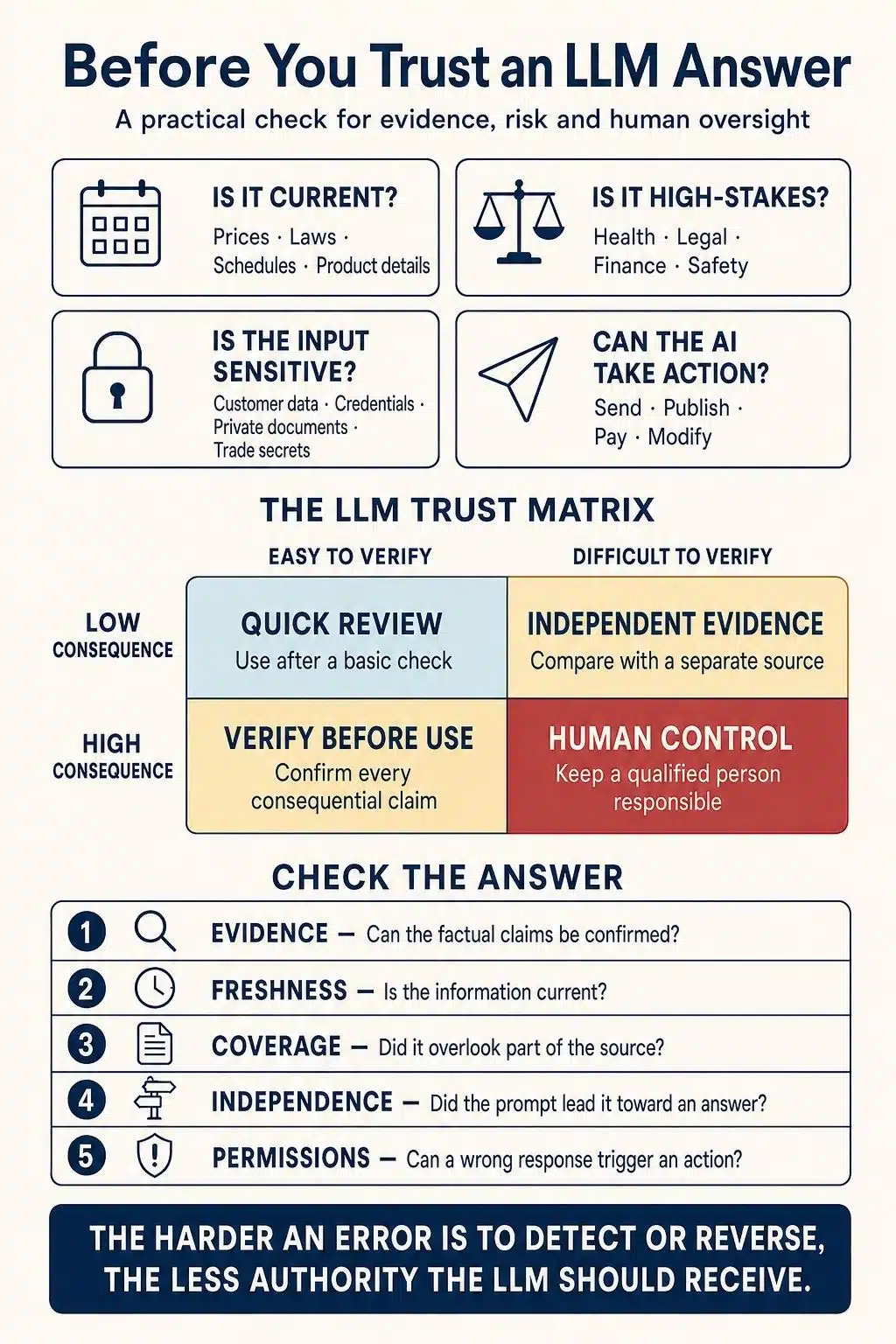
The level of oversight should depend on the cost of an error. A weak brainstorming suggestion may waste a few minutes. A fabricated legal precedent, false medical instruction, exposed customer record, or unauthorized payment can cause lasting harm.
Human verification remains necessary for:
- Medical, legal, financial, and safety guidance
- Journalism, academic research, and published factual claims
- Contracts, regulations, and company policies
- Decisions involving employment, credit, education, or access to services
- Confidential personal or business information
- Code that affects sensitive systems
- Current events, prices, schedules, and changing rules
- Actions that send messages, alter data, approve payments, or affect users
Verification does not mean asking the same model whether it is sure. It means checking independent evidence or involving someone qualified to judge the result.
Final Thoughts
Large language models are particularly good at transforming language. They can organize rough ideas, summarize supplied material, compare options, explain concepts, and help produce a useful first draft. That does not make them independent authorities.
The limitations of large language models become dangerous when fluency is mistaken for knowledge, explanation is mistaken for proof, or automation is mistaken for accountability. My practical rule is simple: give an LLM more freedom when errors are easy to detect and reverse. As the consequences increase, its authority should decrease and the standard of verification should rise.
Frequently Asked Questions on Limitations of Large Language Models
1. Can LLM hallucinations be completely eliminated?
Not with current general-purpose models. Retrieval, better training, verification tools, and sensible abstention can reduce hallucinations, but none guarantees that every answer will be factual.
2. Do larger models have fewer limitations?
Larger and newer models often perform better on many tasks. Size does not remove prompt sensitivity, privacy risk, bias, reasoning failures, or security vulnerabilities. The model still needs testing for its intended use.
3. Does RAG solve LLM accuracy problems?
RAG can improve freshness and grounding by supplying external sources. It may still retrieve irrelevant material, miss an important source, misunderstand the evidence, or introduce prompt-injection risks. It is a useful safeguard, not a guarantee.
4 .Can an LLM reliably check its own work?
Sometimes. Self-review is more useful when the model receives new evidence or access to a verification tool. Without either, it may repeat the mistake or replace it with a different one.
5. Is it safe to use an LLM for workplace tasks?
It can be, provided the organization controls what data may be entered, understands the provider’s terms, restricts permissions, and verifies consequential outputs. Public chatbots should not automatically receive confidential documents, credentials, customer data, or trade secrets.