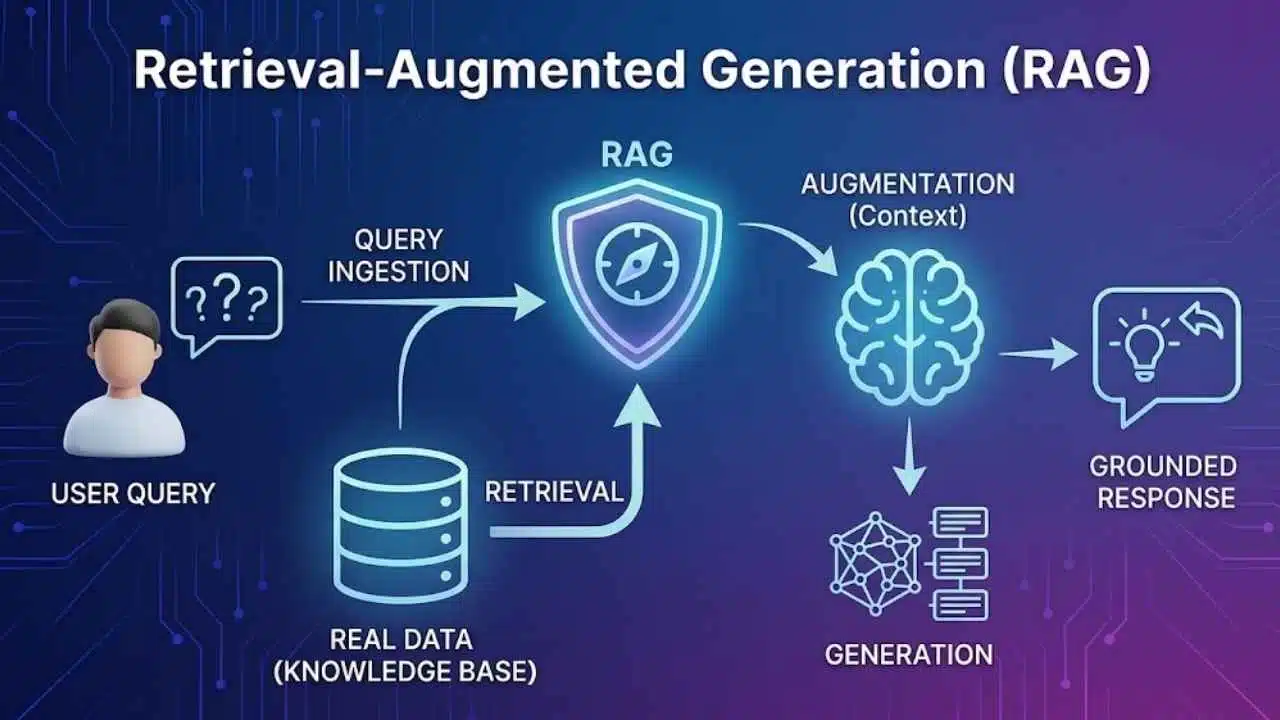
When enterprise AI models encounter context cutoffs or proprietary databases, they risk hallucinating outdated information. Retrieval-Augmented Generation solves this by connecting Large Language Models directly to external, authoritative data sources in real time.
Relying solely on pre-trained memory, a system built on Retrieval-Augmented Generation fetches relevant documents—such as newly updated travel policies or private technical manuals—and passes them into the prompt before generating a response. This two-step approach separates context retrieval from language generation, eliminating factual errors without expensive model fine-tuning. By anchoring AI outputs in verified enterprise data, organizations transform static language models into reliable, real-time engines for accurate decision-making.
What Retrieval-Augmented Generation Actually Means
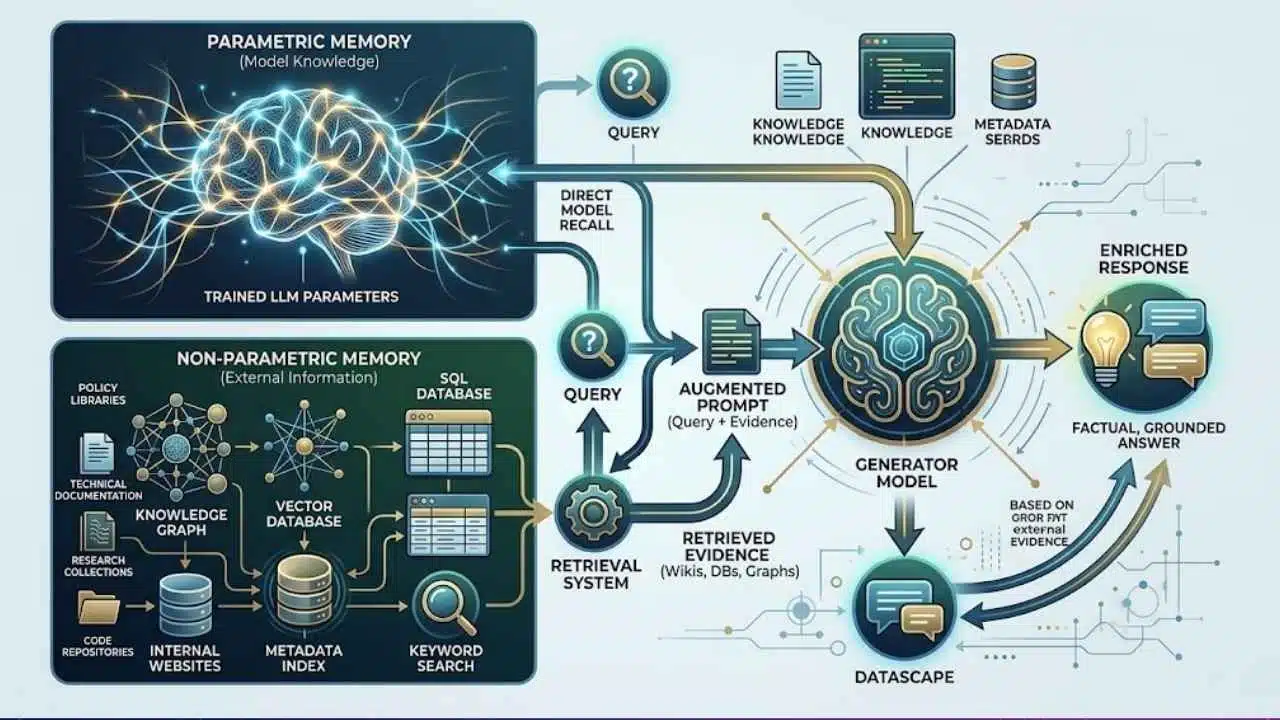
The named RAG framework comes from a 2020 NeurIPS paper led by Patrick Lewis. It combined two kinds of memory:
- Parametric memory: Knowledge represented in the model’s trained parameters
- Non-parametric memory: Information held outside the model and retrieved when needed
The original system used a dense vector index of Wikipedia. Enterprise implementations now apply the same pattern to policy libraries, technical documentation, research collections, support records, code repositories, databases, and internal websites.
A vector database is common, but it is not the defining feature of RAG. Keyword search, SQL queries, metadata filters, knowledge graphs, and hybrid search can all retrieve evidence for a language model.
What matters is that the system fetches external information at query time and supplies it to the generator.
How Retrieval-Augmented Generation Works
A production RAG system has two connected jobs: preparing information for search and answering a user’s question.
1. Prepare the Source Material
The process starts with approved sources such as SharePoint, Confluence, object storage, internal websites, document-management systems, or code repositories.
Raw files are rarely ready for retrieval. Scanned PDFs need optical character recognition. Headers may repeat on every page. Tables can lose their rows and columns during extraction. A slide deck may become a collection of fragments with no obvious reading order.
These are not minor cleanup problems. If a return policy is extracted without its exceptions, the system may confidently retrieve an incomplete rule.
Documents are then divided into smaller passages called chunks. Each chunk needs enough surrounding information to make sense independently, but not so much that several topics compete within it.
Fixed-length splitting is easy to implement and often poor at respecting meaning. It can separate a warning from the procedure it qualifies or divide a contract clause from its conditions. Structure-aware chunking is usually the better choice for policies, manuals, contracts, and technical documentation.
Metadata should remain attached to every chunk. Useful fields include the source, title, section, revision date, jurisdiction, language, product version, owner, and access restrictions.
2. Build a Searchable Index
Many RAG systems convert chunks into embeddings: numerical representations designed to capture aspects of meaning. The vectors, original text, and metadata are stored in a searchable index.
A user’s question can be converted with a compatible embedding model and compared with the indexed vectors. Passages with similar representations are treated as likely matches. Similarity helps retrieval, but it does not prove relevance.
Vector search is good at paraphrases. A question about “parental leave” might find a policy section titled “Family leave entitlement” even though the wording differs.
It is less dependable with some exact identifiers. Product codes, dates, error messages, regulatory clauses, and names often benefit from traditional keyword matching. A query for SKU-4821-A should find that exact code, not the product description that happens to be closest in vector space.
For many enterprise knowledge systems, hybrid retrieval is the sensible starting point. It combines keyword and vector search, then merges the results. Vector-only search is often treated as the default because it sounds more advanced, not because it fits every query.
3. Retrieve, Filter, and Rerank
When a question arrives, the retrieval layer searches the material that the user is authorized to access. Permissions should be applied before a passage reaches the model.
The application may also rewrite an unclear query, use conversation history, or apply filters for country, department, date, product, or document status. Without those filters, a search for an expense policy could mix current US rules with an expired UK document.
The initial search may return more candidates than the model needs. A reranker examines those results more closely and moves the strongest evidence to the top.
Retrieving more passages is not automatically safer. Extra context increases latency and processing cost while giving the model more irrelevant or contradictory material to interpret. Peer-reviewed research has shown that models tested on long-context tasks did not always use information consistently when the relevant evidence appeared in the middle of a large input. Current models and workloads vary, so the chosen setup still needs direct testing.
4. Generate From the Retrieved Evidence
The application builds a prompt containing the question, selected passages, instructions, and source metadata. It may tell the model to answer only from the evidence, cite the relevant sources, and decline when the material is insufficient.
The model then generates the response. Citations need their own engineering. The application should connect claims to the records actually retrieved. Allowing the model to invent document titles or URLs creates the appearance of traceability without the substance.
A Practical Enterprise Example
Suppose an employee asks:
Can I add two personal days to an international business trip, and which expenses will the company cover?
A general model does not know the employer’s current travel rules. A RAG system could retrieve the approved travel policy, filter it for the employee’s country and employment group, and find the sections covering personal extensions, airfare, accommodation, insurance, and manager approval.
The answer could summarize those rules and link to the relevant sections. If regional policies conflict, the system should not blend them into one polished response. It should apply a more precise filter or explain that the available evidence is ambiguous.
The model makes the policy easier to use. The policy remains the authority.
Grounding Does Not Guarantee Accuracy
RAG is frequently presented as a cure for hallucinations. That promises too much.
Retrieval can reduce the model’s reliance on knowledge stored in its parameters, but every part of the pipeline can fail:
- The correct document may not be retrieved.
- An obsolete version may rank above the current one.
- A passage may be relevant but incomplete.
- Several valid sources may disagree.
- The model may misinterpret the evidence.
- A citation may not support the claim attached to it.
- The model may fall back on internal knowledge when context is weak.
A grounded answer can still be wrong. If the source contains an error, RAG may repeat it with a professional-looking citation.
The system therefore needs a clear refusal path. When the evidence is missing or contradictory, an honest “I could not find a reliable answer in the approved sources” is better than a fluent guess.
RAG, Fine-Tuning, and Long Context Solve Different Problems
These approaches can complement one another, but they are not substitutes.
| Approach | Useful When | Main Limitation |
| RAG | Answers require current, private, or traceable information | Quality depends on retrieval and source management |
| Fine-tuning | The model needs specialized behavior, terminology, formatting, or task patterns | Changing facts may require further training, and provenance is not automatic |
| Long-context prompting | One or a few known documents must be analyzed together | Larger inputs cost more and may not be used consistently |
| Database or API query | The system must return an exact status, balance, calculation, or live record | Structured output may need a separate explanation layer |
A support assistant might use RAG to find an approved troubleshooting procedure, fine-tuning to follow the company’s response format, and an API to check the customer’s actual order status.
Forcing every problem into a vector index is unnecessary. If the user wants a live account balance, query the account system. Do not ask a language model to infer it from embedded statements.
Where RAG Earns Its Complexity
Retrieval-Augmented Generation is most useful when answers must draw from information that is private, frequently updated, too large to include in every prompt, or expected to have visible provenance.
Good candidates include internal policy assistants, customer service over approved documentation, maintenance manuals, contract review with human oversight, research discovery, and developer support across documented code and architecture.
RAG is often unnecessary for one short document that can be passed directly to the model. It adds little to creative tasks that do not require factual evidence.
Source quality should decide whether a project is ready. Indexing duplicate files, expired policies, and documents with no clear owner does not create an authoritative assistant. It makes disorganized information easier to retrieve.
The Failures That Matter in Production
When answers disappoint, teams often replace the model first. Retrieval and source quality deserve investigation before an expensive model change.
Poor extraction can flatten a table into nonsense. Bad chunking can separate an instruction from its warning. Pure vector search may miss a part number. Loose filters can mix regions or product versions, while aggressive filters may remove the only useful result.
Freshness creates a quieter failure. Updating a document in its original repository does not prove that the search index has refreshed. A production system needs ingestion monitoring, deletion handling, version control, and a way to remove superseded material.
Access control deserves equal attention. Shared indexes need user and tenant boundaries that cannot be bypassed through a carefully phrased query. Filtering sensitive content after generation is too late because the model has already received it.
Retrieved material must also be treated as untrusted input. A webpage, uploaded file, or internal document can contain instructions intended to manipulate the model. OWASP identifies indirect prompt injection, poisoned knowledge sources, weak access controls, and cross-context leakage as risks in RAG applications.
Source validation, permission-aware retrieval, content inspection, logging, and restricted tool access reduce the exposure. They do not make prompt injection impossible. A system that can send emails, change records, or call sensitive tools needs tighter controls and human approval than a read-only knowledge assistant.
Evaluate Retrieval and Generation Separately
A few successful demo questions do not establish reliability. Build a test set from real tasks, including vague queries, old terminology, conflicting documents, access-restricted requests, and questions the system should refuse.
Measure each stage:
- Did retrieval find the correct evidence?
- Did ranking place the best passage near the top?
- Does every factual claim follow from the supplied context?
- Do citations support the nearby statements?
- Does the system decline when evidence is missing?
- Are latency, failure rates, and processing costs acceptable?
Automated frameworks such as RAGAS can help compare context relevance, answer relevance, and faithfulness across pipeline changes. Those scores are useful for iteration, not final proof of accuracy. Model-based evaluators can make mistakes of their own.
Human review remains necessary for sensitive legal, medical, financial, security, and operational uses. Those reviews should examine the retrieved evidence as well as the final answer; otherwise, teams may miss a weak retriever hidden behind good writing.
A Sensible Starting Architecture
Begin with one well-defined knowledge area rather than every document the organization owns. Clean the sources, preserve their structure, attach version and permission metadata, and build a realistic test set before tuning search.
Hybrid retrieval, metadata filtering, reranking, source-linked citations, and a clear refusal rule provide a strong initial architecture for many enterprise assistants. Add graph retrieval, query decomposition, or multi-step agents only when testing shows that the simpler pipeline cannot answer the required questions.
Connecting a model to an index is the easy part. Deciding which information deserves trust, who may retrieve it, and what happens when the evidence is insufficient takes most of the serious work.
Final Thoughts
Retrieval-Augmented Generation gives AI systems a practical way to answer from current, controlled, and traceable information without storing every fact in model parameters. It can improve enterprise question answering, but it does not turn a language model into a database or eliminate hallucinations.
Start with one trusted source collection, a realistic evaluation set, and strict permissions. When retrieval is accurate and the system is allowed to admit uncertainty, RAG becomes a credible bridge between generative AI and the information a business actually trusts.