
ImagineLab Art is an AI creative platform. People type prompts to make images and videos, including ad creative. Building it forced the same question every software team runs into: product-led vs. sales-led growth.
The usual advice says pick a side. In practice, most SaaS companies run a mix of both approaches instead of committing to one. The answer is rarely as simple as the advice makes it sound.
Strip the debate down and it’s about who brings the customer in. In one model, the product does that work on its own. In the other, a sales team closes the deal before most users see much of the product. Deal size and product complexity shape that call. So does whether users can reach value by themselves.
What Product-Led and Sales-Led Growth Actually Mean
Your growth model decides how new customers arrive. That pick ripples out into pricing and team structure. With product-led growth, the product itself drives acquisition. Sales-led growth hands that job to a rep. Almost no SaaS team stays pure to either side—most run both.
What Product-Led Growth Is
Someone signs up alone, usually through a free trial or freemium tier. They poke around the features without ever talking to a human. They find value, and the upgrade follows.
Shopify and Snowflake both grew this way. Their users could test the product right away, no sales call required.
This path only works if the product is simple enough to grasp quickly. It also helps when users would rather figure things out than sit through a scheduled demo. The best product-led tools carry viral growth inside them. One person’s use pulls in others who want a turn.
By 2026, product-led adoption reaches past traditional SaaS into AI tools and creative platforms. Anything users can test instantly tends to fit—promotional products land here too.
What Sales-Led Growth Is
The whole motion starts with a form. A prospect fills it out and a rep takes over. Everything after that—the demo, the walkthrough, the pricing talk—comes from the rep standing between the buyer and the product. Full access waits until a contract is signed.
Complex products that need explaining suit this model. The deals also have to be big enough to pay for a sales team. That typically means more than $10,000 a year. Enterprise buyers tend to want vendor evaluations and security reviews before they commit.
Here the sales team owns the buying process: screening leads, tailoring demos, pushing toward a close. It fits products with heavy customization needs and deals that pull in several stakeholders. Sales growth in specialized markets usually follows this pattern.
The Core Difference Between Them
Under product-led growth (PLG), the buying decision sits with the user. They try the product, decide whether it solves their problem, and upgrade when they’re ready. Under sales-led growth (SLG), a rep drives it, screening prospects and showing value along the way.
Friction tolerance splits the two as well. PLG needs users starting in minutes with zero help. SLG can absorb far more friction because the deal size pays for it. Large annual contracts cover several demo calls and a long evaluation.
Revenue behaves differently in each. Once the product works well, PLG speeds up, since new users sign up without human help. SLG scales more predictably instead: you control the process, so you can forecast revenue more accurately.
Deal size and product complexity usually settle the product-led vs. sales-led growth question. After that, the two models part ways on almost everything else.
Operational Mechanics of Each Model
Fill in a lead form under sales-led growth and you wait for a rep to quote you a price. Product-led growth skips that wait: you sign up, get access right away, and start working in the product.
The two motions part ways at every step:
| Aspect | Product-Led Growth | Sales-Led Growth |
|---|---|---|
| Entry point | Self-serve signup with immediate access | Lead form followed by sales contact |
| Pricing | Transparent, tiered self-serve pricing | Custom quotes and annual commitments |
| Onboarding | Automated in-product guidance | Scheduled demos and training calls |
| Upgrade path | Usage-based triggers and automated prompts | Sales rep negotiation and contract execution |
| Time to value | Minutes to hours | Days to weeks |
Team structure is not the only thing to weigh when you pick a GTM motion, and pricing structure matters just as much. Product-led companies show their pricing tiers openly, so users can upgrade on their own. Sales-led companies keep pricing hidden and let reps negotiate based on deal size and the features a buyer needs.
Building a SaaS product? Start with one question: can users reach value without talking to anyone? If they can, product-led mechanics fit, and if they can’t, you’ll need sales support behind the product.
In practice, PLG treats the product as the growth driver, while SLG puts sales teams at the center instead. Shopify and Zoom scale because users find the value on their own, and SLG companies put money into sales infrastructure that guides complex buying decisions. Both models work, but they demand different resources and a different organizational structure.
Strategic Fit for Product-Led Models
Product-led growth only works when the product can stand on its own, without your team in the room. Someone should grasp it within minutes for it to qualify. They also have to succeed alone. Finishing a workflow with no help counts, and so does creating an image or sending a message.
Technical comfort matters just as much. Product-led companies target users who prefer exploring a tool themselves over booking a sales call. These people try before they commit.
There’s one more factor worth weighing: viral potential. When one person uses your product, others should notice and want in. Collaboration tools like Slack grew exactly this way, and AI tools for product teams can ride the same effect.
If your product clears these bars, the product-led route is worth a try. Product led sales growth has become common in AI creative platforms, where users need immediate access to test capabilities.
Strategic Fit for Sales-Led Models
A self-serve signup only works when the value shows up fast. When a user can’t see it within a few minutes, they leave. Products with deep feature sets tend to fall into that trap. A guided demo does what a self-serve onboarding flow can’t.
Complexity isn’t the only test. Money carries equal weight. An average contract value above $10,000 a year covers the cost of running a sales team. That $10,000 mark is roughly where sales-led models start turning a profit. Below it, winning a customer usually costs more than that customer ever brings in.
A few clear cases call for this model:
- Enterprise buyers: they don’t sign up on their own. Each vendor gets weighed against the others, and security reviews plus legal contracts come before any deal.
- Customization needs: the product has to be configured or shaped around the way each customer works.
- Multi-stakeholder decisions: several people must approve the purchase, which means coordinated demos and proposals.
This is where a rep earns their keep. They dig into the customer’s problem and show how the product solves it. Then they settle terms both sides can accept.
The harder case sits between them. A product needs a demo to sell, but the deal size won’t pay for one.
The Hybrid Model: Product-Led Sales Strategy
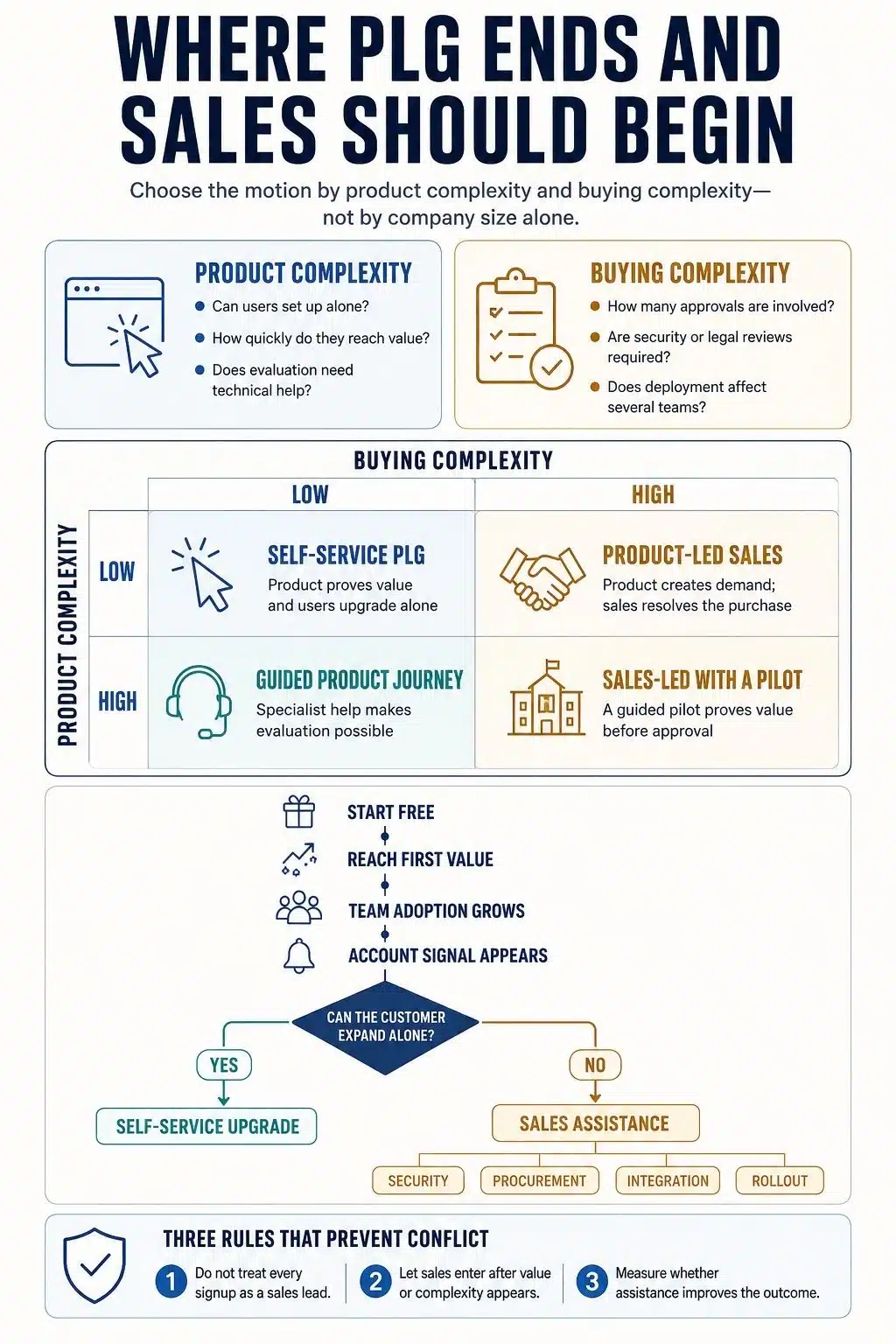
Small customers upgrade on their own, and large accounts get white-glove treatment from a sales team. Both paths can run inside one company, and most successful SaaS companies now use product-led and sales-led growth side by side rather than picking one.
In this setup, the product does the qualifying first. Users arrive through self-serve access, and the product tracks how they use it. When someone crosses an engagement threshold, like inviting team members or using advanced features, sales reaches out. Sales resources then go to accounts that have already shown intent.
Self-serve entry stays open to individual users, while sales is reserved for teams and enterprise segments. Revenue grows from both channels.
ImagineLab Art runs the same pattern: a free trial lets people test AI image and video generation right away. Individual creators and small teams upgrade through self-serve pricing, while teams that need custom AI models or enterprise features go to sales. Research into both groups shaped a go-to-market strategy that serves each of them well.
By 2026, the hybrid model dominates SaaS, capturing high-volume self-serve revenue and high-value enterprise deals. If you’re weighing that shift, start with your product team. Its read-on usage is what usually guides the move.
Questions on Growth Model Selection
Three attempts each by call, email and voicemail, spread across three weeks. That’s the 3-3-3 rule—the pace a sales team keeps when it’s chasing a lead. Knowing that pace helps when you’re deciding how much of the buying process a rep should own.
Who drives the buying process is the real split. In a product-led model, users try the product first and upgrade on their own. Sales-led models route users through a rep before they ever get access.
What is product-led sales?
Usage data tells you which accounts are ready to spend more. Reps step in to close those deals instead of waiting for users to upgrade on their own.
The product keeps its self-serve access. Once engagement signals fire—a user hits usage limits or invites teammates—a sales conversation starts. That gets you self-serve volume, plus revenue from closing qualified accounts faster. Pure product-led growth waits for users to upgrade themselves; product-led sales acts once the signal fires.
How do you choose a GTM motion?
Two things decide it when you’re weighing product-led vs. sales-led growth: how much setup the product needs and how big the average deal runs. How fast a user reaches value matters just as much. Match your motion to those traits, not to industry trends.
Say users reach value in minutes without help, and the average deal sits below $10,000 — start with product-led. If the product needs configuration and the average deal runs above $10,000, start with sales-led. Land in between, or serve both individual users and enterprise buyers? Build a hybrid model from the start.
Where Does Sales Fit in a PLG World?
Reps in a product-led company don’t handle initial acquisition. Users sign up and activate themselves through the product. Sales works the accounts showing high engagement signals, chasing expansion revenue and enterprise segment capture.