Games like League of Legends and other competitive online titles are unforgiving. You can know all the mechanics, map rotations, and champion abilities perfectly, yet if your mind isn’t steady, mistakes multiply, and momentum collapses. The competitive gaming mindset is what allows players to maintain clarity under pressure, execute strategies efficiently, and recover quickly from setbacks. Without it, even the most practiced mechanics can fail at crucial moments.
Mental discipline is the foundation that supports every mechanical and strategic skill. It determines how well you communicate with teammates, anticipate opponent moves, and execute plays under stress. Players who ignore this aspect often plateau despite hours of practice.
Why Mindset Shapes Performance
In competitive gaming, small errors can escalate rapidly. A single missed skill shot or poor rotation can snowball into lost objectives or team fights. Players with a strong mindset respond calmly, maintain situational awareness, and adapt to changes. I’ve noticed that in late-game team fights, composure often matters more than raw reaction time or champion mastery. The mind dictates whether preparation converts into results.
A clear mental framework helps players stay consistent over long sessions, recover from mistakes without tilting, and maintain strategic awareness even during chaotic moments.
Components of a Competitive Gaming Mindset
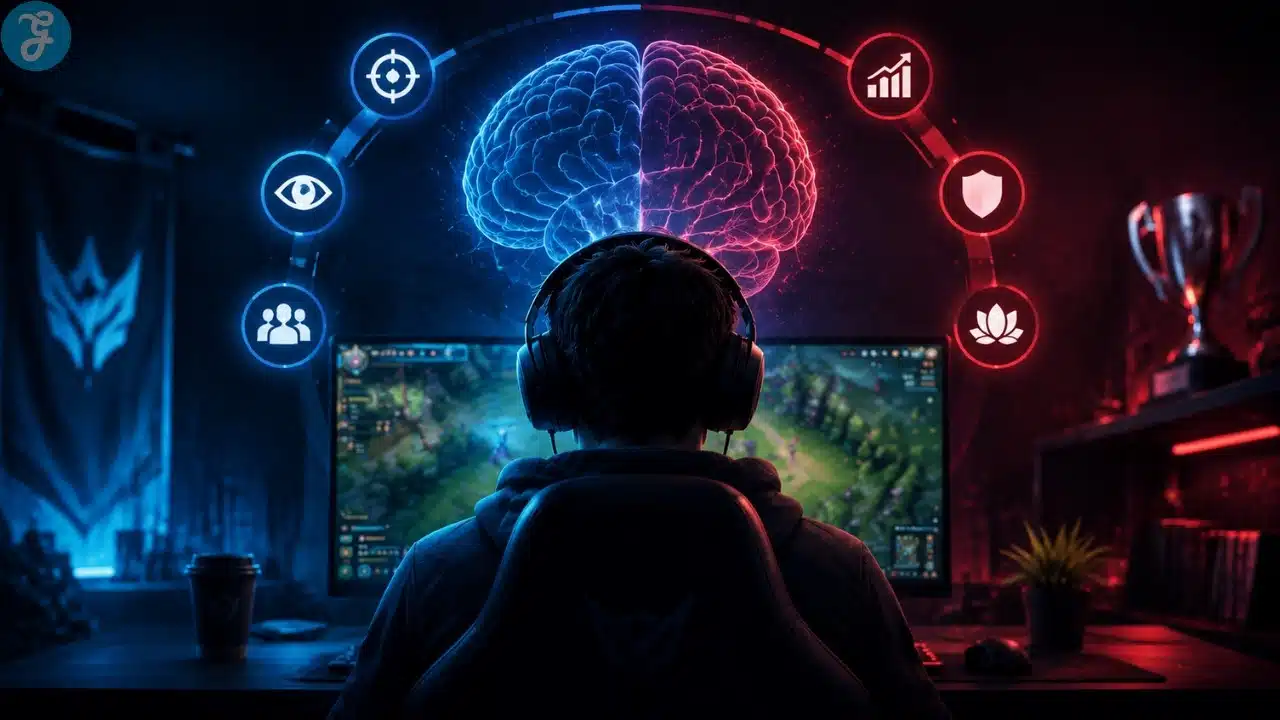
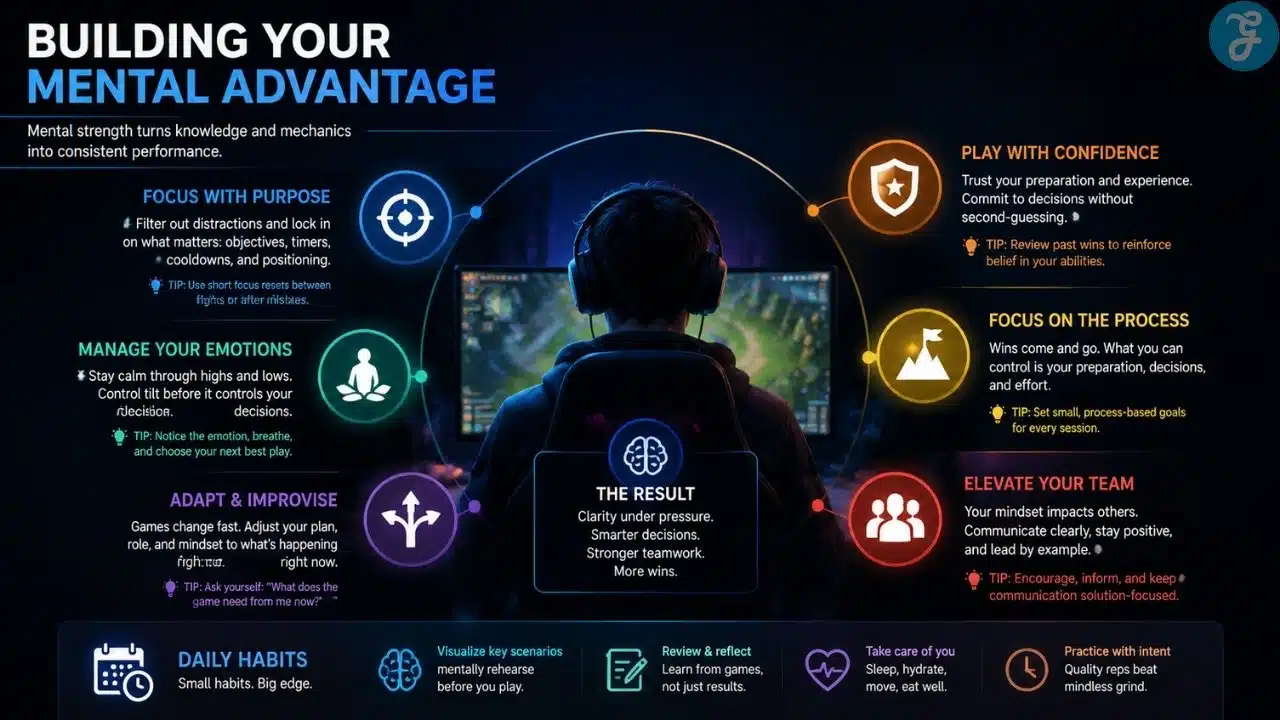
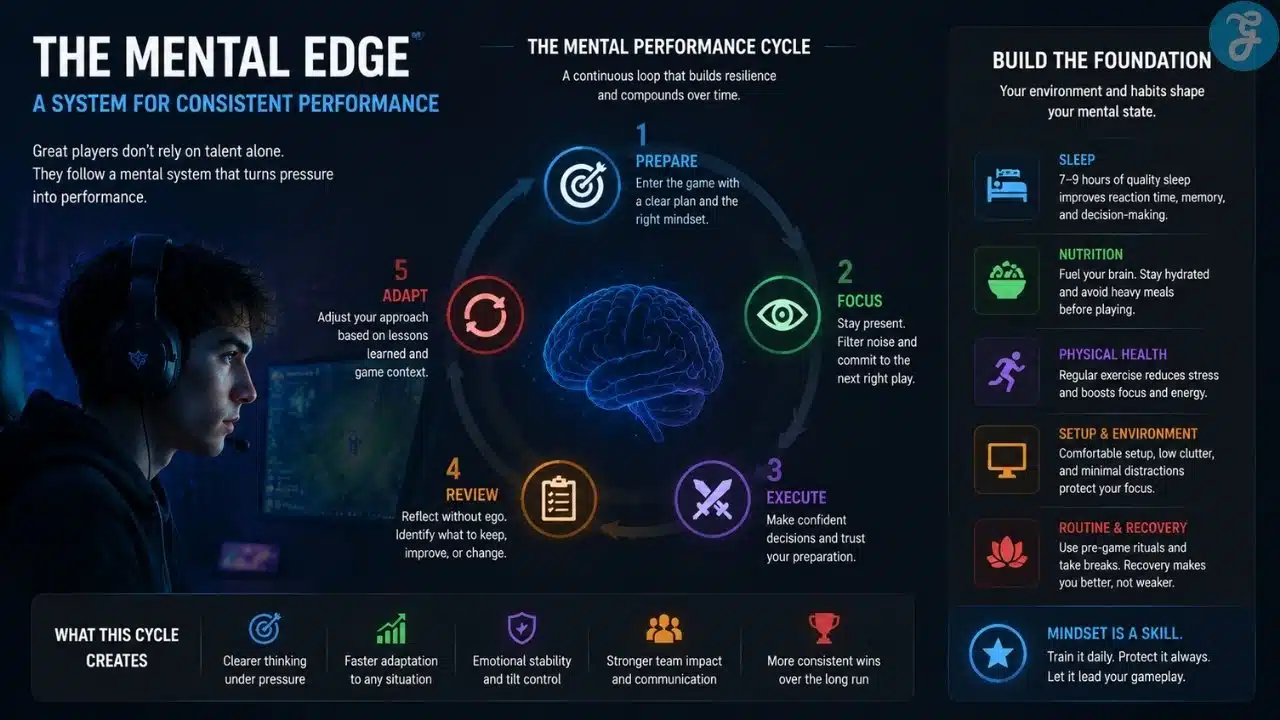
Developing a mental edge involves several interconnected skills. Focus, emotional regulation, adaptability, confidence, and goal orientation all play a role:
- Focus: Tracking map cues, enemy cooldowns, and teammate positions while ignoring distractions.
- Emotional Regulation: Preventing frustration from minor mistakes from affecting future plays.
- Confidence: Trusting preparation and skill without overthinking decisions.
- Adaptability: Adjusting strategies in real-time to counter unexpected opponent plays.
- Goal Orientation: Structuring matches and practice around specific objectives rather than just kills or win rates.
Together, these components create a mental baseline that allows players to perform consistently even under stress.
Training Mental Resilience
Mental skills can be trained deliberately. I structure my practice sessions to combine mental conditioning with mechanical drills. For example, before ranked matches, I might rehearse late-game Baron fights mentally, imagining the timing of abilities, vision control, and enemy rotations. During games, I monitor my emotional state to prevent frustration from escalating.
Reflection is equally important. After matches, I analyze how decisions were affected by stress, distraction, or tilt, separating mental mistakes from mechanical errors. Over time, this reinforces composure under pressure and strengthens the competitive gaming mindset.
Managing Tilt and Stress
Tilt is unavoidable, but it can be managed. Early signs include frustration after small errors, impulsive plays, or repeated misjudgments. Recognizing these signals and implementing short mental resets—deep breaths, brief pauses, or controlled reflection—prevents mistakes from snowballing.
Stress management also affects teammates. Players who maintain composure can stabilize communication, help coordinate strategies, and prevent team panic during high-pressure moments.
Applying Mindset in Team Play
A stable mindset improves not just individual performance but also team dynamics. Calm players communicate clearly, execute strategies reliably, and positively influence teammates. In my experience, teams with mentally steady players recover faster from setbacks and make better coordinated plays.
| Mental Skill | Team Impact | Practical Tip |
|---|---|---|
| Composure | Reduces panic in clutch moments | Pause after mistakes to reset focus |
| Focus | Maintains awareness of objectives | Track rotations, enemy cooldowns, and vision carefully |
| Adaptability | Smooths strategy adjustments | Observe teammate cues and adjust quickly |
| Confidence | Encourages teammates | Reinforce successful plays verbally |
Advanced Mental Conditioning
At higher levels, mental conditioning includes biofeedback, cognitive load drills, and scenario simulation. Monitoring stress responses helps players manage physiological reactions in tense situations. Cognitive load drills train decision-making under multiple simultaneous pressures. Scenario simulations, like late-game fights or sneaky objectives, allow players to rehearse calm, effective responses.
Peer feedback is another crucial element. Reviewing mental performance with teammates exposes blind spots and reinforces effective habits. This approach ensures the competitive gaming mindset is robust under real-match conditions.
Sustaining Mental Performance
Long-term mental performance relies on routine, reflection, and physical health. Sleep, nutrition, hydration, and ergonomic setups are critical for maintaining cognitive endurance. Incrementally increasing practice difficulty while integrating recovery periods preserves stability. Documenting emotional patterns and responses during sessions allows players to adjust routines proactively.
Structured practice builds mental resilience gradually. Without it, even skilled players risk collapse under prolonged pressure or fatigue.
Integrating Mindset with Mechanical Skill
The competitive gaming mindset amplifies mechanical skill. Maintaining mental clarity allows strategy to guide execution. In League of Legends, this means:
- Anticipating opponent rotations while managing your own resources
- Executing combos and rotations cleanly under stress
- Recognizing when to disengage or risk objectives
A strong mental framework prevents emotion from dictating gameplay.
Mistakes That Undermine Mental Performance
Even experienced players make avoidable errors:
- Over-focusing on stats like KDA instead of process
- Letting frustration influence future decisions
- Ignoring fatigue or environmental factors
- Failing to review mental performance systematically
Identifying these tendencies allows for corrective measures and targeted improvement.
Practical Techniques for Growth
Deliberate exercises strengthen mental capacity:
- Pre-session visualization for critical scenarios
- Short focus exercises to improve attention to key game elements
- Structured reflection to separate errors from results
- Controlled exposure to stress through scrims or practice simulations
- Observing teammates and opponents without emotional bias
These methods integrate mental discipline naturally into competitive routines.
Applying Mindset in Matches
Players with a trained competitive gaming mindset see consistent benefits:
- Faster, more accurate decision-making
- Better team coordination and communication
- Reduced cascading mistakes from tilt
- Enhanced situational awareness during chaotic fights
- Sustained motivation and focus across long sessions
The difference is measurable in ranked performance, tournament play, and scrims.
Long-Term Mental Framework
Developing the competitive gaming mindset is an ongoing process. Integrate structured mental training with mechanical practice, reflect on games consistently, and expose yourself gradually to stress. Over time, resilience becomes instinctive, ensuring skills translate to consistent performance.