

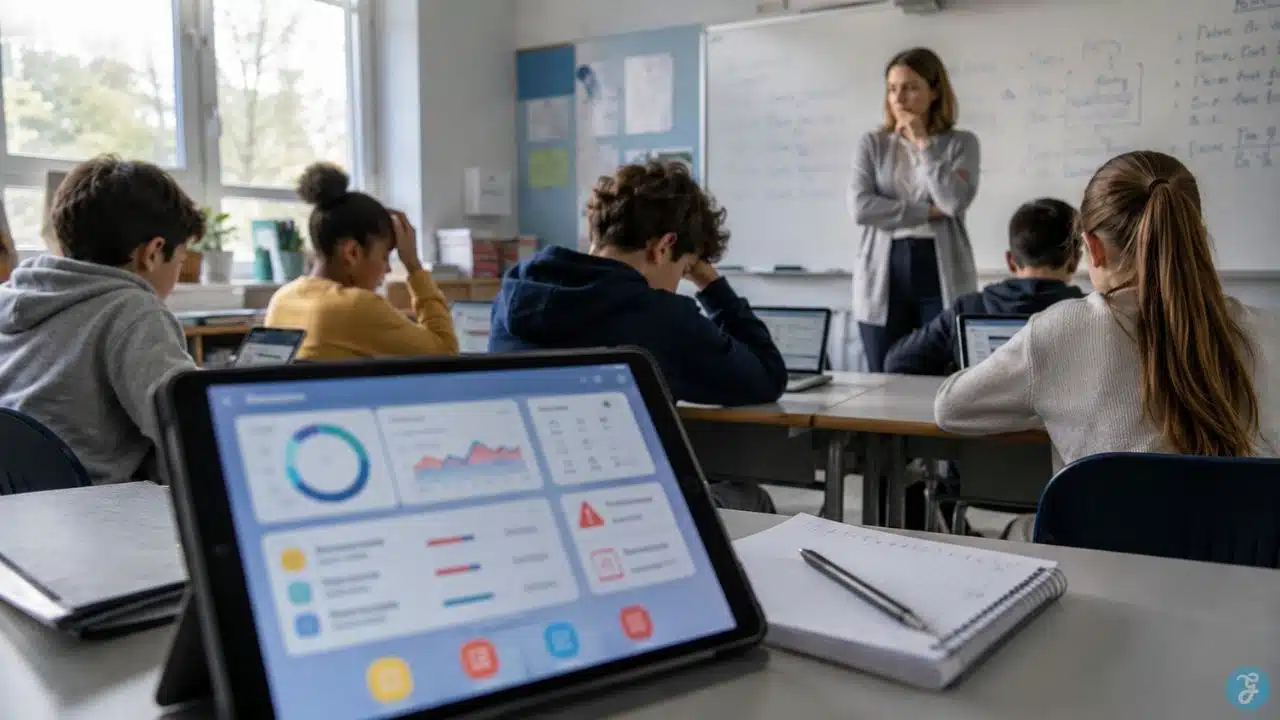
EdTech failed kids not because technology is evil, but because adults sold technology as a shortcut around the hard parts of education. I say this as someone who works around media, technology, e-learning, SaaS products, and digital content every day.
At Editorialge Media LLC, we are not standing outside the tech world throwing stones at it. We are inside it. We build, test, publish, analyze, and experiment. We understand how powerful digital tools can be when they are designed with purpose. Our own ecosystem includes an AI image creation platform and an e-learning platform, so I am not writing this as a nostalgic “ban every screen” sermon.
But after watching the edtech industry for years, I think the honest sentence is this: children were promised better learning, and too often they got more screens, more logins, more dashboards, more gamified distractions, and more data extraction.
The uncomfortable truth is not that every educational technology failed. The truth is worse. The industry learned how to look successful without proving that kids were learning.
The EdTech Promise Was Beautiful. The Execution Was Not.
The original promise sounded reasonable. Give students access to learning materials. Help teachers save time. Support children who need extra practice. Bring high-quality lessons to places where good teachers and resources are limited.
That part still matters. UNESCO’s 2023 Global Education Monitoring Report does not say technology has no role in education. It says the focus should be on learning outcomes, not digital inputs, and that technology should support rather than replace human teaching. It also notes that digital tools can help in some contexts, especially when they improve access or support targeted learning.
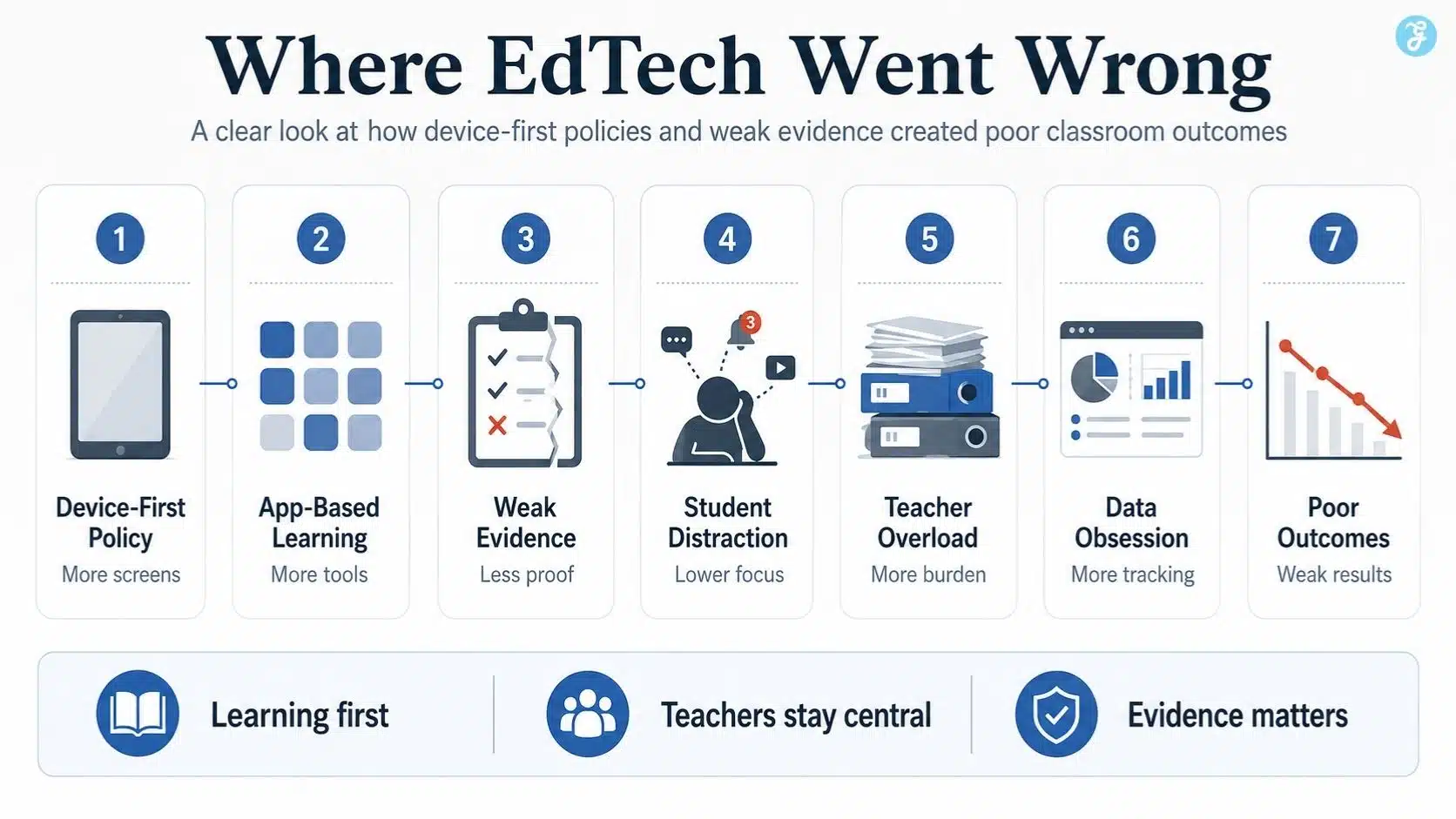
The problem is that schools, investors, vendors, and policymakers started treating technology itself as reform. A tablet became a policy. A dashboard became “personalized learning.” A login streak became engagement. A colorful app became a literacy support. A procurement contract became an innovation.
That is where the edtech failure begins.
What The Research Actually Says About EdTech Outcomes
The evidence is much more mixed than the marketing decks suggest. UNESCO found that “little robust evidence” exists on digital technology’s added value in education. It also noted that edtech products change every 36 months on average, which means many tools evolve faster than researchers can properly evaluate them. In the UK, only 7% of education technology companies had conducted randomized controlled trials, and only 12% had used third-party certification.
That one finding should embarrass the industry. Imagine a school buying a reading app for thousands of children, but the company behind it has no serious evidence that it improves reading. Imagine calling that innovation. In any other child-focused sector, this would trigger alarms. In edtech, it often triggers a sales renewal.
| EdTech Promise | What Often Happened |
| Better learning | More screen time without better outcomes |
| Personalized instruction | Algorithmic pacing with limited human judgment |
| Teacher support | More platforms teachers had to manage |
| Student engagement | Gamification that confused activity with learning |
| Data-driven education | Dashboards that measured clicks more easily than understanding |
| Equal access | More inequality when devices, internet, support, and guidance differed |
This is why educational technology criticism is not anti-progress. It is a demand for proof.
The Tablet-In-Every-Classroom Experiment Failed
The tablet-in-every-classroom dream was supposed to democratize learning. Every child would have access to the world’s knowledge. Every classroom would become modern. Every student would learn at their own pace. The reality was messier.
Large-scale evidence has repeatedly shown that more device use does not automatically mean better learning. OECD research found an “inverted-U” relationship between technology use and performance: moderate use may help, but high levels of ICT use are associated with worse outcomes, partly because digital activities can replace more effective traditional learning tasks.
PISA 2022 data also showed a distraction problem. Across OECD countries, 30% of students reported being distracted by digital devices in most or every mathematics lesson, and 25% reported being distracted by other students using those devices.
That is not a small classroom management issue. That is a learning design failure. A tablet can be useful when it gives a child access to a simulation, reading support, translation, feedback, or creative production. But when the tablet becomes the default surface for everything, the classroom changes. Attention fragments. Teachers become screen monitors. Students learn how to switch tabs faster than they learn how to think.
The problem was never the device alone. The problem was the lazy assumption that distribution equals transformation.
Why Most Learning Apps Don’t Actually Teach
Most learning apps are not built like serious learning environments. Many are built like engagement machines. That difference matters.
A good teacher notices confusion, changes explanation, uses examples, asks follow-up questions, reads body language, and knows when a child is guessing. Many apps simply reward taps, badges, streaks, speed, and completion. They give the feeling of learning without always producing a durable understanding.
Research on children’s educational apps has raised similar concerns. A study on “educational” apps for young children noted expert concern over the lack of evidence showing that many children’s apps have real educational value. This is one of the biggest edtech outcomes problems: apps are easy to count but hard to trust.
- Completed lesson? Counted.
- Minutes spent? Counted.
- Questions answered? Counted.
- Actual understanding? Maybe.
- Long-term retention? Often unknown.
- Ability to apply the idea in a new context? Rarely measured properly.
A child can spend 30 minutes dragging animated objects across a screen and still fail to explain the basic idea afterward. But the platform will proudly report “high engagement.”
That is not learning. That is a decorated activity.

Adaptive Learning Algorithms Aren’t That Adaptive
Adaptive learning sounds amazing on paper. The platform studies each learner, detects gaps, and serves the right lesson at the right time.
Some adaptive systems do help, especially when they are focused, evidence-based, and connected to teacher judgment. But many so-called adaptive products are not as adaptive as the pitch suggests.
In practice, a lot of “adaptive learning” means this: if the student gets Question A wrong, show Question B. If they get Question B right, move to Question C. That is branching logic, not deep personalization.
The U.S. Department of Education’s AI guidance emphasizes keeping humans in the loop because educators must remain central as instructional decision-makers. The report warns against replacing teacher judgment with automated systems and frames AI as something educators must be able to inspect, override, and control. That is exactly where many edtech tools fall short.
They personalize pace, but not always the explanation.
They personalize difficulty, but not always motivation.
They personalize practice, but not always meaning.
They personalize content delivery, but not always human support.
Children are not just data profiles. A student may fail a math problem because of weak number sense, anxiety, language confusion, boredom, poor sleep, lack of confidence, or a bad explanation. A platform may see only the wrong answer. Teachers see the child.
The Big Lie About Personalized Learning
The biggest lie about personalized learning is that software automatically makes learning personal. It does not. Real personalized learning is not just “everyone on headphones doing separate tasks.” Real personalization requires knowing the learner: their background, confidence, pace, interests, misunderstandings, and emotional state.
RAND’s research on personalized learning found early evidence that it can improve achievement, but it also warned that the field still lacks evidence about which practices are most effective and what policies are needed to maximize benefits.
That is the nuance the edtech industry often skips. Personalized learning can work when it is a teaching model supported by technology. It fails when it becomes a technology model, with the teacher pushed to the edge.
And honestly, many “personalized” classrooms have looked less like personalization and more like isolation. Students sit with screens. Teachers circulate like tech support. The platform decides the pathway. The dashboard decides the intervention. The child becomes a progress bar. That is not the future of learning. That is factory education wearing a hoodie.
Why Teachers Are Pushing Back Against EdTech
Teachers are not pushing back because they hate innovation. Many teachers use technology every day. They are pushing back because they are tired of tools being forced into classrooms without enough training, evidence, time, or respect for teaching reality.
A UK Department for Education technology survey for 2024–2025 found that only 18% of teachers had undertaken training on how to use technology to improve pedagogy or learning outcomes since the start of the academic year. It also showed that 34% had not undertaken any such edtech training during that period.
That tells us something important. Schools keep adding tools, but teacher preparation does not always keep up. A teacher may be expected to manage learning platforms, AI tools, grading dashboards, parent portals, attendance software, digital safety issues, device rules, accessibility settings, and classroom behavior, while still teaching real children.
Then, when results disappoint, the system quietly blames “implementation.” That word does a lot of dirty work in edtech. It often means the product was sold faster than the school could absorb it.
Standardized Tests Are Driving Bad EdTech Decisions
Standardized tests did not create every edtech problem, but they shaped many bad incentives. When schools are judged heavily by test scores, vendors build tools that promise measurable gains. The easiest measurable gains are usually narrow: test prep, question banks, benchmark drills, predictive scoring, and dashboards that mimic accountability systems. That creates a dangerous loop.
Schools want better scores.
Vendors sell score-focused tools.
Students get more screen-based drills.
Dashboards show progress.
Deeper learning gets squeezed.
This is why edtech failure is not only a technology problem. It is also an assessment problem. If the system rewards short-term measurable improvement, software will optimize for that. But a child’s education is not just about answering multiple-choice questions faster. Writing, reasoning, curiosity, discussion, creativity, memory, patience, collaboration, and moral judgment are much harder to turn into neat analytics.
So edtech often measures what is easy, then pretends it measured what matters.

EdTech VC Money Has Corrupted Educational Goals
Venture capital did not invent bad education policy, but it intensified the pressure to scale before proving impact.
The edtech boom created a strange situation: children became users, teachers became adoption channels, and classrooms became markets. During the pandemic period, investment surged. Then the correction came. HolonIQ reported that global edtech VC investment fell to about $2.4 billion in 2024, the lowest level since 2014 and an 89% decline from the 2021 peak. In 2025, HolonIQ reported $2.6 billion in edtech investment, with capital concentrating around companies showing traction, AI-enabled products, and employability-linked solutions.
That funding cycle matters because it reveals the industry’s priorities.
VC-backed products need growth. Schools need patience.
VC wants scale. Children need attention.
VC wants recurring revenue. Teachers need fewer useless tools.
VC wants defensibility. Education needs interoperability and transparency.
When investor logic enters the classroom unchecked, “learning outcomes” becomes a slide in a pitch deck, not the moral center of the product.
The Privacy Problem Nobody Took Seriously Enough
Edtech also failed kids by normalizing surveillance inside learning.
UNESCO’s summary report noted that around two-thirds of education software licenses were unused in the United States, which is already a sign of waste. More seriously, it reported that only 16% of countries explicitly guaranteed data privacy in education by law, and one analysis found that 89% of 163 edtech products recommended during the pandemic could survey children.
Human Rights Watch similarly investigated pandemic-era online learning products and found that many children, parents, and teachers were kept in the dark about data surveillance practices.
That should bother anyone working in technology. Children should not have to trade privacy for homework. Parents should not need a law degree to understand what an app collects. Teachers should not be forced to become cybersecurity analysts before assigning a lesson. Edtech companies love to talk about trust. Trust starts with not quietly tracking children.
Where EdTech Still Works
This article is not a rejection of all educational technology. That would be lazy. Technology works when it solves a real learning problem better than the available alternative. It works when it expands access, supports teachers, helps students practice at the right level, improves feedback, assists learners with disabilities, reduces administrative burden, or enables creative work that was previously difficult.
The World Bank’s work on digital technologies in education still frames technology as a tool that can support teaching, learners, and education systems when used effectively. So the question is not “Should schools use technology?”
The better question is:
What educational problem does this tool solve, and how do we know it works?
That one question would eliminate a lot of bad edtech.
A Better Framework For EdTech In 2026
If edtech is going to deserve a second chance, it needs a reset. Not a rebrand. Not “AI-powered” stickers slapped on old products. A real reset.
Here is the framework I would use before trusting any classroom technology.
| Question | Why It Matters |
| Does it improve a specific learning outcome? | Vague engagement is not enough. |
| Is there independent evidence? | Vendor-funded claims should not be the only proof. |
| Does it support teachers? | Tools should reduce burden, not create more work. |
| Can students learn without being tracked excessively? | Privacy must be a design requirement. |
| Does it work for disadvantaged learners? | Edtech should reduce gaps, not widen them. |
| Can teachers override the system? | Human judgment must stay central. |
| Is screen time justified? | Digital use should earn its place. |
| Is it curriculum-aligned? | Fun is not the same as instructional value. |
| Does it build thinking, not just clicking? | Activity is not learning. |
This is where companies like ours must be more honest, too. If we build learning tools, content systems, creative AI tools, or e-learning platforms, we should not hide behind buzzwords. We should ask whether the product helps people learn, create, think, practice, and improve. That is the standard edtech should have had from the beginning.
The Hard Truth: EdTech Failed Kids Because Adults Wanted Easy Answers
EdTech failed kids because too many adults wanted education reform without the slow, human, expensive work of improving education.
We wanted tablets instead of better teaching conditions.
We wanted apps instead of reading culture.
We wanted dashboards instead of trust.
We wanted personalized learning without personal relationships.
We wanted AI tutors before we gave teachers enough support.
We wanted scale before proof.
Technology can still help education. I believe that. I work in digital media, e-learning, SaaS, and AI-adjacent spaces, so I would be lying if I said otherwise. But the next phase of edtech must be more humble. The classroom does not need more shiny tools pretending to be teachers. It needs technology that knows its place.
Use the screen when it helps. Close it when it does not. Let teachers teach. Let children think. Measure learning honestly. Protect student data. Stop confusing investor excitement with educational progress.
That is how edtech earns back trust. Not by promising to revolutionize education again. By finally proving it helps kids learn.























