In a move that has triggered concerns about freedom of speech and press freedom, the Indian government has issued formal directives to X (formerly Twitter), instructing the platform to block more than 8,000 user accounts within India. These accounts include not only individual users but also prominent voices and verified profiles belonging to international media organizations, journalists, and activists.
The announcement came via a public statement from X’s Global Government Affairs team on May 8, 2025. According to the statement, the Indian Ministry of Electronics and Information Technology (MeitY) delivered the takedown orders with an expectation of immediate compliance. The orders were backed by legal threats, including the possibility of fines and imprisonment for X’s local employees in India if the platform refused to comply.
X Complies—But Strongly Opposes the Orders as “Overreach”
In its official statement, X acknowledged that it had begun the process of withholding access to the specified accounts—but only within India. However, the platform was candid in expressing its disagreement with the government’s actions, calling them both “excessive” and “lacking transparency.”
“We disagree with the Indian government’s demands. Blocking entire accounts is not only unnecessary—it amounts to censorship of both current and future content,” the statement read.
X emphasized that the decision to comply was not taken lightly. The company highlighted that its primary objective is to keep the platform accessible in India, ensuring that citizens still have access to essential communication tools and information-sharing services. Despite the company’s disagreement with the orders, they are choosing a path of limited compliance to avoid a full ban or legal repercussions.
No Explanation or Evidence Provided for Most Blocked Accounts
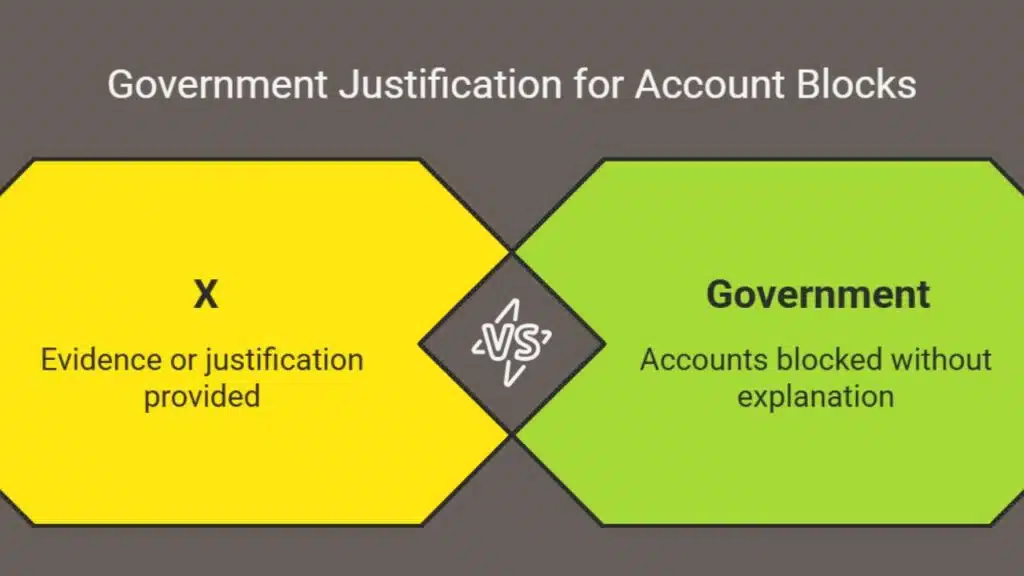
One of X’s key criticisms centered on the lack of transparency in the government’s directives. In many instances, the Indian authorities did not specify which posts from a user violated Indian laws, nor did they provide detailed explanations or evidence to justify the blocks.
“For a significant number of accounts, we did not receive any evidence or justification to block them,” X noted.
This opacity, according to the platform, violates international norms of accountability. X insists that executive orders impacting speech should be disclosed to the public to maintain institutional credibility and ensure that decisions are subject to scrutiny.
Despite these concerns, X stated that legal restrictions prevent it from publishing the takedown orders. Nevertheless, the company is actively exploring all legal avenues to challenge the directives, potentially including litigation in Indian courts or appeals to international digital rights forums.
International Media and Journalists Affected
Sources familiar with the matter confirmed that the blocked accounts include those associated with international media outlets, including reporters and organizations known for covering Indian politics and civil liberties. Though X did not publish the list of affected profiles, early reports from The Washington Post and Reuters suggest that some of the accounts belong to journalists and non-governmental organizations that have previously criticized the Indian government’s handling of sensitive topics like farmer protests, minority rights, and free expression online.
This is not the first time India has clashed with X or other social media platforms. In recent years, the Modi government has made repeated efforts to force compliance on content moderation through Section 69A of the Information Technology Act, a law that gives authorities broad powers to block content they deem harmful to national security or public order.
Legal Battle Already Underway Between X and the Indian Government
This latest clash adds fuel to an ongoing legal dispute. In March 2025, X filed a lawsuit against the Indian government, arguing that previous takedown orders violated constitutional protections for freedom of speech and lacked proper legal justification. The company argued that being forced to remove content without explanation was a violation of both Indian constitutional law and international human rights standards.
The case is still pending in Indian courts and could set a precedent for how tech companies balance compliance with local laws versus upholding global standards of free expression.
Human Rights and Digital Freedom Advocates Alarmed
The move has alarmed global digital rights watchdogs. Organizations such as Access Now, Electronic Frontier Foundation (EFF), and Reporters Without Borders have spoken out in support of X’s position, stating that arbitrary censorship threatens democracy and press freedom.
In a tweet, Access Now wrote:
“India’s increasing pressure on tech companies to remove content without justification is deeply concerning. We stand with efforts to bring transparency and protect digital rights.”
Several opposition politicians within India have also criticized the government’s actions, accusing it of attempting to suppress dissent and eliminate critical voices ahead of elections and major political events.
A Pattern of Digital Authoritarianism?
Analysts believe this incident is part of a growing pattern in India’s digital governance strategy. Under Prime Minister Narendra Modi’s administration, India has introduced increasingly stringent tech regulations, often under the pretext of national security. These include proposals for mandatory content filtering, traceability of encrypted messages, and expanded data localization laws.
Many see these efforts as an attempt to assert state control over global tech platforms—a trend not unique to India, but increasingly common in countries like Turkey, Russia, and China.
A Test for Tech Giants and Free Speech
This episode poses a crucial test not just for X, but for all global technology platforms that operate in markets with authoritarian or semi-authoritarian governments. Balancing local compliance with international norms of speech, transparency, and user rights is becoming an increasingly difficult task.
X’s decision to comply “under protest” while preparing to challenge the orders legally could become a blueprint for future platform responses in similar environments.
As the legal battle unfolds and the list of affected accounts emerges, the global digital rights community will be watching closely—both to assess the impact on free expression in India and to understand how far platforms like X are willing to go in defending those rights.
The Information is Collected from MSN and The Hindu.