

You might worry about market swings when you try to buy bitcoin (BTC) and other crypto assets. Dollar-cost averaging means you invest a fixed sum at regular times, no matter how prices move.
This guide will show you 7 ways to use DCA, from picking the right crypto coin to setting up auto buys on an exchange or in an individual retirement account (IRA). Read on.
Key Takeaways
- Dollar-cost averaging (DCA) means you invest a fixed sum at daily, weekly, or monthly intervals to cut market timing stress. In 2022, investing $500 monthly in Bitcoin yielded about 0.205 BTC, versus 0.105 BTC from a lump-sum buy in January.
- You can automate DCA on most exchanges or IRAs. For example, Caleb & Brown lets you link a bank account, set daily/weekly/monthly buys, and skip emotional trades.
- Spread DCA across assets like Bitcoin (21 million supply cap), Ethereum, altcoins, or S&P 500 index ETFs. This mix smooths out price swings in bull and bear markets.
- Adjust your plan to market moves: boost buys 50% after a 20% drop, cut 30% after a rally, or pause buys if daily volatility tops 7%.
- DCA helps tame volatility and keeps you disciplined but offers no downside protection. In a steady bull market, lump-sum buys can outperform DCA by about 15%.
How do I choose the best cryptocurrency for dollar-cost averaging?
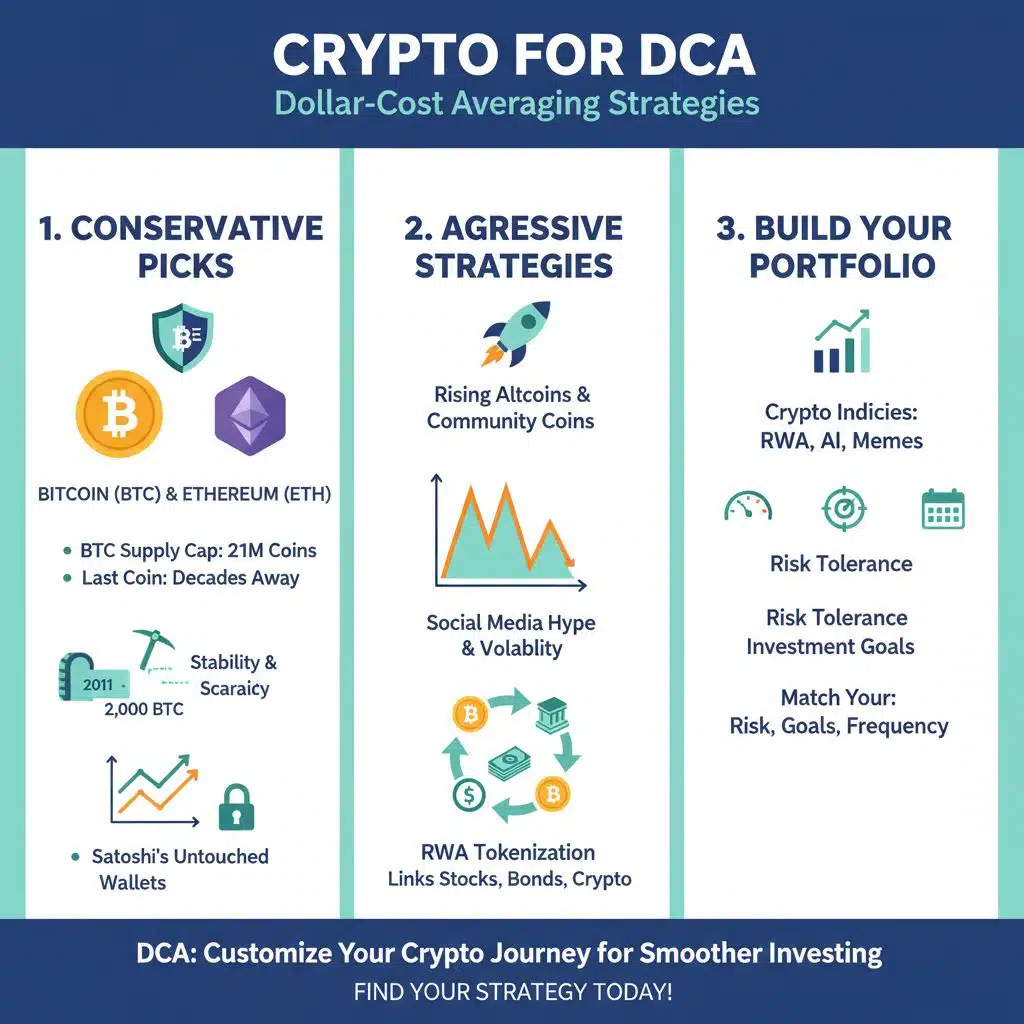
Conservative investors often pick Bitcoin (BTC) and Ethereum (ETH) for passive investing. Bitcoin supply caps at 21 million coins. The last coin could mine decades ahead. Satoshi Nakamoto’s twenty thousand BTC wallets sat untouched since 2011, like a time capsule.
This fact highlights market volatility and scarcity in financial planning.
Aggressive traders chase rising altcoins or community-driven coins. Social media hype can cause sharp price fluctuations and steep drops. Tokenization of Real World Assets links stocks, bonds, and crypto in one mix.
Crypto indices for RWAs, AI, or meme-based assets assist in building a diversified portfolio. Pick assets matching your risk tolerance, investment goals, and investment frequency for smoother dollar-cost averaging.
What is the ideal fixed amount to invest regularly?
Pick an amount that fits your budget after reviewing income and expenses. Some people allocate 10% of each paycheck. Joe uses $100 from his $1,000 bi-weekly pay, sending $50 into a large-cap mutual fund and $50 into an S&P 500 index fund in his 401(k).
You can match that method inside an individual retirement account or an exchange-traded fund for extra tax benefits. Dollar-cost averaging at regular intervals makes long-term investing feel simple.
Targeting $500 per month works for many. Investing $6,000 in bitcoin over a year breaks down to that sum. This method let Joe invest $50 weekly into those funds instead of a lump sum.
The staggered buys yielded around 0.205 BTC in 2022, versus 0.105 BTC at January prices. This steady plan limits market timing stress and controls market volatility. It builds a diversified portfolio.
This approach holds up in bull market runs and bear market slides.
How often should I buy cryptocurrency when using DCA?
Investors set daily, weekly, or monthly buys in a dollar-cost averaging plan. They weigh transaction fees, market volatility, risk tolerance, and investment goals. A broker charges a flat fee per trade, so weekly buys can smooth market fluctuations but raise costs.
Monthly moves of five hundred dollars into the digital asset in 2022 led to an average purchase price of twenty-nine thousand dollars. Automation on your exchange keeps buys steady, cuts emotional investing, and supports passive investing.
How can I automate my dollar-cost averaging strategy?
You can set up crypto buys on a set schedule. Automation cuts down on emotional investing and missed buys.
- Pick a brokerage with automatic buy tools for dollar-cost averaging. Caleb & Brown serves 30,000 clients, offers personal brokers, 24/7 support, secure storage, no signup fees, and free consults.
- Link a bank account or credit card for funding. A set payment gives a fixed investment amount, so you avoid lump sum risk and stick to passive investing.
- Set your buy schedule at daily, weekly, or monthly regular intervals. Trades will run even in bull and bear markets, taming market volatility.
- Choose an asset mix for portfolio diversification. Add bitcoin (btc), other tokens, or etfs to match your risk tolerance and long-term investing goals.
- Let the platform execute the buys and drop emotional investing. Automation enforces discipline, cuts guessing on market timing, and helps you never miss a scheduled buy.
- Check a dashboard from time to time. Evaluate performance, adjust amounts or frequency, and tweak rules as market trends shift.
When and how should I adjust my DCA based on market changes?
Crypto prices rarely stay flat. Smart investors tweak DCA plans as markets shift.
- Aim for a 20% price drop in a bear market for bitcoin (BTC) or ethereum (ETH) before you boost allocations by 50% to grab bargains during market corrections.
- Scale back your fixed investment after a 30% rally in a bull market to dodge peak prices and curb emotional investing.
- Shift DCA frequency when market fluctuations push daily volatility above 7% so you can pause buys during chaos and lower stress from market timing.
- Blend sector rotation or simple arbitrage moves when charts signal a trend flip to pair DCA with smarter trades.
- Apply DYOR and technical analysis on top tokens and exchange-traded funds (ETFs) before you tweak amounts, keeping your plan tied to data not hype.
- Mix risk management tools like stop-loss alerts or stablecoin buffers when prolonged downturns erode funds, since DCA gives no downside protection.
- Tap diversification by adding a small S&P 500 index fund in an IRA or another top ETF alongside crypto to spread market risk.
- Revisit financial goals each quarter and adjust your investment frequency or amount to match new targets and risk tolerance.
Using DCA to diversify your crypto portfolio
You can spread your crypto bets across Bitcoin, Ethereum, and fresh tokens, use an index fund model or a Tangem AG hardware wallet to smooth out swings—keep reading.
How does DCA help with diversification across cryptocurrencies?
Spreading dollar-cost averaging across bitcoin (btc), ethereum, and niche tokens cuts the risk of a bad lump sum investment. DCA at regular intervals taps AI, real world asset tokens, and meme coin trends.
It builds a diversified portfolio that can handle wild market volatility. Each sector shows its own price swings, and steady buys help smooth out the rough patches. This investment strategy supports long-term investing and boosts risk tolerance.
Trakx offers a single plan to buy crypto index funds with dollar-cost averaging. Passive investors set one plan for etf style funds or mutual fund indexes. This method locks in market dips in bull market runs and bear market slides.
It also keeps exposure to potential rebounds across the broader crypto market. DCA on a platform automates buys, cuts emotional investing, and eases market timing stress.
What are the benefits of combining DCA with long-term holding?
Dollar-cost averaging breaks a lump sum into small buys at regular intervals. You pick a fixed investment amount for bitcoin, index funds, or ETFs. You skip market timing guesses in bull markets and bear markets.
You lock in a lower average cost. You hold those coins and shares for years. You let compounding and market rebounds fuel growth.
Pairing this approach with HODL cuts emotional trading. That stops you from selling on down days. Such a plan suits beginners and seasoned investors. You build a diversified portfolio with mutual funds and an IRA.
This fits your risk tolerance and financial goals.
Benefits of using dollar-cost averaging in crypto

Dollar-cost averaging tames market volatility, grows your bitcoin stash, and fits in mutual funds or an IRA to suit your risk tolerance—read on.
How does DCA reduce volatility risks?
This investment strategy, known as dollar-cost averaging, uses a fixed investment amount at regular intervals to tame market volatility. It acts like a metronome in stormy crypto seas.
2022 data shows DCA into BTC yielded 0.205 BTC, while a lump sum in January grabbed only 0.105 BTC. That split order cut the risk of buying at peaks in a bear market.
More frequent buys limit the punch from sudden price swings. Passive investors use this strategy to avoid market timing mistakes. Savvy planners pair it with an S&P 500 index fund or a Vanguard ETF for a diversified portfolio.
Strategy works best with assets in long-term investing plans, because doomed tokens still can tank.
How does DCA promote emotional discipline in investing?
Dollar-cost averaging via a trading robot holds nerves in check. A crypto wallet moves a fixed investment amount each week. It skips stress and gut calls over market volatility. It automates regular purchases in bitcoin or other tokens.
Automation ensures emotional discipline and plan adherence. It stops greed during bull market climbs and fear in bear market drops. Newcomers and seasoned traders use it to dodge impulsive moves tied to emotional investing.
They stay on track with long-term investing goals.
Potential challenges of dollar-cost averaging
You might buy a crypto token at high market volatility, chase token lows, and miss out on lump sum gains—read on to learn more.
What are the risks of no downside protection with DCA?
DCA does not shield you from a prolonged bear market. Continual purchases of a falling asset can rack up big losses. Blind DCA into one crypto token like BTC raises the risk of total loss.
Add a few index funds or ETFs to your plan. That spreads risk across sectors and tokens. Risk management and diversification help guard against crashes. Invest funds you can afford to lose.
Could DCA cause missed investment opportunities?
Traders lose big gains when prices climb fast. A lump sum investment in bitcoin (BTC) during the 2021 bull market beat a DCA plan by about 20%. A $1,000 bulk buy rode sharp rallies that slow buys missed.
Aggressive investors find DCA too cautious for rapid market rallies.
That gap adds an opportunity cost. Studies show DCA underperforms lump-sum by nearly 15% in steadily rising markets. Passive investing in index funds or exchange-traded funds (ETFs) can miss the boat on big spikes.
Market timing choices shape total returns.
What tips can maximize my dollar-cost averaging results?
Smart tweaks can boost DCA returns. Each tip draws on proven tools and market insight.
- Audit income and expenses to pick a sustainable fixed investment amount.
- Schedule buys at regular intervals in your brokerage or crypto app.
- Spread orders across bitcoin, ethereum, and an S&P 500 index ETF.
- Tap Trakx crypto index trading to diversify into multiple tokens easily.
- Adjust purchase frequency or asset mix after shifts in bull market or bear market.
- Focus on assets with proven long-term growth, like BTC or a blue-chip ETF.
- Limit each buy to cash you can afford to lose, based on your risk tolerance.
- Book a free session with Caleb & Brown to refine your investment strategy.
- Monitor market volatility and tweak allocations to match your financial goals.
Takeaways
The steady drip of fixed buys feels like filling a jar with spare change, but each coin counts toward a solid stash. You grab BTC and altcoins on regular intervals, skipping the stress of market timing.
This plan fits any risk tolerance and pairs well with an Individual Retirement Account or exchange-traded fund approach. You mute your fear motor when prices jump and buy deep when they fall.
That calm, clear path can turn wild market swings into a smooth ride toward your financial goals.
FAQs on Ways to Use Dollar-Cost Averaging in Crypto
1. What is dollar-cost averaging in crypto?
It is a passive investing move, you buy a fixed amount of crypto leader BTC at regular intervals. It spreads out your risk, fights emotional investing, and makes long-term investing easier in the face of market fluctuations.
2. How do I pick my fixed investment amount and frequency?
Look at your budget and pick a number you can spare each time. Choose weekly or monthly buys, that is your investment frequency. This plan fits your financial goals and risk tolerance, and helps you stick to long-term investing.
3. When is it better to use dollar-cost averaging instead of a lump sum investment?
A lump sum can win in a bull market, but it can hurt you badly in a bear market if prices fall. Dollar-cost averaging smooths out both rides, it removes hard market timing, and it keeps you from panic buys and big drops.
4. Does dollar-cost averaging shield me from market volatility and suit my risk tolerance?
It does not stop market volatility, but it tames wild swings by spreading buys over time. You build a diversified portfolio, one coin at a time. You match your risk tolerance by adjusting each buy size, and you curb emotional investing.
5. Can I use dollar-cost averaging for crypto and for mutual funds or exchange-traded funds?
Yes, the same idea works for mutual funds, ETFs, and index funds like an S&P 500 index fund. You can tap dividend reinvestment plans too. It is a solid investment strategy for coins or shares and fits individual retirement account plans and your broader financial planning.
6. How do I keep from emotional investing when markets swing?
Set clear rules and stick to them, don’t chase every hot tip or panic when prices dip. Treat dollar-cost averaging like a savings habit, not a wild ride. Talk to a friend or seek financial advice, stay focused on your investment goals, and let the plan run its course.





















