
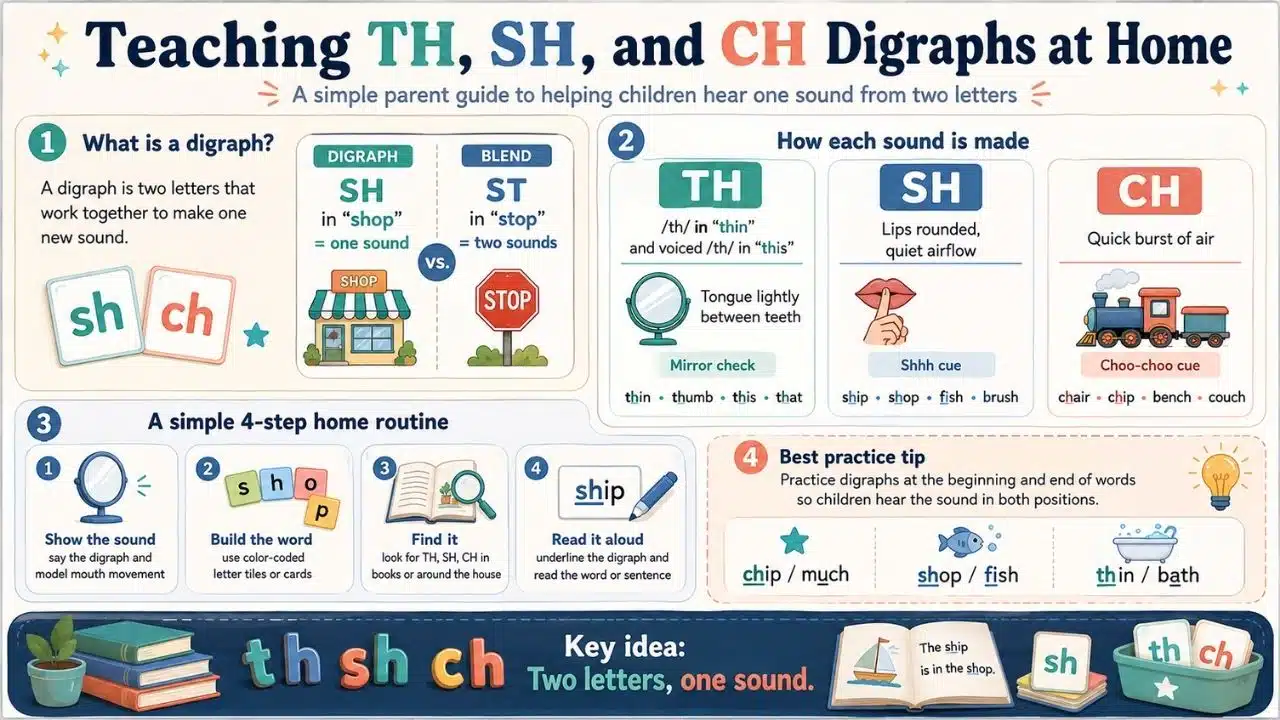
A digraph is a pair of written letters that join together to represent a single, unique speech sound (phoneme), such as the /sh/ in ship or the /ch/ in chip. Unlike consonant blends where each letter retains its individual sound, digraphs merge completely to make a brand-new sound.
Context-switching between repetitive tasks—copying data across spreadsheets, drafting identical email replies, and manually logging leads— quiet drains hours from your week. Most professionals assume that streamlining these workflows requires an engineering background or a heavy IT budget. The reality is that modern no-code platforms and AI tools have made it simple to automate your workday without coding.
By connecting your existing software stack and setting up clear trigger-action rules, you can eliminate low-value admin work, reduce manual errors, and reclaim hours every single week for deep, high-impact tasks.
| Digraph | Primary Sound(s) | Mouth & Tongue Position | Example Words (Start / End) | Simple Home Activity |
| TH |
/θ/ (unvoiced)
/ð/ (voiced) |
Tongue lightly between teeth |
thin, thumb / path, math
this, that / with, smooth |
Mirror Check: Have your child check if their tongue sticks out between their teeth in a mirror. |
| SH | /ʃ/ | Lips rounded, teeth close together | ship, shop / fish, brush | Shh Gesture: Put a finger to your lips to make the quiet “shhh” sound together. |
| CH | /tʃ/ | Tongue taps the roof of the mouth | chair, chip / bench, couch | Train Motion: Move arms like train wheels while making a “choo-choo” sound. |
10 Steps to Teach “th,” “sh,” and “ch” Digraphs at Home
1. Explicitly Teach the “Two Letters, One Sound” Rule
Explain to your child that when “h” stands next to “c,” “s,” or “t,” they form a secret team that makes one brand-new sound. Building this foundational phonemic awareness early ensures children stop trying to pronounce both letters individually.
2. Focus on Mouth Mechanics and Tactile Cues
Young readers rely heavily on physical sensation. Show your child how their lips, tongue, and airflow change when switching between digraphs:
-
TH: Tongue touches front teeth.
-
SH: Lips push forward into a circle.
-
CH: Air bursts quickly out of the mouth.
3. Teach the Unvoiced and Voiced “TH” Distinctions
The “th” digraph makes two distinct sounds:
-
Unvoiced /θ/: Air blows softly without vocal cord vibration (thumb, think).
-
Voiced /ð/: Vocal cords vibrate (this, them, father). Have your child place two fingers on their throat to feel the vibration during voiced words.
4. Master the Soft “SH” Sound with Visual Aids
Pair the /sh/ sound with familiar visual clues. Draw or show pictures of a ship, shell, or shoe to help visual learners connect the letters sh directly to the sound.
5. Practice the Explosive “CH” Sound
Contrasting /sh/ (a continuous sound you can hold) with /ch/ (a quick, stopping sound) prevents confusion. Use rhythmic chants or train sounds (“ch-ch-ch-choo-choo”) to reinforce the sudden burst of the /ch/ sound.
6. Use Color-Coded Letter Tiles
When building words with magnetic letters or paper tiles, keep digraph letters on a single tile or use a distinct color for the h combinations. This visually reinforces that sh, ch, and th function as a single unit.
7. Differentiate Between Digraphs and Consonant Blends
Clarify the difference between blends and digraphs:
-
Consonant Blend (e.g., st in stop): You hear both /s/ and /t/.
-
Consonant Digraph (e.g., sh in shop): You hear one new sound /sh/.
8. Practice Digraphs at the Beginning and End of Words
Children often master initial digraphs first before struggling with final digraphs. Practice word pairs systematically:
-
CH: chip vs. much
-
SH: shop vs. fish
-
TH: thin vs. bath
9. Play “Digraph Sound Hunts” Around the House
Give your child a magnifying glass or marker and hunt for household items containing target digraphs (e.g., chair, shelf, thermos, brush, matchbox).
10. Read Decodable Books and Underline Digraph Teams
Use simple decodable books containing CVC (Consonant-Vowel-Consonant) words and digraphs. Have your child underline every ch, sh, and th team before reading the sentence aloud. This exercise strengthens core decoding skills as children transition to full sentence reading.
Reclaim Your Time: Start Automating Your Workday Today
Transforming your daily routine does not require an overnight overhaul of your entire software stack. The most effective approach to automate your workday without coding is to start small: pick a single high-friction task, such as email routing or automatic task scheduling, and set up your first simple workflow.
As those initial time savings compound, you can gradually build multi-step integrations across your sales, marketing, and project management tools. Eliminating repetitive manual labor gives you back your focus, protects your energy, and allows you to spend your working hours on strategy and creative growth.
Frequently Asked Questions (FAQs) About What Are Digraphs
What is the difference between a digraph and a diphthong?
A consonant digraph consists of two letters making one consonant sound (like sh or ch). A diphthong is a glide between two vowel sounds in a single syllable (like oi in boil or ou in cloud).
At what age should children learn consonant digraphs?
Consonant digraphs are typically introduced in Kindergarten or early 1st Grade, right after children master individual single-letter consonant and short-vowel sounds.
What are the most common consonant digraphs in English?
The primary consonant digraphs taught first are sh, ch, th, wh, and ck.