
Venezuela inducts 5,600 troops as a US carrier strike group operates nearby in the Caribbean, deepening military tensions between Caracas and Washington.
President Nicolás Maduro frames the move as a defensive step against what his government calls an imperialist threat, while the United States insists its naval buildup targets regional drug trafficking networks.
New troops sworn in at Fuerte Tiuna
The Venezuelan army inducted 5,600 new soldiers on Saturday at the Fuerte Tiuna military complex in Caracas, one of the country’s most important army bases. The recruits took their oaths in a mass ceremony led by senior officers, who portrayed the expansion as vital to defending national sovereignty.
President Nicolás Maduro has pushed for accelerated enlistment as tensions with the United States have risen in recent months. In official speeches, Maduro has argued that Venezuela must be ready to resist any foreign military intervention and has linked the troop surge to broader defensive plans around the country’s borders and coasts.
At the ceremony, commanders repeated long-standing government claims that Venezuela faces the risk of invasion by imperialist forces, language often used by Caracas to refer to the United States and its allies. Military figures said the new soldiers will reinforce units responsible for air defense, coastal protection and strategic infrastructure.
US carrier strike group patrols the Caribbean
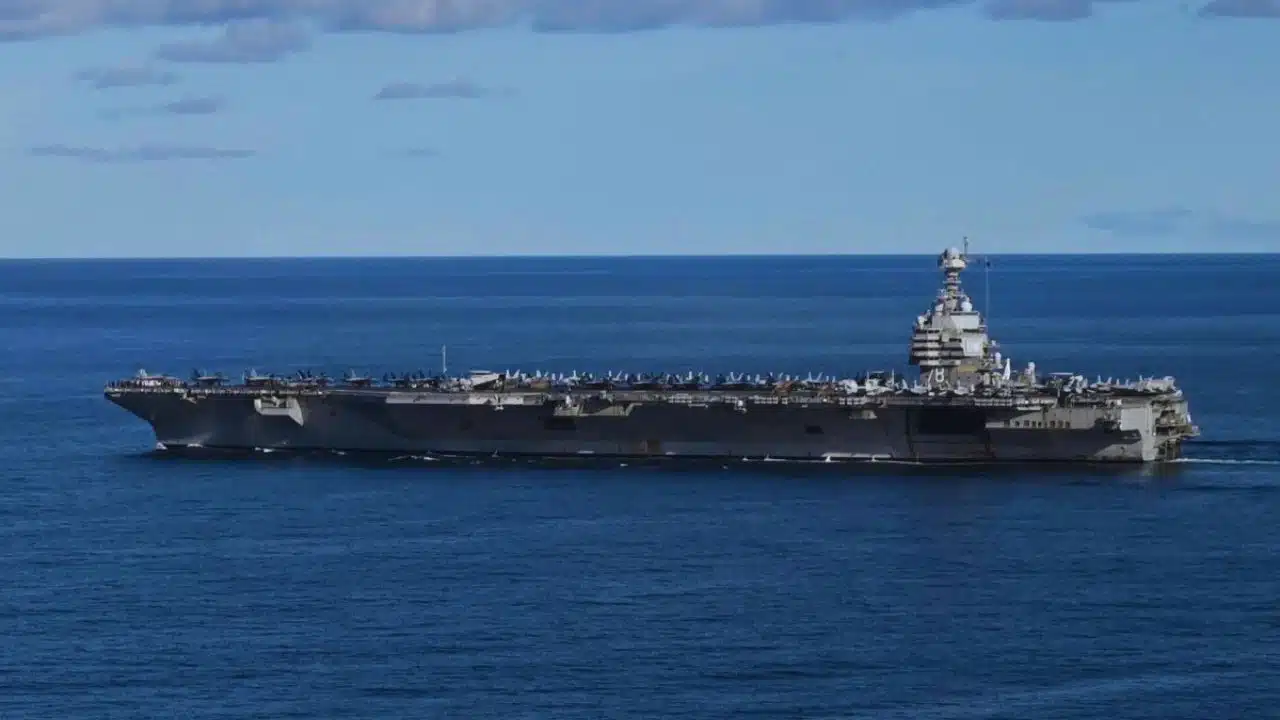
The troop induction comes as the USS Gerald R. Ford, the world’s largest aircraft carrier, leads a US Navy strike group operating under US Southern Command in the Caribbean and nearby Atlantic waters. US officials say the deployment is part of a large-scale operation against transnational drug trafficking routes that run through the region.
The carrier group’s arrival in Latin American waters in November added to an earlier buildup that already included several warships, a nuclear-powered submarine and F-35 fighter jets based in Puerto Rico. Washington has described the campaign as an effort to disrupt powerful narcotics networks allegedly linked to criminal groups in Venezuela and other countries.
US forces have carried out multiple strikes on suspected drug-smuggling vessels since early September, sinking boats and seizing cargos along major maritime corridors. According to public reporting, at least 80 people have been killed in these operations, with one recent update from the BBC citing a total of 87 fatalities across the campaign.
Caracas denounces regime-change agenda
Venezuelan authorities view the US buildup very differently, describing it as a disguised attempt to force political change in Caracas. Maduro has accused Washington of plotting to topple his government and seize Venezuela’s vast oil reserves under the cover of anti-drug operations.
Officials close to the president have linked the naval deployment to previous US sanctions and criminal charges against senior figures in the Venezuelan state. In August, US authorities doubled the reward offered for information leading to Maduro’s arrest to 50 million dollars, further fueling Caracas’s claim that it is under direct threat.
Analysts quoted in regional and US media say that while a full-scale invasion of Venezuela remains unlikely, the scale of the deployment and the use of targeted strikes against suspected cartels have increased pressure on the country’s leadership. Some experts argue that limiting the flow of drug revenues could weaken the financial networks that help sustain loyalty among senior Venezuelan security officials.
Long-running disputes and regional fears
The current standoff unfolds against a broader backdrop of territorial and political disputes involving Venezuela and its neighbors. Caracas has long claimed the Essequibo region, an area administered by Guyana where major offshore oil discoveries have drawn renewed international attention.
In late 2023, Maduro ordered large-scale defensive drills involving more than 5,600 troops near the Guyana border after the United Kingdom announced the deployment of a warship to support Guyana. That episode alarmed regional governments and highlighted how quickly tensions around Venezuela’s borders can escalate when outside powers send naval forces into the area.
Several Latin American states have voiced concern that the new US carrier presence and Venezuela’s military mobilization could spark incidents at sea or in the air. Governments that are critical of Maduro describe the US deployment as a deterrent, while countries aligned with Caracas condemn it as an imperialist show of force in an already fragile region.
Key 2025 dates in the US–Venezuela military standoff
The table below summarizes major milestones in the current phase of the crisis as reported by open sources.
| Date (2025) | Event | Details |
| Late August | Start of US naval buildup | US announced a major campaign in the southern Caribbean and eastern Pacific to combat drug trafficking networks, deploying warships and air assets. |
| 2 September | First publicly acknowledged strike | US forces destroyed a suspected drug-smuggling vessel linked to Venezuelan routes, killing 11 people and marking the first openly confirmed strike of the campaign. |
| October–November | Expanded operations | Additional strikes targeted other suspected smuggling boats in the Caribbean; regional navies, including the Dominican Republic, assisted in interdictions. |
| 11–13 November | Carrier strike group enters region | The USS Gerald R. Ford carrier strike group arrived in the Caribbean under US Southern Command, significantly raising the US military footprint near Venezuela. |
| 4 December | Latest reported strike | US forces carried out a new attack on a vessel, with US officials stating four people were killed; total fatalities in the campaign reached at least 87, according to BBC reporting. |
| 6 December | Venezuela inducts 5,600 troops | Venezuelan army swore in 5,600 new soldiers at Fuerte Tiuna in Caracas, framed as a response to the US naval deployment. |
Forces and assets now in play
Both sides are signaling determination through visible military deployments, even as they insist they do not want open conflict. The following table outlines key assets and actions reported so far.
| Side | Main assets / actions | Stated purpose |
| United States | USS Gerald R. Ford aircraft carrier; multiple escort warships; at least one nuclear-powered submarine; F-35 fighter jets based in Puerto Rico; maritime patrol and surveillance aircraft. | Washington says the deployment supports a large regional effort to disrupt cocaine trafficking routes and dismantle transnational criminal organizations. |
| Venezuela | Induction of 5,600 new soldiers in Caracas; heightened alert status under an expanded defense plan; mobilization of units responsible for coastal and air defenses. | Caracas describes these moves as defensive steps to protect national sovereignty and deter what it calls the threat of foreign aggression and regime change. |
Officials on both sides have said they do not seek a war, but each accuses the other of destabilizing the region. Venezuelan leaders warn that any US strike on targets inside the country would be treated as an act of aggression, while US officials stress that their current focus remains at sea and on interdiction.
What comes next
Diplomatic channels remain limited, and there is no public sign yet of direct talks to scale back the military deployments. Regional organizations and neighboring states are likely to push for de-escalation, fearing that a miscalculation between heavily armed forces could spill over into a wider crisis.
For Venezuela, the induction of 5,600 new troops is both a show of domestic strength and a message to Washington that Caracas intends to respond to any perceived threat. For the United States, the carrier strike group’s presence signals that the Trump administration is prepared to sustain high-profile military pressure in the Caribbean as part of its broader strategy against Maduro and regional drug networks.
How long the standoff continues will depend on political decisions in both capitals and on whether operations at sea avoid incidents involving Venezuelan forces or civilian vessels. If current trends persist, the coming weeks may see continued US interdictions and further Venezuelan mobilizations—or renewed diplomatic efforts if regional mediators manage to bring both sides to the table.