A proposal often starts with a useful conversation and ends with an afternoon of copying text, checking prices, and chasing approval. The document may look polished, but the process behind it still depends on someone remembering every step.
Proposal automation software can take over parts of that work: reuse approved service descriptions, populate client details, present optional packages, collect signatures, and move an accepted deal toward invoicing. The right choice depends on where your process breaks down. An agency with several people editing scopes needs different controls from a consultant sending five proposals a month.
This shortlist covers 10 options, from dedicated proposal builders to broader client-management platforms. The most useful starting point is your workflow, followed by the plan that actually supports it.
Proposal Automation Software for Agencies at a Glance
Prices below are USD subscription prices unless marked unverified. Annual rates are monthly equivalents with annual billing, not month-to-month offers. Taxes, payment processing, implementation, and usage charges may be additional. Follow each official pricing link before purchasing.
| Software | Consider it for | Relevant advertised price | Buying condition to check |
|---|---|---|---|
| PandaDoc | Proposals connected to CRM and agreement approvals | Business: $49/seat/month, billed annually | Automation and API usage can incur separate charges |
| Proposify | Reusable proposal content and team control | Build: $39/user/month annually; $49 monthly | Approval workflows are on Grow; published send-limit information conflicts |
| Qwilr | Interactive online proposals | Starter: $35/user/month annually; $49 monthly | Growth is $55/user/month annually with a five-user minimum |
| Better Proposals | Solo practices and smaller proposal teams | Starter: $13/month annually or $19 monthly, one user | Starter allows 10 sends/month; CRM integrations require Premium |
| Nusii | Small agencies wanting bundled seats | Agency: $49/month for three users, monthly billing | 20 active proposals; active is different from monthly sends |
| Bidsketch | Traditional proposals with predictable document volume | Solo: $23/month annually or $29 monthly | The cheaper $15 Starter plan excludes electronic signatures |
| Bonsai | Proposals within client and project management | Essentials: $19/user/month annually or $25 monthly | Basic does not include proposals and contracts |
| HoneyBook | Connecting proposals with client onboarding | Essentials: $49/month, billed annually, on the US page | Automations start here; confirm location eligibility and team allowance |
| Dubsado | Configurable client workflows | Premier: $525/year, equivalent to $43.75/month | Automated workflows and public proposals require Premier |
| Ignition | Proposals linked closely to recurring billing | NOT VERIFIED—request a current regional quote | Confirm subscription, client limits, add-ons, and payment fees |
1. PandaDoc: Consider for CRM-Connected Proposal Workflows
PandaDoc is worth shortlisting when proposals are part of a broader agreement process. Its business plan lists CRM integrations, a content library, custom branding, and approval workflows alongside document creation and signing.
That combination suits an agency where account managers prepare scopes but someone else must approve pricing before a document goes out. It also gives buyers a reason to examine the business rather than judging suitability by the lower starter price.
The material cost issue is automated document creation. PandaDoc distinguishes subscription access from usage credits, and its pricing FAQ describes different behavior when API credits run out versus other automation allowances. Do not assume unlimited uploads mean unlimited automated generation.
Buying decision: Ask for a written cost illustration using your expected number of automatically generated proposals, not just your number of staff. Official plans and usage explanation.
2. Proposify: Consider for Proposal Content and Approval Control
Proposify’s Build tier combines reusable content, a product catalog, document insights, integrations, and automations. Grow adds approval workflows, roles and permissions, custom fields, and API access.
For a consulting firm, that distinction matters when several people reuse the same service descriptions but only a partner can approve a discounted fee. Centralized content is useful; the authority to change it is a separate buying requirement.
There is an unresolved pricing detail. The current page advertises Build, Grow, and Scale, while another section lists send allowances under Basic, Team, Business, and Enterprise. It also describes unlimited documents in the Build card. Those statements should not be combined into an invented allowance.
Buying decision: Get the applicable send limit, overage policy, minimum seats, and any onboarding charge confirmed before signing. Grow is advertised at $65/user/month, billed annually.
3. Qwilr: Consider for Interactive Online Proposals
Qwilr is a candidate when the proposal should feel like a browsable sales page. Its product offering includes interactive quotes, online content creation, engagement analytics, and electronic signing.
Starter lists HubSpot, Zoho, and Pipedrive integrations. Growth adds automations and custom branding, while Scale adds capabilities such as conditional content and the Smart Proposal Engine. This makes the required automation depth more important than the entry price alone.
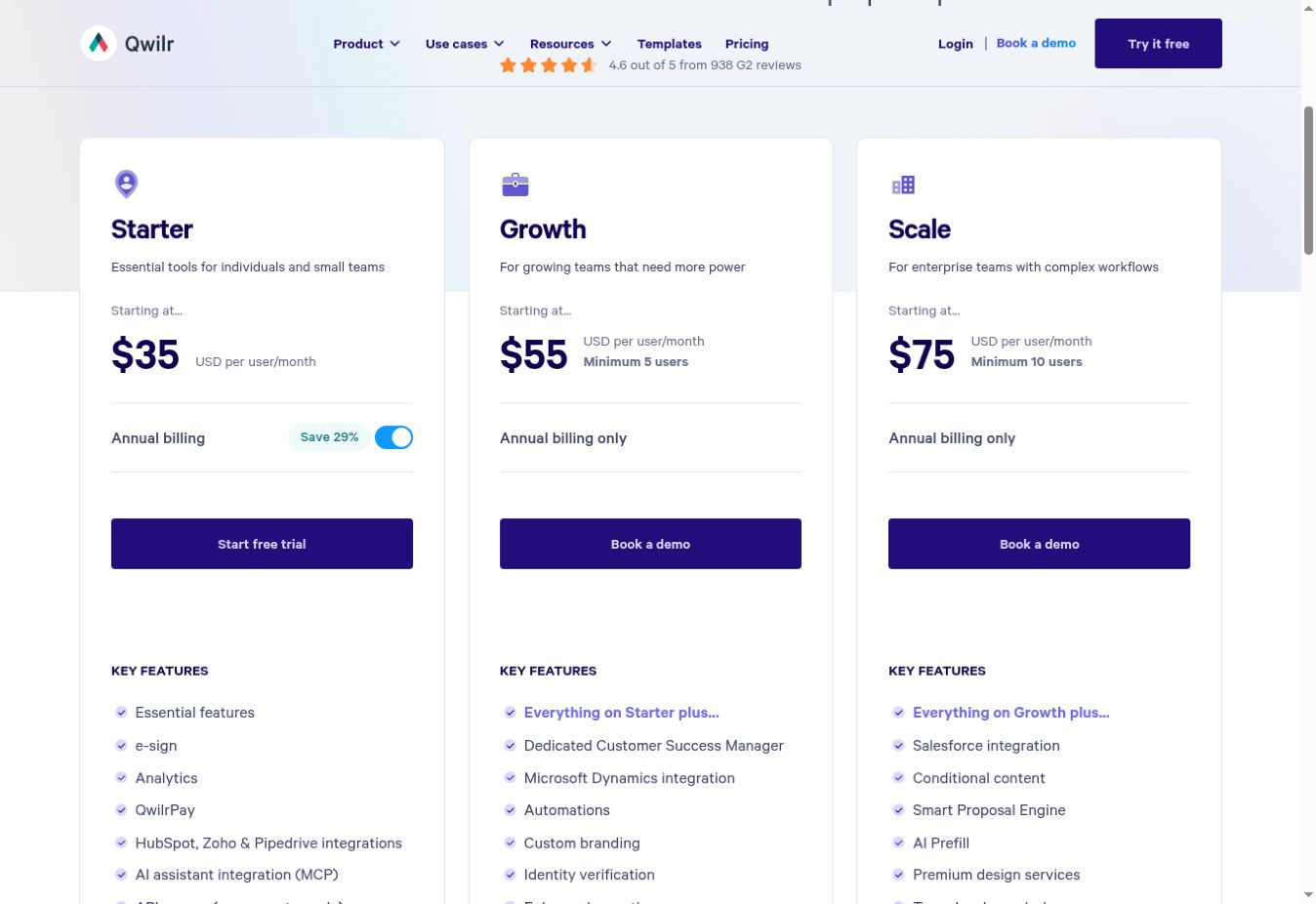
The seat minimum creates a substantial budget step. Growth starts at five users, even if only three people need it. API access also carries usage costs.
Buying decision: Trial a real scope and optional service package on Starter first. If growth features are essential, budget for its minimum subscription rather than multiplying the price by your current headcount.
4. Better Proposals: Consider for a Small Proposal Operation
Better Proposals puts interactive pricing, reusable content, signatures, and payment integrations into its Starter offering. That gives a solo consultant a relatively inexpensive way to present service options and move toward acceptance.
Starter is limited to one user and 10 document sends a month. Premium adds CRM integrations, API access, Zapier, and a custom domain, with a 50-document monthly send limit. Enterprise adds manager approvals, content locking, and more collaboration controls.
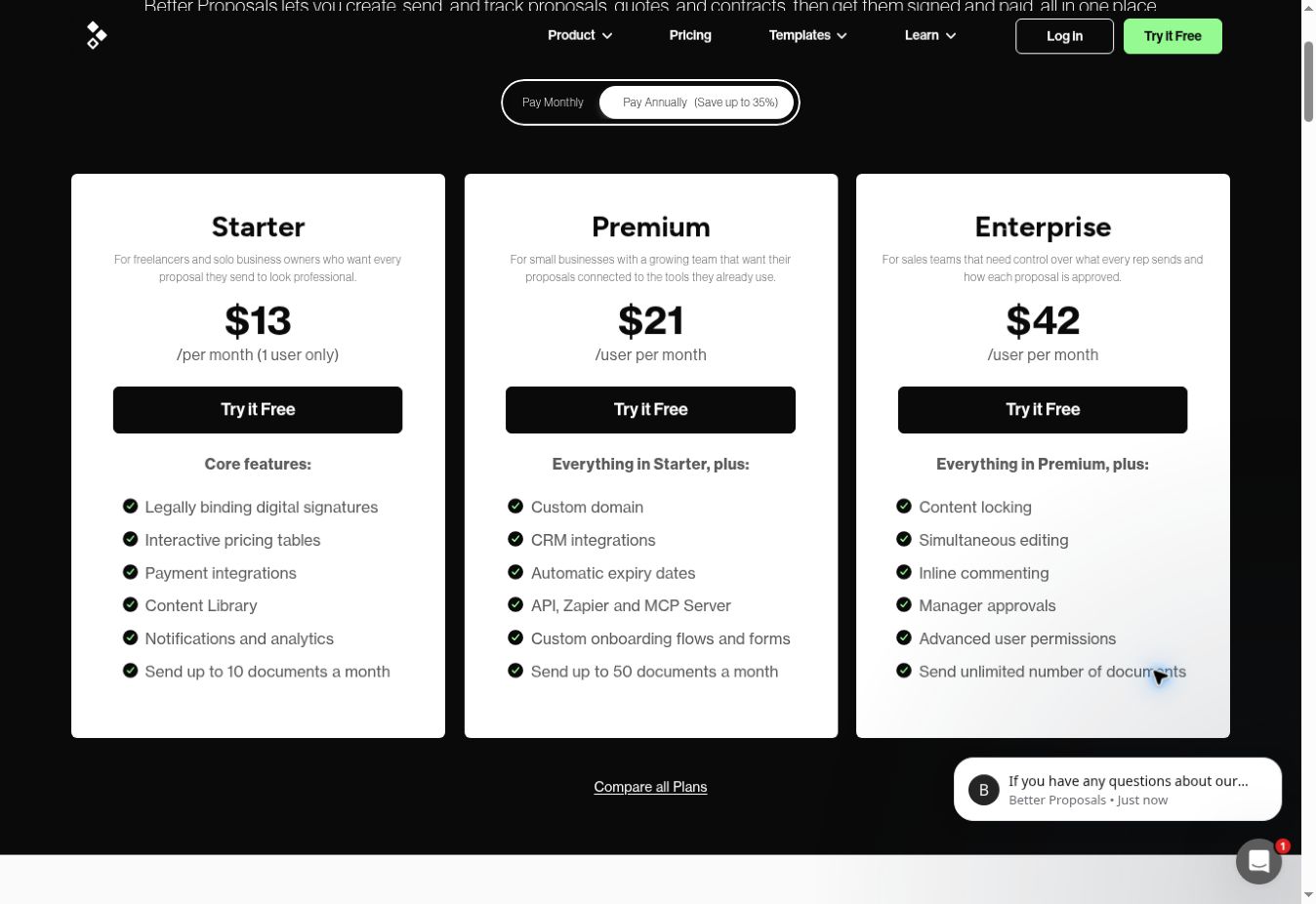
The practical distinction is between preparing a proposal efficiently and connecting it to the rest of your business. A consultant entering client details manually may be comfortable on Starter; a team expecting CRM-driven processes should examine Premium.
Buying decision: Count sends across all document types, and confirm how the account-wide allowance applies to your team.
5. Nusii: Consider for Three-Person Agency Teams
Nusii’s Agency plan includes three users for $49 a month on monthly billing. It lists CRM and payment integrations, automatic reminders, a custom domain, and removal of Nusii branding.
The important limit is 20 active proposals. An agency with long sales cycles should model how many proposals remain open simultaneously, rather than looking only at how many it sends each week. Ask exactly when a proposal stops counting as active.
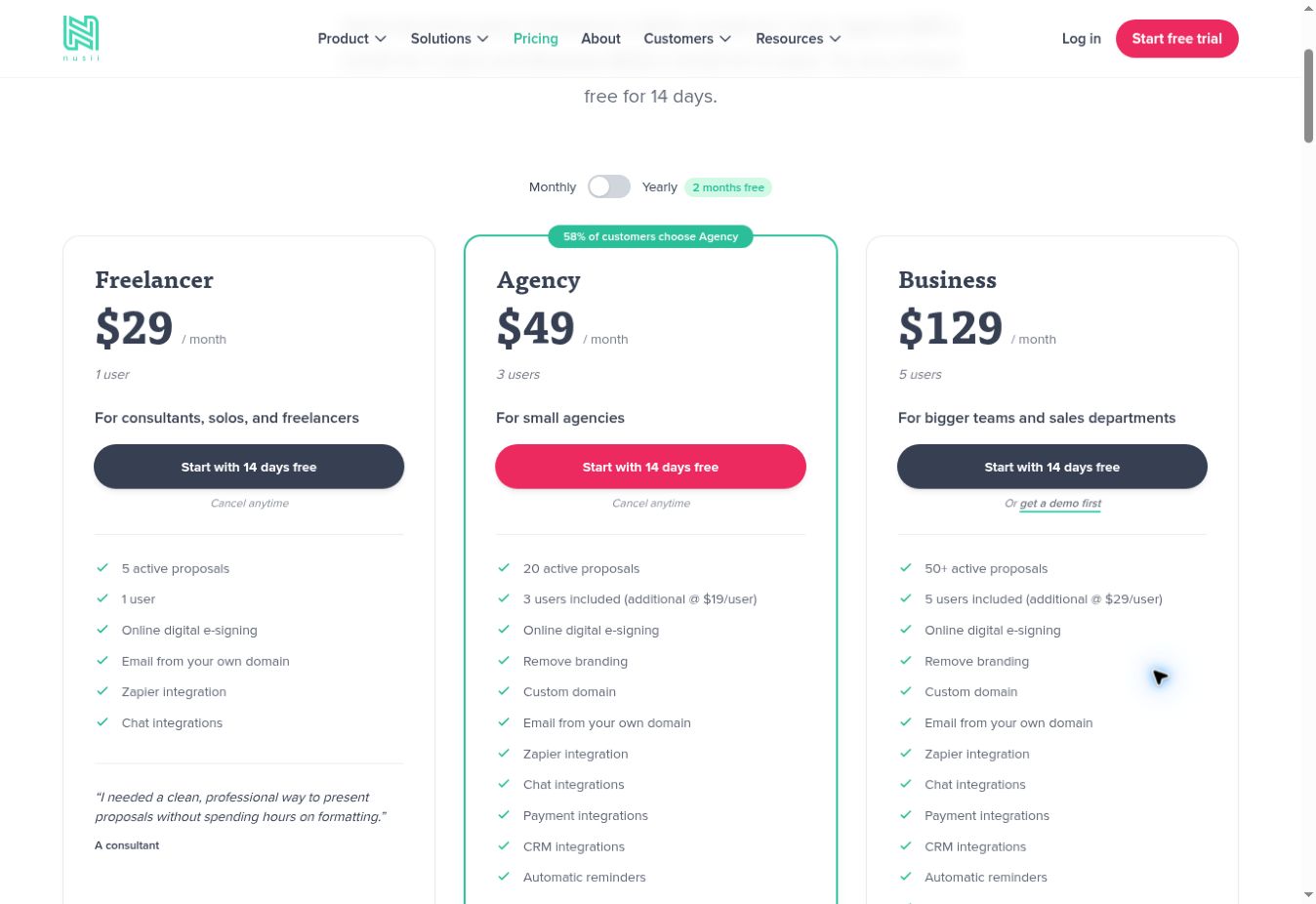
Freelancer is $29 a month for one user and five active proposals. Business adds permissions and multiple signatures. Version history was labeled “coming soon” on the inspected page, so it should not be treated as an available feature.
Buying decision: Nusii deserves a place on a small team’s trial list when bundled seats matter more than sophisticated approval controls.
6. Bidsketch: Consider for Straightforward Proposal Production
Bidsketch offers a conventional proposal-focused option. Solo is advertised at $23 a month with annual billing, or $29 month to month, with unlimited proposals and clients.
The team plan covers up to three users at $47 a month billed annually, or $79 monthly. That provides a useful comparison point for agencies whose main concern is document volume and a small number of authors.
A cheaper starter plan is also listed, but it excludes electronic signatures and custom domains. Buyers who need acceptance inside the proposal process should avoid using that entry price as their total budget.
Buying decision: Verify the exact integrations and approval behavior you need during a trial. The inspected pricing page supports the document-volume comparison; it does not establish that Bidsketch can replace a complex CRM automation setup.
7. Bonsai: Consider for Proposals Within Project Management
Bonsai makes sense to investigate when the proposal is one step in a longer client relationship. Essentials brings proposals and contracts together with invoices, scheduling, forms, and a client portal.
Its proposal page describes service-package choices, seen receipts, electronic approval, and deposit capture. Those capabilities are relevant to consultants who want to move from an agreed package into delivery without managing several disconnected tools.
However, the lowest basic plan does not include proposals and contracts. Premium adds integrations and removal of Bonsai branding, among other features. A low per-user entry price therefore does not describe every agency’s required setup.
Buying decision: Map the journey from proposal to project and invoice before choosing a tier. Confirm whether the acceptance record meets your requirements; electronic proposal approval and signing a separate contract are distinct steps.
8. HoneyBook: Consider for Proposal-to-Onboarding Work
HoneyBook is another broader client platform. Its US Starter plan lists proposals, contracts, invoices, payments, and a client portal. Essentials adds automations, scheduling, and QuickBooks Online integration.
That makes Essentials the more relevant comparison for a service business trying to reduce administrative follow-up after a proposal is accepted. The inspected US page advertises it at $49 a month billed annually and lists up to two team members.
Location eligibility needs attention. The page contains references to the US, Canada, UK, and Australia, but also retains older US-and-Canada wording. International readers should confirm current support for their operating location and payment setup directly.
Buying decision: Check both geographic eligibility and whether the team-member allowance includes or excludes the owner. Do not assume a foreign company registration settles either question.
9. Dubsado: Consider for Configurable Client Workflows
Dubsado is relevant when proposals sit alongside lead forms, scheduling, invoices, and client communications. Its Premier plan includes automated workflows, public proposals, and Zapier integration.
The published annual price is $525, equivalent to $43.75 a month. Starter costs $335 a year, but the comparison excludes automated workflows and public proposals from that tier. Readers should not interpret that narrower distinction as proof that Starter cannot handle any proposal-related form.
The pricing page also lists three additional users without an added user charge and separate charges for larger user bands and additional brands.
Buying decision: Write down the exact trigger and action you need—for example, an approved proposal followed by an onboarding email—and verify it in Premier before moving your client process.
10. Ignition: Consider for Proposals and Recurring Billing
Ignition connects proposals with payment collection and billing. Its proposal documentation describes service packages, optional add-ons, deposits, and bulk proposal creation or renewal.
This is relevant to consultancies and agencies selling repeatable retainers. The buying question is less about making a document attractive and more about whether the agreed service and billing schedule stay aligned after acceptance.
A reliable subscription amount could not be verified from the retrieved pricing page. Rather than repeat a potentially stale figure, request a regional quote covering your client count, users, payment methods, and any pipeline or forms add-ons.
Buying decision: Demonstrate a retainer, an additional one-off service, and a changed billing date during evaluation. Confirm how each affects invoices and collection.
What Would a Three-Person Agency Pay?
Consider a hypothetical agency with three proposal authors. It needs shared content and sends proposals regularly, but has not yet decided whether internal approval automation is essential.
These are subscription-only examples, not equivalent feature bundles or total-cost quotes:
| Illustrative setup | Calculation | Subscription amount |
|---|---|---|
| Nusii Agency, monthly | Three included users | $49/month; $588 across 12 monthly payments |
| Bidsketch Team, annual | Three included users × $47 monthly equivalent | $564/year |
| Bonsai Essentials, annual | 3 × $19 × 12 | $684/year |
| Better Proposals Premium, annual | 3 × $21 × 12 | $756/year |
| PandaDoc Business, annual | 3 × $49 × 12 | $1,764/year, before usage charges |
| Qwilr Growth, annual | Minimum 5 × $55 × 12 | $3,300/year, before additional charges |
The lesson is to price the required workflow. A bundled three-user plan can be economical, but it may lack an approval feature another team considers essential. Equally, paying for a larger minimum seat bundle can make sense only if the added capability solves a valuable problem.
Choose the Process Before the Template
Start by separating three things often grouped under “automation.”
Content reuse saves you from rewriting an introduction, service description, or case study. Workflow automation moves information between stages and systems. Commercial controls determine who can change prices, approve exceptions, or authorize a document to leave the business.
A product can be strong in one area without meeting your needs in another. Before a trial, identify your most expensive recurring error: incorrect pricing, outdated scope, missed follow-up, or an accepted proposal that never reaches invoicing.
There is also a limit to what software should automate. In the 2Bobs discussion “Phase Your Client Engagements,” Blair Enns argues for breaking larger engagements into phases and presenting options after understanding the problem. This is sales-method advice, not an endorsement of any product here. Applied to software selection, it suggests a useful question: can your system support a smaller paid discovery engagement before you commit to a detailed implementation scope?
Do not let a reusable template make an uncertain promise look settled.
A Practical Trial Checklist
Use the same fictional client and scope in two shortlisted products. Include a fixed project fee, optional maintenance, two revision rounds, a deposit, and a named internal approver.
- Create the proposal: Record which fields populate correctly and which require manual correction.
- Change an option: Check whether selecting maintenance changes the price and billing description consistently.
- Test authority: Confirm who can alter fees and whether an approval rule actually stops an unauthorized send.
- Preview the buyer experience: Review the proposal on a phone and check whether acceptance requires an account.
- Inspect the next step: Use a permitted test mode to confirm the CRM update, onboarding task, or invoice behavior.
- Export the record: Check what remains available if you later cancel the subscription.
Keep test emails and payment activity in a controlled environment. A successful template preview is not proof that signatures, billing, and integrations work end to end.
Frequently Asked Questions (FAQs)
Is proposal automation the same as AI proposal writing?
No. AI writing helps draft or revise language. Proposal automation can also populate structured information, apply pricing rules, route approvals, track status, and initiate downstream actions. Evaluate those separately.
Which option should a solo consultant investigate first?
Better Proposals Starter is a candidate for low-volume sending, while Bidsketch Solo is relevant when proposal volume is higher. Bonsai Essentials may be worth evaluating if client and project administration also need attention. These are shortlist suggestions, not results from comparative usability tests.
Can proposal software replace a CRM?
A dedicated proposal tool should not automatically be treated as a CRM replacement. Decide where contacts, deal stages, and the authoritative price live, then test how information moves between systems. A broader client platform may cover more of that process, but migration still requires verification.
Does proposal tracking prove that a client is ready to buy?
No. An open notification is a prompt for informed follow-up, not proof of intent. Ask about the decision process and remaining concerns rather than treating viewing activity as acceptance.
What should an agency choose first?
Choose two products that address the same bottleneck, then run the same scope through both. Compare the corrections required, the buyer experience, the approval controls, and the full subscription commitment. Buy the workflow your team can maintain consistently.