Fidelity is the best starting point for most U.S. beginners comparing fractional share investing apps. It lets you buy eligible stocks and exchange-traded funds (ETFs) from $1 and schedule those purchases from the same minimum.
Charles Schwab is a strong choice if you want a wide selection for one-time purchases. If you already manage your money through Chase, J.P. Morgan Self-Directed Investing offers one-time and recurring fractional stock and ETF purchases from $5.
A fractional share lets you buy part of a stock or ETF. If an ETF fills at $200 a share, a $25 order would buy about 0.125 shares before any fees or rounding. The dollar amount makes it easier to start small. The investment still moves with the price of the underlying stock or fund.
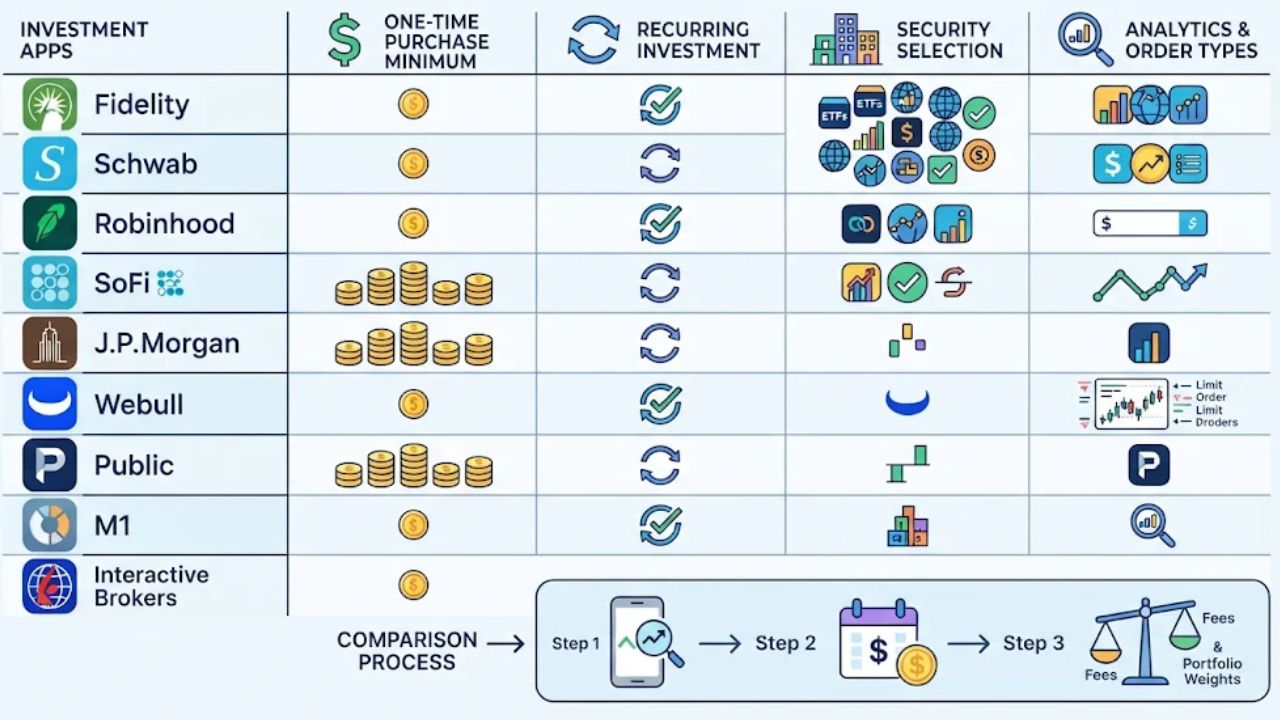
The comparison covers self-directed U.S. brokerage accounts. The minimum shown is the advertised starting amount for a one-time fractional purchase. A recurring plan or an initial deposit can have its own minimum, and each broker decides which securities qualify.
| App | One-time buy from | Best fit | What to check |
| Fidelity | $1 | First account and small recurring buys | Scheduled stock and ETF buys use market orders |
| Charles Schwab | $1 | Wide choice of U.S.-listed stocks and ETFs | Eligibility and minimums can vary by order |
| Robinhood | $1 | Dollar-based orders and automatic purchases | Scheduled buys are grouped into batch orders |
| SoFi Invest | $5 | Existing SoFi customers | Recurring purchases require a fraction-eligible ticker |
| J.P. Morgan Self-Directed Investing | $5 | Existing Chase customers | Recurring stock and ETF purchases require an eligible cash account |
| Webull | $1 | Charting and fractional limit orders | Its simulator excludes fractional trades |
| Public | $5 for stocks | A recurring plan built around multiple securities | Per-purchase plan fees can apply |
| M1 | $1 per security | Investing toward portfolio weights | Initial deposit minimums and a potential $3 monthly fee |
| Interactive Brokers | $1 for eligible stocks | Fractional access across multiple markets | $10 minimum for a U.S. dollar recurring order and applicable commissions |
These picks are based on published brokerage terms, including security coverage, minimums, automation, order types, and fees that matter for small balances. The comparison is based on public documentation checked November 16, 2026.
1. Fidelity — Best overall for most beginners
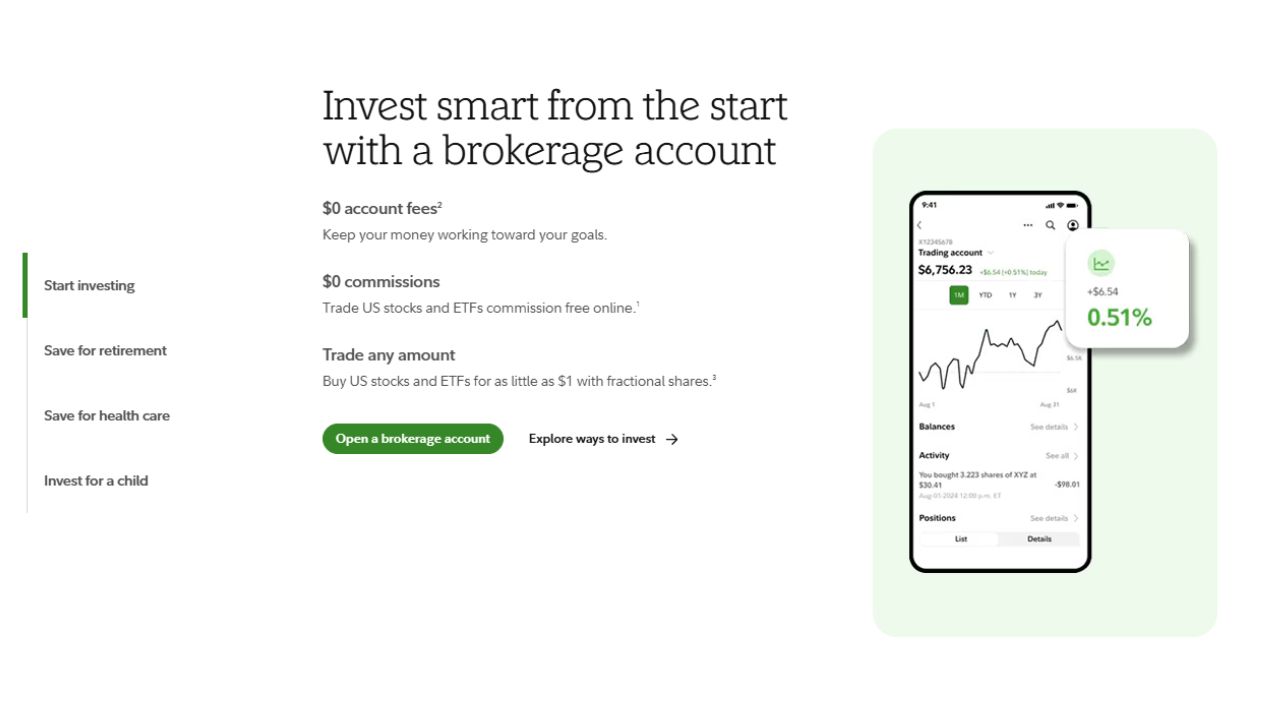
Fidelity supports $1 one-time and recurring purchases of eligible U.S. stocks and ETFs. Its standard retail brokerage account has no opening minimum, and online trades in U.S. stocks and most ETFs carry no commission. That combination makes it a practical choice when the first purchase and each later contribution are both small.
Fidelity submits scheduled stock and ETF purchases as market orders. When the selected date falls on a nontrading day, the order moves to the next trading day.
2. Charles Schwab — Best for a wide selection of U.S.-listed securities
Schwab now offers fractional trades in more than 7,000 U.S.-listed stocks and ETFs, starting at $1. Its older Stock Slices name may still turn up in guides. Schwab has expanded that offering and refers to it as fractional shares. Eligible online fractional trades carry no commission.
If you already know which fund or stock you want, check the ticker in Schwab’s trade ticket. The broker says the order screen displays applicable minimums and limits.
3. Robinhood — Best for buying by dollar amount
Robinhood allows dollar-based or share-based fractional orders in eligible stocks and ETFs, starting at $1. It also supports scheduled purchases. Knowing how those orders fill is useful if you plan to automate. Robinhood groups recurring buys into market orders and uses the weighted average execution price of the relevant batch to calculate how many shares each customer receives. A quote you see earlier in the day can differ from your final price.
4. SoFi Invest — Best for existing SoFi users
SoFi lists more than 4,000 stocks and ETFs available in fractions from $5. For people who already use SoFi Checking or Savings, SoFi Invest can use that account as a funding source for recurring purchases. To check a particular stock or fund, open its trade options. SoFi says the Recurring option appears only when the security qualifies for fractional trading.
5. J.P. Morgan Self-Directed Investing — Best for existing Chase customers
Chase supports $5 fractional market orders in eligible stocks and ETFs during regular U.S. market hours. Recurring stock and ETF purchases also start at $5 for eligible self-directed cash accounts. They can draw from a linked bank account or available cash in the brokerage account.
Account type matters here. Chase lists recurring mutual fund purchases for eligible self-directed IRAs and excludes margin accounts from recurring investing. Check the rules for the specific account you plan to use.
6. Webull — Best for charts and fractional limit orders
Webull lists a $1 fractional buy minimum for eligible stocks and ETFs, subject to a minimum share quantity. It supports fractional limit orders during regular trading hours. A buy limit lets you set the highest price per share you will accept, though the trade may go unfilled. Its recurring feature starts at $1 for eligible securities and uses market orders.
Beginners can explore the platform’s paper-trading simulator, but Webull excludes fractional trades from the simulator.
7. Public — Best for building a custom recurring plan
Public has a $5 minimum for one-time fractional stock buys. Its Investment Plans can schedule purchases across up to 20 assets. For stock and ETF plans, Public lists a fee of $0.49 per purchase for one to three symbols, $0.99 for four to ten, and $1.99 for 11 to 20. Public Premium members are exempt from those plan fees.
Compare the fee with the amount you actually intend to contribute. For scale, a $0.49 fee is 4.9% of $10 and 0.98% of $50. Those are fee comparisons, and a specific plan may have a different minimum.
8. M1 — Best for investing toward portfolio weights
M1 lets you set target percentages for the stocks and ETFs in a portfolio it calls a Pie. With auto-invest enabled, it uses available cash to buy toward those targets, subject to its cash threshold and $1 minimum per security.
The initial deposit is $100 for an individual investment account and $500 for an IRA. M1 can also charge $3 a month unless you meet a waiver condition. At $3 a month, the fee adds up to $36 a year. That makes account costs worth checking before choosing M1 for a small balance.
9. Interactive Brokers — Best for access beyond U.S. markets
Interactive Brokers offers fractional trading in eligible U.S., Canadian and European stocks and ETFs, with one-time purchases from $1 for eligible stocks. GlobalTrader is its mobile app for people who want to explore international markets.
The minimum for a recurring order in U.S. dollars is $10. Commissions depend on the pricing plan, market and order. IBKR Lite’s commission-free terms for qualifying U.S. trades have exceptions, including recurring investment instructions.
Compare the order you plan to place
- Search for the exact ticker: Check that your stock or ETF supports fractional purchases in the account you intend to open. A broad-market ETF can hold many companies, while a narrow fund may concentrate on a single sector. Look at the fund’s holdings when deciding how to diversify your investment portfolio.
- Check the recurring minimum: If you plan to buy a set dollar amount every month, verify the minimum for that schedule and whether the app needs a separate deposit instruction.
- Price out the whole setup: Compare any per-order fees, monthly platform fees and the fund’s expense ratio. If you’re investing small amounts, how brokers and apps charge for investing matters as much as the opening price.
- Read the transfer rules: Fractional shares generally cannot move directly to another brokerage. The old broker may sell the fractional portion and send cash. In a taxable account, a sale can result in a capital gain or loss.
Frequently asked questions
Can you start with $1?
Yes, for eligible securities at brokers such as Fidelity, Schwab and Robinhood. Check the account funding rules and the minimum for any automatic purchases you intend to set up.
If the underlying stock or fund pays a distribution, fractional holders generally receive their proportional amount, subject to the broker’s rules and rounding. For example, a quarter share would ordinarily earn $0.25 from a $1-per-share dividend.
Yes. If the price of the stock or ETF falls, the value of your fraction falls with it. A smaller order limits the amount you put into that trade. SIPC protection at a member brokerage applies to eligible missing cash or securities if the firm fails and excludes losses from market declines.
Start with the Purchase You’ll Repeat
The best fractional share investing apps make it easy to buy the security you’ve chosen at the dollar amount and frequency that fit your plan. Fidelity is a practical starting point for small scheduled buys. Schwab stands out for the breadth of U.S.-listed securities available in fractions. Before opening an account, compare the same ticker and dollar amount across your shortlist and check what it would cost to make that purchase every month.