
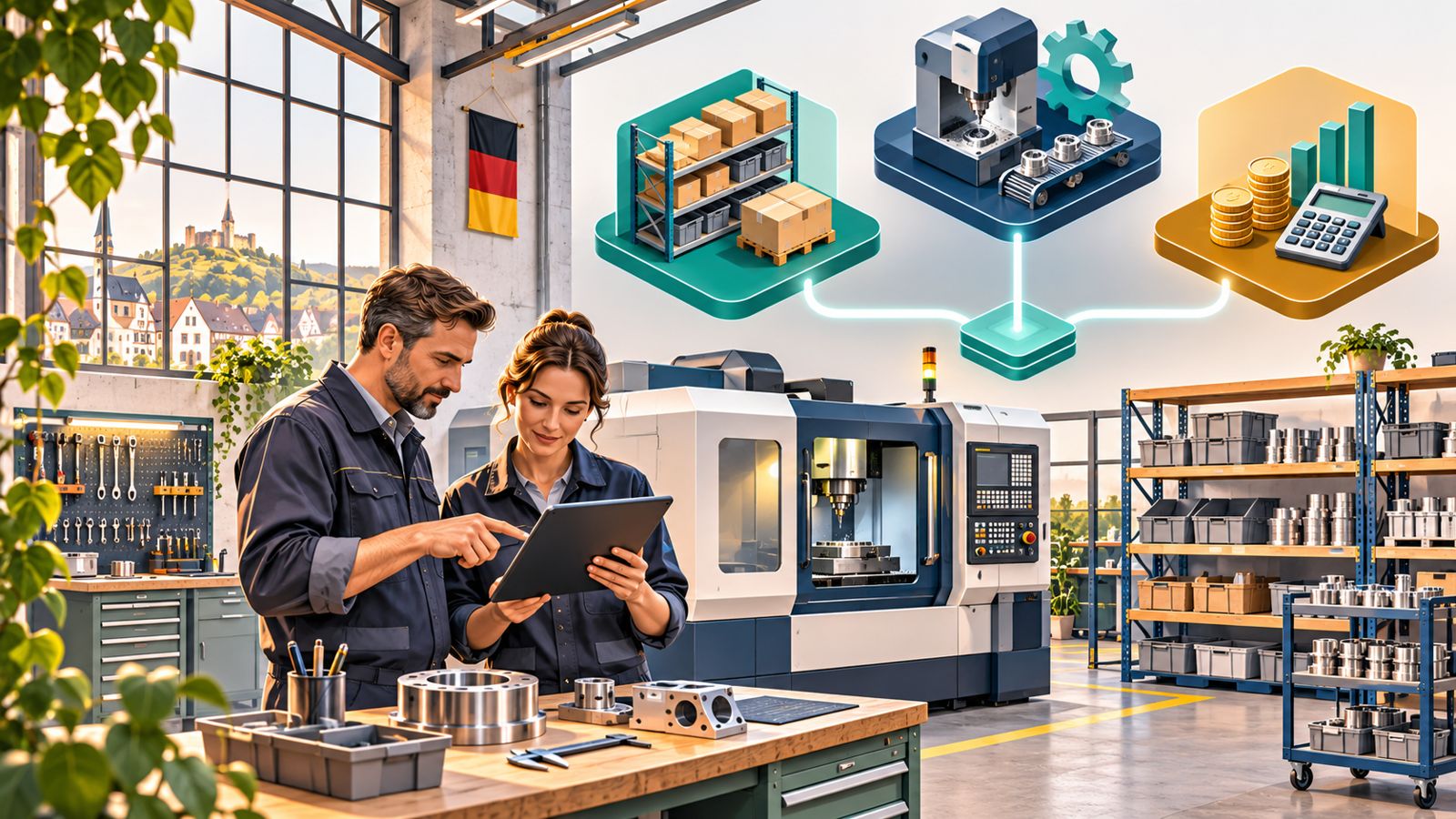
Comparing ERP platforms for German small manufacturers starts with the way your factory works. A metal subcontractor, a repeat-assembly business, and a custom machine builder can need very different systems. These 15 options offer a useful longlist, with attention to manufacturing scope, German implementation needs, licensing boundaries, and the questions that expose costly gaps before a contract is signed.
Which ERP should a small German manufacturer compare first?
For a broad business system with manufacturing, begin with Business Central Premium, SAP Business One, Odoo, weclapp, Sage 100, Myfactory, Haufe X360 or microtech. Metalworking businesses should investigate Proalpha MKG. Production-focused firms can add Abas and Monitor; engineering-heavy or more complex operations can consider APplus, ams.erp, oxaion and PSIpenta. These are starting points based on documented scope, not a performance ranking.
How we selected these ERP platforms
This research-led comparison reviews official product pages, documentation and available pricing, checked on 15 November 2026. Inclusion required identifiable manufacturing functionality and evidence of a German-market offering, localisation or local representation. We distinguish vendor-described capability from our editorial assessment of likely fit. We did not run production trials, interview customers or measure implementation outcomes.
“Small” describes an organisation with limited implementation resources here; it is not a promise that every product suits every firm below a headcount threshold. Several specialist options make sense only when production complexity justifies the project. Product names, modules and commercial terms can change, so require a dated, configuration-specific proposal.
The screenshots below were captured from official public homepages, product landing pages or pricing pages on 15 November 2026. They document the pages visible in our browser, not hands-on software testing. Prices, currency settings and promotional terms can change; confirm the configuration and German commercial terms with the supplier.
ERP Platforms for German Small Manufacturers: quick comparison
| Platform | Best fit to investigate | Main buying check |
|---|---|---|
| Microsoft Dynamics 365 Business Central Premium | Manufacturers already working in the Microsoft ecosystem | Premium required; extensions may add cost |
| SAP Business One | Light manufacturing with a shared commercial and financial backbone | Separate core capability from partner manufacturing extensions |
| Odoo | Businesses that want manufacturing alongside a broad suite of apps | Customisation, hosting and implementation change the total cost |
| weclapp | Smaller producers combining stock, sales and manageable production flows | Validate scheduling depth and the complete production package |
| Sage 100 Produktion | German manufacturers seeking a modular production and commercial system | The production starting price is not a complete finance-and-rollout budget |
| Myfactory Cloud ERP with PPS | Manufacturers wanting cloud ERP with integrated production planning | Confirm the PPS scope and shop-floor capture process |
| Haufe X360 | Growing producers evaluating cloud ERP across production and finance | Choose and verify the manufacturing configuration, not just the platform |
| Abas ERP | Discrete manufacturers needing production planning to anchor the ERP | Master-data preparation and specialist planning scope need attention |
| Proalpha MKG | Small metalworking, machining and subcontract manufacturing businesses | Assess MKG specifically; do not substitute a generic Proalpha proposal |
| APplus | Manufacturers combining production, projects and after-sales work | A broader process scope demands clear implementation priorities |
| ams.erp | Engineer-to-order and one-off machine or plant builders | Its project emphasis may exceed the needs of simple repetitive assembly |
| oxaion ERP | Variant-rich and machinery manufacturers needing connected PPS | Test configurator rules and engineering maintenance effort |
| PSIpenta/ERP | Growing factories with demanding material and capacity coordination | A substantial manufacturing project may be disproportionate for a microbusiness |
| Monitor ERP | Manufacturers wanting a production-centred operational system | Verify German accounting, interfaces and local delivery in the proposed package |
| microtech ERP with Produktion & Fertigung | Small producers connecting Warenwirtschaft with production | The production add-on and eligible base edition must be specified |
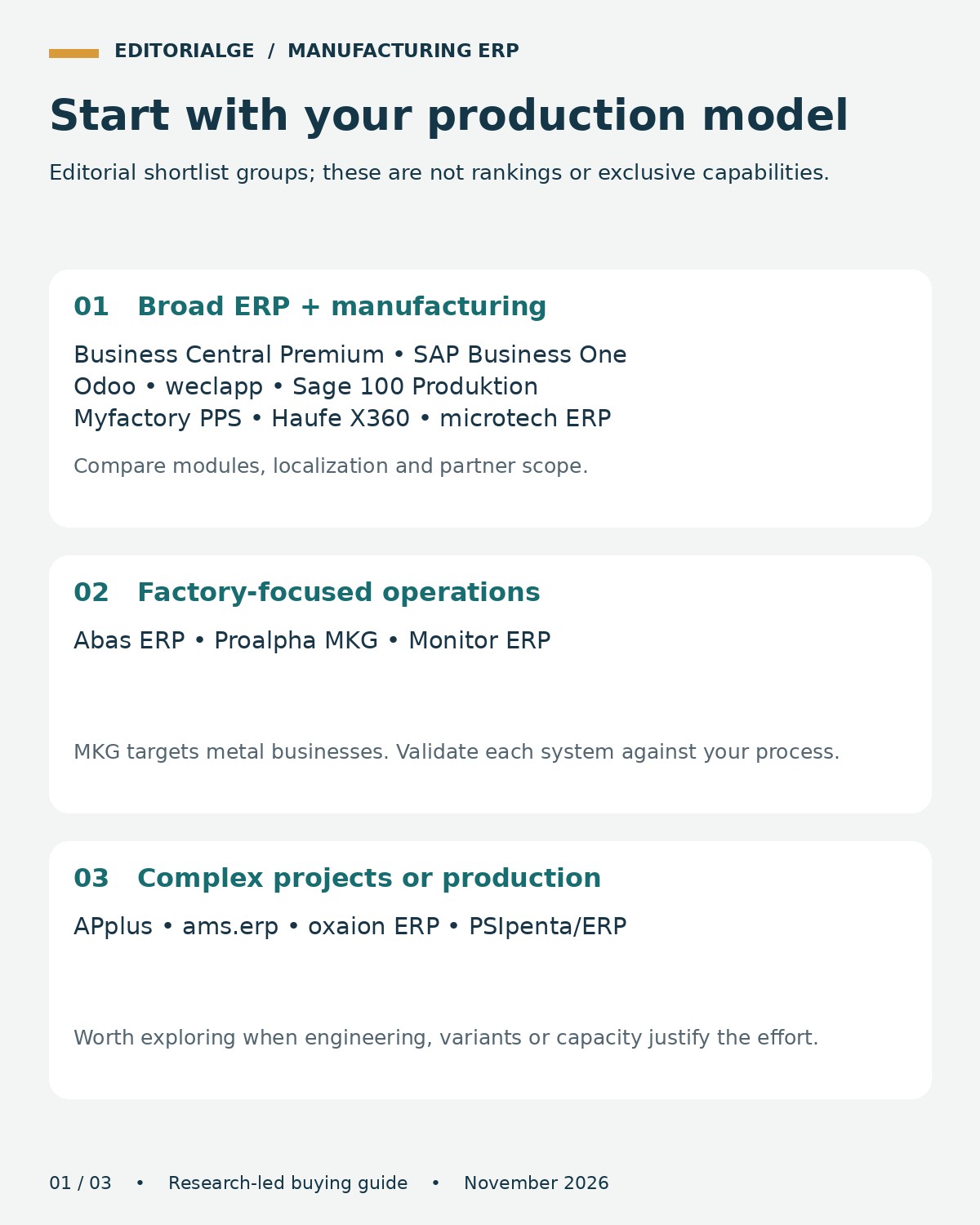
15 platforms and the questions to ask each supplier
1. Microsoft Dynamics 365 Business Central Premium
Best for: Manufacturers already working in the Microsoft ecosystem.
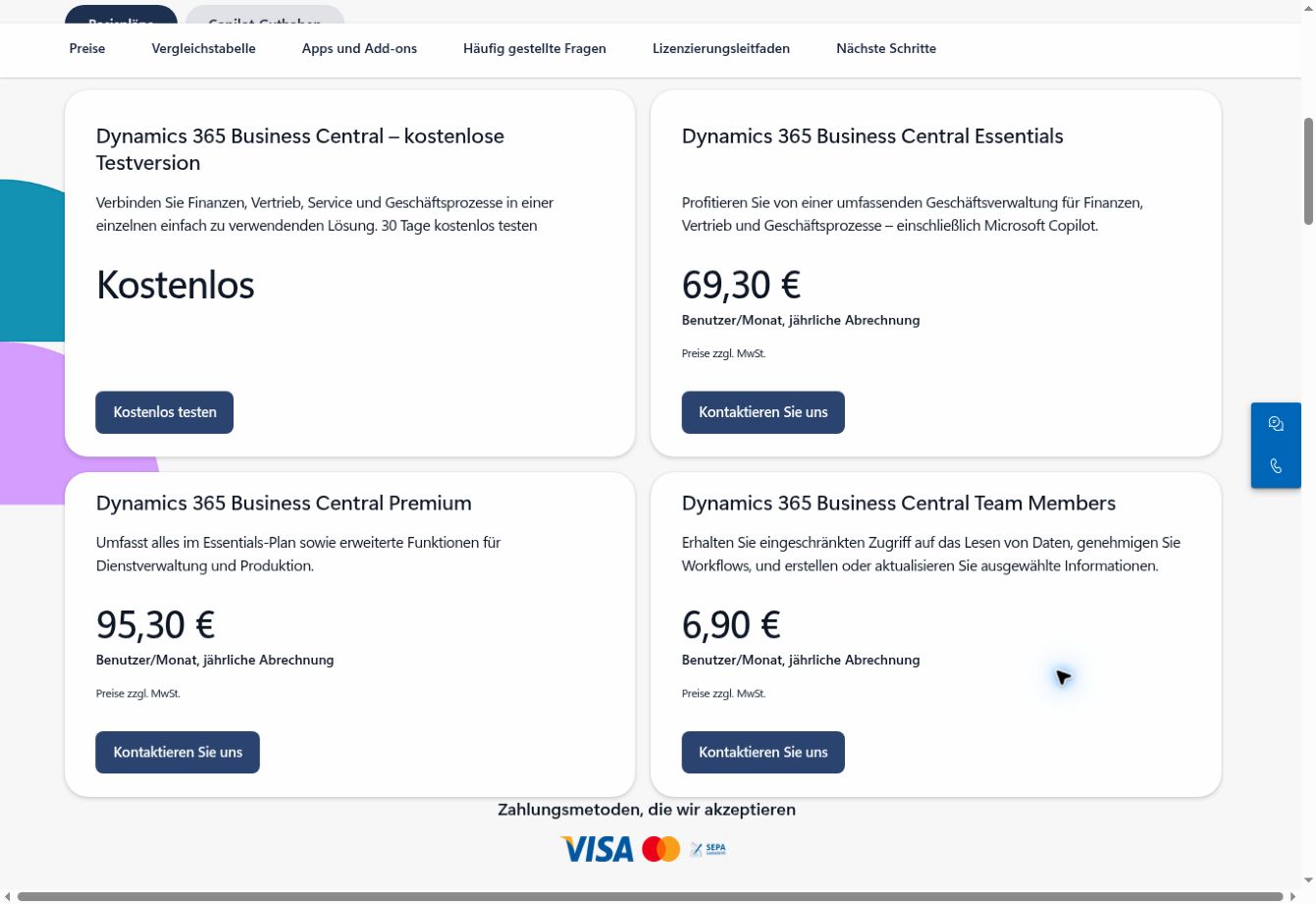
Business Central belongs on the shortlist when purchasing, stock, production and financial control need to share one system. Its manufacturing configuration covers production processes and work centres. For a small factory already using Microsoft tools, the practical attraction is a familiar supplier ecosystem and the ability to connect operational records with wider business reporting.
The licence distinction matters: manufacturing is in Premium, rather than Essentials. Microsoft’s German pricing page lists Premium at €95.30 per user per month, billed annually, excluding VAT, as checked on 15 November 2026. This is a software subscription reference, not an implementation quotation. Partner services and specialised extensions need their own lines in the budget.
Ask the proposed German implementation partner to demonstrate your production route, a material shortage and the resulting cost postings. Also ask which screens and licences shop-floor staff need. A broad ERP can be a sound foundation, but advanced scheduling or industry-specific functions should be demonstrated in the exact configuration being offered.
2. SAP Business One
Best for: Light manufacturing with a shared commercial and financial backbone.
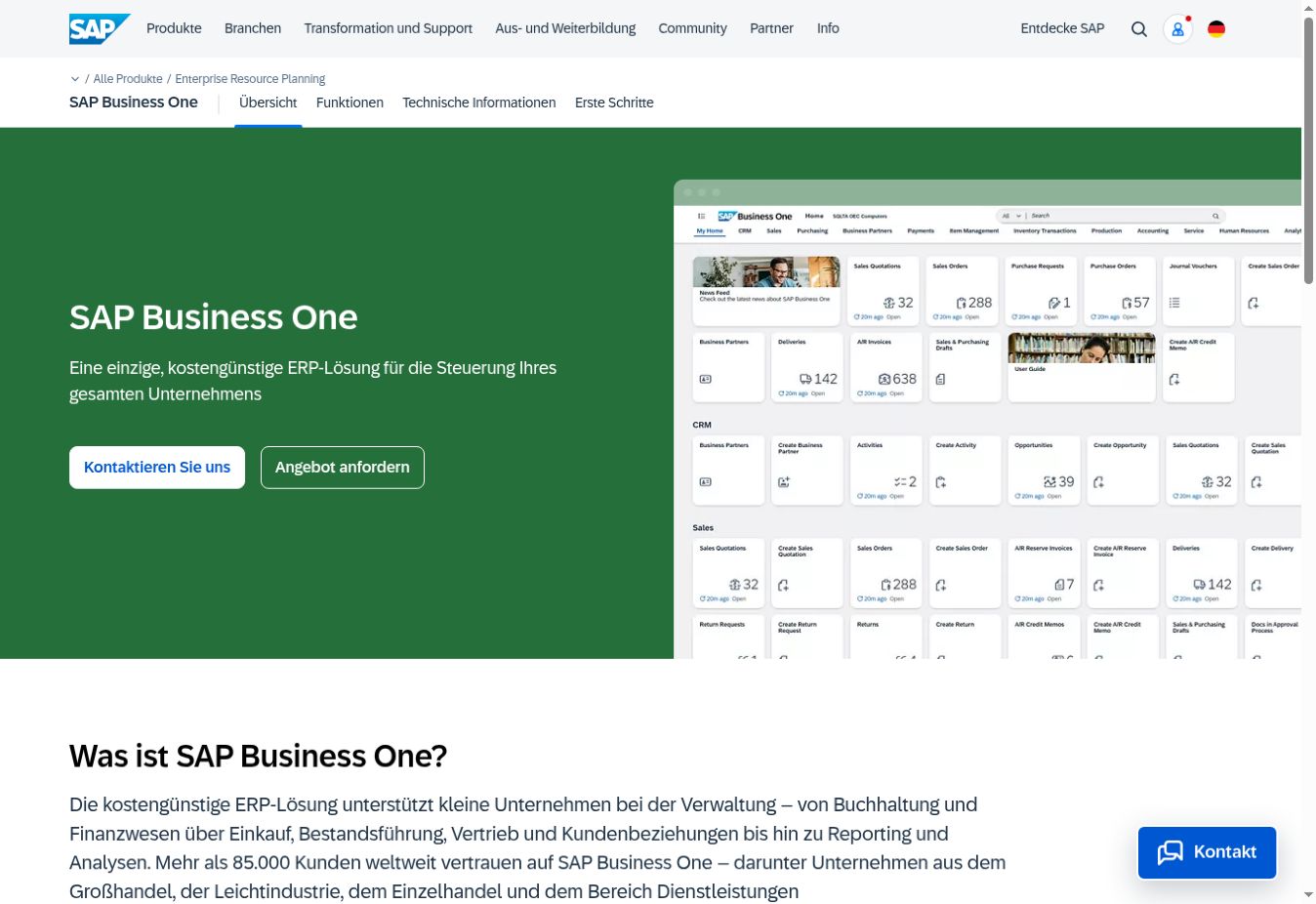
SAP Business One is a candidate for a manufacturer that also has substantial purchasing, distribution and accounting requirements. SAP’s own documentation describes its Production and Resources modules as a base for light manufacturing. Bills of materials define components, resources and route stages; production orders record consumption and completed output.
Material requirements planning adds a useful link between demand and supply. Existing inventory, sales demand and open orders inform recommendations, giving a small business a more disciplined purchasing process than separate departmental spreadsheets.
The important qualification is scope. Do not assume a demonstration of a partner manufacturing package represents functionality included in the core SAP Business One licence. Obtain a German proposal that separates the base product, production extensions, hosting and ongoing support. In the demo, change a component requirement after an order is released and follow the impact through purchasing, production and accounting. Ask who fixes the issue if the core software and an extension disagree.
3. Odoo
Best for: Businesses that want manufacturing alongside a broad suite of apps.
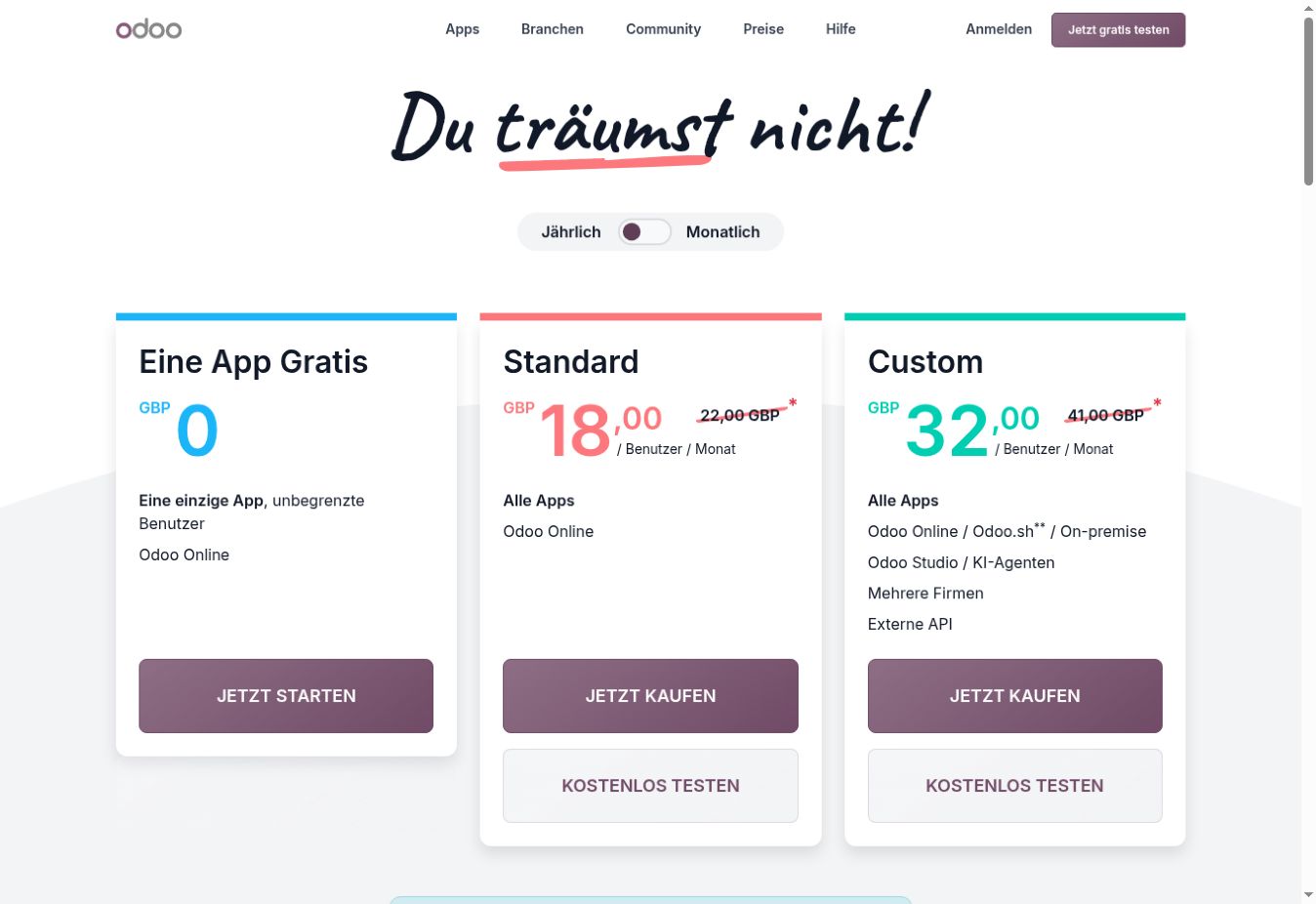
Odoo is worth examining when a manufacturer wants sales, purchasing, inventory and manufacturing in a connected application suite. Its manufacturing documentation describes bills of materials containing components and operations assigned to work centres. That makes it a plausible starting point for a growing assembly business with processes it is willing to standardise.
For Germany, official localisation documentation describes SKR03 and SKR04 charts of accounts and DATEV export options. Have the tax adviser test the actual export and attachments before migration; a localisation checklist alone does not prove that the proposed setup matches the business.
Odoo distinguishes Standard from Custom: external API access and custom developments can move the project into a different plan and hosting arrangement. Implementation services, custom-code maintenance and Odoo.sh hosting are not simply absorbed into the headline subscription. Request a current German-currency proposal, including operator access. During the demonstration, identify every step that depends on an extra module or custom code, and require a named owner for keeping those changes working after upgrades.
4. weclapp
Best for: Smaller producers combining stock, sales and manageable production flows.
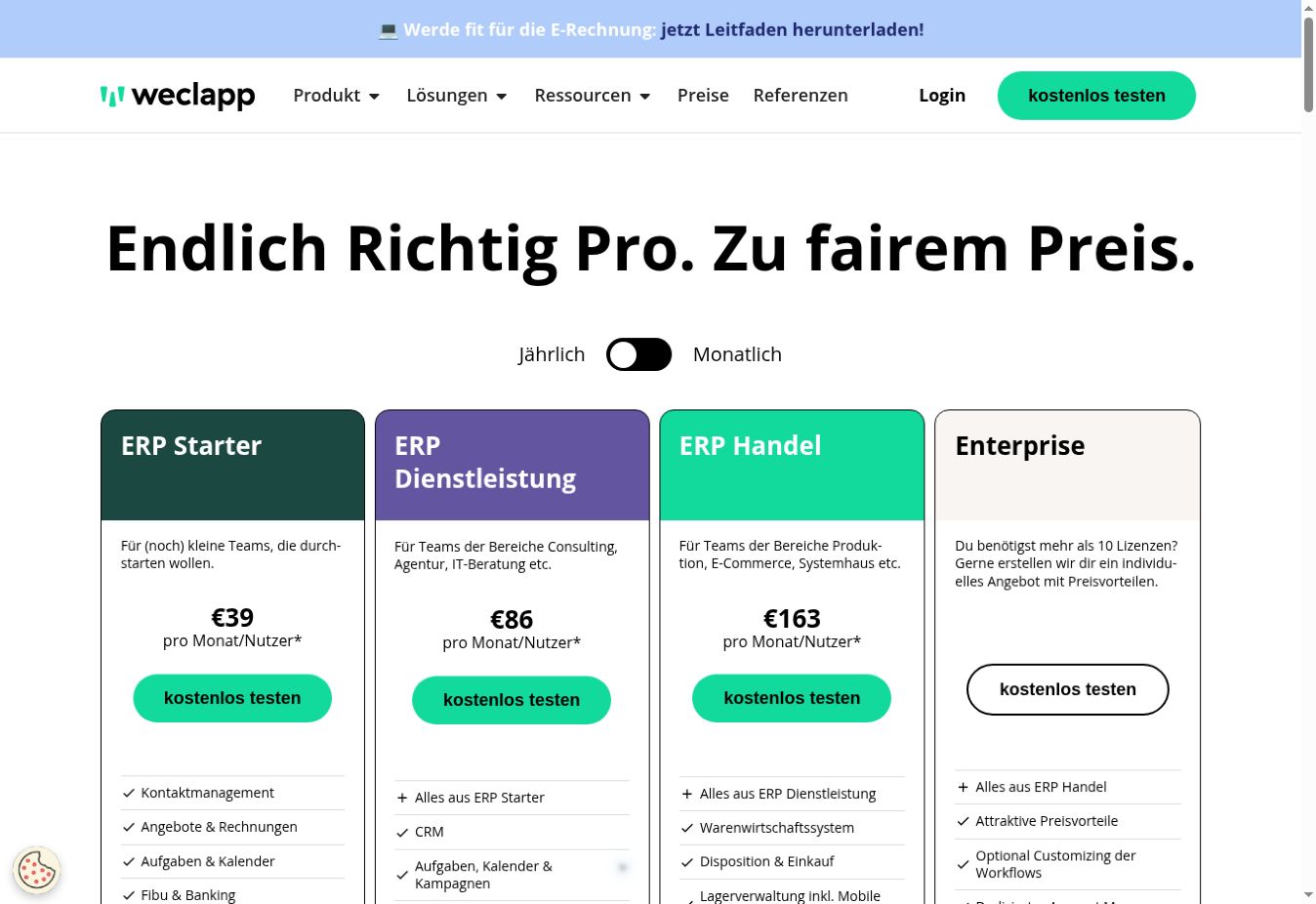
weclapp deserves consideration where the business sells stocked items as well as products it makes or assembles. Its production material describes reusable multilevel bills of materials, variations and work plans. A shared item and supplier base can help a small team connect commercial activity with production preparation.
The most useful evaluation is an ordinary order that becomes awkward: a component is unavailable, a product variant changes and only part of the order can ship. See how the proposed configuration records those events without a parallel spreadsheet becoming the real source of truth.
For this list, weclapp is a candidate for relatively manageable production requirements, not an automatic recommendation for every complex factory. Ask specifically about finite-capacity planning, subcontracting and traceability at your required level of detail. Obtain the base-plan and production-module combination in writing rather than comparing a general entry price with a manufacturing quotation. German-language product material is useful; the support hours and escalation arrangements still belong in the contract.
5. Sage 100 Produktion
Best for: German manufacturers seeking a modular production and commercial system.
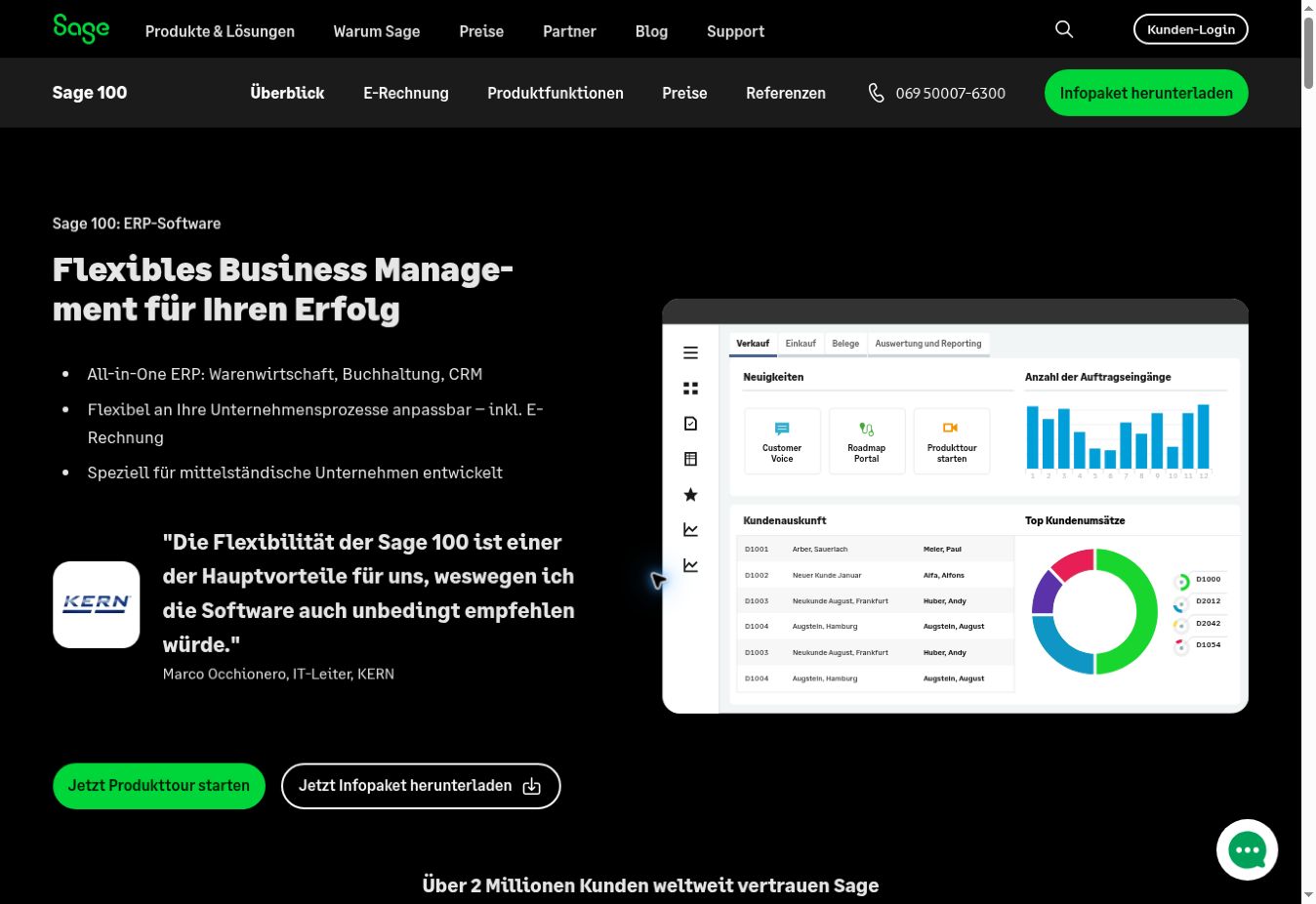
This entry concerns the German Sage 100 product. Its production offering includes manufacturing control, graphical resource planning, preliminary and subsequent costing, shop-floor data capture and external production. That combination makes it relevant to workshops that need a closer connection between estimated job costs and what happened on the floor.
Sage lists Produktion from €90 per user per month, including the Warenwirtschaft package, with annual invoicing, a 12-month minimum term and VAT extra. The separate accounting module and any additional project requirements should be priced explicitly. Treat “from” as a starting condition, not a guaranteed configured price.
Ask a local partner to show an outsourced operation returning with a higher invoice than expected, then inspect the revised job margin. Confirm the proposed deployment, remote access, CAD connection and responsibility for updates. Sage’s modular structure offers choices, but it also means two proposals carrying the same product name may contain materially different functionality and services.
6. Myfactory Cloud ERP with PPS
Best for: Manufacturers wanting cloud ERP with integrated production planning.
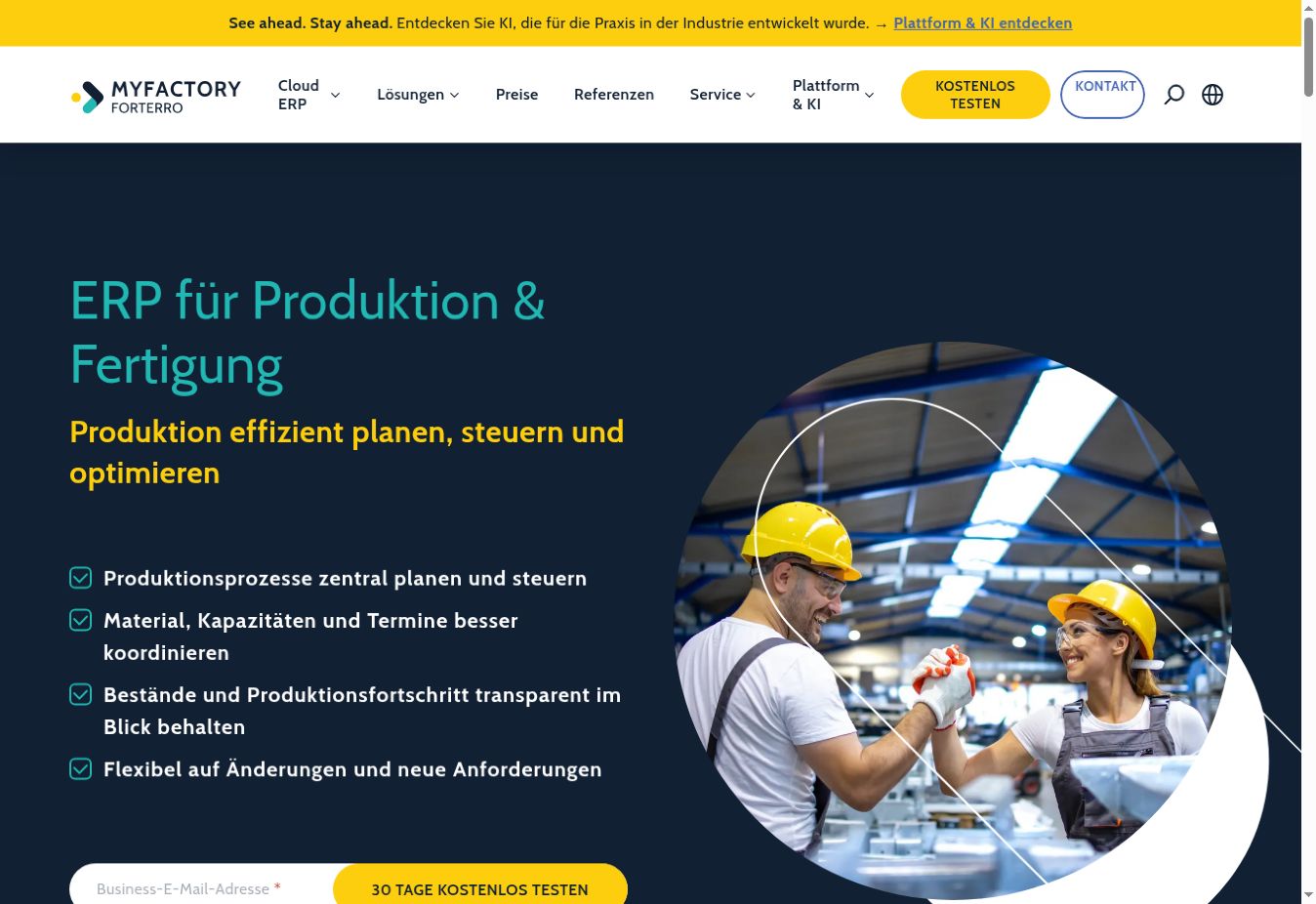
Myfactory’s PPS offering connects production planning with a broader cloud ERP. The vendor describes multilevel bills of materials, production orders, capacity planning, planned-versus-actual costs, batch and serial tracking, and the involvement of external production partners. These are useful areas to investigate for a small manufacturer with several linked production steps.
Its appeal is the possibility of keeping purchasing, production and commercial records together while using a cloud delivery model. The operational test is whether a planner can see a shortage and the warehouse and finance teams can follow the same underlying transaction.
Request a configuration-specific quotation that includes PPS, the required accounting functions, data migration and training. Do not infer the entire manufacturing package from a general cloud ERP price. In the demo, complete one partial batch and leave another unfinished; inspect stock, remaining work and cost treatment. If factory connectivity is unreliable, ask how operators will record work during an interruption and how reconciliation will be handled.
7. Haufe X360
Best for: Growing producers evaluating cloud ERP across production and finance.
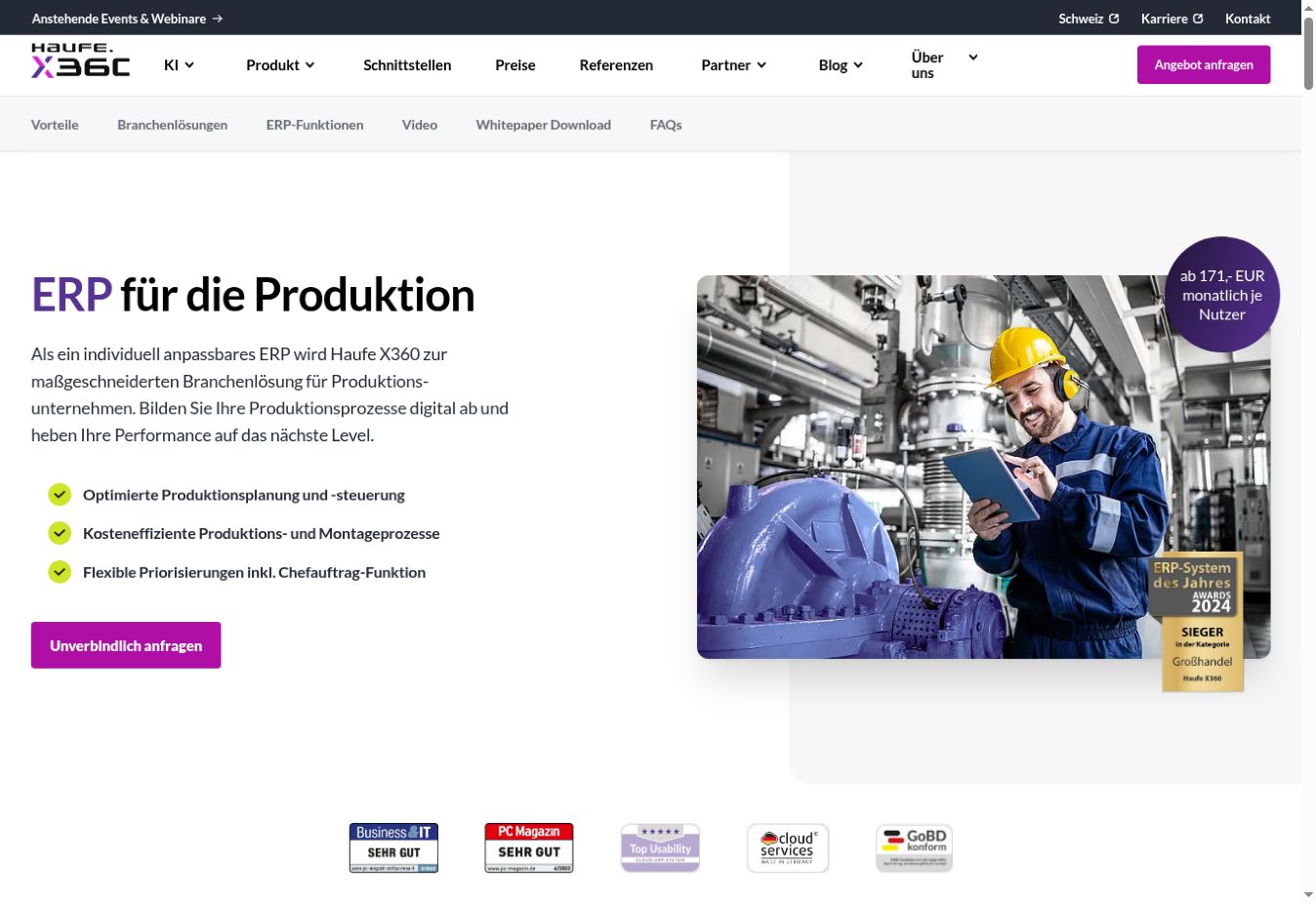
Haufe X360 offers production functions alongside finance, inventory, project control and other business applications. It also presents process manufacturing separately. That distinction is valuable: making discrete components and making products from recipes can require different records, controls and demonstrations.
A German manufacturer can use its local partner search to identify implementation candidates with relevant production experience. Evaluate those partners as carefully as the platform. Ask for a reference with a similar production model and a comparable internal project team, rather than relying on a familiar customer logo.
The buying question is which configuration covers your actual work. A recipe-based business should demonstrate units, yields and lot handling; a discrete manufacturer should show routings, variants and job costing. Obtain a quotation for that configuration and the associated interfaces. Our fit assessment is that X360 merits investigation when the business needs a wider cloud operating system, with enough internal ownership to define the cross-department processes before rollout.
8. Abas ERP
Best for: Discrete manufacturers needing production planning to anchor the ERP.
Abas positions its ERP around the manufacturing Mittelstand. Its production material focuses on planning and controlling manufacturing, with feedback from completed work informing future orders and better master data. It is worth comparing when the production planner’s needs have outgrown a mainly commercial system.
For a small factory, the attraction should be specific: better visibility of material, work and capacity across an order. Translate that aim into a test. Change a routing time, interrupt a work centre and ask the supplier to show which promises can still be met.
Abas also markets advanced planning capabilities, so establish which planning functions are included in the offered scope and which require additional products or services. The depth can be useful, but reliable outputs depend on credible routings, calendars and feedback. Budget time for supervisors and planners to clean these records. A business unwilling to maintain production data may struggle to realise the value of a more specialised implementation.
9. Proalpha MKG
Best for: Small metalworking, machining and subcontract manufacturing businesses.
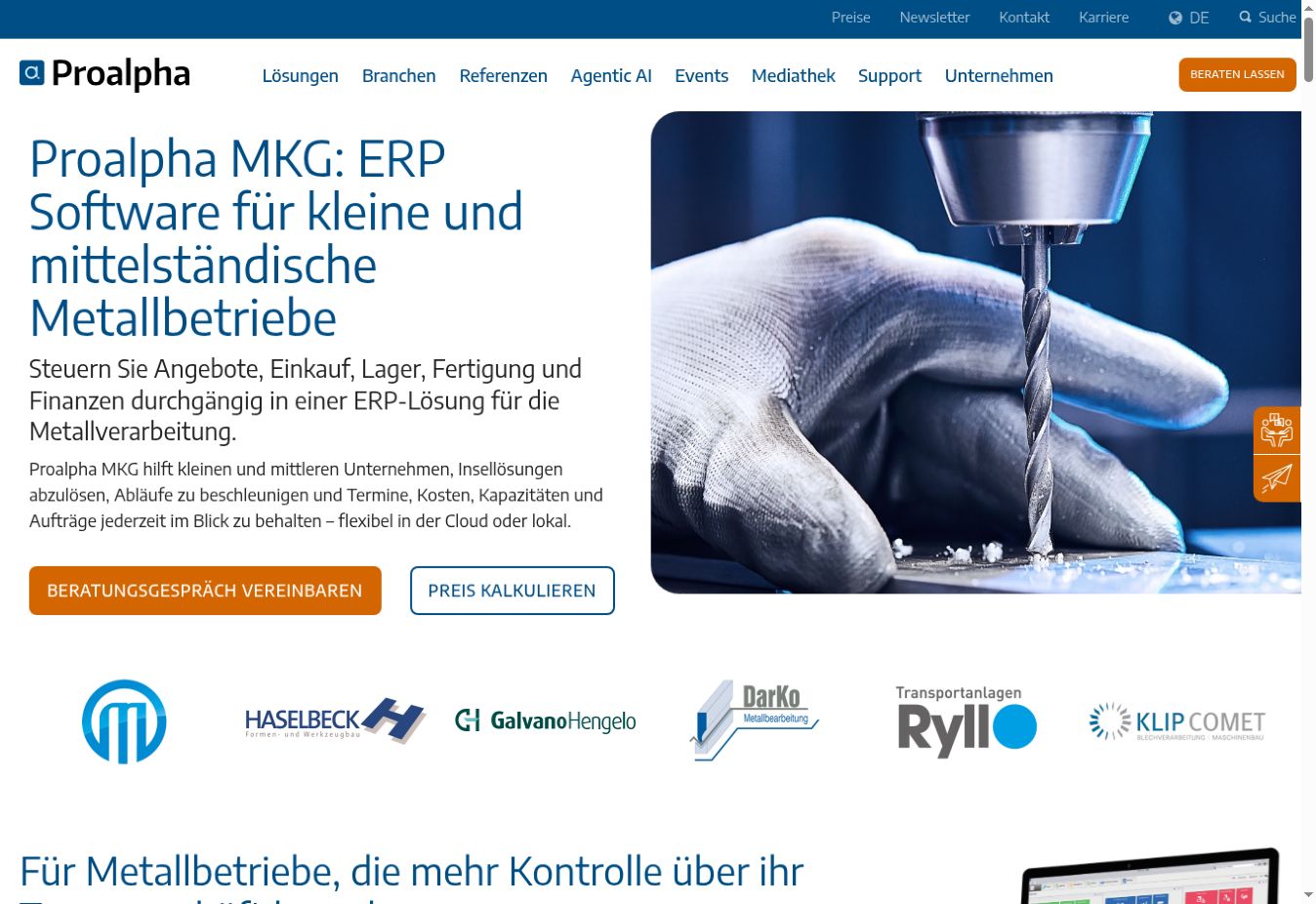
Proalpha MKG is a particularly relevant name for this audience because its official positioning explicitly includes small and medium-sized metal businesses. Machining, sheet-metal work, welding and toolmaking are among the examples. That is a closer starting point for a small German metal shop than a broad enterprise ERP label.
The product brings commercial and production processes together, with attention to costs and capacities. For a subcontractor, the decision often turns on whether an estimate remains understandable after material prices change, an operation runs late or another supplier performs part of the job.
Ask for a demonstration built around one quoted metal part: material, setup time, processing, outside treatment and final costing. Then request a project quotation identifying the precise MKG package and German support arrangements. Its industry focus is the reason to compare it, but also a boundary: a food producer or a business with unrelated manufacturing requirements should not assume the metalworking fit transfers. Confirm accounting connections and data-export arrangements before committing.
10. APplus
Best for: Manufacturers combining production, projects and after-sales work.
APplus addresses hybrid manufacturing, where production, project activity and service can overlap. This is relevant to a smaller machine builder that makes equipment, installs it and continues to maintain it. A production-only comparison may overlook the information that needs to survive after delivery.
The useful question is whether the business can follow the same customer order across those stages. Ask the supplier to demonstrate how a changed component affects the build, the delivered configuration and a later service requirement. Include your purchasing and finance colleagues in that session.
APplus should be a conditional shortlist entry for a small firm: its broader scope is valuable when the business needs it, but the project must remain manageable. Request a phased proposal separating essential production work from later service or optimisation features. Agree who owns product structures and engineering changes. Evaluate the actual German implementation team and its availability, rather than treating a sophisticated demonstration as proof of a straightforward rollout.
11. ams.erp
Best for: Engineer-to-order and one-off machine or plant builders.
ams.erp is designed around order-based manufacturing, including production that proceeds while engineering is still developing the design. This makes it a distinct candidate for small specialist machine builders, where buying long-lead components before every drawing is complete can be normal work.
A conventional finished bill of materials may be an unrealistic starting assumption for such a company. The demonstration should therefore begin with an incomplete project, then introduce a design change after purchasing has started. Ask how commitments, outstanding engineering work and expected costs remain visible.
The product’s emphasis is less compelling if the factory repeats a few stable assemblies and has little project complexity. For a relevant business, obtain a quotation that includes the interfaces to engineering systems and the required project-accounting scope. Confirm which team maintains those interfaces and supports users in German. The selection case rests on handling engineering change and commercial consequences together, not on collecting the largest possible feature list.
12. oxaion ERP
Best for: Variant-rich and machinery manufacturers needing connected PPS.
oxaion’s production planning and control material covers one-off, variant and series manufacturing. It describes an integrated variant generator that can support costing during quotation. That makes it worth exploring where salespeople configure products and production must receive a workable specification.
The potential benefit is avoiding repeated manual reconstruction of a customer’s choices. However, a configurator is only useful when its rules match what the factory can build. Bring a valid configuration and an impossible one to the demonstration, then inspect the resulting materials, operations and estimate.
For a small company, rule maintenance is part of the ownership cost. Establish who updates options when engineering changes a component or a supplier withdraws an item. Request a proposal covering PPS, the required configuration functions and interfaces rather than a platform-only figure. oxaion’s German business presence is relevant to local evaluation, but partner capacity, support commitments and the proposed delivery scope still need direct confirmation.
13. PSIpenta/ERP
Best for: Growing factories with demanding material and capacity coordination.
PSIpenta/ERP deserves a place on the longlist when production complexity is the main problem. PSI’s production module describes planning from bottleneck materials and capacity at a broad level through detailed planning, production orders, bills of materials and routings.
That depth can matter in a small but technically demanding factory. Headcount alone is a poor guide: a specialist supplier with tight capacity constraints may have harder planning problems than a larger business doing simple assembly. Conversely, sophisticated scheduling is not automatically worth its implementation burden.
Ask PSI to demonstrate a realistic capacity conflict and the consequences for delivery dates, then identify which functions belong to ERP and which depend on additional shop-floor or planning components. Obtain a phased, fully scoped quotation. Include the effort to maintain calendars, operation times and actual production feedback. This is a conditional option for complex requirements, rather than the default starting point for a very small workshop replacing basic invoicing software.
14. Monitor ERP
Best for: Manufacturers wanting a production-centred operational system.
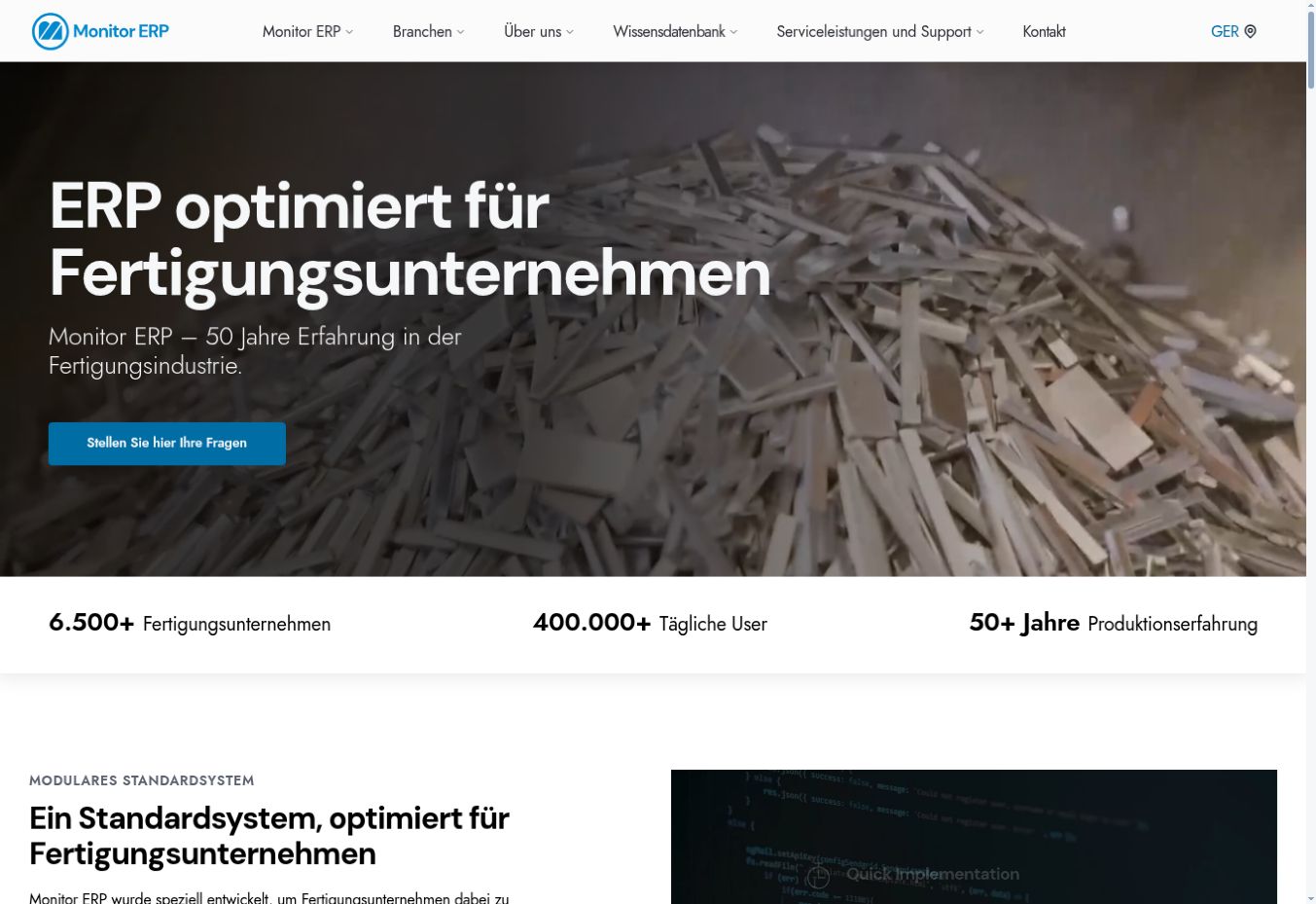
Monitor ERP is focused on manufacturing. Its production documentation covers product structures, costing, production orders, subcontracting, loading, reporting and work-centre calendars. That gives a manufacturing team several concrete areas to compare without beginning from a purely finance-led shortlist.
The company lists Germany among its markets with local representation. A German buyer should still establish the contracting entity, implementation resources and support arrangements for its particular project. Local presence does not answer every localisation question.
Use a job with an outside operation and a partial completion to test material ownership, capacity and actual costs. Then have finance inspect the German accounting workflow, adviser handoff and required electronic documents. Request a quotation that identifies all necessary modules and integrations. The reason to consider Monitor is its manufacturing focus; the decision should depend on whether its standard workflows fit the factory closely enough to avoid an expensive layer of bespoke changes.
15. microtech ERP with Produktion & Fertigung
Best for: Small producers connecting Warenwirtschaft with production.
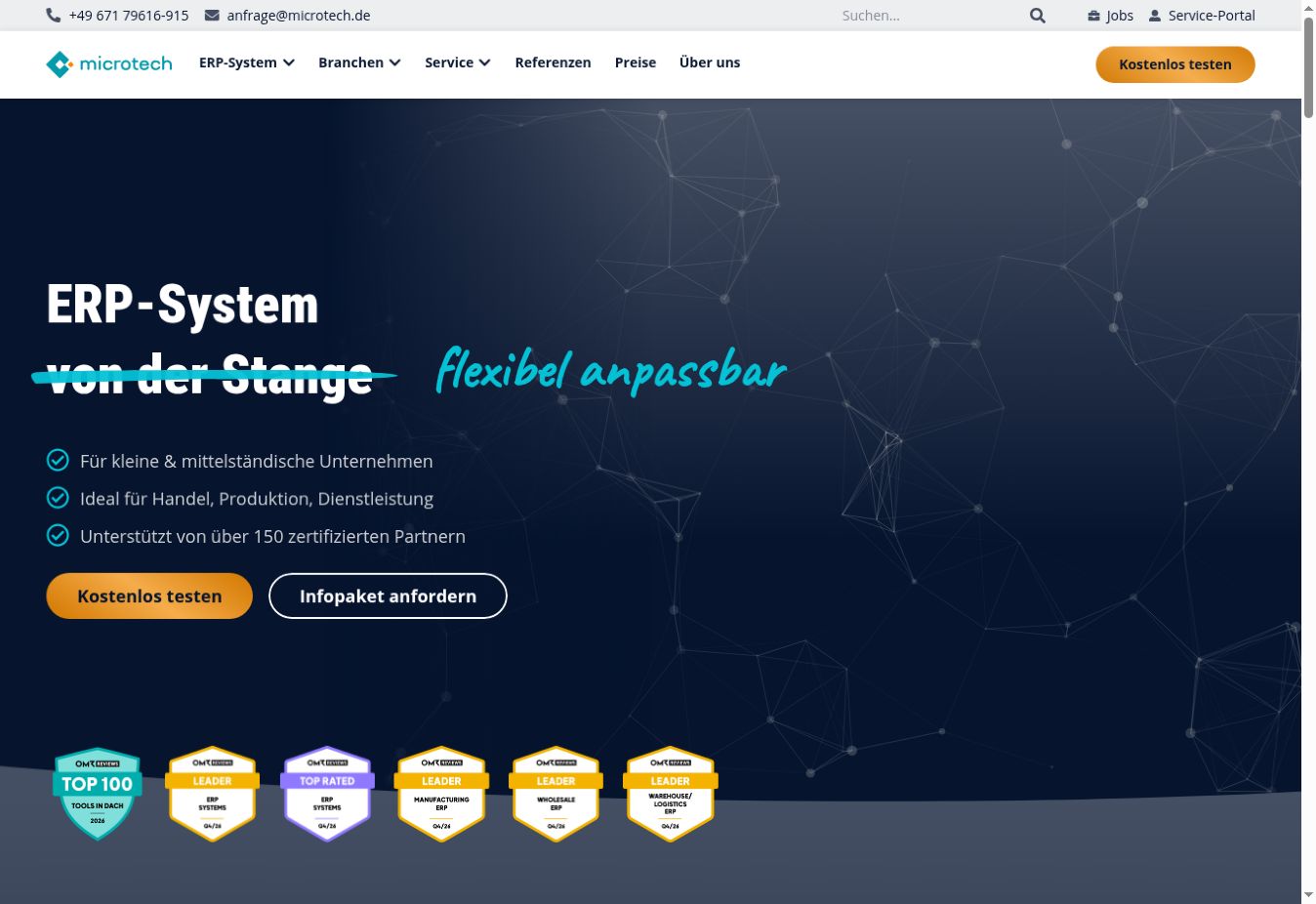
microtech ERP is the current name used for the product previously known as büro+. It should be counted once, not presented as two competing platforms. Its modular approach combines Warenwirtschaft with optional functions including production, logistics and accounting.
The official production documentation describes the Produktion & Fertigung add-on and its relationship to eligible Core or Enterprise editions. Resource requirements are built around production structures, making the exact base-plus-module combination important when comparing proposals.
This is a practical candidate for a business whose commercial processes and relatively contained production requirements need to come together. Ask the supplier to show a multistep order with a shortage, actual time and a stock correction, using the specific edition being quoted. More demanding planning requirements deserve an explicit demonstration. Include accounting connections, installation or hosting, operator access and ongoing support in the cost comparison. Avoid using a legacy büro+ price or a base ERP figure as the cost of a complete manufacturing deployment.
German requirements to verify before choosing a supplier
Start with the invoice lifecycle. The Federal Ministry of Finance’s e-invoice FAQ explains Germany’s domestic B2B rules and exceptions. Businesses have needed to be able to receive e-invoices since January 2025. General issuance transition arrangements run through 2026; issuers with prior-year turnover up to €800,000 have an extension through 2027, and a separate EDI transition also applies. A plain PDF is not a structured e-invoice. Ask the tax adviser which rules apply to the company and test the required XRechnung or qualifying ZUGFeRD workflow, including receipt, validation and retention.
Then involve the Steuerberater. Agree the chart of accounts, posting responsibility, DATEV handoff if used, attachments and reconciliation. A successful export button is insufficient if the adviser cannot import the result and trace the documents. Test credits, partial deliveries and foreign-currency transactions that the business actually uses.
For cloud or outsourced processing of personal data, examine the processing agreement, subprocessors and technical safeguards. The BfDI’s GDPR guidance explains the Article 28 framework. German hosting alone does not settle every data-protection question. Ask about support access, backups, recovery tests and complete data export. Have the responsible adviser review the arrangements that apply to your business.
Use one realistic order to compare all demonstrations
Give each shortlisted supplier the same anonymised job: a multilevel bill of materials, an outsourced step, one delayed component, partial completion and a customer change. Ask the supplier to identify what is standard, configured, extended or still to be developed. This creates a comparable record of scope instead of a competition between polished presentations.
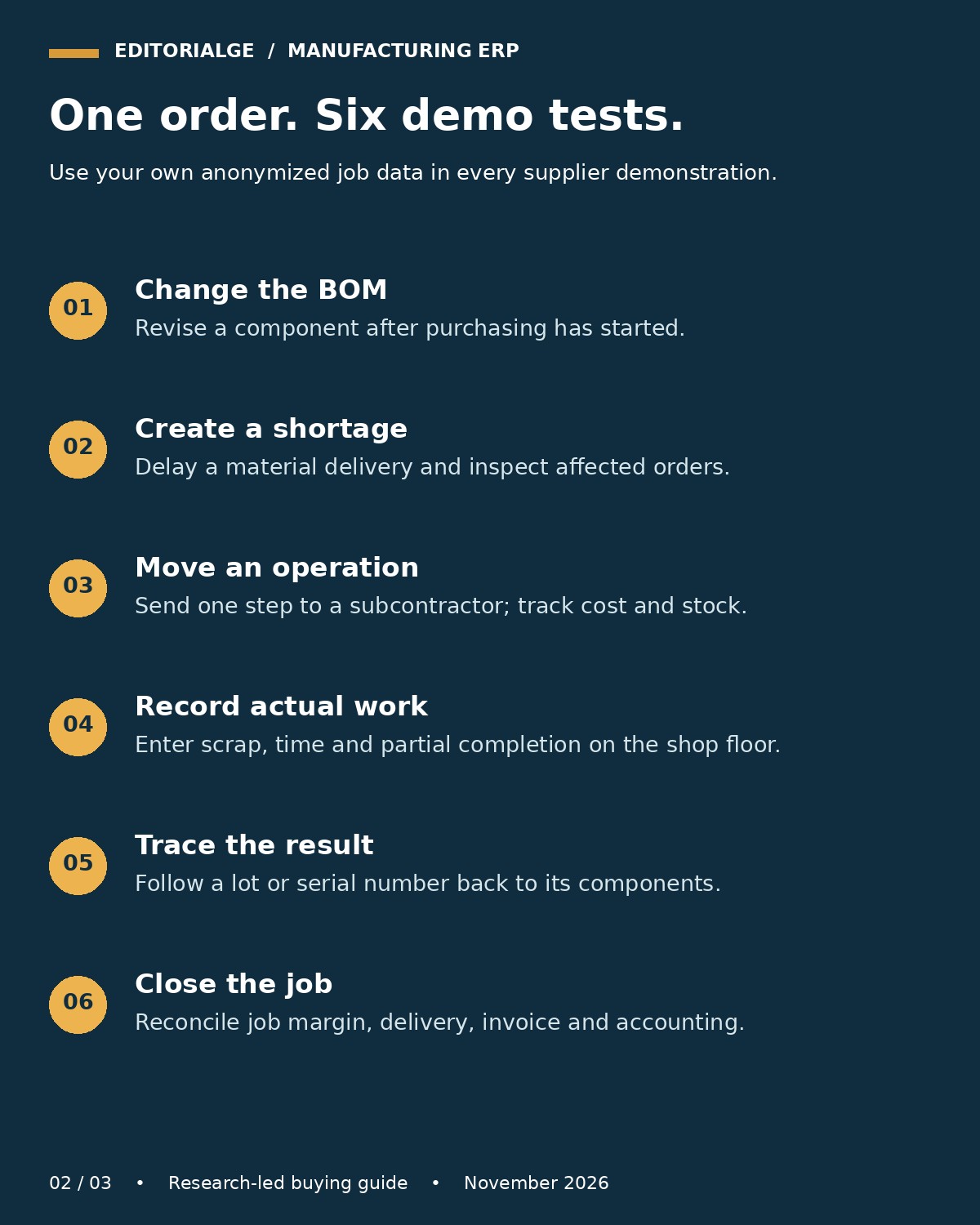
Record the result of each test as demonstrated, partly demonstrated or not demonstrated. Save the version, module list and unresolved question. These are proposed buyer tests, not results we obtained from the vendors. A missing critical capability should stop the shortlist progressing until there is a credible, priced solution.
Keep integration decisions tied to the process. Our guide to choosing a business automation approach explains when native rules, APIs and other methods serve different needs. For ERP, the practical issue is who owns a failed transaction and how staff recover it.
Compare three-year ownership cost, not a headline subscription
Ask every supplier to price the same users, sites, modules, interfaces and service expectations over three years. Separate recurring fees from one-off delivery work and your own staff time. Request the renewal basis, minimum commitment, change-request rate and exit costs. The Business Central and Sage figures above are reference prices with different inclusions, so they should not be used as a direct cost ranking.
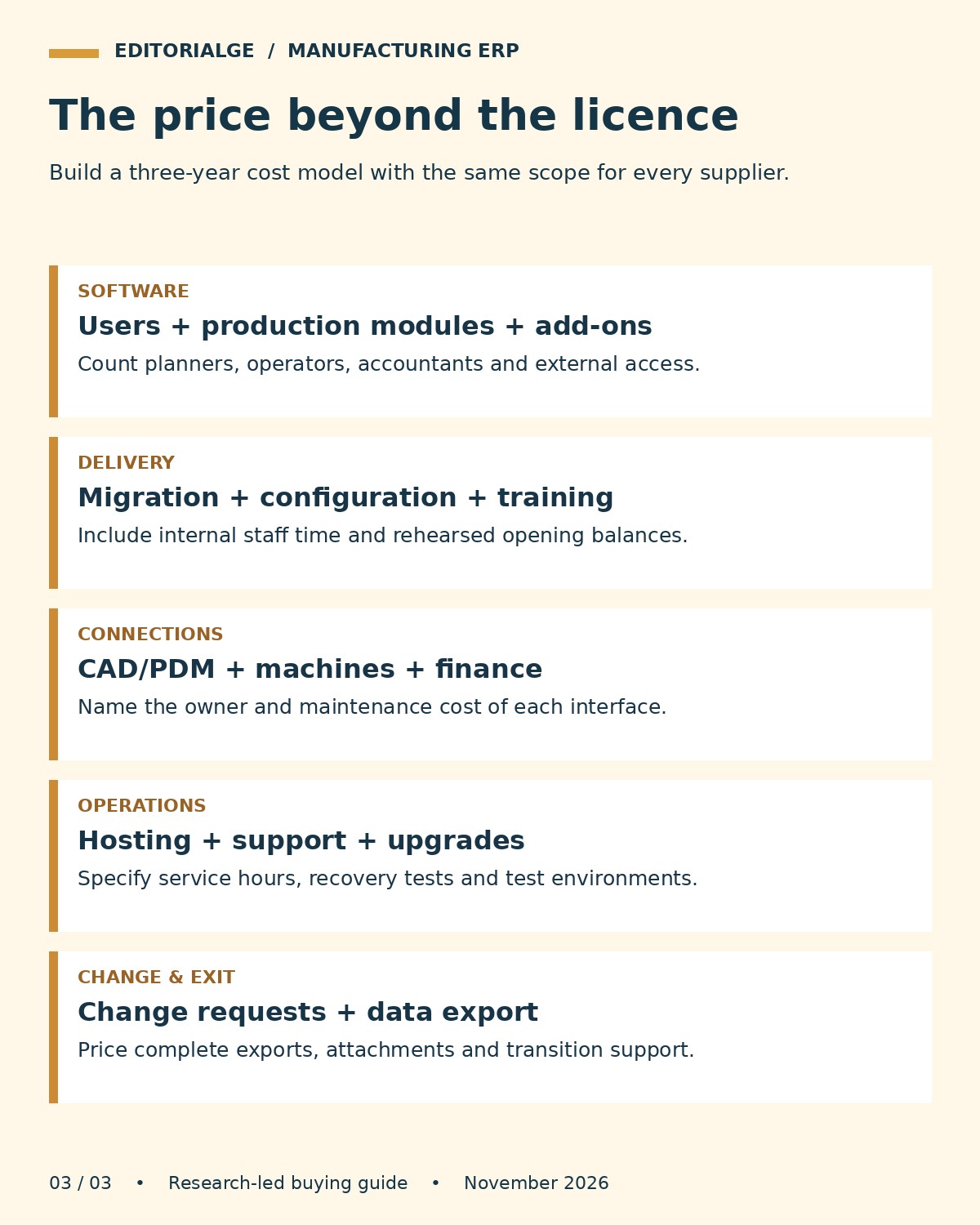
A usable model is: one-off implementation and migration, plus three years of software and operating charges, plus internal project effort and an explicitly documented allowance for agreed changes. Include hardware where needed. Add contingency based on unresolved scope rather than assuming every ERP project requires the same percentage.
Compare deployment responsibilities as well as fees. Our overview of cloud ERP and traditional systems provides background; for this purchase, obtain a written responsibility matrix for infrastructure, updates, security, backups and recovery. Cloud delivery reduces some local tasks but does not remove process ownership.
A manageable shortlist and rollout plan
Choose three credible candidates after the first scope discussion. Give each the same demonstration brief, then investigate the implementation team and a relevant reference. Ask that reference about master-data cleanup, training, change requests and support after go-live. Their experience is more useful when their production pattern resembles yours.
Before signing, name internal owners for items, bills of materials, routings, stock and finance. Rehearse migration and reconcile opening balances. Pilot a bounded product family or process where practical, with agreed acceptance criteria and a recovery plan. Avoid buying future complexity before the business can operate the essentials reliably.
Frequently asked questions
What is the best ERP for a small manufacturer in Germany?
There is no universal winner. Match production type first, then verify German finance requirements, partner capability and the total implementation scope. Proalpha MKG merits attention for metal shops; broader ERP suites and engineering specialists serve different needs.
Is Microsoft Business Central Essentials enough for manufacturing?
Microsoft places manufacturing in Business Central Premium. A proposal based on Essentials should explain any alternative manufacturing extension and its licence, support and upgrade implications.
Can an ERP replace MES or advanced scheduling software?
Sometimes the ERP covers the required shop-floor work, but do not assume it replaces every manufacturing execution system or planning tool. Demonstrate machine integration, operator feedback and scheduling at the detail your factory needs, and price any additional components.
Does German localisation guarantee compliance?
No. Configuration, procedures, contracts and the way staff use the system also matter. Have the tax adviser and relevant data-protection specialist review the proposed workflows rather than relying on a product label.
Should every manufacturer buy the cheapest cloud plan?
No. Compare the configured production scope and three-year ownership cost. A low starting subscription can exclude modules, migration, interfaces or services that the factory requires.
Choose the system that can handle your real production order
The most useful comparison of ERP Platforms for German Small Manufacturers is a documented test of the factory’s work. Select a few candidates suited to the production model, verify the German finance and support requirements, and compare complete proposals. The right choice is the system your team can implement, maintain and use to explain what happened to an order—from its first estimate to its final margin.