

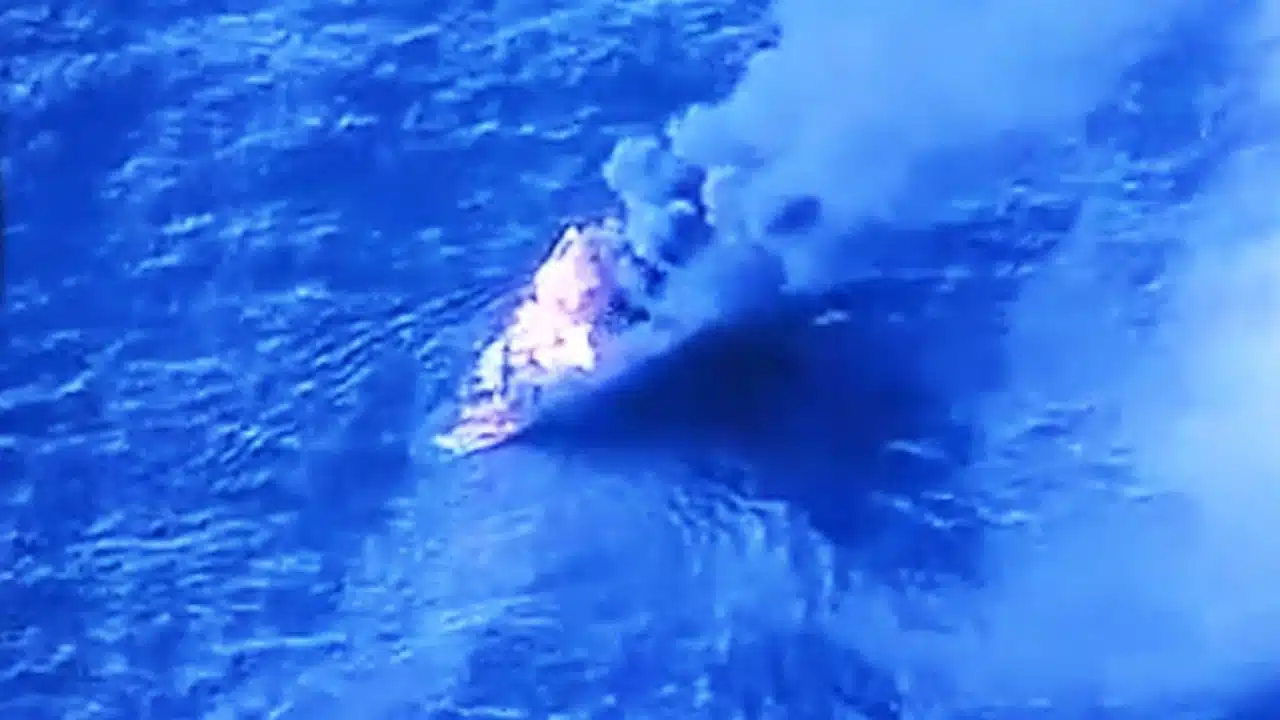
The United States military conducted a deadly strike on a small vessel in international waters near Venezuela on Friday, October 3, 2025, killing four people. U.S. officials allege the boat was trafficking narcotics and operated by “narco-terrorists,” marking the latest and fourth fatal incident in an escalating and legally contentious anti-drug campaign in the Caribbean that has now claimed a total of 21 lives.
The operation was confirmed by Secretary of War Pete Hegseth in a social media post, which included a video showing a small boat exploding into flames. Hegseth stated the strike was ordered by President Donald Trump and that U.S. intelligence “without a doubt, confirmed that this vessel was trafficking narcotics, the people onboard were narco-terrorists, and they were operating on a known narco-trafficking transit route.” President Trump, in his own social media post, claimed the boat was “loaded with enough drugs to kill 25 TO 50 THOUSAND PEOPLE.”
However, the administration has not publicly released any evidence to substantiate these claims, including the type and quantity of narcotics, or the specific affiliations of the deceased. This lack of transparency has fueled growing criticism from international bodies, human rights organizations, and legal experts who question the legality of using lethal military force in what have traditionally been law enforcement operations.
A New Front in the War on Drugs
This series of deadly maritime strikes represents a significant shift in U.S. counter-narcotics strategy. The operations are part of a major U.S. military buildup in the southern Caribbean, which includes the deployment of multiple Navy warships, thousands of sailors and Marines, and advanced surveillance aircraft.
The legal foundation for these actions was laid out in a confidential notice to the U.S. Congress, revealed in early October 2025. In it, the Trump administration asserted it is engaged in a “non-international armed conflict” with certain drug cartels that it has designated as Foreign Terrorist Organizations. This classification allows the administration to treat alleged drug traffickers not as criminal suspects, but as enemy combatants who can be targeted with lethal force under the laws of armed conflict.
The October 3rd Strike
Details on the specific military asset used in the Friday strike remain undisclosed. The Department of Defense and U.S. Southern Command have refrained from providing operational details, referring press inquiries to Secretary Hegseth’s social media announcements.
The identities and nationalities of the four individuals killed have not been released. The U.S. administration has labeled them “narco-terrorists” but has not specified which designated terrorist organization they were allegedly affiliated with. This follows a pattern from the previous strikes in September, where U.S. officials made claims of cartel membership without presenting public evidence.
Official Responses & International Condemnation
The Venezuelan government has vehemently protested the increased U.S. military presence and the series of strikes. On Thursday, October 2, 2025, Venezuelan Defense Minister Vladimir Padrino López denounced the presence of U.S. combat aircraft near its coast as a “great threat” and “military harassment.” While Caracas has condemned the overall U.S. posture, a specific official statement on the four deaths from the October 3rd strike is still forthcoming.
International condemnation has been pointed. Following the September strikes, United Nations human rights experts issued a forceful statement.
“International law does not allow governments to simply murder alleged drug traffickers… The use of potentially lethal force is only permitted in personal self-defence or defence of others against an imminent threat to life.” — UN Experts, Office of the High Commissioner for Human Rights, September 16, 2025.
Human rights organizations have echoed these concerns. Human Rights Watch labeled the previous strikes “unlawful extrajudicial killings,” arguing that the situation does not meet the criteria for an armed conflict and that law enforcement standards, which prioritize arrest, should apply.
A Legally Contentious Doctrine
Legal scholars have raised serious questions about the validity of the administration’s “armed conflict” designation. Geoffrey S. Corn, a former U.S. Army lawyer and an expert on the law of war, told The New York Times that “selling a dangerous product is different from an armed attack,” suggesting the legal basis for treating drug trafficking as an act of war is dubious.
Critics argue that this new doctrine circumvents international human rights law, which guarantees a right to life and due process. By bypassing traditional law enforcement methods of interdiction and arrest, the U.S. is setting a dangerous precedent for the use of military force against civilians.
Timeline of Recent U.S. Strikes in the Caribbean
- September 2, 2025: U.S. military strikes a boat, killing 11 people. The Trump administration claims they were members of the Tren de Aragua gang.
- September 15, 2025: A second strike targets a vessel, resulting in three fatalities.
- September 19, 2025: A third incident leaves another three individuals dead.
- October 3, 2025: The latest strike kills four people on a small boat.
What to Watch Next
The key issue moving forward is whether the U.S. administration will provide evidence to support its claims or continue to rely on a legal framework that is being heavily contested. Congress, which received the notification of the “armed conflict,” may hold hearings or demand further justification for the use of military funds and personnel in these operations. The continued silence from the Pentagon on operational details is also a point of contention that will be monitored by journalists and lawmakers.
Furthermore, the reaction of other Latin American and Caribbean nations will be critical. While some may quietly support tougher anti-drug measures, the unilateral use of lethal military force by the U.S. could destabilize regional relations and provoke further confrontation.
The October 3rd strike that killed four individuals off the Venezuelan coast is a stark escalation in a new and aggressive U.S. counter-narcotics policy. By declaring an “armed conflict” with cartels, the Trump administration has authorized the military to use lethal force in situations previously handled by law enforcement. This approach, carried out with minimal transparency and without public presentation of evidence, is raising profound legal and ethical questions at home and abroad, and is dangerously heightening tensions in an already volatile region.





















