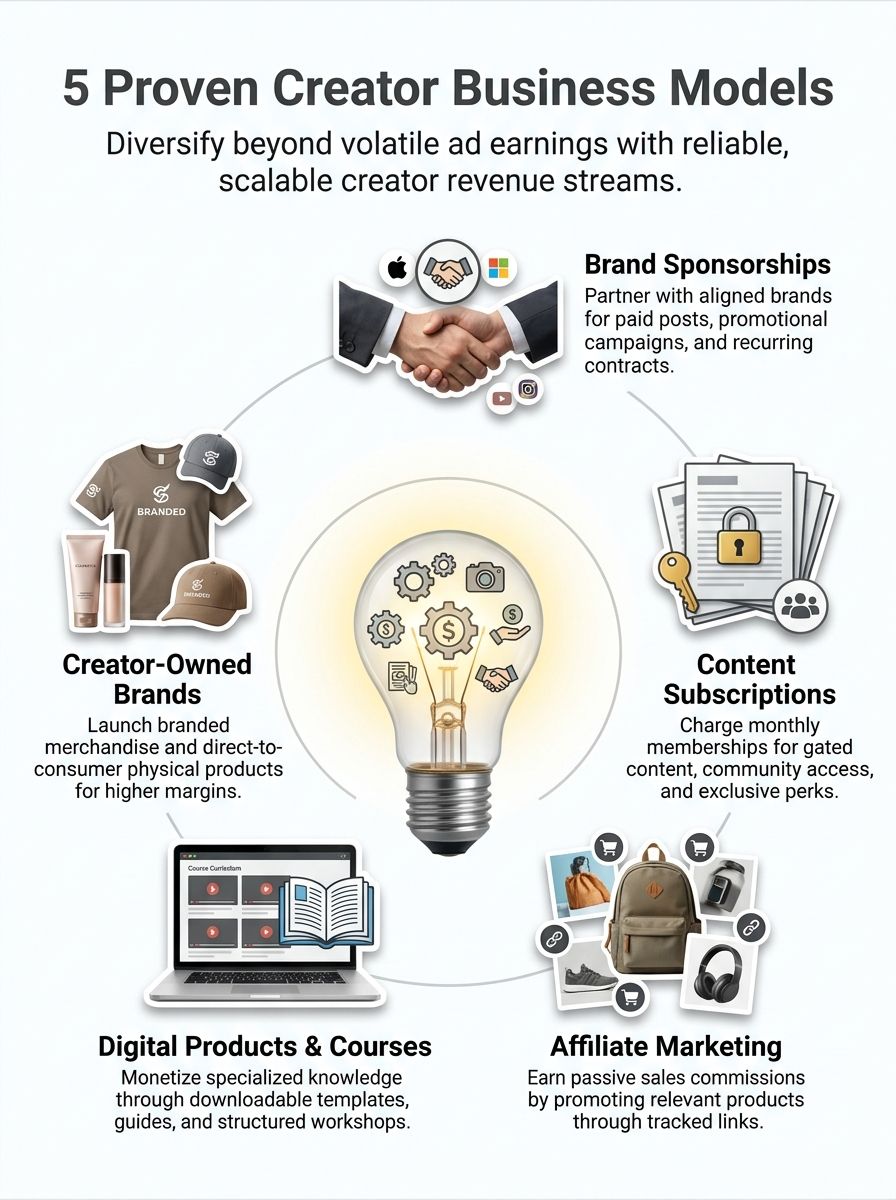
Have you ever looked at a great month of views and still wondered how you will pay next month’s bills? The 5 Creator Business Models give you a way to build income that does not depend on one viral post, one platform, or one sponsor.
The simple shift is to treat your content as the start of a business strategy. Your videos, posts, newsletter, and community can lead to brand partnerships, subscription services, affiliate marketing, digital content, online courses, and e-commerce sales.
Pick one model that fits what your readers already ask for, test it on a small scale, and build from there.
Creator Business Models 1: Brand Sponsorships
Brand sponsorships pay you to feature a product, service, or campaign in content your audience already enjoys. They can bring in meaningful revenue, but the best deals feel like useful recommendations rather than a sudden change in your voice.
There is real demand for strong creator partnerships. The IAB projected U.S. creator advertising spend at $43.9 billion for 2026, so brands are spending more, while also looking harder at reporting, audience fit, and measurable results.
Partnering with brands for promotions
Start with brands your readers would recognize as a logical fit. A budget creator can pitch a budgeting app, a home cook can pitch kitchen tools, and a fitness creator can pitch equipment they already use.
Your pitch should answer four questions quickly: who you reach, what you will make, when it will go live, and how you will report results. Include audience location, average views or opens, engagement, content format, and a clear call to action.
- Offer a focused package: Pitch one short video, one story set, and one follow-up post instead of a long list of vague deliverables.
- Set usage rights in writing: A brand may want to repost your content or run it as an ad. Price that permission separately from the cost to create the post.
- Ask for payment timing: Put the payment date, late-payment terms, revision limit, and cancellation terms in your agreement before filming.
- Report the results: Share reach, views, clicks, saves, comments, sales, and promo-code uses in a one-page recap.
A repeat sponsor is usually more useful than a one-off deal because you spend less time prospecting. Keep a simple spreadsheet with the contact name, campaign date, deliverables, results, payment date, and next follow-up date.
Sponsored content works best when the product solves a problem your audience already has. Build the product into a tutorial, comparison, routine, or honest review, rather than forcing it into unrelated content.
The Federal Trade Commission says paid relationships must be clear and easy for people to notice. Put a plain disclosure such as “ad” or “paid partnership” near the endorsement, and say it in the video when the promotion appears.
- Choose one campaign goal: Ask whether the brand wants awareness, email sign-ups, app installs, or sales. Your creative idea should match that goal.
- Protect your voice: Agree on the required talking points, then write the script in language your readers expect from you.
- Use a unique code or landing page: This gives the brand a cleaner way to connect your work to results.
- Save proof of performance: Take screenshots of analytics before platform data expires, then add the results to your media kit.
- Pitch a second campaign: After sending the report, suggest a fresh angle for the next month instead of waiting for the brand to contact you.
Do not accept a product-only deal if the brand expects polished content, broad usage rights, or exclusivity. Free products can make sense for a simple test, but real production work deserves a clear value exchange.
Creator Business Model 2: Content Subscriptions
A subscription turns your most engaged readers into recurring customers. Instead of chasing a new sale every week, you give members a reason to stay through useful, reliable digital content.
This model works best when your paid offer saves time, provides access, or gives members a closer connection to your work. Think bonus tutorials, practical templates, early access, private discussions, or live office hours.
Platforms like Patreon or Substack
Patreon works well for creators who want membership tiers, community chats, native video, and livestreams in one place. Substack suits writers, podcasters, and video creators who want email delivery, paid posts, podcast hosting, and subscriber tools.
As of November 2026, Substack lists a minimum paid subscription price of $5 per month or $30 per year. That makes a low-priced tier a practical way to test whether readers will pay before you build a larger member library.
| Platform | Best fit | Useful starting offer |
|---|---|---|
| Patreon | Creators building a member community | Bonus posts, member chats, livestreams, and tiered perks |
| Substack | Writers, podcasters, and educators | Paid newsletter, private podcast, downloadable resource, or live session |
Keep your first subscription offer small and repeatable. One members-only post each week and one live question-and-answer session each month is easier to maintain than promising daily extras you cannot keep up with.
Exclusive content for paying subscribers
Paid content needs a clear difference from your free work. Your public posts can attract new readers, while your paid tier can give them the tool, process, feedback, or access that helps them act.
Substack’s Subscriber Perks feature can give paying readers digital downloads, promotional codes, or access to live videos. That means you can add value without producing a full extra article or video every week.
- Entry tier: Offer early access, one bonus post, or a monthly resource.
- Middle tier: Add live question-and-answer sessions, member polls, or deeper tutorials.
- Premium tier: Limit this to a small group and offer feedback, office hours, or a group workshop.
- Annual option: Give committed members a modest discount or a useful bonus download.
A guild-style community can be a real reason to stay, but do not make access your only perk. Give people something useful they can save, apply, or revisit.
Creator Business Model 3: Affiliate Marketing
Affiliate marketing pays you a commission when a reader buys through your tracked recommendation. It can work alongside almost every other creator business model because you are helping people choose products they already need.
The strongest affiliate content starts with a real question from your audience. “Which microphone should I buy?” or “How do I organize my freelance invoices?” gives you a better starting point than a random product roundup.
Promoting products through affiliate links
Choose products you have used, tested, or researched deeply enough to explain who should buy them and who should skip them. Your credibility matters more than squeezing several links into every post.
Amazon Associates is one option for product recommendations, while direct brand programs can work well for software, courses, and niche tools. Amazon’s program requires affiliates to identify themselves clearly and disclose the relationship near affiliate links.
- Match the offer to intent: Put a product link in a buying guide, tutorial, or comparison where readers are already looking for help.
- Use plain disclosures: Tell readers you may earn a commission before they click, using language they can understand quickly.
- Recommend fewer products: One well-explained pick can feel more useful than a page full of choices.
- Show the product in use: A short demo, before-and-after example, or setup guide gives readers context before they buy.
- Track the source: Compare clicks and sales from your newsletter, video descriptions, blog posts, and social posts.
Affiliate links belong near the helpful part of the content, not buried after a long sign-off. Put the recommendation after you explain the problem, then give the reader a clear reason to consider it.
Earning commissions on sales
Affiliate income rises when your content keeps helping readers after publication. A searchable tutorial, a resource page, or an on-demand video can continue sending qualified readers to a product long after you post it.
Do not treat commission rates as the only deciding factor. A smaller commission from a product that fits your audience and has a strong reputation can beat a high commission from something your readers do not trust.
| Content type | Best affiliate use | Reader benefit |
|---|---|---|
| How-to tutorial | Link the tool used in each step | Readers can copy the process without hunting for products |
| Product comparison | Explain who each option serves | Readers get help making a confident choice |
| Resource page | List tools you use repeatedly | Readers can find trusted recommendations in one place |
Review your links every few months. Prices, availability, features, and program rules can change, and a broken or outdated recommendation can cost you trust.
Creator Business Model 4: Digital Products and Courses
Digital products let you package your knowledge into something readers can buy without waiting for a sponsor or a platform payout. A checklist, template, workbook, guide, or mini-course can solve one focused problem and create a new revenue stream.
This is also a strong place to test innovation. If readers repeatedly ask how you plan content, edit videos, train for a goal, or organize work, that repeated question may be the start of a product.
Selling eBooks, templates, or guides
Start with the smallest useful version of the answer. A one-page checklist, editable template, or short guide often gives you clearer feedback than spending months creating a huge eBook.
Teachable lets creators sell digital downloads on their own or bundle them with courses, memberships, and coaching. Use a small download as a freemium sample, then offer a fuller paid resource to people who want more support.
- Pick one painful task: Create a product that helps readers finish a job faster or avoid a common mistake.
- Make it easy to use: Add clear instructions, examples, and a quick-start page.
- Test the promise: Share the product idea with your email list or audience before building every extra page.
- Offer a simple bundle: Pair a guide with templates, checklists, or a short video walkthrough.
- Update what sells: Refresh screenshots, examples, and instructions when tools or platforms change.
Price the outcome, not the number of pages. A short template that saves a reader two hours can have more value than a long guide full of filler.
Offering online courses or workshops
Online courses work when readers need a sequence, not just a quick answer. Teach a result in stages, such as building a portfolio, cooking five weeknight meals, or starting a freelance service.
Teachable supports courses alongside memberships, coaching, and digital downloads, so you can start with a live workshop and turn the recordings, worksheets, and lessons into an on-demand offer later.
- Teach one outcome: A course should help students reach a specific finish line.
- Start live if you can: A small workshop lets you hear questions before recording polished lessons.
- Use an apprenticeship mindset: Show your process, give practice tasks, and explain how students can judge their own work.
- Build short lessons: Give students a clear action after each video instead of a long lecture.
- Plan support: State whether buyers get comments, group calls, office hours, or self-paced access only.
A marketplace can help people discover your course, but your own store gives you more control over pricing, customer relationships, and product bundles. Decide which matters more for your first launch.
Creator Business Model 5: Creator-Owned Brands
A creator-owned brand turns audience trust into products you control. That can mean merch, physical goods, a niche product line, or a store that pairs products with your digital content.
This model has more moving parts than a guide or affiliate link, so start with a small test. You need to know your product cost, shipping cost, platform fees, refund rate, and time required to support customers.
Launching branded merchandise or products
Good merch reflects the community, not just your logo. A useful water bottle, notebook, print, shirt, or digital accessory can work when it fits what your readers already care about.
Test a small limited drop before buying large inventory. Preorders or print-on-demand products can help you learn which design, size range, or price point gets real demand without filling your home with unsold boxes.
- Order samples: Check the material, print quality, packaging, and sizing before customers see the product.
- Use a product page that answers questions: Include dimensions, materials, shipping timing, care instructions, and return rules.
- Build a simple cost sheet: Add product cost, packaging, shipping, platform fees, payment fees, taxes, returns, and any ad spend.
- Launch with a story: Show why you made the item, how you use it, and who it is for.
- Collect buyer feedback: Ask what people liked, what confused them, and what product they want next.
For example, if an item costs $7 to make, $3 to pack and ship, and $1.50 in selling costs, your starting cost is $11.50 per order before advertising. At a $30 price, you have room to cover marketing and still see whether the product can support your business.
Building independent ecommerce businesses
An ecommerce business can grow beyond merch when you sell a focused product that solves a clear customer problem. Your content brings attention, while your store handles the transaction, product information, fulfillment, and customer support.
Shopify and WooCommerce can support a store you control, while Etsy gives sellers access to an established marketplace. Etsy currently charges a $0.20 listing fee, a 6.5% transaction fee, and U.S. payment processing fees of 3% plus $0.25 per order, so put those costs into your price before you launch.
| Store approach | Good for | Watch closely |
|---|---|---|
| Your own store | Building a long-term brand and email list | Traffic, fulfillment, support, and store setup |
| Marketplace | Testing a product where shoppers already browse | Fees, competition, platform rules, and less direct customer control |
| Preorder or limited drop | Measuring demand before a larger order | Clear delivery dates and customer updates |
Treat every launch as a small experiment. Track which product page, email, video, or social post led to sales, then put more effort into the channel that brings buyers who come back.
Final Thoughts
The Creator Business Models all solve the same problem: they give you more than one way to earn. Brand partnerships, subscriptions, affiliate marketing, digital products, online courses, and ecommerce each fit a different kind of audience and workload.
You do not need to launch everything at once.
Choose the revenue stream that matches what your readers already ask for, run a small test this week, and track what happens. A steady creator business grows through useful offers, honest promotion, and repeated improvements.