
You checked a flight, came back later, and the price had jumped. That is airline dynamic pricing at work. Now you’re deciding whether to book now or wait, and wondering if the airline is using what it knows about you to charge you more.
Airlines sort the seats on each flight into price levels, and software — more and more often AI — raises or lowers the fare in real time based on demand, seats left, time until the flight, and what other airlines charge. That kind of pricing follows timing and demand. Surveillance pricing is different, because it would set your price based on who you are.
This guide shows how the system works and why one seat’s price can change many times. It also separates what is shown about your personal data from what is only claimed. Last, it gives you booking moves, with numbers, that can help you pay less.
What Is Airline Dynamic Pricing?
This kind of pricing means changing ticket prices in real time based on current demand, remaining seats, and what competitors charge. The goal is simple. Airlines want to sell every seat at the highest price each passenger is willing to pay.
The idea is not new. US airlines started using yield management, an early form of this pricing, in the 1980s.
Older systems moved prices between a few set fare levels. Newer continuous pricing lets airlines fill in prices between those levels. That gives them finer control over each fare.
So the same seat on the same flight can cost different amounts. The price depends on when you buy and how the market looks at that moment.
How Airlines Set and Change Ticket Prices
A ticket price is not one number that the airline picks and leaves alone. It comes out of a few moving parts that work together.
Booking classes, or fare buckets
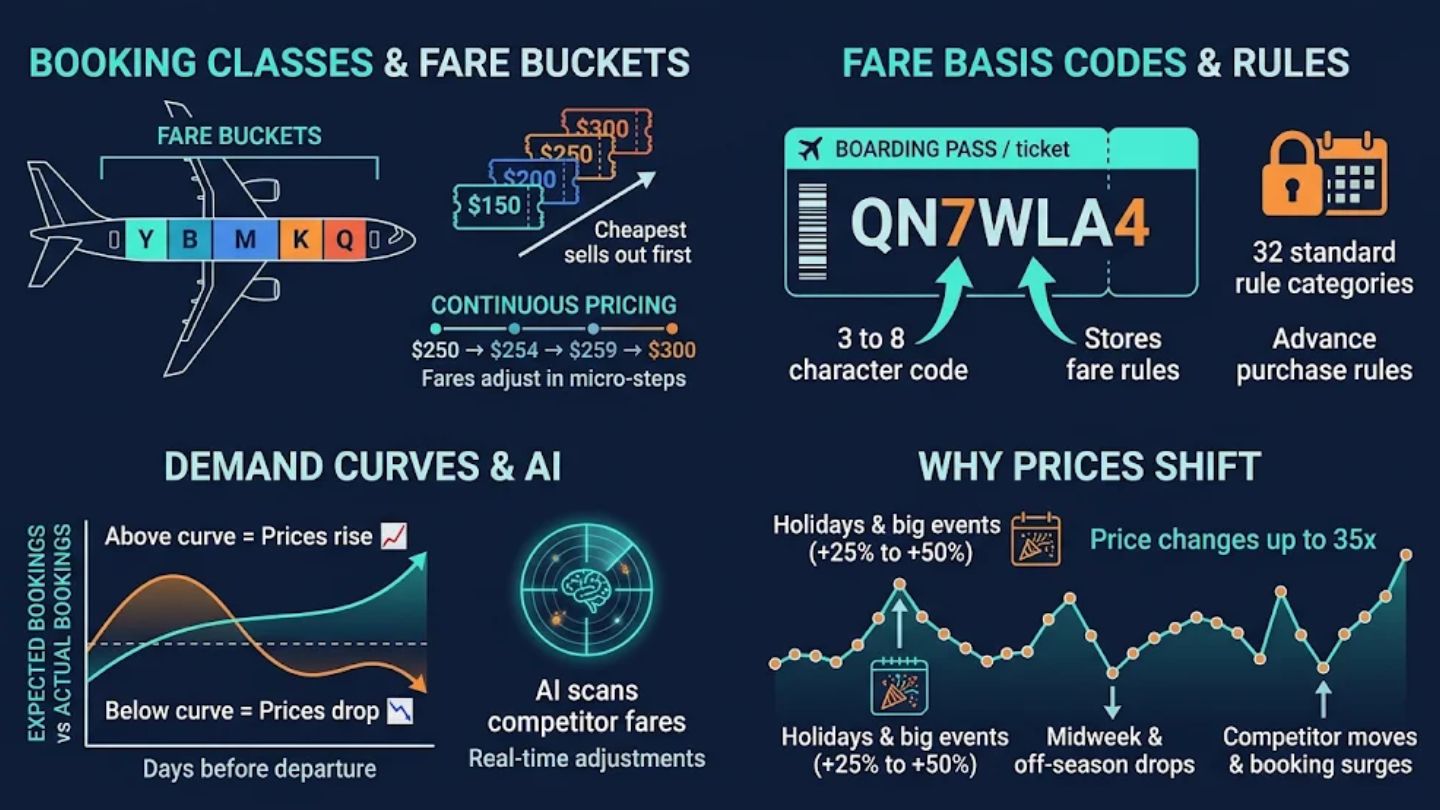
Airlines divide each plane into several booking classes. Each class has its own fare rules, limits, and price. Travelers often call these “fare buckets.”
A booking class is not a section of the cabin or a group of assigned seats. It is a fare category with a certain number of tickets the airline is willing to sell at that price. The airline can open, close, or resize these categories at any time.
Here is how they work:
- Each bucket has a limit. The cheapest buckets usually have the fewest tickets for sale.
- Cheap buckets close first. Once the low-price tickets sell out, the next bucket up becomes the lowest fare you can buy.
- Buckets can open again. If sales are slow, the system can make cheaper tickets available again to get people buying.
- Each class has a code. A reservation booking designator is the letter that shows which bucket your ticket came from.
Say the lowest open fare on your flight is $250. That bucket sells out, so the lowest fare you can buy becomes $300, even though nothing about the plane changed. A week later, bookings are weaker than the airline expected, so it opens cheaper tickets again and the fare drops.
Continuous pricing adds another layer. Instead of jumping only from $250 to $300, the system can offer amounts in between. That is why fares can shift in small steps, not just big jumps.
Fare basis codes and fare rules
Every fare comes with a short label called a fare basis code. It is 3 to 8 characters long and stores the fare’s conditions, like its booking class and how far ahead you must buy.
The rules behind each fare are sorted into 32 standard categories. These cover things like change limits and advance purchase rules. That is why two fares with the same price can come with very different rules.
Demand curves: ahead of plan or behind it
Airlines expect a certain number of seats to be sold at each point before departure. If bookings run ahead of that expected curve, the system raises prices. If bookings fall behind, the system can open cheaper buckets to catch up.
Airlines use AI to keep adjusting prices, and it tracks things like booking trends and competitor fares. When a rival drops its price on your route, your fare may follow.
Why one seat’s price changes so often
The fare-deal site Dollar Flight Club reports that a single seat’s price can change up to 35 times before the flight leaves. Treat that as a reported upper range, not a count every airline publishes.
Each change can come from a bucket closing, a burst of bookings, or a move by a competitor. So if you search on two different days and see two prices, nothing is broken. You are seeing the system work.
Holidays and big events
Holidays and major events can push prices up by 25% to 50%. Airlines can predict these spikes early, because the same weeks get busy year after year.
The flip side helps you. Fares for midweek or off-season travel tend to be lower, because airlines want to fill seats that would otherwise fly empty.
How AI, ATPCO, and Booking Systems Power Dynamic Airfares
Three kinds of tools sit behind the price you see. There is a fare database, the booking systems that sell fares, and the software that decides what to charge.
What ATPCO does, and what it does not do
ATPCO stands for Airline Tariff Publishing Company. It is a central database, started in 1945, where airlines publish their fares, rules, and pricing logic.
Airlines own it. Its owners include Delta, United, American, Lufthansa, and Air France-KLM.
The scale is huge. ATPCO works with more than 400 airlines and handles “306 million active fares in the market and over 12 million fare changes each day.”
Here is the key point many guides miss. ATPCO does not set prices. Airlines do.
ATPCO provides “the standardized technical framework that allows those prices to be sold worldwide.” Think of it as a shared bulletin board. Each airline posts its own fares there, and the rest of the travel world reads them.
Booking systems: GDSs and NDC
Once a fare is published, it reaches travel sites and agents through Global Distribution Systems, or GDSs. Companies like Sabre, Amadeus, and Travelport run the technology behind many of these systems.
A newer standard called NDC, short for New Distribution Capability, helps airlines send fares and offers out to booking sites. Work on it began in 2012.
NDC gives airlines another path to shape the offer a seller shows you. Using it does not, by itself, show that anyone is getting a personal price.
Where AI comes in
AI is the part that has made headlines. In December 2023, Delta’s president said the airline wanted AI to set 20% of all fares by the end of 2025. Treat that as a stated goal, not a measured result.
AI pricing tools look at many inputs at once. One AI pricing company, Fetcherr, describes its inputs as “factors like customer lifetime value, past purchase behaviors, and the real-time context of each booking inquiry.”
Some of those inputs are about the market. Others sound like they are about the customer. That gap is where the debate over your personal data begins.
Why Airlines Use Dynamic Pricing
An airline seat is “the most perishable product in the world.” You cannot store it or sell it tomorrow, and “its value drops to zero the moment the aircraft door closes.” An empty seat earns nothing, so airlines would rather sell it for less than fly it empty.
There is a second risk on the other side. If cheap fares sell out months ahead, the airline may miss travelers who would have paid more later.
Real-time pricing tries to balance those two risks. It protects higher-priced tickets when demand is strong and cuts prices when demand is weak.
Airlines track a number called the load factor, which is how full their planes are. Revenue management covers pricing, seat control, and demand forecasts. The aim is to keep planes full while earning as much as possible per seat.
For you, the takeaway is easy. A flight that sells fast tends to get pricier, and a slow one may open cheaper fares.
Do Airlines Use Your Personal Data to Set Prices?
This is the question behind the news reports about Delta. The honest answer is that the facts are not settled, and the public evidence is limited.
First, it helps to separate two ideas that often get mixed up.
Demand-based pricing vs. surveillance pricing
| Demand-based pricing | Personalized surveillance pricing | |
| What sets the price | Demand, seats left, timing, and rival fares | Data about you as a person |
| Who sees the same price | Market conditions rather than an individual’s profile; comparisons still require the same itinerary, fare conditions, channel, and time | Could differ from shopper to shopper |
| Goal | Sell each seat at the highest price the market will bear | Find “the maximum amount that you as an individual customer are willing to pay” |
| Is it shown for airlines? | Yes, US airlines have used yield management since the 1980s | Not shown in the evidence here; Delta denies it and critics raise questions |
A visiting scholar at Harvard’s Berkman Klein Center for Internet & Society describes surveillance pricing as using individual customers’ data as a main factor in the pricing formula.
What Delta says
Delta has drawn a firm line. As quoted by Georgetown Law, Delta said: “There is no fare product Delta has ever used, is testing or plans to use that targets customers with individualized prices.”
That is a denial of individualized fares. It does not spell out every kind of data its pricing tools may use.
What Georgetown Law says
Georgetown Law’s Institute for Technology Law & Policy questions how firm that line really is. Its concern rests on two points.
- The inputs being advertised. Fetcherr, an AI pricing company, lists “customer lifetime value” and “past purchase behaviors” among its inputs.
- Loyalty data is personal. As the institute puts it, “a frequent flyer number is still personal data that can be and is tied to one individual.”
Delta’s goal of AI setting 20% of fares is useful context. But using AI to set fares is not the same as setting a personal fare for you.
What the evidence does and does not show
- Shown: Airlines change prices based on demand, timing, seats left, and competitor fares.
- Shown: Signing out does not stop data collection.
- Denied: Delta says it does not use individualized fares.
- Questioned: Georgetown Law points to customer-focused AI inputs and loyalty data that can be tied to you.
- Not shown: The evidence here does not prove that any one traveler’s fare went up because of their personal data.
What Harvard experts say
Harvard Law School has covered the same issue. One expert there said things get uncomfortable when companies use personal data such as gender, shopping history, or search history.
Experts also point to an imbalance. “There is much more of what economists call ‘information inequality’ today.” The seller may know a lot about you, while you know little about how the price was set.
This tech is not brand new either. The Harvard Law School article says surveillance pricing technology has been around for roughly two decades.
Does incognito mode stop tracking?
No. Many travelers think a private window or a logged-out search will get them a “clean” price. But not signing in does not mean you are not being tracked, and companies still collect consumer data.
Dollar Flight Club says airlines use digital data such as your IP address, ZIP code, and network connection to adjust fares. That claim comes from a deal site, not from an airline or a regulator. Still, it shows why a private window alone is not a shield.
What regulators are doing
The government has started paying attention. In January 2025, the FTC published a surveillance pricing study and a request for information.
That shows regulators are looking at the practice across the market. On its own, the study date does not tell you what any one airline does with your data.
Experts admit the rules will be hard to write. One Harvard expert said it will be hard to craft laws that cover all of this, but that we need to try.
A new twist: AI shopping for you
There is also a new question coming. “Chatbots are becoming a huge thing, and as more people use AI agents to shop for them,” the old rules may not fit.
The Berkman Klein Center piece asks: “How can the law protect individuals when it’s no longer the individual doing the shopping?” For now, that is an open question, not a settled rule.
How to Pay Less When Fares Keep Changing
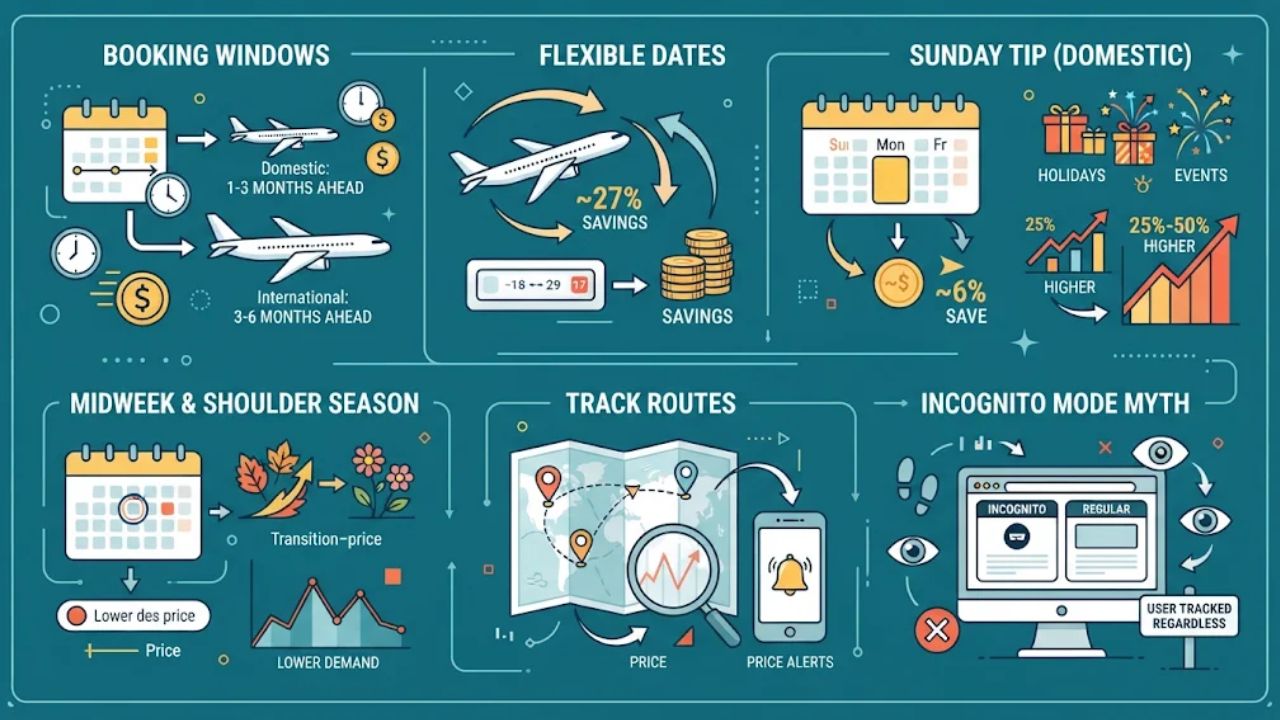
You can’t control the algorithm. But you can control when, how, and where you shop. The numbers below come from one fare-deal site, Dollar Flight Club, so treat them as averages and guides, not promises.
One quick note first. The day you buy and the day you fly are two different things, and each can change your price.
- Shop in a sensible window. For domestic flights, the site suggests booking 1 to 3 months ahead. For international trips, it suggests 3 to 6 months ahead. These are planning guides, not the perfect date for every route.
- Let your travel dates move. The site reports that flexible date tools save travelers about 27% on average. Shifting your trip by a day or two can land you on a cheaper fare.
- Know the Sunday tip and its limits. The site reports that buying domestic flights on a Sunday saves about 6% on average compared with Monday or Friday. That is an average, so don’t pass up a good fare just to wait for Sunday.
- Dodge holiday and event peaks. These can raise prices by 25% to 50%. If your plans allow, fly a few days before or after the rush.
- Fly midweek and in the shoulder season. Demand is lower on these days and in the weeks between peak and off-season, so cheaper fares are more likely to be open.
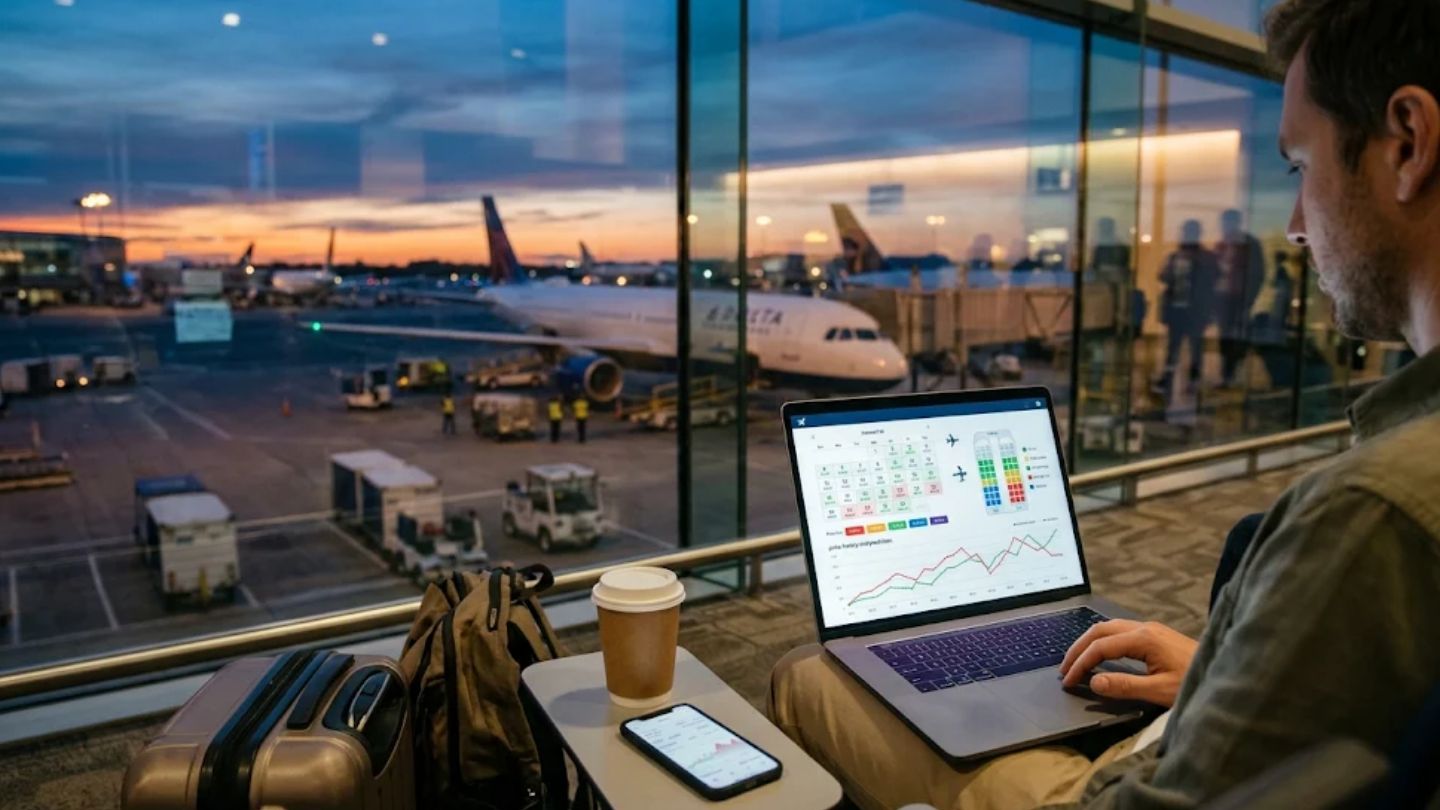
- Track one route over time. Fares can change many times before departure. Set a price alert so you can see what a normal price looks like on your route.
- Don’t count on incognito mode. Signed-out users are still tracked. Comparing the same search signed in and signed out, or on another device, is a simple check. It will not prove surveillance pricing or reliably lower your fare.
Here is a simple order to follow. First, compare nearby dates. Next, set an alert and watch the route for a bit.
Then judge the fare in front of you against your budget and the prices you have tracked. If bookings run ahead of plan, prices climb, so a fare that fits may not last.
Say you are flying domestic, you are 6 weeks out, and the fare is at the low end of what you have tracked. In that case, waiting is often a gamble against a system built to raise prices as seats fill.
The Bottom Line on Airline Dynamic Pricing
Airlines change fares in real time based on demand, seats left, and competition. Booking classes close as cheap tickets sell, AI tracks trends, and ATPCO helps share the fares. But airlines set the prices.
The bigger open question is personal data. Delta denies using individualized fares. Georgetown Law notes that a frequent flyer number is personal data tied to one person, and that some AI pricing tools list customer data as inputs.
What the public evidence does not show is that your own fare rose because of your data. Until regulators or the airlines share more, that part stays unproven.
The tactics above still help with the part that is proven. Shop in a sensible window, keep your dates flexible, avoid peak days, and track your route before you buy. These steps won’t guarantee the lowest fare, but they can help you pay less more often.
Frequently Asked Questions About Airline Dynamic Pricing
1. How do airlines use dynamic pricing to set ticket prices?
Airlines set fares based on demand, available seats, and time to departure, using filed fares submitted to the Airline Tariff Publishing Company (ATPCO). Pricing software like PROS Dynamic Offers then pulls from that data to show you a specific price.
2. What is price elasticity, and why does it matter for fares?
Price elasticity measures how much buying behavior shifts when a price changes. Business travelers tend to pay higher fares because their schedules are fixed, while leisure travelers use tools like Going to track price drops.
3. Do other businesses price things this way?
Yes. Lyft, Instacart, and Walmart have tested variable pricing, and even FIFA has used it for World Cup tickets, as Forbes reported.
4. Is dynamic pricing the same as price-fixing?
Price-fixing is illegal because it involves rival companies secretly agreeing to set prices together. With dynamic pricing, each airline adjusts its own fares independently based on demand.
5. Who studies airline pricing and its effects?
Data firms like OAG and IdeaWorks Company track airline fares and earnings, and their reports inform airport financial planning. Math professor Noah Giansiracusa authored “Robin Hood Math: Take Control of the Algorithms That Run Your Life.” The book draws on his research with the Berkman Klein Center for Internet & Society and aims to help shoppers understand pricing algorithms.