Japan-Founded SaaS Companies offer several routes to back-office modernization, from replacing scattered accounting spreadsheets to improving employee records, contract workflows and access controls. The useful question is which company’s software solves your next operational problem. This shortlist connects twelve Japanese-founded businesses with specific back-office use cases, explains where their products overlap, and identifies the work that still belongs to your team.
For accounting and related administration, start by comparing freee and Money Forward. For employee information and HR processes, consider SmartHR, HRBrain and Kaonavi. RAKUS, Sansan and LayerX address different parts of finance administration, while Cybozu, Bengo4.com, LegalOn Technologies and HENNGE cover workflows, contracts and secure access. These are starting points for a shortlist, not twelve systems every business needs to buy.
How We Selected These Japan-Founded SaaS Companies
We reviewed official corporate histories, company profiles and product documentation on November 12, 2026. Each business has a documented Japanese corporate origin and a cloud software offering relevant to internal operations. The list includes established software businesses that expanded into SaaS, as well as companies built around cloud products. “Japan-founded” describes company origin; it does not mean every product is hosted exclusively in Japan or suitable for every overseas customer.
This is a research-led company comparison, without hands-on product testing. Founding years below refer to the company or its original corporate identity, not the launch of the product named beside it. Numbering follows workflow groupings rather than a performance ranking. Recommendations are editorial judgments based on documented capabilities; vendor marketing claims about market leadership or time savings are not treated as measured results.
The 12 Companies at a Glance
| Company / founded | Relevant product | Back-office role | Japan-specific fit |
|---|---|---|---|
| freee / 2012 | freee Accounting; freee HR | Accounting and employee administration | Products built around Japanese business administration |
| Money Forward / 2012 | Money Forward Cloud | Accounting, payroll and HR applications | Japanese payroll, employee and accounting workflows |
| SmartHR / 2013 | SmartHR | Employee records and HR procedures | Japanese labor administration and employee information |
| RAKUS / 2000 | Rakuraku Seisan | Expense claims and approvals | Japanese travel-expense and accounting workflows |
| Sansan / 2007 | Bill One | Invoice receipt and finance operations | Paper and electronic invoice handling for Japan |
| LayerX / 2018 | Bakuraku | Spend requests, expenses and invoices | Japanese finance-document and approval workflows |
| Cybozu / 1997 | kintone | Custom operational apps and approvals | Japanese-origin workflow platform with international offerings |
| HRBrain / 2016 | HRBrain | HR procedures and talent information | Japanese labor-management and HR products |
| Kaonavi / 2008 | Kaonavi | Employee data and evaluation workflows | Japanese HR teams managing people and appraisal records |
| Bengo4.com / 2005 | CloudSign | Electronic contracting and document management | Contract workflows developed for the Japanese market |
| LegalOn Technologies / 2017 | LegalOn | Contract review and legal operations | Japan offering with Japanese and English contract-review support |
| HENNGE / 1996 | HENNGE One Identity Edition | Cloud identity and access management | Japan-founded provider supporting workplace cloud access |
The table identifies a useful product within each company, not its entire portfolio. Buying from the same vendor does not establish that every module is included, shares the same permissions or synchronizes every field automatically.
1. freee: Bring Accounting and Everyday Administration Closer Together
Founded in 2012, freee offers accounting and HR software aimed at business administration in Japan. Its accounting product presents different options for newer businesses, smaller companies and larger organizations. That matters because the needs of a founder handling bookkeeping differ from those of a finance team managing review responsibilities.
freee is worth considering when the main problem is fragmented financial administration rather than one isolated approval step. A business can assess its accounting and employee-related products together, instead of assuming that bookkeeping and people administration must always be purchased from unrelated suppliers.
The decision should start with a representative monthly close. Have the accountant examine how source documents, transaction records and corrections move through the proposed setup. Then identify which HR functions need a separate subscription. A unified vendor relationship can simplify procurement, but it does not remove migration work or the need to agree on account codes and responsibilities. Companies keeping an established accounting system may gain more from a targeted expense or invoice product first.
2. Money Forward: Connect a Modular Back-Office Suite
Money Forward was established in 2012. Its Money Forward Cloud business includes accounting, payroll and HR applications, making it relevant to companies that want a connected set of specialist tools. The important comparison is the required combination of applications, rather than the corporate brand alone.
One documented connection illustrates the approach: Cloud HR Management can pass employee information to related payroll, attendance and My Number applications. For a growing Japanese operation, reducing repeated employee-data entry can be a more immediate objective than replacing every administrative process at once.
Evaluate the suite with a specific change, such as an employee updating personal details before payroll closes. Establish where that change starts, which applications receive it and what happens if synchronization fails. Money Forward’s pricing documentation distinguishes products and usage counts, so a headline subscription should not be treated as an unlimited allowance across the suite.
This is a strong candidate for organizations that value modular adoption. It is less attractive if the chosen combination duplicates applications that already work well and creates another set of records to reconcile.
3. SmartHR: Make Employee Information More Useful
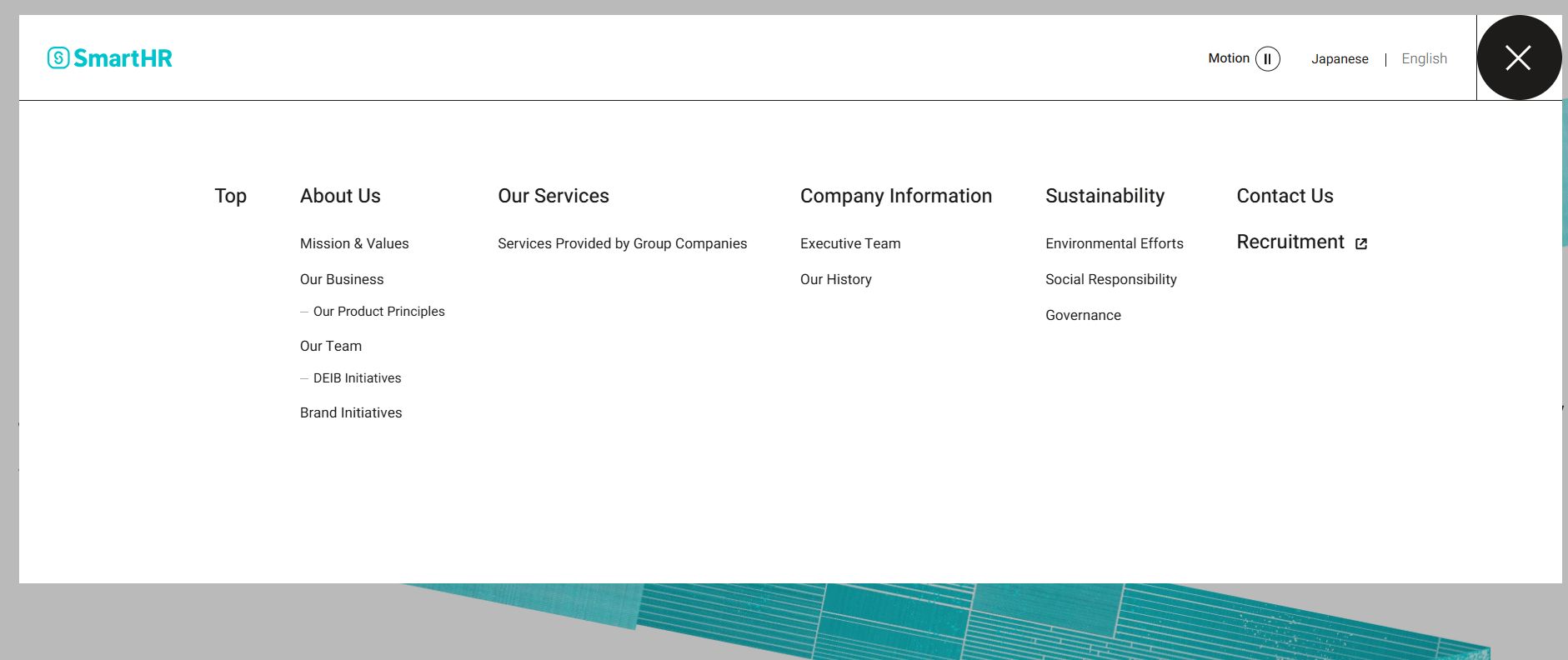
SmartHR’s company history begins in 2013, before the launch of its namesake service. Today, the product spans labor management, employee information and talent-management functions. Its relevance to back-office modernization is the connection between collecting employee details and using those records in ongoing HR work.
Consider a company whose onboarding information arrives through email attachments and separate forms. A centralized employee record gives HR a place to organize that information and support subsequent procedures. SmartHR’s product documentation describes both employee-data management and applications that use the accumulated information.
The value depends on clear ownership. Someone must decide which record is authoritative, when changes take effect and what managers can see. Evaluate the exact labor, payroll and talent-management scope included in the proposed configuration; a broad HR product family is not proof that every function is included in a single agreement. SmartHR belongs near the top of an HR-led shortlist when the business wants to improve employee administration before pursuing more elaborate workforce analysis.
4. RAKUS: Start With the Expense Process That Causes Rework
RAKUS was established in 2000 and offers several business cloud services. For this comparison, Rakuraku Seisan is the relevant example: a cloud expense-management product covering submission, approval and settlement processes, including travel expenses. Its documentation also describes accounting connections and automated document-reading functions.
A targeted expense project can be easier to define than a full back-office replacement. The employee submits a claim, the manager reviews it, and finance receives the information needed for processing. Each handoff gives the implementation team something concrete to evaluate.
Useful trial cases include a return journey, a claim split between departments and a receipt that needs correction. These are proposed scenarios, not tests performed for this article. Check whether the configured accounting output matches your existing ledger and whether employees understand rejection messages. RAKUS is particularly relevant when expense handling is the bottleneck. It should not be mistaken for a requirement to replace the accounting system or buy every service in the wider product family.
5. Sansan: Use Bill One to Organize Incoming Invoices
Sansan was founded in 2007. Although its name is closely associated with business-contact information, Bill One gives it a direct back-office role through invoice receipt and related finance operations. Its company history records Bill One’s launch in 2020, a separate milestone from the company’s founding.
The workflow starts with incoming supplier documents. Bill One supports invoice receipt and data handling, including arrangements for paper documents. This is relevant when invoices arrive at several offices or individual inboxes and finance spends time gathering them before review can begin.
There are operational details to resolve before switching supplier instructions. Bill One’s Japanese FAQ describes storage and eventual disposal arrangements for paper invoices after scanning. Its sender guidance also identifies format restrictions, including problems when a single file contains multiple invoices. Those details should inform the onboarding message sent to suppliers.
Bill One is a useful candidate when document collection is delaying accounts payable. Invoice intake, accounting recognition and payment authorization remain different activities: the implementation needs to show how each connects to the next.
6. LayerX: Connect Spending Requests With Finance Documents
Founded in 2018, LayerX operates Bakuraku. Its current product range includes expense reimbursement, invoice receipt and issuance, approval requests and other back-office services. The useful starting point is its spend-related workflow, where a purchase request and the later invoice should not become unrelated records.
Imagine an illustrative equipment purchase: a team requests approval, a supplier issues an invoice, and finance needs to understand the approved purpose. When evaluating Bakuraku, follow that transaction across the modules you intend to use. The business case is stronger if it reduces repeated entry and makes exceptions easier to investigate.
Bakuraku promotes AI-supported processing, but automation claims should be evaluated against your own documents and approval policies. Keep responsibility for unusual amounts, supplier changes and payment release explicit. OCR or a suggested classification is not the same as an authorized payment.
LayerX is worth shortlisting when the organization wants several connected finance workflows. A business solving only one narrow problem should compare the cost and administrative effort of the required modules with a smaller intervention.
7. Cybozu: Build the Workflow Your Standard Software Does Not Cover
Cybozu was founded in Matsuyama, Japan, in 1997. Its kintone platform enables teams to build business applications around structured records, collaboration and workflow. This addresses a common modernization gap: work that is too specific for a standard package but too important to leave in an uncontrolled spreadsheet.
A purchase-request register or internal equipment tracker is an illustrative use case. Teams can define the information to collect and configure access around the process. Kintone documents permissions at app, record and field levels, which matters when a shared workflow contains information that only certain employees should see.
The flexibility creates a maintenance obligation. An owner must keep fields, approval rules and integrations understandable as the business changes. A no-code application does not become an accounting or payroll engine simply because it stores financial or employee data. Cybozu is a practical choice for the operational gaps between core systems. Regional offerings and commercial terms should be evaluated for the market where the application will actually run.
8. HRBrain: Link HR Procedures With People Management
HRBrain was founded in 2016, with its original evaluation service launching in 2017. Its range now includes labor management, employee information, evaluations and other HR applications. The distinction from a standalone form tool is the opportunity to use collected employee information across more of the HR function.
HRBrain’s labor-management offering is relevant to teams trying to organize administrative procedures, while its talent-management products address a different set of questions about employees and organizational needs. Choose the combination around the actual problem. A company struggling with onboarding paperwork may not need an extensive evaluation redesign in the same project.
A useful assessment follows one employee record from collection through an update and into a selected management process. Review access rights as carefully as the form experience: employment details, manager observations and evaluation records should not automatically be visible to the same audience. HRBrain is worth comparing when the team wants a path from administrative consistency to broader HR use, provided the project has clear boundaries.
Kaonavi’s company was established in 2008. Its platform includes an employee database and evaluation workflows, making it relevant when HR teams struggle to assemble a reliable view of staff information. The back-office problem may be as basic as finding the current appraisal rather than another copy in a manager’s folder.
Kaonavi’s documented functions include employee profiles and structured evaluation processes. Its feature materials also describe API and CSV-based data connections. These can help a company plan how existing people records enter the system, although the available connection method still needs to match the source application.
The limiting factor is often information quality. An attractive employee directory cannot correct inconsistent job titles or evaluation criteria by itself. Agree on those definitions before importing years of records. Kaonavi is a relevant option for people-data and appraisal modernization; organizations whose immediate need is payroll processing should evaluate that requirement separately rather than assuming talent-management coverage answers it.
10. Bengo4.com: Move Contract Execution Into a Managed Process
Bengo4.com was established in 2005 and operates CloudSign. The company’s wider legal-information activities should not be confused with the SaaS product assessed here. CloudSign supports electronic contracting and management of contract documents.
That makes it relevant to general affairs, HR, procurement and legal teams coordinating agreements. CloudSign’s feature documentation covers document confirmation and agreement, alongside management capabilities for contracts created through other routes. Centralizing the records can help teams avoid treating a signed PDF in someone’s inbox as the final filing system.
The control question is who has authority to commit the company. Routing a document through software does not establish that the sender or signatory has that authority. Define the internal approval process, counterparty experience and record-retention requirements before implementation.
Choose CloudSign when execution and document handling are the primary obstacles. If the main difficulty is interpreting clauses and negotiating acceptable wording, contract-review software or legal expertise addresses a different stage of the work.
11. LegalOn Technologies: Support the Review Before a Contract Is Signed
LegalOn Technologies was founded in 2017 under the LegalForce name. Its LegalOn offering supports contract review and legal work, with a Japan-specific product presence and documented support for Japanese and English contract review. This is a distinct role from the signature process.
Its review materials describe AI-assisted checking and use within Microsoft Word. For an internal legal team, the useful question is whether suggested issues and revisions help staff apply the organization’s review standards consistently. A standard procurement agreement and an unusual negotiated contract may require very different levels of attention.
Evaluate the exact contract types and language combinations involved, using approved sample documents. Do not assume the Japan and overseas offerings have identical coverage. AI-generated findings need professional assessment, and an unflagged clause is not proof that an agreement is acceptable. LegalOn is relevant when review capacity and consistency are the bottlenecks; it does not supply the company’s commercial judgment or replace authorized legal decision-makers.
12. HENNGE: Manage Access Across the Growing SaaS Stack
HENNGE was founded in 1996, originally as Horizon Digital Enterprise. Its HENNGE One Identity Edition addresses cloud access, including single sign-on and access controls for workplace services. That earns it a place in a back-office shortlist even though it does not process invoices or run payroll.
As departments adopt cloud applications, identity becomes an operational dependency. HENNGE documents connections with services such as Microsoft 365, Google Workspace and Box, as well as multifactor authentication and access-management capabilities. The practical aim is to make access administration more consistent across supported services.
Test the full employee lifecycle: joining, changing responsibilities and leaving. Single sign-on and account provisioning are related but different functions; disabling one login should not be assumed to remove every downstream account or active session. Identify unsupported applications and recovery procedures. HENNGE is most relevant when cloud adoption has created an access-management problem that individual application administrators can no longer handle consistently.
Choose by the Work That Needs to Change
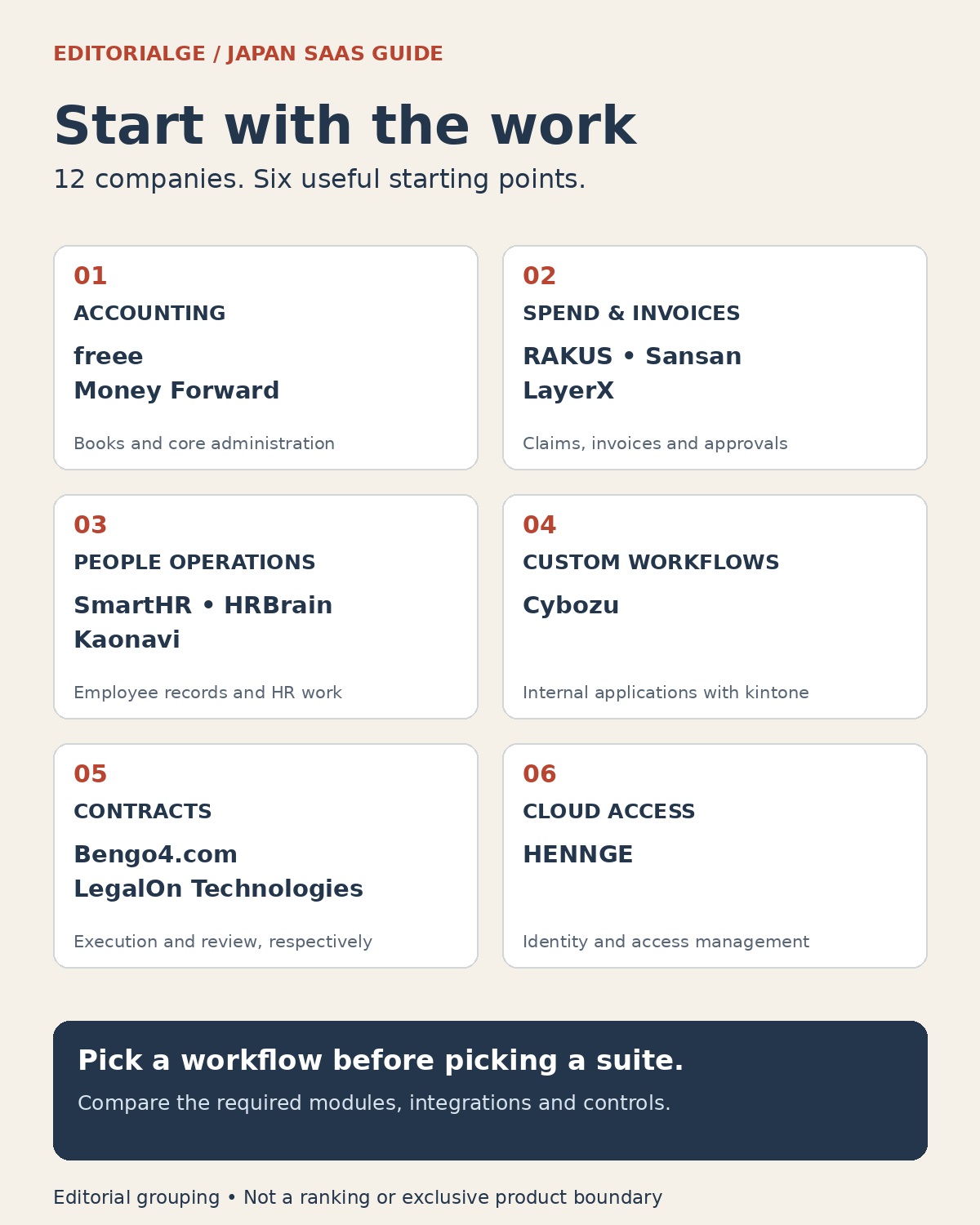
Use the following grouping to organize demonstrations. These are starting points, not exclusive product boundaries:
- Accounting foundations: freee and Money Forward.
- Expense and invoice operations: RAKUS, Sansan and LayerX.
- Employee administration and people records: SmartHR, HRBrain and Kaonavi.
- Custom internal workflows: Cybozu.
- Contract execution and review: Bengo4.com and LegalOn Technologies, respectively.
- Access across cloud applications: HENNGE.
For a broader view of workflow selection, Editorialge’s guide to business process automation software provides context. Start with the recurring failure in the process: missing information, delayed approval, repeated entry or unclear responsibility. That is a more useful selection criterion than the number of features on a vendor page.
What Makes the Japan Fit Meaningful?
Local documents and operating practices
Evaluate actual Japanese business documents and employee forms, not only translated interface screenshots. For finance tools, use sample invoices and receipts that resemble those your team receives. The National Tax Agency’s consumption-tax resources are an authoritative starting point for applicable tax guidance. A vendor’s invoice-related feature should not be presented as a guarantee that every tax or recordkeeping obligation is satisfied.
Language, data handling and support
Ask which languages are supported in the exact product, employee-facing forms, documentation and support channel. A global corporate website does not prove that every Japanese product has equivalent English functionality. Likewise, Japanese company origin does not establish the location of all hosting, support access or subprocessors.
For employee and other personal information, review the proposed data flows against your organization’s requirements and the Personal Information Protection Commission’s laws and guidance. Record where data goes, who can access it and how exports and deletion work. Obtain appropriate review for consequential legal or compliance decisions.
Connections and total cost
Describe the exact integration: which fields move, in which direction, how often and what happens on failure. “API available” is not the same as a maintained connector for your accounting package. Editorialge’s explanation of integration platforms as a service can help teams understand when a separate connection layer is useful.
This company-level comparison does not present entry prices as comparable deployment costs. Build a cost sheet for the actual Japanese-market configuration, recording currency, tax treatment, contract term, required modules, employee or user counts, document volume, setup work and support. Add the cost of keeping older systems during migration. A cheaper licence may be outweighed by manual reconciliation.
A Practical Way to Shortlist and Pilot
Choose one workflow and two or three plausible products. Define its start, completion point and responsible owner. Then run a small pilot with synthetic employee information or approved sample documents. This is a proposed evaluation method; no pilot results are claimed here.
Include exceptions, not just a successful submission. For finance, test a duplicate document, a rejected claim and a correction after approval. For HR, test a changed employee record and restricted access. For contracts, test a revised version and an absent approver. For identity, test an employee leaving while accounts remain active in connected services.
Record completion time, manual corrections, unresolved exceptions and permission failures. Agree on acceptable results before the demonstration so that a polished presentation does not replace operational evidence. Export the records at the end and check whether another system could interpret them. The ability to leave a service is part of the buying decision.
Modernize One Connected Process at a Time
The value of these Japan-Founded SaaS Companies lies in the specific workflows their products can support. Accounting, employee administration, invoice intake, contract review and identity management need different capabilities. Choose the company and product combination that addresses the most costly recurring problem, then verify how it connects to the systems you will keep.
A successful first project should produce clearer records, visible responsibility and a process people can maintain. Use that result to decide what to modernize next, rather than replacing the entire back office simply because a wider suite is available.