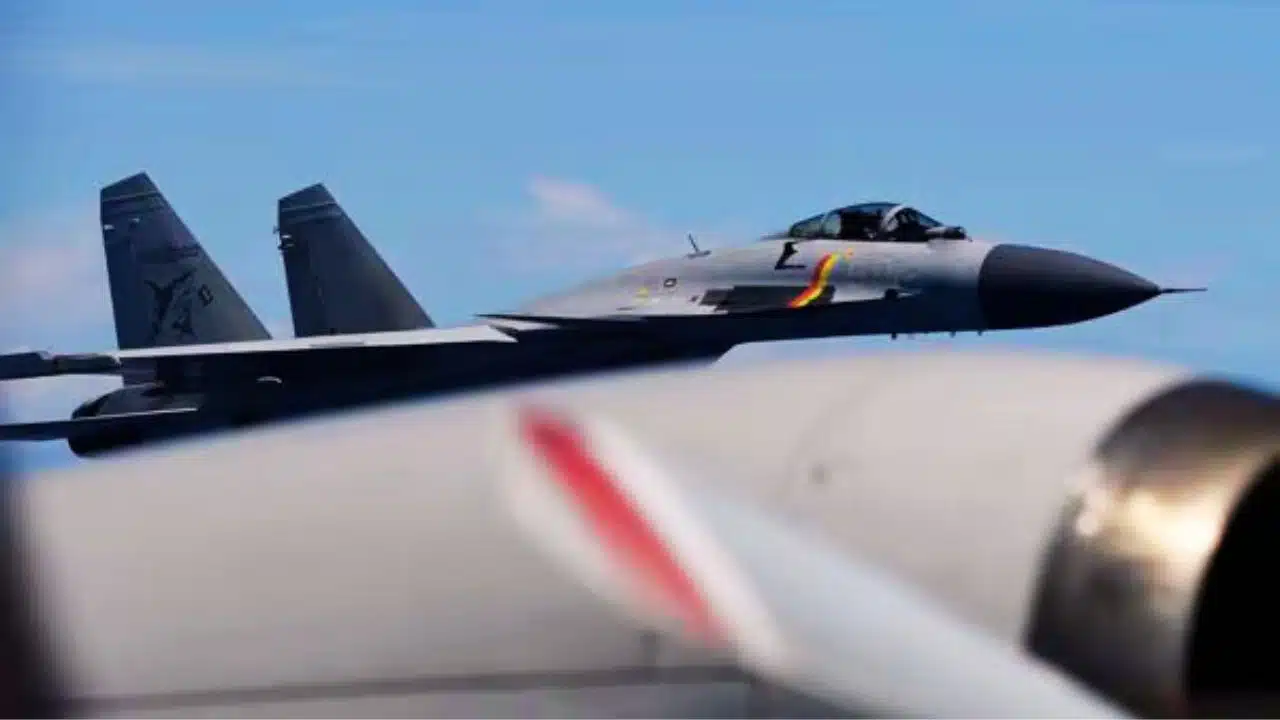
Japan’s Defense Ministry says a Chinese J‑15 fighter jet locked its fire‑control radar on ASDF F‑15 fighters twice on Saturday over international waters southeast of Okinawa, near key sea lanes close to Taiwan.
Officials describe the radar lock as a dangerous move that went beyond what is necessary for safe flight operations and have lodged a strong protest with Beijing through diplomatic channels.
According to Tokyo, the Chinese aircraft were operating from the Liaoning aircraft carrier group, which was conducting training between Okinawa’s main island and Miyako Island when the encounters occurred. Japan says its fighters scrambled to monitor the Chinese formation in response to a possible airspace violation, but confirmed that no Japanese airspace was actually breached during the incident.
How the radar lock incident unfolded
The Defense Ministry in Tokyo reports that the first radar lock took place in the late afternoon, when a J‑15 intermittently aimed its fire‑control radar at a Japanese F‑15 for several minutes. A second episode later in the evening allegedly saw another Japanese jet illuminated for roughly half an hour, suggesting a sustained tracking of the Japanese aircraft.
Japanese officials say radar lock warnings were detected by different ASDF fighters, which had been scrambled to shadow the Chinese carrier group as it maneuvered in the Pacific southeast of Okinawa. The encounters took place in international airspace but in an area where Japanese, Chinese and U.S. forces frequently operate, increasing the risk of miscalculation in already crowded skies.
Key incident details at a glance
| Item | Detail |
| Date of incident | Saturday, 6 December 2025 (local time), announced by Japan on 7 December 2025. |
| Location | International airspace southeast of Okinawa, between Okinawa’s main island and Miyako Island. |
| Chinese aircraft | People’s Liberation Army Navy J‑15 fighter launched from aircraft carrier Liaoning. |
| Japanese aircraft | Air Self‑Defense Force F‑15 fighters scrambled to monitor Chinese naval formation. |
| Nature of action | Fire‑control radar locked intermittently twice on Japanese jets; described as dangerous by Tokyo. |
| Airspace violation | Japan says no incursion into its sovereign airspace occurred despite the close encounter. |
| Immediate Japanese move | Strong diplomatic protest lodged with China; call for measures to prevent recurrence. |
What Tokyo and Beijing are saying
Japanese Defense Minister Shinjiro Koizumi condemned the radar lock as an action that exceeded what is needed for safe operations, saying it raised the risk of an unintended clash. Prime Minister Sanae Takaichi called the behavior dangerous and extremely regrettable, noting that Tokyo had demanded strict steps from Beijing to ensure such incidents do not happen again.
Japan also publicly disclosed the event, marking the first time it has officially reported a Chinese military aircraft locking radar on ASDF jets, signaling the seriousness with which it views the encounter. Officials emphasize that ASDF aircraft were engaged in routine surveillance around a foreign carrier group operating close to Japanese territory and that the use of fire‑control radar was unnecessary and escalatory.
Beijing, for its part, disputes Japan’s account and blames Tokyo for the confrontation, according to Chinese state‑linked reporting. Chinese officials argue that their naval formation was conducting planned training and accuse Japanese aircraft of repeatedly approaching and disturbing their exercises near the Miyako Strait. China says its forces acted lawfully and safely within what it views as its area of operation, while urging Japan to stop what it calls provocative close‑in monitoring.
Why fire‑control radar locks are so serious
Fire‑control radar is used by combat aircraft and warships to track targets with sufficient precision to guide weapons, and locking it onto another aircraft is widely interpreted as a precursor to potential missile engagement. Military experts note that when a pilot receives a radar lock warning, standard practice is to treat it as a possible attack, which can force sudden evasive maneuvers and quickly increase the risk of accidents or unintended escalation.
Japan has stressed that the latest encounter represents one of the most serious direct confrontations between Chinese and Japanese forces in recent years, particularly because it involves air‑to‑air radar use near disputed and strategically sensitive waters. The episode also revives memories in Tokyo of a 2013 incident, when Japan accused a Chinese warship of locking fire‑control radar on a Japanese destroyer in the East China Sea, an event that also triggered protests at the time.
Wider regional reactions and implications
The radar lock incident comes amid intensifying Chinese military activity around Taiwan and in the East China Sea, where Chinese aircraft and ships regularly operate near Japanese‑controlled islands and air defense identification zones. Defense analysts say such close encounters, even when they stay in international airspace, add to a pattern of rising military pressure and signaling across the region.
Australia has already joined Japan in urging calm, with officials in Canberra emphasizing the need for professional conduct and adherence to international norms in contested skies and waters. The episode is likely to feature in upcoming security consultations among U.S., Japanese and Australian officials, given all three countries’ shared concern over the risk of miscalculation around China’s growing naval and air presence.
Security experts warn that repeated radar lock incidents could push Japan to expand rules of engagement and invest further in air and missile defense capabilities around Okinawa and the Nansei island chain, which already host a significant U.S. military presence. The event may also harden domestic Japanese debates over defense spending and constitutional limits on the use of force, particularly under a government that has already signaled plans to strengthen deterrence against both China and North Korea.
Outlook: what comes next
Diplomats expect Tokyo and Beijing to manage the immediate fallout through back‑channel communications, but the underlying sources of friction—disputed maritime claims, Taiwan’s security, and competing patrols—remain unresolved. Analysts say both sides face pressure to show resolve to domestic audiences, raising concerns that another close encounter, or an accident, could quickly escalate into a broader crisis.
For now, Japan is likely to continue publicizing such incidents to build international awareness and support, while calling for China to adhere to existing military‑to‑military communication mechanisms and codes of conduct. The radar lock on Japanese aircraft has thus become another flashpoint in a crowded and contested region, underscoring how a single cockpit‑level decision can reverberate across Asian geopolitics.