


A powerful coalition of students, professors, staff members, and labor unions within the University of California (UC) system has filed a lawsuit against the Trump administration, accusing federal officials of misusing civil rights laws to suppress free speech and academic independence. The lawsuit, filed in federal court in San Francisco, claims that the government is unlawfully wielding its control over federal research and financial aid funding to impose sweeping restrictions on one of the largest public university systems in the United States.
The coalition behind the lawsuit includes the American Association of University Professors (AAUP), staff organizations, student advocacy groups, and every labor union that represents UC employees. They argue that the federal government is trying to force ideological reforms on campuses under the guise of fighting antisemitism and protecting civil rights, but in reality, it is eroding constitutional protections and threatening the university’s ability to carry out its educational and research mission.
Federal Actions Against UCLA Spark Legal Battle
The immediate catalyst for the lawsuit was the Trump administration’s decision to fine the University of California, Los Angeles (UCLA) $1.2 billion and freeze more than $584 million in federal research funding. According to the administration, UCLA failed to adequately address alleged antisemitism on its campus and violated civil rights laws.
This unprecedented move marked the first time a major public university faced such a broad freeze in federal funding, although elite private universities like Harvard, Brown, and Columbia have also faced similar freezes and investigations. For UCLA, the funding suspension affects vital research programs, student financial aid, and medical initiatives that serve millions of Americans.
What the Federal Government is Demanding
Court filings and public reports reveal that the Trump administration has put forward a settlement offer with conditions that go far beyond addressing antisemitism or civil rights concerns. Among the demands are:
- Access to university data: The administration is seeking admission, hiring, and personnel records for faculty, staff, and students.
- Restrictions on diversity programs: UC would be required to eliminate diversity scholarships and roll back other equity-focused initiatives.
- Control over campus activity: Overnight demonstrations on UC property would be banned, and stricter protest regulations would be introduced.
- Immigration enforcement cooperation: The university would be compelled to assist federal immigration authorities in monitoring students and staff.
- Limitations on healthcare and identity policies: Demands include ending certain gender-affirming medical services at UC hospitals and revising campus housing and sports team participation rules.
Critics say these measures extend well beyond civil rights enforcement and amount to political interference in academic governance.
UC System Leaders Call It a Historic Threat
University of California President James Milliken has described the situation as “one of the gravest threats in the university’s 157-year history.” He noted that the UC system depends heavily on federal support—receiving over $17 billion annually, including $10 billion tied to Medicare and Medicaid programs, along with research grants and financial aid for students.
Without these funds, UC campuses could face devastating consequences: reduced medical research, halted scientific projects, layoffs, and diminished access to higher education for thousands of low-income students.
While the UC system itself is not listed as a direct plaintiff in the lawsuit, its leadership strongly supports the legal and advocacy campaign. Milliken emphasized that the university is part of multiple ongoing efforts to restore funding and protect academic freedom.
Broader Pattern of Federal Pressure on Universities
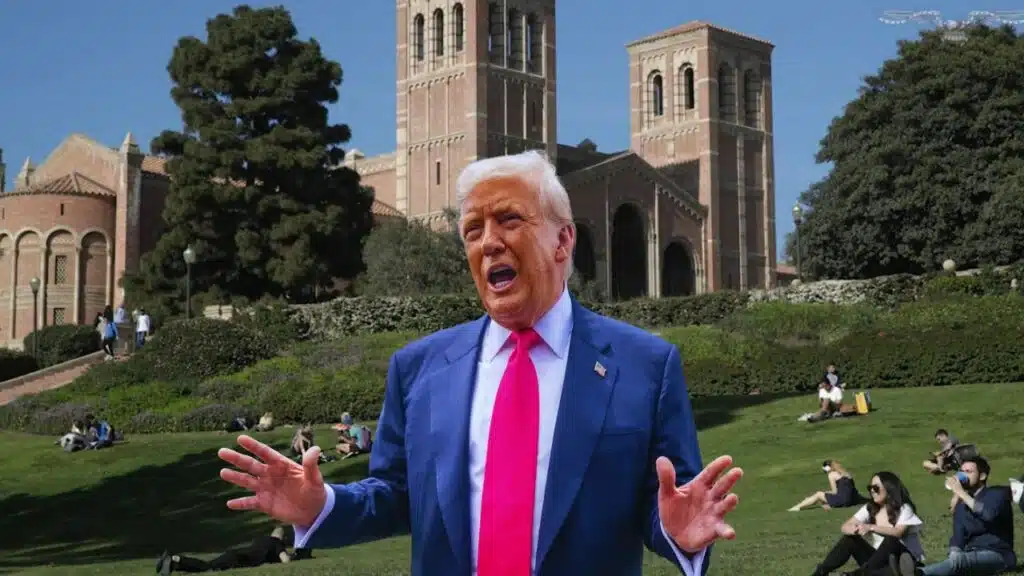
The actions against UC are part of a broader campaign by the Trump administration targeting universities that it claims tolerate antisemitism or discriminate against certain groups. Federal officials have also opened dozens of investigations into K-12 school districts, signaling that the administration’s approach goes far beyond higher education.
Earlier this summer, Columbia University reached a settlement after facing similar allegations. The Ivy League school agreed to pay $200 million in financial penalties and accept federal oversight of its campus policies. In exchange, more than $400 million in frozen research grants were restored. Columbia did not admit wrongdoing but had to implement major reforms, including stricter protest rules and limits on diversity programs.
Observers believe that the Trump administration is now using Columbia’s deal as a template for other institutions, with financial penalties and structural changes becoming standard expectations in negotiations.
The Core Legal Argument
The lawsuit filed by UC faculty, students, and staff claims that the government’s actions are:
- Unconstitutional: By tying funding to ideological demands, the administration is allegedly violating the First Amendment rights of universities, professors, and students.
- Unlawful: Plaintiffs argue that the abrupt cancellation of federal research grants violates due process and established contract rights.
- Politically motivated: The lawsuit asserts that civil rights enforcement is being used as a cover for political interference in higher education, targeting programs viewed as “too liberal” or “anti-conservative.”
In a statement, the Democracy Forward Foundation, which is representing the coalition, said the government is using a “blunt cudgel” by unilaterally and unlawfully terminating research funding critical to the public interest.
Why This Matters for Academic Freedom
At stake is more than just money. The lawsuit underscores a fundamental conflict between federal oversight and academic autonomy. If the government can dictate university policies by threatening to cut funding, critics warn that universities may lose their independence to decide who they admit, who they hire, what research they conduct, and how they manage free speech on campus.
For the University of California, with its 10 campuses, hundreds of thousands of students, and some of the world’s leading research facilities, the outcome could shape the future of American higher education. Scholars, student leaders, and civil rights advocates argue that if this precedent is allowed to stand, it could spread to universities across the country.
Next Steps in Court
The case will now move forward in federal court in San Francisco. The Trump administration’s Department of Justice has not yet issued a public response to the lawsuit. Legal experts suggest the proceedings could take months, with possible appeals extending the battle even further.
Meanwhile, UC leaders and faculty unions are mobilizing public support, warning that the loss of federal funds could halt life-saving biomedical research, slow technological innovation, and weaken America’s economic competitiveness in fields ranging from medicine to artificial intelligence.
The Information is collected from CNN and Yahoo.





















