

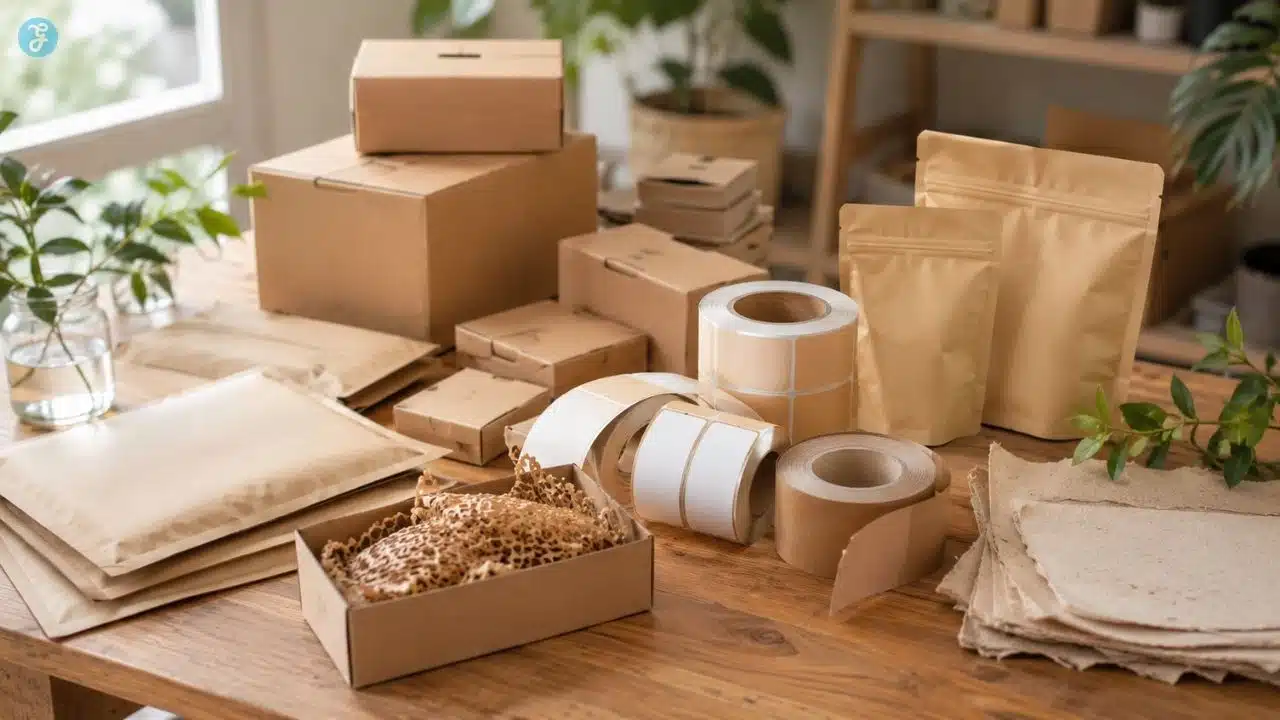
Compostable packaging has a problem nobody likes to brag about: the sticky parts. A brand may spend months choosing the right compostable pouch, kraft mailer, food-safe wrap, fruit label, or paperboard pack. Then one ordinary adhesive label or plastic tape can quietly weaken the whole sustainability claim. It is not always dramatic. It is not always visible. But it matters.
For zero-waste brands, the adhesive is no longer a tiny technical detail. It is part of the packaging story. If the label, sticker, tape, or glue line does not match the product’s end-of-life claim, the brand may end up with packaging that sounds better than it performs. That is exactly why compostable adhesive technology deserves more attention.
The tricky part is that this market is full of soft language. “Eco-friendly,” “green,” “biodegradable,” “plant-based,” and “plastic-free” are useful words only when they are backed by clear material details, testing, and certification. A compostable-looking sticker is not automatically a compostable label. A paper tape is not automatically compostable. A biodegradable adhesive is not always suitable for a compostable package.
So this list does not treat every company as if it is doing the same thing. Some are label specialists. Some are printers. Some are sustainable packaging suppliers. Some distribute or apply adhesive technologies rather than inventing the chemistry themselves. That distinction is important.
Here are six US-based or US-operating SMEs and specialist companies helping zero-waste brands deal with the adhesive problem more seriously.
How I Selected These Companies
This list was built around practical business relevance, not hype. To be included, each company needed to meet most or all of the following criteria:
- It had to be real, active, and publicly verifiable.
- It had to be based in the US or have meaningful US operations.
- It had to be small, mid-sized, privately held, or specialist-led rather than a massive global packaging conglomerate.
- It needed a clear public connection to compostable, biodegradable, compost-compatible, or sustainability-focused adhesive systems.
- It had to serve a real brand use case, such as ecommerce, food packaging, produce labeling, retail labels, coffee packaging, or packaging assembly.
- Its claims had to be specific enough to discuss without inventing extra facts.
One note before the list: not every company here manufactures adhesive chemistry. Some convert materials, print labels, distribute adhesive systems, or supply finished packaging products that use compostable or compost-compatible adhesives. That is normal in packaging. The end product is usually a chain of material suppliers, converters, printers, distributors, and brand owners.
1. Elevate Packaging / PURE Labels
Elevate Packaging is one of the most direct fits for this topic because compostable adhesive labels are not a side product in its business. Through PURE Labels, the company focuses on compostable adhesive label solutions for brands that want the label to match the packaging.
That matters more than many people realize.
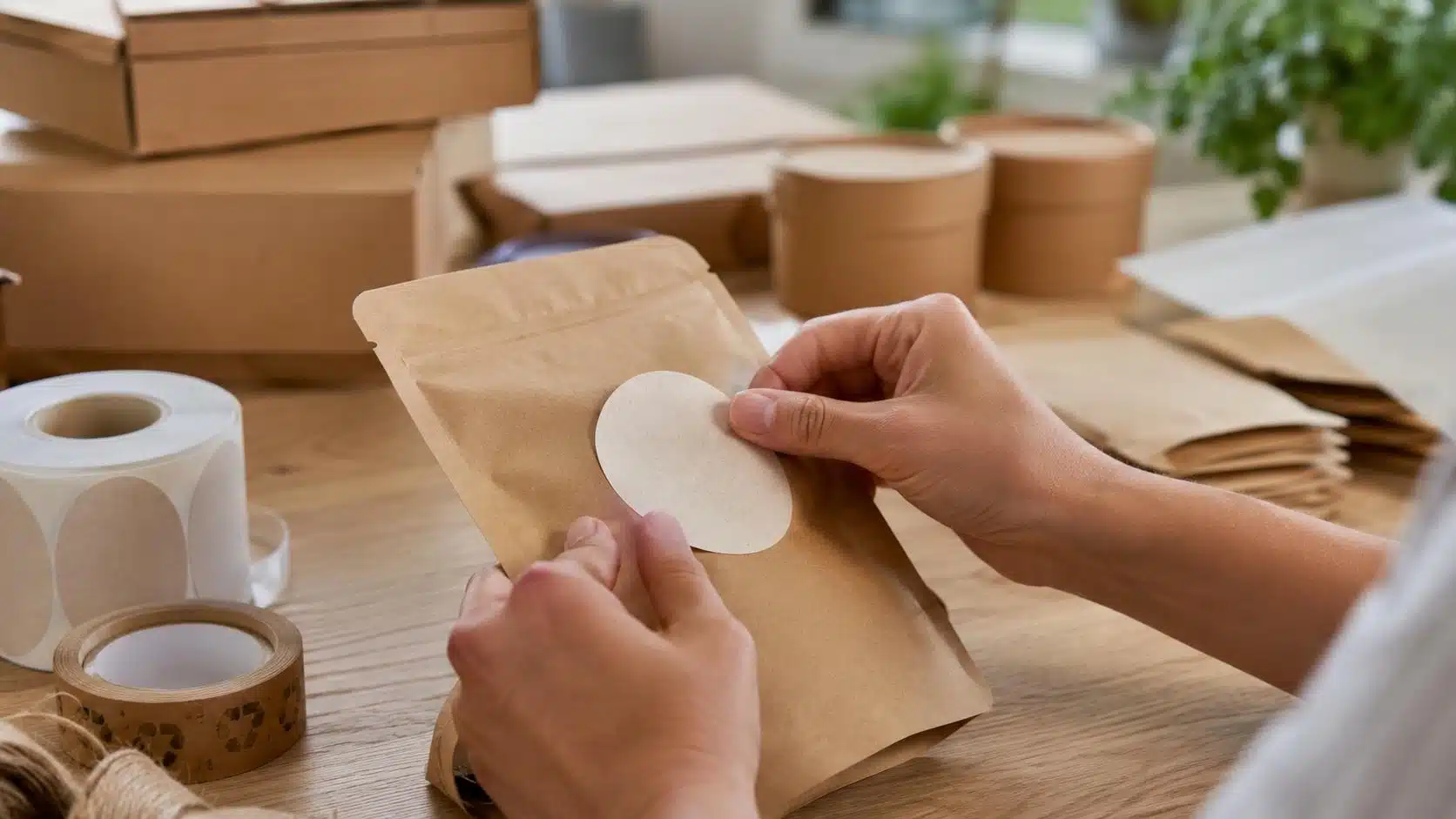
A compostable pouch with a conventional label can create a credibility problem. The pouch may be designed for composting, but the sticker can become the weak link. PURE Labels addresses that by treating the label as a full system: facestock, adhesive, print compatibility, and compostability claim.
Business Snapshot
| Field | Details |
| Main solution | Compostable pressure-sensitive adhesive labels |
| Location | Chicago, Illinois |
| Strongest use case | Product labels for compostable packaging |
| Best suited for | Food, coffee, tea, supplements, cosmetics, wellness, and eco-retail brands |
| Buyer profile | Brands that need adhesive labels to support compostable packaging claims |
What the Company Actually Offers
PURE Labels offers a wide range of compostable adhesive label materials, including options for custom printed labels, blank sheets, blank rolls, and different material needs. Its public product information specifically talks about certified compostable adhesive label stocks, compostable adhesives, and pressure-sensitive labels.
That level of detail is important. A lot of “eco label” suppliers talk mostly about the face material. PURE Labels puts the adhesive inside the compostability conversation, which is exactly where it belongs.
The company’s product range can be useful for brands working with compostable bags, pouches, coffee packaging, paper-based packaging, food items, and natural product lines. It also gives smaller brands an easier entry point because they do not necessarily need to start with a massive custom packaging project.
Why It Belongs on This List
Elevate Packaging belongs here because it is solving one of the cleanest, most obvious pain points in zero-waste packaging: the label that should not ruin the package.
Its positioning is not just “we print sustainable labels.” The company publicly connects its adhesive label materials to compostability standards. That makes it much easier for a brand to ask the right follow-up questions and request proper documentation.
For a zero-waste brand, this is the difference between buying something that looks sustainable and buying something that may support a real compostable packaging system.
Business Reality Check
This is still not a “buy blindly and put compostable everywhere” situation.
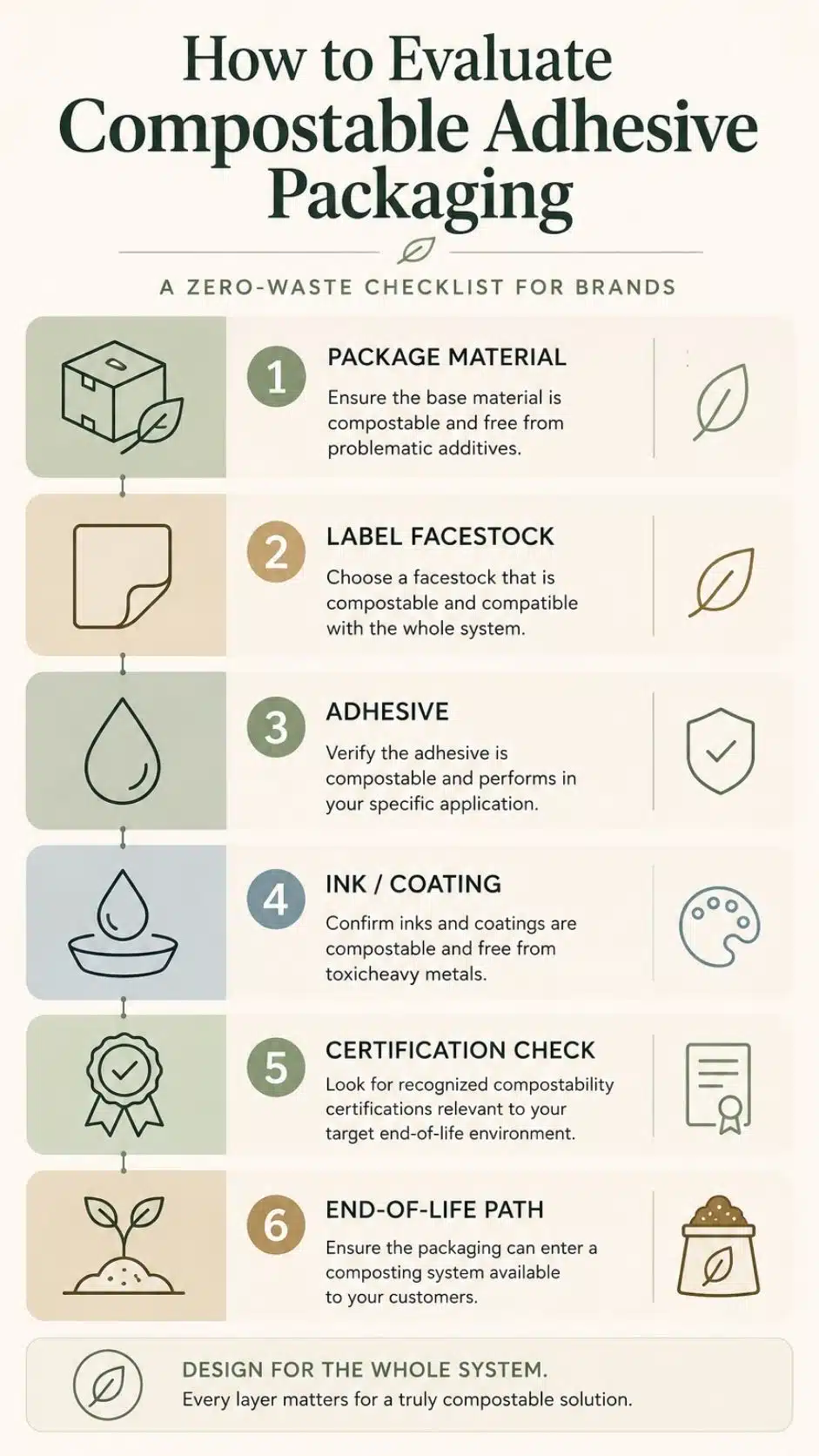
Brands should confirm the exact label construction before making claims. The facestock, adhesive, ink, coating, liner, and intended disposal environment all matter. A label may be certified for one type of composting condition but not another. A printed version may also need to be checked against the same claim.
The better move is simple: ask for the certification or technical documentation for the exact label material being ordered.
Best Fit
Elevate Packaging / PURE Labels is best for brands that already use compostable packaging and need labels that will not create a mismatch between the package and the sustainability message.
2. Plan It Green Printing
Plan It Green Printing is a smaller Los Angeles-based green printing company, and that is part of why it belongs here. Not every sustainable brand is buying label rolls on an industrial scale. Many are still working with small batches, seasonal SKUs, limited-edition products, farmers’ markets, cafés, local food businesses, or early-stage ecommerce packaging.
Those businesses still need better label options.
Plan It Green offers compostable sticker labels with a European Certified Compostable adhesive option. The company also makes a useful distinction between adhesive choices, noting that one water-based emulsion acrylic adhesive is not certified compostable, while another European Certified Compostable adhesive option is available.
That distinction is exactly the kind of honesty buyers should look for.
Business Snapshot
| Field | Details |
| Main solution | Custom compostable labels and stickers |
| Location | Los Angeles, California |
| Strongest use case | Short-run and custom eco-label printing |
| Best suited for | Food, beverage, coffee, bakery, cosmetics, and event-related brands |
| Buyer profile | Small to mid-sized brands that need printed labels without vague material claims |
What the Company Actually Offers
Plan It Green Printing works in the practical middle ground between materials and branding. Its customers are not just buying a raw adhesive material. They are buying printed labels that need to look good, stick properly, survive handling, and support a cleaner packaging story.
The company’s compostable label page points to uses such as compostable packaging, food service labels, coffee bags, transparent labels, freezer labels, bakery ingredient labels, and labels for jars. That range makes sense for small sustainable brands because these are everyday packaging needs.
The company also talks about ink and label performance, including situations where testing is important. That is refreshing because compostable materials are not magic. They can behave differently under heat, moisture, freezer conditions, rubbing, or long storage.
Why It Belongs on This List
Plan It Green belongs here because it helps smaller brands access compostable label options without pretending the decision is effortless.
Its value is partly in the material and partly in the transparency. The company does not simply say, “Here is a green label.” It gives buyers a choice and makes the adhesive issue visible.
That is useful for brands that are still learning the difference between a compostable facestock, a compostable adhesive, a compostable ink, and a fully compostable label construction.
Business Reality Check
Plan It Green should not be described as an adhesive manufacturer. It is better understood as a green printing and label provider that can work with compostable label stock and certified adhesive options.
Brands should be specific when ordering. Asking for “compostable labels” is not enough. The better request is: “We need the label material, adhesive, and print setup that support the compostable claim for our packaging use case.”
It is also worth testing samples before committing to a full order. Compostable labels may behave differently on glass, compostable film, paperboard, freezer packaging, oily food containers, or curved surfaces.
Best Fit
Plan It Green Printing is best for smaller brands that need realistic, custom-printed compostable labels and want a supplier that makes the adhesive choice part of the conversation.
3. Nova Custom Label Printing
Nova Custom Label Printing is another strong fit for brands that need custom labels rather than raw adhesive materials. Based in New York City, Nova works in the custom label space and publicly addresses one of the most common mistakes in compostable labeling: forgetting the adhesive.
That may sound basic, but it is exactly where many packaging claims become messy.
A company can choose a biodegradable paper, sugarcane-based material, PLA film, or NatureFlex option, then accidentally pair it with an adhesive that does not match the intended end-of-life story. The result is a label that sounds better than it actually is.
Nova’s compostable label page directly warns buyers not to forget the adhesive and says its compostable labels, stickers, and adhesives meet EN13432 European standards for compostable packaging.
Business Snapshot
| Field | Details |
| Main solution | Compostable custom labels and biodegradable stickers |
| Location | New York City, New York |
| Strongest use case | Custom product labels with eco-material options |
| Best suited for | Food, beverage, personal care, wellness, retail, and specialty product brands |
| Buyer profile | Brands that want custom label printing with compostability in mind |
What the Company Actually Offers
Nova’s compostable label offering includes several eco-friendly material options, including bagasse, cane fiber paper, kraft-style paper, PLA, NatureFlex, FSC-related paper options, recycled PE, and grass paper. That gives buyers a broader material menu than a single “green label” product.
This is useful because no one material works for every brand.
A refrigerated drink label does not have the same demands as a dry tea pouch label. A jar label is different from a bakery sticker. A flexible pouch label is different from a label applied to a rigid compostable container.
Nova’s role is to help brands choose and print the label, not to make sweeping environmental promises about every possible package.
Why It Belongs on This List
Nova belongs here because it addresses compostable labels as a construction issue, not just a material trend.
The company’s public language is practical: if the adhesive is not as biodegradable as the sticker itself, the label is not completely compostable. That is a useful warning for brand owners who may otherwise focus only on the visible label surface.
This makes Nova relevant for zero-waste brands that need custom printing but also need the packaging claim to be more defensible.
Business Reality Check
Nova’s claim is tied to EN13432, which is a European compostability standard. For US brands, that may not be the only standard that matters. Depending on the product, sales channel, state rules, and packaging type, buyers may also need ASTM-related documentation, third-party certification, retailer approval, or additional compliance support.
That does not make Nova a weak choice. It simply means brands should not assume one standard solves every market requirement.
A serious buyer should ask: Which exact standard applies? Is the finished label construction covered? Does the certification include adhesive and ink? Is it industrial compostable only, or does it support another disposal pathway?
Best Fit
Nova Custom Label Printing is best for brands that want custom compostable labels and need a printer that openly recognizes the adhesive as part of the sustainability claim.
4. EcoEnclose
EcoEnclose is different from the first three companies because its strongest fit is not compostable product labels. Its strongest fit is ecommerce packaging, especially shipping materials and tapes.
That distinction matters.
For an ecommerce brand, adhesive is not only on the product label. It is also on carton-sealing tape, return packaging, branded stickers, shipping labels, and fulfillment materials. If a brand ships thousands of boxes a month, tape becomes part of its packaging footprint.
EcoEnclose offers sustainable shipping supplies and documents adhesive details across its tape products, including water-activated tape with cornstarch adhesive and plant-derived tape options. It also explains where composting is appropriate and where recyclability is the better end-of-life route.
That kind of nuance is valuable.
Business Snapshot
| Field | Details |
| Main solution | Sustainable carton-sealing tapes and shipping packaging |
| Location | Louisville, Colorado |
| Strongest use case | Ecommerce shipping and box closure |
| Best suited for | DTC, apparel, lifestyle, subscription, beauty, and retail ecommerce brands |
| Buyer profile | Brands are trying to reduce plastic tape and improve the shipping package end-of-life |
What the Company Actually Offers
EcoEnclose offers several tape choices, including water-activated tape, flatback tape, and cello tape. Its water-activated tape uses a cornstarch adhesive. For non-reinforced water-activated tape, EcoEnclose states that boxes taped with it are naturally biodegradable and compostable in backyard and industrial composting facilities.
The company is also careful about reinforced tape. Reinforced water-activated tape may be recyclable with boxes, but it should not be composted because of the reinforcement material. That kind of clarification is exactly what brands need to avoid making lazy claims.
EcoEnclose also explains that some tapes are better viewed through the recycling lens than the composting lens. For corrugated boxes, that can often be the more practical route.
Why It Belongs on This List
EcoEnclose belongs here because zero-waste shipping is not only about mailers and boxes. The closure method matters.
Plastic pressure-sensitive tape is still common in ecommerce. Switching to paper-based or plant-derived adhesive tape can help brands reduce plastic-heavy shipping materials and make corrugated packaging easier to process in recycling systems.
For ecommerce brands, the business value is straightforward: better packaging alignment, cleaner customer messaging, and fewer contradictions between the brand’s sustainability promise and the package that lands on someone’s doorstep.
Business Reality Check
EcoEnclose should not be framed as a compostable adhesive label company. That would be too broad and not accurate enough.
Its best fit in this article is shipping tape and closure systems. Also, not every EcoEnclose tape should be composted. Some are designed primarily to be recycling-compatible. Some should be removed before composting. Some are industrially compostable under specific conditions.
That nuance is not a weakness. It is actually a good sign. Sustainable packaging decisions are usually about choosing the right end-of-life path, not forcing everything into the word “compostable.”
Best Fit
EcoEnclose is best for ecommerce brands that want to reduce plastic tape, improve corrugated-box recyclability, and choose adhesive-backed shipping materials with clearer sustainability logic.
5. APPLIED Adhesives
APPLIED Adhesives brings a different part of the adhesive world into this list: hot melts.
Labels and tapes get most of the attention because shoppers can see them. But packaging operations also rely on adhesives for carton sealing, case forming, paperboard assembly, displays, product assembly, and packaging lines. If a zero-waste brand is scaling production, adhesive choice can become an operational issue, not just a design issue.
APPLIED Adhesives is a Minnetonka, Minnesota-based adhesive solutions provider. Its relevance here comes from its partnership with UK-based Power Adhesives to bring Tecbond biodegradable hot melt adhesives to the Americas.
That does not mean APPLIED invented the adhesive. It means the company plays a North American supply, distribution, and application-support role.
Business Snapshot
| Field | Details |
| Main solution | Biodegradable hot melt adhesive access and support |
| Location | Minnetonka, Minnesota |
| Strongest use case | Packaging lines, carton closing, paperboard packaging, and production assembly |
| Best suited for | Brands and manufacturers using hot-melt adhesive systems |
| Buyer profile | Scaling brands, co-packers, packaging operations, and manufacturers |
What the Company Actually Offers
APPLIED Adhesives works across adhesive products, equipment, technical support, maintenance, and industrial applications. That makes it useful for brands that need more than a roll of labels or a box of tape.
Through the Power Adhesives partnership, APPLIED is connected to Tecbond biodegradable hot melts, including Tecbond 214B. Industry coverage has described Tecbond 214B as 45% bio-based, 100% biodegradable, and certified to ASTM D6400, EN13432, and FDA 175.105.
For brands that use hot melt adhesives in packaging operations, this is a meaningful development. A compostable or biodegradable packaging strategy can fall apart if the adhesive used in assembly is ignored.
Why It Belongs on This List
APPLIED belongs here because it represents the production side of compostable adhesive technology.
Zero-waste brands eventually run into operational realities. The adhesive has to set quickly. It has to work with equipment. It has to bond the right substrates. It has to survive storage, transport, and handling. It has to make sense for the production line.
A small brand may start with compostable labels. A growing brand may later need adhesive systems for paperboard packaging, cartons, and assembly. That is where companies like APPLIED become relevant.
Business Reality Check
This is not the same kind of company as PURE Labels or Plan It Green. APPLIED is not selling consumer-facing compostable stickers to small brands. It is an adhesive solutions provider serving packaging and industrial users.
The other important point is that a biodegradable hot melt does not automatically make the finished package certified compostable. The adhesive is one part of the construction. The substrate, coatings, inks, barriers, and final product design still matter.
Brands should ask for technical data, certification details, equipment compatibility, food-contact relevance if needed, and production testing before making public claims.
Best Fit
APPLIED Adhesives is best for brands, manufacturers, and co-packers that need biodegradable hot melt adhesive options for packaging operations rather than simple product-label replacement.
6. Sinclair
Sinclair is the most specialized company on this list. Its focus is fresh produce labeling, which may sound narrow until you think about how many tiny fruit stickers pass through stores, kitchens, compost bins, and waste streams every day.
Produce labels are small, but they create a very visible adhesive problem.
Consumers often forget to remove fruit stickers before composting peels, scraps, or spoiled produce. Composters do not love finding conventional stickers in organic waste. Growers and retailers still need traceability, PLU codes, branding, and supply-chain identification. The result is a real design challenge: how do you label fresh produce without leaving behind a stubborn piece of plastic-backed waste?
Sinclair’s EcoLabel work directly addresses that issue.
Business Snapshot
| Field | Details |
| Main solution | Compostable fruit and vegetable labels |
| US presence | Fresno, California and Wenatchee, Washington operations |
| Strongest use case | Fresh produce labeling |
| Best suited for | Growers, packers, exporters, retailers, and produce brands |
| Buyer profile | Fresh food businesses that need traceability and compostable label options |
What the Company Actually Offers
Sinclair provides produce labels, labeling machinery, and technical support for the fresh produce industry. Its compostable label work is notable because it focuses on the whole label construction.
That point matters.
A fruit sticker is not just one material. It includes facestock, adhesive, and inks. Sinclair’s compostable label documentation describes certified compostable label constructions where those parts are considered together. Its EcoLabel HOME product is described as a food-safe, bio-based, plastic-free construction certified as a finished product, not just as one individual component.
That is the right way to think about compostable adhesive labels. A single compostable component is not enough if the finished label fails the end-of-life claim.
Why It Belongs on This List
Sinclair belongs here because fresh produce labels are one of the clearest real-world examples of why compostable adhesive technology matters.
A compostable fruit sticker may not sound glamorous, but it solves a genuine packaging irritation. It helps produce brands keep the benefits of item-level labeling while reducing the mismatch between organic food waste and non-compostable sticker waste.
This is especially relevant as retailers, growers, and regulators pay closer attention to packaging claims and contamination in composting systems.
Business Reality Check
Sinclair is not a general-purpose label printer for every small business. It is a produce-labeling specialist. A skincare brand, coffee roaster, or ecommerce store probably does not need Sinclair. A fruit grower, packhouse, or fresh produce exporter might.
Also, Sinclair has global operations, so buyers should confirm which product, certification, production region, and compliance documentation apply to their market. The exact label construction matters, especially when making home compostable or industrial compostable claims.
Best Fit
Sinclair is best for produce businesses that need fruit and vegetable labels designed around compostability, traceability, food safety, and high-speed labeling performance.
Quick Comparison Table
| Company | US Presence | Main Compostable Adhesive Fit | Best For | Business Type |
| Elevate Packaging / PURE Labels | Chicago, Illinois | Certified compostable pressure-sensitive adhesive labels | Food, coffee, beauty, wellness, and compostable packaging brands | Compostable label and packaging specialist |
| Plan It Green Printing | Los Angeles, California | Printed compostable labels with certified compostable adhesive option | Small brands needing custom eco-label printing | Green printing and label provider |
| Nova Custom Label Printing | New York City, New York | Compostable labels and adhesives meeting EN13432 | Custom product-label buyers | Custom label printer |
| EcoEnclose | Louisville, Colorado | Water-activated tape with cornstarch adhesive and compostable tape options | Ecommerce and shipping brands | Sustainable packaging supplier |
| APPLIED Adhesives | Minnetonka, Minnesota | Biodegradable hot melt adhesive distribution and application support | Packaging lines, carton sealing, and production operations | Adhesive solutions provider |
| Sinclair | Fresno, California, and US operations | Certified compostable produce labels using adhesive, facestock, and inks as a full construction | Produce growers, packers, and fresh food brands | Produce labeling specialist |
Why Compostable Adhesive Tech Is So Hard to Get Right
The hard part is that “adhesive” sounds simple from the outside. It is not.
A pressure-sensitive label may include facestock, adhesive, liner, ink, coating, varnish, and print method. A tape may include backing, adhesive, reinforcement, release coating, and application behavior. A hot melt adhesive may need to perform under heat, pressure, machine speed, shipping stress, and food or product-safety requirements.
This is why brands should be careful with broad packaging claims.
A compostable package with the wrong label may not support the claim cleanly. A paper tape with the wrong reinforcement may be recyclable but not compostable. A biodegradable adhesive may be useful, but not enough to certify the finished package.
The stronger question is not, “Is this eco-friendly?”
The stronger question is:
“Does the full construction support the end-of-life claim we are making?”
That one question can save a brand from sloppy messaging, customer confusion, and compliance risk.
What Zero-Waste Brands Should Ask Before Buying
Before choosing any compostable adhesive label, tape, or glue system, brands should ask practical questions:
- Is the adhesive itself compostable, biodegradable, recyclable, or just lower-impact?
- Does the claim apply to the full label, tape, or packaging construction?
- Is the product certified for industrial composting, home composting, or both?
- Which standard or certification applies?
- Does the certification include the adhesive, ink, and coating?
- Is the material suitable for food contact if the product requires it?
- Will it perform under moisture, freezer, heat, oil, abrasion, or shipping stress?
- Does the product work on the exact substrate being used?
- Can the supplier provide current documentation?
- Is composting actually the most realistic end-of-life path for this package?
That final question is often overlooked. Compostable is not always better. For a corrugated ecommerce box, recyclability may matter more. For a compostable food scrap bag or certified compostable foodservice item, compostability may be the priority. For fresh produce, a compostable sticker may solve a very specific contamination problem.
Better packaging is not about chasing one magic word. It is about matching the material, claim, and disposal path.
Business Opportunity in Compostable Adhesive Tech
Compostable adhesive technology is still a niche, but it is not a gimmick niche. It sits at the intersection of packaging compliance, material science, brand trust, and waste infrastructure. That makes it commercially interesting, especially for SMEs.
Large packaging companies can dominate volume. But smaller specialists often move faster in narrow problems. Compostable adhesive labels, fruit stickers, water-activated tapes, and biodegradable hot melts are all specific enough to give SMEs room to compete.
There is also a branding advantage. Zero-waste brands are tired of packaging contradictions. They do not want a compostable pouch with a plastic sticker. They do not want a recyclable box buried under plastic tape. They do not want an “eco” label that cannot survive basic scrutiny.
The companies that can provide clear documentation, honest limitations, and real application guidance will have an edge. Not because sustainability language sounds nice, but because buyers are becoming more careful.
Final Verdict
Compostable adhesive tech is not one market. It is several small but connected markets.
Elevate Packaging / PURE Labels is one of the strongest direct fits for compostable pressure-sensitive labels. Plan It Green Printing and Nova Custom Label Printing are practical options for brands that need custom-printed labels and want the adhesive issue taken seriously. EcoEnclose is more relevant for ecommerce tape and shipping closures than for product labels. APPLIED Adhesives brings biodegradable hot melt options into production and packaging operations. Sinclair stands out in the produce world, where compostable fruit labels solve a very specific and very visible problem.
The common thread is simple: the adhesive has to be part of the sustainability conversation.
Zero-waste brands should not settle for packaging that only looks responsible from a distance. They should ask what the label is made of, what the adhesive does, which certification applies, and whether the full construction supports the claim.
That is not overthinking. That is how better packaging actually gets made.
Frequently Asked Questions about Compostable Adhesive Technology
1. What is compostable adhesive technology?
Compostable adhesive technology refers to adhesives designed to break down under defined composting conditions, usually as part of a label, tape, hot melt, or packaging construction. For brands, the key issue is whether the adhesive supports the end-of-life claim of the finished package.
2. Is biodegradable adhesive the same as compostable adhesive?
No. Biodegradable is a broader term. Compostable is more specific and usually tied to defined standards, testing conditions, timeframes, and residue limits. A biodegradable adhesive may be useful, but brands should not automatically call it compostable unless documentation supports that claim.
3. Why do zero-waste brands need compostable labels?
Compostable labels help prevent a mismatch between compostable packaging and conventional stickers. If the package is compostable but the label is not, the brand’s claim becomes weaker and harder to defend.
4. Are compostable labels always the best option?
No. Compostable labels make the most sense when the package itself is intended for composting. If the package is designed for recycling, a recycle-compatible label may be more appropriate.
5. What should brands verify before ordering compostable adhesive products?
Brands should verify the exact product construction, certification, composting environment, adhesive type, ink compatibility, and documentation. They should also test samples on the actual packaging material before committing to a large order.
6. Can compostable tape replace plastic shipping tape?
In some cases, yes. Water-activated paper tape or plant-derived tape can reduce reliance on plastic tape. But brands should check whether the tape is meant for composting, recycling compatibility, or both. Not every sustainable tape should go into compost.
7. Are fruit stickers compostable?
Most conventional fruit stickers are not designed for composting. Companies like Sinclair offer certified compostable produce-label options, but buyers should confirm the exact certification and label construction before making claims.





















