

Climate grief is not just sadness about the planet. For many people, it feels like emotional exhaustion, anxiety about the future, anger at slow action, grief over damaged ecosystems, or numbness after another wildfire, flood, heatwave, or climate disaster. That emotional weight has created space for a new kind of support model. Climate Grief Digital Health Platforms are not all traditional telehealth companies.
Some are nonprofit peer-support programs. Some are therapist directories. Some are youth resource hubs. Others use nature-based digital tools to reconnect people with the natural world.
This article looks at six US-based or US-relevant platforms working around climate grief, eco-anxiety, eco-psychology, climate-aware therapy, or nature-informed mental health. The market will probably split into two groups: serious climate-aware care providers and shallow wellness brands using eco-anxiety as a marketing hook.
The goal is not to call every organization a startup or force them into the same business template. The goal is to show who they serve, how they operate, and where they fit in the growing climate mental health space. Read further to learn and tell the difference.
Our Editorialge Selection Criteria
I know a business listicle on climate grief needs stronger filtering than a normal company roundup. This is a mental health-adjacent topic, so accuracy matters. The platforms included here were selected based on the following standards:
- Active official website or digital presence
- Clear connection to climate grief, eco-anxiety, eco-psychology, climate emotions, or nature-informed mental health
- US-based operation or strong relevance to US users
- Practical digital access, such as online groups, resource hubs, directories, apps, training, or virtual programs
- Publicly available business or organizational details
- No exaggerated cure claims
- No inactive, fake, or unclear companies are included, only to fill the list
One important note: this space is still early. Not every credible organization has venture funding, a polished SaaS model, or a Crunchbase-style company profile. Some of the most relevant work is being done by nonprofits, therapist networks, and hybrid community platforms.
Why Climate Grief Is Becoming a Digital Health Topic
Climate grief sits at the edge of mental health, environmental loss, public health, and community care.
A person does not need to lose a home in a wildfire to feel climate distress. Some people experience grief after watching familiar landscapes change. Some feel anxiety about raising children in a warming world. Others feel burnout from climate work, activism, disaster recovery, or constant exposure to bad news.
Traditional therapy can help, but many people do not know how to bring climate emotions into the therapy room. Some therapists are still learning how to respond to ecological grief, climate anxiety, solastalgia, and activist burnout. That gap has created demand for new support models.
The platforms below approach the problem from different directions. Some help people talk. Some help professionals train. Some help young people name their emotions. Some use nature connection as part of mental well-being.
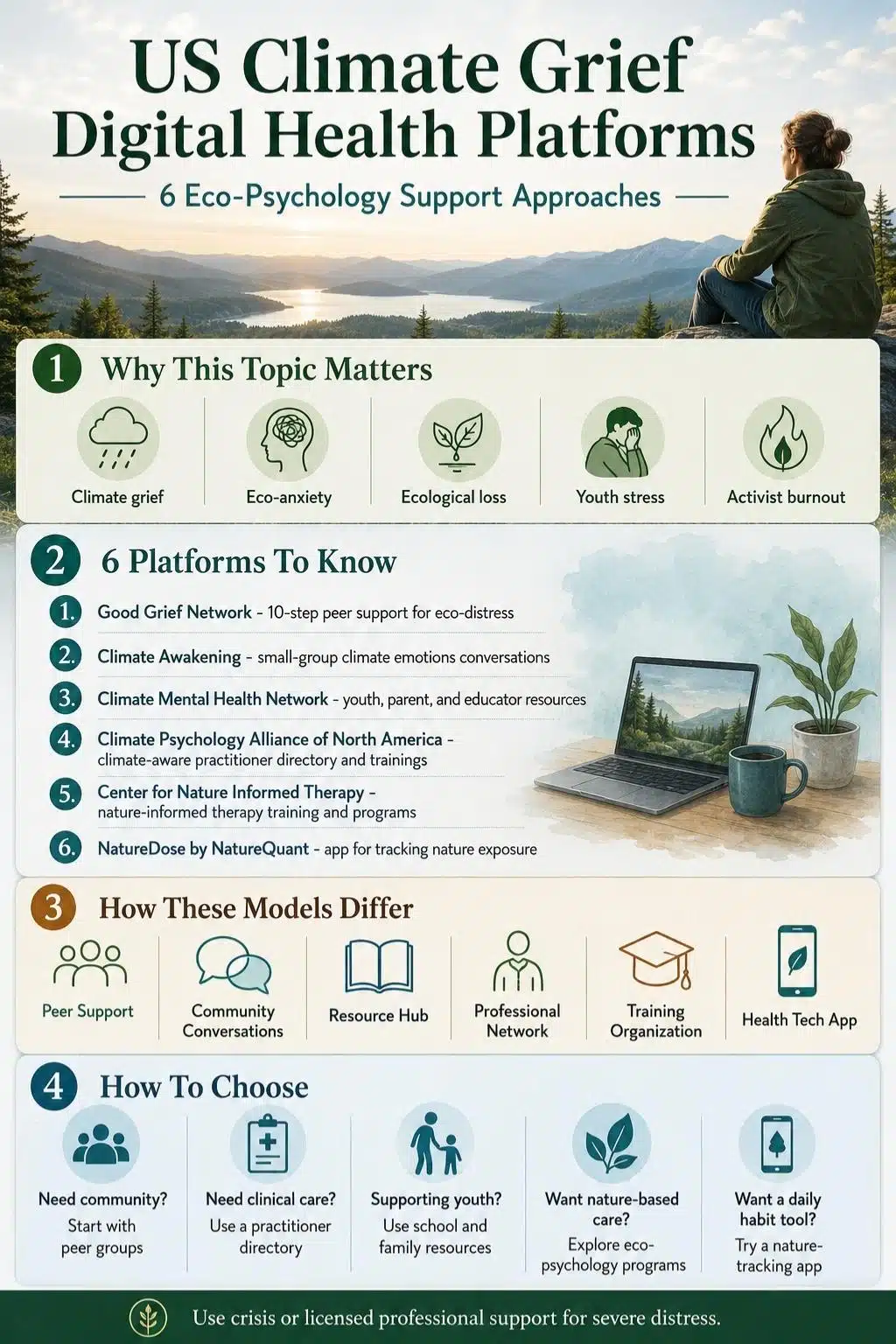
6 Climate Grief Digital Health Platforms in the US
These six platforms are not identical, and that is the point. Climate grief support is not one product category yet. It is a developing field with peer support, education, therapy, professional networks, and nature-based technology all playing different roles.
1. Good Grief Network
Good Grief Network is one of the clearest climate grief support platforms in the US. It serves people who feel overwhelmed by climate change, ecological damage, social instability, and the wider “polycrisis.”
Its main offering is a 10-step peer-support program. The structure gives participants a guided way to process heavy emotions, build community, and reconnect with meaning instead of staying stuck in isolation.
Business Snapshot
| Field | Verified Detail |
| Founder | LaUra Schmidt |
| Cofounder | Aimee Lewis Reau |
| Funding Model | Nonprofit model with donations, program fees, sliding-scale payments, scholarships, and work exchanges |
| Main Product/Service | 10-step peer-support groups for eco-distress, climate grief, and collective trauma |
| Target Customers | Individuals, climate-aware communities, facilitators, partner groups, and people experiencing eco-distress |
| Business Model | Mainly B2C, with facilitator and affiliate-community elements |
What the Platform Actually Does
Good Grief Network runs peer-to-peer support groups, often online, where people process emotional responses to climate and social crises. The 10-step program uses group sharing, journaling, embodiment exercises, and trained facilitation.
The platform is careful about one important boundary: it is not therapy. That honesty makes it more credible. It is designed for community-based emotional support, not clinical diagnosis or treatment.
How It Connects to Eco-Psychology
Good Grief Network’s work fits eco-psychology because it treats personal distress and planetary distress as connected. It does not frame climate grief as a private weakness. Instead, it gives people a relational space to feel, speak, listen, and act with more emotional capacity.
Market Position
Good Grief Network is strongest as a structured peer-support model. It is not trying to become a generic meditation app. Its value is in giving climate-aware people a place to process grief and burnout with others who understand the weight of the issue.
For buyers, funders, or partners, the strongest use case is community resilience. The weaker fit would be someone looking for one-on-one clinical care.
2. Climate Awakening
Climate Awakening focuses on climate emotions through small-group conversations. Its work centers on the idea that people need honest spaces to talk about fear, grief, rage, and pain related to the climate emergency.
The platform was founded by Margaret Klein Salamon, PhD, a clinical psychologist turned climate activist. That background gives the project a strong psychological foundation, even though the main product is conversation-based support rather than traditional therapy.
Business Snapshot
| Field | Verified Detail |
| Founder | Margaret Klein Salamon, PhD |
| Funding Model | Fiscally sponsored project, volunteer-run conversation model, donation-supported |
| Main Product/Service | Climate Emotions Conversations |
| Target Customers | Individuals experiencing climate fear, grief, rage, despair, or emotional isolation |
| Business Model | Mainly B2C and community-support focused |
Operating Model
Climate Awakening uses small-group digital conversations to help people speak openly about climate emotions. The platform describes its conversation tool as partially automated and volunteer-run.
This makes the model lighter than therapy and more scalable than traditional group counseling. It is not built around medical billing, insurance, or clinical treatment. It is closer to civic emotional infrastructure for people who are climate-aware but emotionally overloaded.
Customer Fit
Climate Awakening is a better fit for people who want to talk before they know what they need. Someone may not be ready to search for a therapist. They may simply need a serious, guided space where climate grief is not dismissed as an overreaction.
The platform is also useful for climate activists, young adults, parents, and professionals who feel isolated because climate emotions are hard to discuss in normal social settings.
Business Insight
Climate Awakening shows how climate mental health support may grow outside traditional healthcare channels. Its value is emotional permission. It gives people language, community, and a bridge from distress to action.
That is useful, but it also creates a clear limitation. The model should not be presented as clinical care. It is a conversation platform, not a licensed therapy marketplace.
3. Climate Mental Health Network
Climate Mental Health Network is one of the strongest resource platforms in this niche, especially for young people, parents, educators, and community organizations.
It does not position itself as a therapy provider. Instead, it works as a national resource hub focused on the emotional impacts of climate change. That includes climate emotions, grief, resilience, extreme weather support, youth tools, educator materials, workshops, and public-facing resources.
Business Snapshot
| Field | Verified Detail |
| Founder | Sarah Newman |
| Funding Model | Nonprofit, fiscally sponsored by Mockingbird Incubator |
| Main Product/Service | Free climate mental health resources, educational tools, workshops, programs, and guidance |
| Target Customers | Youth, parents, educators, schools, nonprofits, communities, companies, media, and technology partners |
| Business Model | B2C resource model plus B2B education, workshop, and partnership potential |
Product and Service Model
Climate Mental Health Network offers tools for people trying to understand and respond to climate emotions. Its site includes resources for youth, Gen Z, parents, caregivers, educators, and people dealing with extreme weather or grief.
The platform also supports climate-informed care through programs, partnerships, workshops, and educational materials. This gives it a broader operating model than a single app or support group.
Why It Matters for Youth Mental Health
Young people often carry climate distress differently from adults. They may feel fear about the future, anger at older generations, helplessness, or pressure to become activists before they have emotional support.
Climate Mental Health Network helps by creating language and tools for adults who support young people. That includes parents, teachers, school leaders, nonprofit workers, and community organizers.
Business Reality Check
This platform sits in a strong market position because it solves a real communication problem. Schools, families, nonprofits, and youth-serving organizations need climate mental health resources, but many do not have the expertise to create them internally.
The strongest growth path is likely through education, youth programs, workshops, partnerships, and resource licensing or sponsored public-health work. The platform should still be described carefully because it is not a direct therapy provider.
4. Climate Psychology Alliance of North America
Climate Psychology Alliance of North America is not a consumer wellness app. It is a professional network for people working at the intersection of climate change and mental health.
Its role is important because climate grief support depends heavily on trained professionals. If therapists, counselors, educators, and allied practitioners do not understand climate emotions, many clients may feel unheard or minimized.
Business Snapshot
| Field | Verified Detail |
| Founder | No single founder was clearly identified in the reviewed official sources |
| Funding Model | 501(c)(3) nonprofit with memberships, donations, events, and related support channels |
| Main Product/Service | Climate-aware practitioner directory, professional community, training, climate cafés, resources |
| Target Customers | Mental health professionals, allied practitioners, educators, researchers, and climate-aware clients |
| Business Model | B2B/professional network plus B2C directory access |
Professional Network Model
CPA-NA brings together mental health workers and allied professionals who want to understand and respond to the psychological impacts of climate change. Its work includes professional education, climate cafés, member programming, resources, and a climate-aware practitioner directory.
The directory is especially useful for people who want a therapist or practitioner who will not dismiss climate distress as irrational. That said, users still need to check credentials, licensing, location, insurance, and scope of practice.
How It Supports the Market
CPA-NA helps build the professional layer of climate mental health. This is different from running a consumer app. It trains, connects, and organizes people who may become part of the care system around climate grief.
That makes it relevant for therapists, clinics, educators, journalists, disaster-support workers, and climate organizations that need emotionally informed support frameworks.
Editorial Note
CPA-NA should not be described as a direct referral service in the same way as a commercial therapist marketplace might be. It has a directory and professional network, but individual users are responsible for checking whether a listed provider is licensed, available, and appropriate for their needs.
Its strongest value is credibility-building for the field itself.
5. Center for Nature Informed Therapy
Center for Nature Informed Therapy, or CNIT, brings eco-psychology into a more practice-based setting. Its work focuses on nature-informed therapy, professional training, research, retreats, and public programs.
The center’s approach is built around a simple but often overlooked idea: mental health support should not always happen only indoors, only through screens, or only through talk. Nature can support awe, regulation, reflection, resilience, and connection.
Business Snapshot
| Field | Verified Detail |
| Founder | Heidi Schreiber-Pan, PhD, LCPC |
| Funding Model | 501(c)(3) nonprofit with training, retreats, public programs, donations, scholarships, and partner projects |
| Main Product/Service | Nature-informed therapy training, therapy resources, retreats, practitioner development, public wellness programs |
| Target Customers | Therapists, mental health professionals, trainees, organizations, communities, and individuals interested in nature-informed care |
| Business Model | Mainly B2B/professional training, with B2C public programs and therapy-related services |
Service Structure
CNIT provides training for professionals who want to integrate nature into mental health care. It also supports retreats, public wellness programs, community projects, therapy-related services, and research.
This gives CNIT a more professional-development-heavy business model than most consumer-facing mental wellness apps. Its customers are not only individuals seeking support. They also include therapists, clinicians, organizations, and communities looking to bring nature-informed practices into their work.
Connection to Climate Grief
Climate grief is not only cognitive. It can show up as stress, disconnection, exhaustion, fear, and loss of meaning. Nature-informed therapy can help people rebuild a healthier relationship with the natural world while processing emotional distress.
That does not mean a walk in the woods “fixes” climate grief. That would be too shallow. The more realistic value is that nature-informed care can help people regulate their nervous systems, reconnect with place, and work with grief in a more embodied way.
Business Insight
CNIT fits the eco-psychology market better than the standard digital health market. Its digital relevance comes through online training, professional resources, directories, education, and program visibility, not through being a pure app business.
The strongest opportunity is professional training. As climate grief and eco-anxiety become more visible, more therapists may need structured training on nature-informed and climate-aware care.
6. NatureDose by NatureQuant
NatureDose is the most app-like platform on this list. It is not a climate grief therapy tool, and it should not be marketed as one. Its relevance comes from the eco-psychology side of the topic.
NatureDose is a personalized nature prescription tracker. It helps users monitor time spent indoors, outdoors, and exposed to natural environments. The broader company, NatureQuant, builds technology around nature exposure, NatureScore, and NatureDose.
Business Snapshot
| Field | Verified Detail |
| Founder/Cofounders | Jared Hanley, Christopher Bailey, and Christopher Minson are publicly identified in reporting and company-related sources |
| Funding Model | Privately held technology company; University of Oregon startup and venture-development support publicly noted |
| Main Product/Service | NatureDose app, NatureScore technology, nature exposure measurement tools |
| Target Customers | Individuals, healthcare partners, insurers, employers, researchers, real estate and wellness partners |
| Business Model | B2C app plus B2B data, partnership, healthcare, research, and wellness applications |
Product Model
NatureDose tracks a user’s exposure to natural environments. NatureQuant’s wider technology also includes NatureScore, which measures the amount and quality of natural elements around a location.
The business opportunity is broader than consumer wellness. NatureQuant’s tools have potential use cases in healthcare, health insurance, research, real estate, parks, workplace wellness, and public health.
Where It Fits in Eco-Psychology
Eco-psychology is not only about talking through distress. It is also about the relationship with place, nature, body, and daily environment. NatureDose supports that side of the equation.
For someone dealing with climate grief, nature exposure alone is not enough. But it can be a useful companion habit. A person who spends most of the day indoors, scrolling climate news, and feeling helpless may benefit from tracking and increasing time in green or blue spaces.
Business Reality Check
NatureDose has the clearest digital product model in this list. It looks more like a health technology platform than a climate support group.
The risk is overclaiming. Nature exposure can support mental well-being, but NatureDose should not be framed as a treatment for climate grief. Its best positioning is as a behavioral support tool that can work alongside therapy, peer support, outdoor programs, or lifestyle medicine.
Business Overview of the 6 Platforms
Here is a quick comparison of how these platforms differ from one another.
| Platform | Organization Type | Main Service | Funding Stage or Model | Target Customers | B2B or B2C |
| Good Grief Network | Nonprofit peer-support organization | 10-step climate grief and eco-distress support groups | Donations, program fees, scholarships, sliding-scale payments | Individuals, communities, facilitators | Mainly B2C with community/facilitator model |
| Climate Awakening | Fiscally sponsored project | Climate Emotions Conversations | Donation-supported, volunteer-run, fiscal sponsorship | Individuals with climate grief, fear, rage, despair | B2C/community |
| Climate Mental Health Network | Nonprofit resource hub | Youth, parent, educator, and community climate mental health resources | Nonprofit, fiscal sponsorship | Youth, parents, educators, schools, nonprofits, partners | B2C + B2B |
| Climate Psychology Alliance of North America | Professional nonprofit network | Practitioner directory, trainings, climate cafés, professional resources | 501(c)(3), memberships, donations, events | Mental health professionals, allied workers, and clients | B2B/professional + B2C directory |
| Center for Nature Informed Therapy | Nonprofit training and therapy organization | Nature-informed therapy training, retreats, programs, resources | 501(c)(3), training, retreats, donations, scholarships | Therapists, organizations, communities, individuals | Mainly B2B/professional + B2C programs |
| NatureDose by NatureQuant | Private health technology company | Nature exposure tracking app and NatureScore technology | Privately held company, partnership, and technology model | Individuals, healthcare, research, insurers, employers, wellness partners | B2C + B2B |
What This Market Tells Us About Climate Mental Health
The climate grief support market is not moving in one direction. It is split into several useful categories.
- Peer-support programs are filling an emotional gap. Good Grief Network and Climate Awakening are useful because many people need community before they need a formal product.
- Professional networks are becoming necessary. Climate Psychology Alliance of North America and CNIT show that therapists and mental health professionals need training, directories, and peer communities of their own.
- Youth and education resources are becoming a major need. The Climate Mental Health Network is important because young people may experience climate distress before they have the language to explain it.
- Nature-based health technology is creating a different layer of support. NatureDose does not treat climate grief, but it helps quantify nature contact, which may support wellbeing and nature connection.
The strongest platforms in this space avoid false certainty. They do not tell people to “calm down” or “stay positive.” They make room for grief, anger, fear, connection, and action.

How to Choose the Right Platform
The right platform depends on the user’s situation.
Someone who feels isolated and wants to talk with others may start with Good Grief Network or Climate Awakening. A parent, teacher, or youth program may find Climate Mental Health Network more useful.
A person looking for a climate-aware therapist may start with CPA-NA’s practitioner directory, then verify the provider’s credentials. A therapist who wants training in nature-informed care may look at CNIT. Someone who wants a daily nature habit may use NatureDose as a support tool.
A simple decision path:
- Choose peer support if the main issue is isolation.
- Choose a practitioner directory if distress is affecting daily life.
- Choose youth resources if the concern involves children, students, or family conversations.
- Choose nature-informed therapy if the person wants outdoor, body-based, or eco-psychology care.
- Choose a nature tracking app if the goal is daily behavior support.
- Choose emergency or clinical support immediately if someone is in crisis.
Climate grief does not always require a clinical response. But serious symptoms should not be handled only with apps, peer groups, or online resources.
The Business Opportunity Behind Eco-Psychology Platforms
Climate grief is likely to become more visible as extreme weather, biodiversity loss, pollution, displacement, and climate uncertainty continue to affect daily life. That creates a real business and public-health opportunity, but it has to be handled carefully.
The weak version of this market would be shallow wellness branding. A company could easily add “eco-anxiety” to a landing page and offer the same generic breathing exercises. That would not build trust.
The stronger version is more grounded. It includes trained facilitators, ethical practitioner directories, youth-safe resources, nature-based training, peer-support models, and digital tools that make nature connection easier without pretending to replace therapy.
The next wave may include:
- Climate-aware employee wellness programs
- Therapist training and certification models
- School-based climate emotions resources
- Digital nature prescription tools
- Insurance and healthcare partnerships around nature exposure
- Peer-support programs for climate workers and disaster-affected communities
- Resource licensing for schools, nonprofits, and public-health agencies
The platforms in this article show that the category is already forming. It is just not a clean SaaS category yet.
A More Honest Way to Support Climate Grief
The best Climate Grief Digital Health Platforms do not promise to erase climate anxiety. That would be unrealistic. In many cases, grief and concern are signs that someone is paying attention. The better goal is capacity.
People need ways to feel without shutting down, act without burning out, and reconnect with nature without pretending the crisis is simple. That is where eco-psychology, peer support, climate-aware therapy, youth education, and nature-based technology can work together.
Good Grief Network, Climate Awakening, Climate Mental Health Network, Climate Psychology Alliance of North America, Center for Nature Informed Therapy, and NatureDose each cover a different part of the problem.
None of them is the full answer. That is fine. Climate grief is too complex for one app, one directory, or one support group. The smarter path is to match the tool to the need, stay honest about clinical limits, and build support systems that help people remain connected to themselves, their communities, and the natural world.
Frequently Asked Questions About Climate Grief Digital Health Platforms
1. What Are Climate Grief Digital Health Platforms?
Climate grief digital health platforms are online programs, apps, directories, networks, or resource hubs that support people dealing with emotional distress related to climate change and ecological loss. They may offer peer support, education, therapy directories, nature-based tools, or professional training.
2. Is Climate Grief a Medical Diagnosis?
Climate grief is not usually treated as a formal diagnosis. It is a term used to describe grief, fear, sadness, anger, or emotional distress related to climate change, ecological damage, species loss, or environmental uncertainty.
3. Are These Platforms a Replacement for Therapy?
No. Some platforms are peer-support or education resources, not therapy. People experiencing severe anxiety, depression, trauma symptoms, suicidal thoughts, or major disruption in daily life should seek licensed professional or emergency support.
4. Can Eco-Psychology Help With Climate Anxiety?
Eco-psychology can help people explore the relationship between mental health, nature, grief, and ecological change. It may include nature-informed therapy, outdoor reflection, grief work, emotional processing, community connection, and meaning-making.
5. Which Platform Is Best for Schools or Youth Programs?
Climate Mental Health Network is one of the strongest fits for youth, parents, educators, and school-facing resources. It offers climate emotions tools and educational materials rather than positioning itself as a therapy provider.
6. Which Platform Is Best for Finding a Climate-Aware Therapist?
Climate Psychology Alliance of North America is a useful starting point because it offers a climate-aware practitioner directory. Users should still verify each provider’s license, location, availability, fees, and scope of practice before booking.