A food package can look healthy from the front and tell a different story on the back. A cereal box may highlight whole grains but still carry more sugar than expected. A snack bar may advertise protein while hiding a candy-bar-like ingredient list. A soup may look like a light lunch until the sodium number makes it a poor everyday choice.
That is why Reading Food Labels is worth learning. Not because every meal needs to be perfect, but because many packaged foods are designed to look better than they are. The label helps you slow down for a few seconds and ask better questions: How much am I actually eating? Is this mostly grain, sugar, oil, or salt? Is this a regular food for my home, or an occasional one?
You do not need to memorize every nutrient. You need a reliable order of checking.
Serving Size Comes First
Start with the serving size before reading anything else.
Calories, sugar, sodium, fat, fiber, and protein are usually listed for the serving shown on the label. That serving may not match what you eat. A small packet may contain two servings. A bowl of cereal at home may be twice the listed serving. A drink bottle may look moderate until the label makes clear that the package is not one serving.
This mistake is common because the numbers feel precise. But precise numbers are not useful if they are attached to an unrealistic portion.
When comparing two products, check whether the serving amounts are similar. A cereal with 8 grams of sugar per 30 grams is not automatically lower in sugar than a cereal with 10 grams per 45 grams. The serving weight changes the comparison.
Where labels show values per 100 grams or 100 milliliters, comparison is easier. Where serving-based labels dominate, the serving size deserves extra attention. Before judging calories, sugar, or sodium, ask one basic question: “Is this the amount I would actually eat?”
Compare Similar Foods, Not the Whole Supermarket
Label reading works best when the comparison is fair. Compare yogurt with yogurt, bread with bread, cereal with cereal, and soup with soup. A protein bar should not be judged as if it were a home-cooked meal. A canned soup should not be judged against fresh fruit.
The better question is: among the products I already buy, which one is the stronger everyday choice?
| Product Type | First Thing to Check | Also Check | Better Everyday Direction |
|---|---|---|---|
| Breakfast cereal | Sugar | Fiber | Less sugar, more fiber |
| Bread | First few ingredients | Fiber and sodium | Whole grain near the top |
| Yogurt | Added or total sugar | Protein | Plain or lower-sugar options |
| Canned soup | Sodium | Protein and fiber | Lower sodium if eaten often |
| Snack bars | Sugar | Fiber and ingredients | More filling, less dessert-like |
| Plant-based milk | Added sugar | Calcium and vitamin fortification | Unsweetened if used daily |
This is where label reading becomes practical. You are not trying to find a perfect packaged food. You are trying to improve the foods that show up in your kitchen again and again.
Calories Are Useful, But They Are Not a Health Score
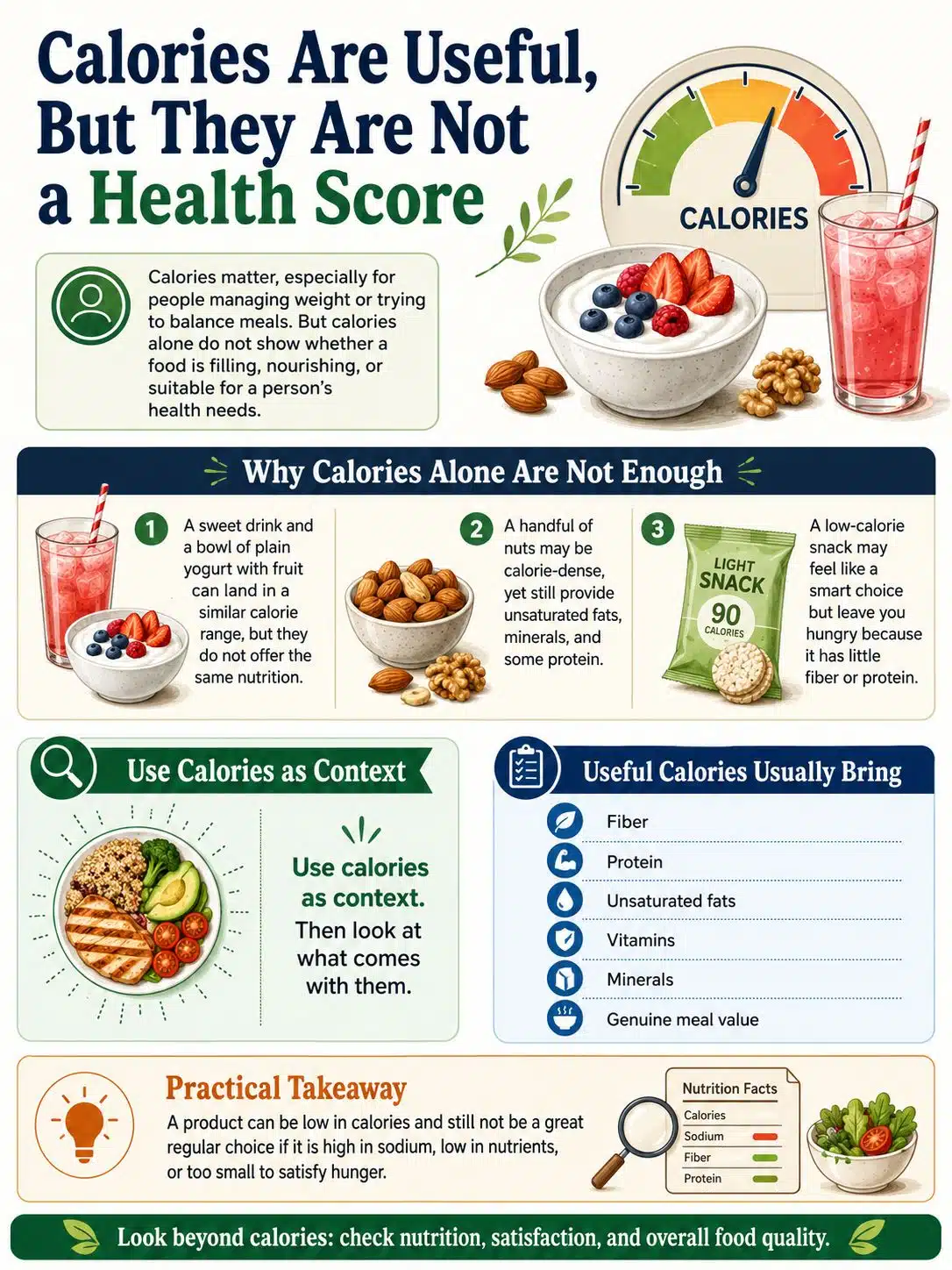
Calories matter, especially for people managing weight or trying to balance meals. But calories alone do not show whether a food is filling, nourishing, or suitable for a person’s health needs.
A sweet drink and a bowl of plain yogurt with fruit can land in a similar calorie range, but they do not offer the same nutrition. A handful of nuts may be calorie-dense, yet still provide unsaturated fats, minerals, and some protein. A low-calorie snack may feel like a smart choice but leave you hungry because it has little fiber or protein.
Use calories as context. Then look at what comes with them.
For everyday foods, useful calories usually bring something along: fiber, protein, unsaturated fats, vitamins, minerals, or genuine meal value. A product can be low in calories and still not be a great regular choice if it is high in sodium, low in nutrients, or too small to satisfy hunger.
The Nutrients That Deserve the Most Attention
Most people do not need to study every line of the nutrition panel. A few numbers usually do most of the work.
Fiber
Fiber is one of the most helpful label numbers, especially for bread, cereal, crackers, wraps, and snack bars. Higher fiber often suggests more whole grains, legumes, vegetables, fruit, nuts, or seeds. It can also make meals and snacks feel more satisfying.
A cereal with very little fiber and a lot of sugar is closer to a sweet snack than a reliable breakfast, even if the front of the box looks wholesome. For bread, fiber can help separate a genuinely whole-grain option from a brown-colored refined loaf.
Added Sugar, Total Sugar, and Free Sugar
Sugar labels vary by country, which is why this part can confuse shoppers.
Some labels clearly show added sugar. Others only show total sugar. Total sugar includes sugars naturally present in ingredients such as milk and fruit, plus any sugar added during processing. Free sugars are a public-health term that includes added sugars as well as sugars naturally present in honey, syrups, fruit juices, and fruit juice concentrates.
For real shopping, do two things: check the sugar line and read the ingredient list.
Sweetened yogurt, breakfast cereal, granola, sauces, flavored drinks, children’s snacks, and protein bars are worth checking closely. Sugar may appear as cane sugar, glucose syrup, brown rice syrup, dextrose, fructose, malt syrup, honey, molasses, or fruit juice concentrate.
A sweetener is not automatically better because it sounds natural.
Sodium or Salt
Sodium is easy to underestimate because many packaged foods do not taste extremely salty. Bread, cheese, processed meat, instant noodles, frozen meals, canned soup, sauces, seasoning mixes, and savory snacks can add up across the day.
Some countries list sodium. Others list salt. They are related, but not identical. For someone managing high blood pressure, kidney disease, heart disease, or another condition affected by sodium, medical advice should come from a clinician or dietitian.
For most households, the better habit is simple: if you buy the food often, compare two or three similar products and choose the lower-sodium option when taste and budget still work.
Saturated Fat
Saturated fat deserves a look in butter, cheese, cream-based sauces, pastries, processed meats, fried snacks, and packaged desserts. That does not mean every food needs to be fat-free. It means a product high in saturated fat and low in fiber, protein, or other useful nutrients is usually better treated as occasional.
Some higher-fat foods, such as nuts, seeds, avocado, olive oil, and oily fish, can still fit well in healthy eating patterns. The type of fat and the whole food matter.
Protein
Protein is useful, but it is also heavily marketed. A “high protein” label should not stop you from checking sugar, sodium, saturated fat, and serving size.
A protein bar can still be mostly sweeteners, refined ingredients, and added flavors. A protein drink may be convenient, but it is not automatically needed if regular meals already provide enough protein. Protein is a useful number, not a free pass.
Use % Daily Value as a Shortcut, Not a Personal Diet Plan
Percent Daily Value, or %DV, shows how much one serving contributes toward a reference daily intake. It is useful for quick comparison, but it is not personalized.
In the United States, 5% DV or less is generally considered low and 20% DV or more is high. Canada uses a different quick guide: 5% DV or less is a little and 15% DV or more is a lot. Other countries may use reference intakes, traffic light labels, or different front-of-pack systems.
This matters because labels are built for broad public use. They do not know your age, health condition, activity level, pregnancy status, medications, or dietary pattern.
Use %DV mainly to compare products. Higher numbers can be useful for nutrients many people need more of, such as fiber, vitamin D, calcium, iron, and potassium where listed. Lower numbers are usually better for nutrients many people need to limit, such as sodium, added sugar, and saturated fat.
The Ingredient List Tells You What the Numbers Cannot
The nutrition panel gives numbers. The ingredient list gives context.
Ingredients are generally listed in descending order by weight. The first few ingredients usually tell you what the product is mostly made from. If sugar, refined flour, or oil appears near the top, that matters. If whole oats, lentils, chickpeas, whole wheat, brown rice, milk, nuts, or fruit appear early, that matters too.
Do not panic over every unfamiliar ingredient. Some technical-sounding ingredients are vitamins, minerals, acidity regulators, stabilizers, or permitted additives. The better question is whether the product is mainly built from nutritious staple ingredients or mostly from refined starches, sweeteners, oils, colors, and flavorings.
Grain claims deserve special care. “Multigrain” only means more than one grain was used. It does not guarantee whole grain. “Made with whole grains” may mean the product contains some whole grain, not that it is mostly whole grain. For bread, crackers, cereal, or wraps, look for whole wheat, whole oats, brown rice, rye, barley, or another whole grain near the beginning of the ingredient list.
Front-of-Pack Claims Should Not Do the Deciding
The front of the package is built to catch your eye. It can be helpful, but it is not where the decision should end.
“No added sugar” does not mean sugar-free.
“Plant-based” does not automatically mean high in fiber or low in sodium.
“Natural” does not automatically mean nutritious.
“Baked, not fried” does not guarantee a food is low in salt, refined starch, or calories.
“Made with real fruit” may mean a small amount of fruit puree in a sweetened product.
Some front-of-pack systems are more useful than marketing claims. The UK traffic light system, for example, uses red, amber, and green to show whether a product is high, medium, or low in fat, saturated fat, sugars, and salt. Australia and New Zealand use the Health Star Rating system on many packaged foods to help compare similar products.
Even then, front labels work best as a first filter. The back label gives the fuller picture.
Allergies and Medical Diets Need Slower Label Reading
For allergies, celiac disease, and medically required diets, label reading is not just about better nutrition. It is about safety.
Do not rely only on familiar packaging. Recipes change. Manufacturing sites change. Imported products may follow different labeling rules. Advisory statements such as “may contain” or “made in a facility that also processes” are not used in the same way everywhere.
In the United States, sesame became the ninth major food allergen under federal law from January 1, 2023, joining milk, eggs, fish, crustacean shellfish, tree nuts, peanuts, wheat, and soybeans. That change improved label visibility, but people with serious allergies still need to read carefully, especially with older stock, imported foods, bakery items, sauces, and foods sold outside standard packaged-food settings.
For gluten, “wheat-free” and “gluten-free” are not the same thing. Gluten can come from wheat, barley, rye, and related grains. In the United States, foods carrying a “gluten-free” claim must meet the FDA rule of less than 20 parts per million gluten, but the claim is voluntary. Other countries may use similar or different rules.
For serious allergies or celiac disease, certified products and manufacturer confirmation may be worth the extra effort.
Parents Should Look for Patterns, Not Perfect Snacks
Children do not need perfect snacks. They need regular meals, enough variety, and fewer packaged foods pretending to be healthier than they are.
Children’s products often use bright packaging, cartoon characters, fruit pictures, or school-lunch language. That can make a food look more balanced than it is. A sweetened yogurt pouch, cereal bar, and boxed juice may each seem reasonable alone. Together, they can become a high-sugar lunch with little fiber or protein.
For parents, the most useful checks are serving size, sugar, fiber, sodium, and the first few ingredients. The aim is not to ban every sweet food. It is to avoid letting sweetened, low-fiber packaged foods become the default.
Practical upgrades can be small:
- Choose a cereal with more fiber and less sugar.
- Move from sweetened yogurt to a lower-sugar version, or plain yogurt with fruit.
- Pick bread where whole grain appears near the top of the ingredient list.
- Treat juice and sweet drinks as occasional, not automatic.
- Compare snack bars instead of assuming the one with oats on the wrapper is the better option.
Small changes matter more when the food is eaten often.
A Store Routine That Does Not Take Forever
A good label-reading routine should be quick enough to use in a real shop.
First, check the serving size. Does it match what you or your family would actually eat?
Second, check the nutrient that matters most for that food. For cereal, look at sugar and fiber. For soup, sodium. For yogurt, sugar and protein. For bread, fiber, sodium, and whole-grain ingredients.
Third, read the first few ingredients. That usually tells you what the product is built from.
Fourth, compare only similar products. A snack bar should be compared with another snack bar, not with a full meal.
Fifth, think about frequency. A salty instant meal once in a while is different from a salty lunch eaten every workday.
This routine works because it does not ask you to become a nutrition expert in the supermarket aisle. It asks you to notice the label details that change your regular habits.
What Better Choices Look Like in Practice
A better label choice is often a small improvement, not a perfect switch.
With yogurt, plain yogurt gives the most control because fruit or sweetness can be added at home. But if your household prefers flavored yogurt, comparing sugar and protein can still lead to a better choice.
With cereal, more fiber and less sugar usually make a stronger everyday option than a cereal built mostly from refined grain and sweeteners.
With canned soup, sodium is often the detail that matters most. A lower-sodium soup may still not be perfect, but it can be a better regular pantry item.
With bread, color can mislead. A brown loaf is not automatically whole grain. The ingredient list matters more than the shade.
With snack bars, check whether the product is mostly a sweet bar with protein added or a more filling mix of oats, nuts, seeds, or fruit with moderate sugar.
That is the useful side of Reading Food Labels. It helps you improve repeat choices without making food feel like a moral test.
What Not to Obsess Over
A long ingredient list is not automatically a warning sign. Some fortified foods, spice blends, allergy-friendly products, and plant-based products need more ingredients for texture, stability, or nutrition.
Organic does not mean low in sugar, sodium, or saturated fat. Organic cookies are still cookies.
Gluten-free does not mean healthier for everyone. It is essential for people with celiac disease and useful for some medically advised diets. For everyone else, the rest of the label still matters.
“Superfood” claims are often overrated. Oats, lentils, beans, eggs, frozen vegetables, canned fish, plain yogurt, nuts, and seeds may be more useful than expensive packaged snacks with trendy ingredients.
One number should not decide everything. Low calorie, low fat, high protein, plant-based, and no added sugar can each be useful in the right context. None of them automatically makes a food a better everyday choice.
Final Thoughts
Reading Food Labels is a practical shopping skill. Once you know the order, the label becomes less intimidating: serving size first, then the nutrients that matter for that food, then the first few ingredients. Front-of-pack claims can help you notice a product, but the back label should shape the decision.
Start with the foods you buy most often. Bread, cereal, yogurt, soup, sauces, snacks, and drinks are good places to begin because small changes there can affect the whole week. Choose the lower-sodium soup if soup is a regular lunch. Pick the cereal with more fiber if it is eaten most mornings. Compare yogurts instead of trusting the fruit picture on the container.
A label will not tell you everything about your diet. It will tell you enough to make the next choice more confidently.
FAQs on Reading Food Labels Effectively
What is the first thing I should check on a food label?
Start with the serving size. Every number on the label, including calories, sugar, sodium, fat, fiber, and protein, is usually based on that serving amount. If you eat more than the listed serving, you need to adjust the numbers.
Is total sugar the same as added sugar?
No. Total sugar includes naturally occurring sugar from foods such as milk and fruit, plus any sugar added during processing. Added sugar refers only to sugar added by the manufacturer or during preparation. Some countries list added sugar clearly, while others mainly show total sugar.
Are “natural” or “organic” foods always healthier?
No. These claims do not automatically mean a product is low in sugar, sodium, saturated fat, or calories. Organic cookies, natural chips, and fruit-flavored snacks can still be highly processed or high in sugar. The nutrition label and ingredient list matter more than the front-of-pack claim.
What should people with diabetes look for on food labels?
Serving size and total carbohydrate are usually the first things to check. Fiber and added sugar, where listed, also matter. People using insulin or following a specific carbohydrate plan should follow advice from their doctor or dietitian.
How can parents use food labels when buying snacks for children?
Parents should check serving size, sugar, fiber, sodium, and the first few ingredients. A snack with fruit pictures or whole-grain claims may still be high in sugar and low in fiber. Small swaps, such as choosing higher-fiber cereal or lower-sugar yogurt, can make everyday snacks better without creating strict food rules.