History is rarely just a collection of dates; it is a continuously evolving mosaic of human ambition, tragedy, and cultural revolution. Looking closely at May 25 in history, we see a day that profoundly bridges human liberation and creative expression. On this exact date, the world witnessed the birth of Kazi Nazrul Islam, the Rebel Poet who ignited the anti-colonial spirit across the Bengal delta through his fierce verses. Half a world away, American President John F. Kennedy stood before Congress on this day to dare humanity to reach the moon, fundamentally altering our trajectory among the stars. It is the day independent African nations united to form the Organization of African Unity, shedding the heavy chains of European imperialism. Yet, it is also a day marked by profound tragedy and reckoning, such as the murder of George Floyd, which sparked a modern global awakening on civil rights.
Examining May 25 reveals that whether through the founding of a republic, the first screening of a cinematic space opera, or a single act of defiance, this date remains an enduring testament to our shared global struggle for freedom, identity, and progress.
The Bangalee Sphere
The Indian subcontinent, and specifically the Bengali-speaking region, has witnessed monumental cultural and political shifts on this day. The events of May 25 highlight a legacy of fierce independence, intellectual brilliance, and resilience against colonial forces.
Establishment of the Sabarmati Ashram (1915)
The founding of the Sabarmati Ashram provided a physical and ideological base for the Indian independence movement, fundamentally changing how resistance was organized.
Established by Mahatma Gandhi shortly after his return from South Africa, the ashram was far more than a commune. It functioned as an ideological laboratory where the principles of Ahimsa (non-violence) and Swadeshi (self-reliance) were rigorously tested and refined. It was here that Gandhi organized local textile workers and conceptualized national campaigns. The discipline and organizational strategies cultivated at Sabarmati resonated deeply with intellectuals and activists across the subcontinent, including the Bengal region, shifting the anti-colonial struggle from disjointed, localized protests into a unified, mass-mobilized national movement. It ultimately served as the historic launchpad for the 1930 Dandi March.
Moving from deliberate political strategy to the chaotic force of nature, the region faced a very different kind of turning point two decades later.
The Devastating Ganges Delta Cyclone (1941)
The 1941 cyclone remains one of the most destructive climatic events to strike the coastal areas of undivided Bengal, exposing severe vulnerabilities in colonial administration during a time of global crisis.
Striking with winds exceeding 100 mph, the cyclone generated massive storm surges that swept through Barisal, Noakhali, and surrounding districts. The destruction of infrastructure, livestock, and standing crops was absolute, leading to an immediate and catastrophic loss of life. Because the British colonial administration was entirely consumed by the logistics and resource demands of World War II, the relief response for the Bengali population was tragically delayed and inadequate. This massive localized destruction decimated the agrarian economy and severely depleted regional grain reserves, serving as a direct catalyst for the horrific Bengal Famine that would ravage the region just two years later.
Three decades later, the region would face another crisis, this time a human-made one, resulting in a decisive structural shift in a war for survival.
Kazi Nazrul Islam (1899)
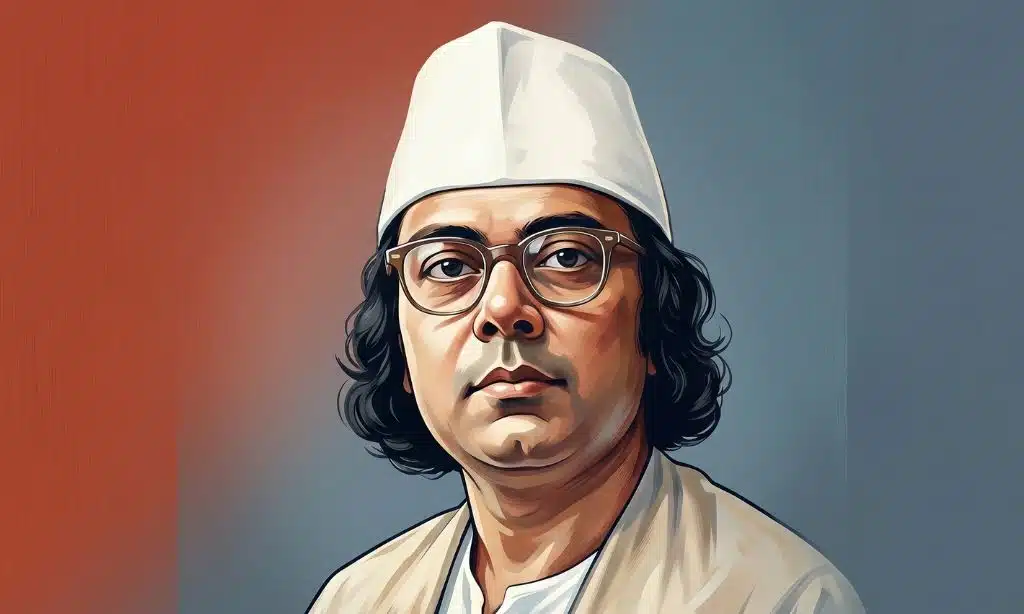
The ‘Rebel Poet’ Kazi Nazrul Islam was born on May 24, 1899 (May 25, or the 11th of Jaistha in the Bengali calendar) in the village of Churulia, located in the Bardhaman district of undivided Bengal. After losing his father, his childhood was spent enduring extreme poverty and endless struggle. At a very young age, he was forced to work various jobs, ranging from a singer in a Leto (traveling folk theater) group to a worker in a bakery. Despite such immense adversity, his profound passion for literature, music, and philosophy never diminished.
Studying in a maktab (Islamic elementary school) during his childhood brought him into contact with Arabic, Persian, and Islamic teachings, which further broadened his perspectives. Later, his creations—such as the publication Dhumketu (The Comet) and the poem Bidrohi (The Rebel)—shook the foundations of the British ruling class, ultimately leading to his imprisonment.
The messages of religious harmony, human equality, and the courage to stand up against injustice that Nazrul conveyed through his writings remain highly relevant to our society today. The extraordinary synthesis of Hindu and Muslim traditions that he achieved offers a profound lesson in our current era of polarization.
Every year, his birth anniversary is celebrated with great reverence as Nazrul Jayanti. Observed annually on the 11th of Jaistha (May 25), this day brings together people across Bangladesh, West Bengal, and the global Bengali diaspora to honor his enduring legacy. Through vibrant cultural programs, poetry recitations, and heartfelt renditions of Nazrul Sangeet, Nazrul Jayanti serves as a powerful reminder of his fiery spirit, his lifelong fight for freedom, and his unwavering commitment to humanity.
Rash Behari Bose (1886)
While many fought the British Empire from within the subcontinent through civil disobedience, Rash Behari Bose took the fight to the global stage, proving that anti-colonial resistance could be meticulously militarized.
A mastermind behind the 1912 Delhi-Lahore Conspiracy and the Ghadar Mutiny, Bose managed to evade British capture and flee to Japan. Once there, he didn’t retire into exile; instead, he relentlessly advocated for Indian independence, learned Japanese, and integrated into political circles. He ultimately founded the Indian Independence League and played the crucial foundational role in organizing the Indian National Army (INA), seamlessly passing the baton to Subhas Chandra Bose. His legacy is one of strategic brilliance and an unwavering commitment to armed liberation.
While Bose fought the empire with militant strategy abroad, another revolutionary voice was preparing to shake the foundations of colonial rule from within through the sheer power of literature.
International Observances & Holidays
May 25 is recognized globally as a day to reflect on the legacy of colonialism, advocate for vulnerable populations, and celebrate cultural independence.
Major International Days
The international community comes together on this date to observe several crucial socio-political and cultural movements.
| Observance | Focus Area | Significance |
| Africa Day | Continental Unity | Commemorates the 1963 founding of the Organization of African Unity. |
| International Missing Children’s Day | Child Safety | Raises awareness for abducted children and preventative measures. |
| Geek Pride Day | Pop Culture | A global celebration of fandoms, science fiction, and nerd culture. |
Africa Day remains a profound celebration of the continent’s ongoing journey toward total independence and economic integration, marking the day 32 independent African states established a unified front against colonial rule. International Missing Children’s Day was established following the tragic disappearance of six-year-old Etan Patz in New York City in 1979, an event that fundamentally overhauled how global law enforcement agencies collaborate on missing persons cases. On a lighter note, Geek Pride Day honors the anniversary of the 1977 release of Star Wars, giving millions an excuse to unapologetically celebrate their favorite niches in pop culture.
National Days
For several nations, this date is deeply tied to the establishment of sovereignty and the birth of their modern political states.
| Country | Observance | Historical Context |
| Jordan | Independence Day | Celebrates the 1946 end of the British mandate, elevating Abdullah I to King. |
| Argentina | First Patriotic Government Day | Marks the 1810 May Revolution that ousted the Spanish Viceroy. |
Jordan’s Independence Day is a culmination of decades of diplomatic negotiation, transitioning the territory from a League of Nations mandate into a fully recognized sovereign kingdom. In South America, Argentina celebrates the anniversary of the Primera Junta, the first local government formed in Buenos Aires, which sparked the brutal but successful Argentine War of Independence against the Spanish Empire.
Global History
Beyond the subcontinent, May 25 has been a stage for revolutionary declarations, tragic conflicts, and monumental technological leaps across the globe.
United States
The American historical timeline on May 25 is defined by foundational political moments and critical civil rights milestones.
| Year | Event | Significance |
| 1787 | Constitutional Convention Opens | Delegates began drafting the document that would govern the United States. |
| 1961 | The Apollo Pledge | JFK committed the nation to landing a man on the moon by the decade’s end. |
| 1977 | Star Wars Released | George Lucas’s film debuted, permanently altering the cinematic landscape. |
| 2020 | Murder of George Floyd | Ignited the largest civil rights protests in American history regarding systemic racism. |
The Constitutional Convention in Philadelphia was a fragile experiment; men with wildly differing regional interests locked themselves in a room to build a functional republic from scratch. Over a century and a half later, President John F. Kennedy’s audacious Apollo Pledge accelerated the Space Race, directly leading to the historic 1969 lunar landing. In recent history, the heartbreaking 2020 murder of George Floyd under the knee of a Minneapolis police officer transcended American borders, forcing a massive, global reckoning regarding police brutality and racial inequity.
Russia
Political exile and the fight for ideological freedom define Russia’s connection to this date in the post-Soviet era.
| Year | Event | Significance |
| 1994 | Alexander Solzhenitsyn Returns | The dissident author returned to Russia after two decades in forced exile. |
Alexander Solzhenitsyn, whose masterpiece The Gulag Archipelago exposed the brutal realities of the Soviet forced labor camp system to the world, was stripped of his citizenship in 1974. His return to a newly democratic Russia in 1994 served as a profound cultural and psychological milestone, signaling the definitive end of Soviet-era intellectual censorship.
China
From ancient dynastic falls to modern aviation tragedies, China’s history on this day is marked by extreme turbulence.
| Year | Event | Significance |
| 1644 | Fall of the Ming Dynasty | Manchu forces captured Beijing, establishing the Qing Dynasty. |
| 2002 | China Airlines Flight 611 | The Boeing 747 disintegrated mid-air over the Taiwan Strait, killing all 225 aboard. |
The collapse of the Ming Dynasty in 1644 was accelerated when Ming general Wu Sangui opened the gates of the Great Wall at the Shanhaiguan pass, forming a desperate alliance with the invading Manchus that ultimately handed them the empire. In modern times, the 2002 crash of China Airlines Flight 611 due to structural failure from an improper repair decades earlier completely overhauled global aviation maintenance protocols for aging aircraft.
United Kingdom
British history on May 25 is characterized by dramatic shifts in governance and tragic moments in literary history.
| Year | Event | Significance |
| 1659 | Richard Cromwell Resigns | Marked the collapse of the Commonwealth and the return of the Monarchy. |
| 1895 | Oscar Wilde Convicted | The playwright was sentenced to hard labor for “gross indecency.” |
The resignation of Richard Cromwell as Lord Protector highlighted the instability of the English republic without the iron will of his father, Oliver Cromwell, paving the way for the restoration of King Charles II. Centuries later, the devastating criminal conviction of Oscar Wilde for his homosexuality destroyed the career and health of one of the Victorian era’s most brilliant literary minds, remaining a dark stain on British legal history.
Europe
European political and religious borders were fundamentally redrawn on this day during the Renaissance.
| Year | Event | Significance |
| 1521 | The Edict of Worms Issued | Holy Roman Emperor Charles V declared Martin Luther an outlaw and heretic. |
The Edict of Worms was the turning point of the Protestant Reformation. By officially banning the writings of Martin Luther and calling for his arrest, the Catholic Church cemented a permanent religious schism that would spark centuries of devastating wars across the European continent.
Australia
Australian history on this day highlights the courage of early aviation pioneers challenging the sheer scale of the globe.
| Year | Event | Significance |
| 1930 | Amy Johnson Arrives in Darwin | Completed the first solo flight by a woman from England to Australia. |
Navigating an open-cockpit biplane across brutal weather systems and vast oceans, Amy Johnson’s arrival in Darwin made her an instant global celebrity. Her incredible feat proved the viability of long-distance international air travel and shattered gender barriers in early 20th-century aviation.
Canada
Canada’s connection to this timeframe is heavily tied to its colonial heritage and modern national identity.
| Observance | Focus Area | Significance |
| Victoria Day Context | Royal Heritage | Celebrates the sovereign’s birthday and serves as the unofficial start of summer. |
While technically honoring Queen Victoria’s May 24 birthday, Canada legally mandates the holiday to be observed on the Monday preceding May 25. It remains Canada’s oldest state holiday, acting as a unique cultural bridge between the nation’s British colonial past and its contemporary, multicultural present.
Rest of World
Key diplomatic milestones in Africa and the Middle East have shaped the geopolitical landscape on this day.
| Year | Event | Region | Significance |
| 1963 | OAU Founded | Ethiopia | 32 nations united to accelerate the decolonization of Africa. |
| 2000 | Israeli Withdrawal | Lebanon | Israel ended its controversial 18-year occupation of southern Lebanon. |
The founding of the Organization of African Unity (now the African Union) was a monumental diplomatic victory, prioritizing Pan-African solidarity over the devastating legacy of the Berlin Conference. In the Middle East, the 2000 withdrawal of Israeli forces from southern Lebanon concluded a bloody, two-decade occupation, fundamentally altering the security dynamics and political influence of militant groups in the Levant.
Notable Births & Deaths (Global)
May 25 is deeply entrenched in the arts and sciences, having introduced the world to master philosophers and acting legends, while also mourning the loss of brilliant composers.
Famous Births
The global figures born on this day have shaped philosophy, cinema, and modern music.
| Year | Name | Nationality | Profession & Contribution |
| 1803 | Ralph Waldo Emerson | American | Essayist who led the transcendentalist movement. |
| 1926 | Miles Davis | American | Jazz trumpeter and composer who revolutionized 20th-century music. |
| 1939 | Ian McKellen | British | Legendary actor celebrated for iconic stage performances and blockbuster films. |
| 1963 | Mike Myers | Canadian | Comedian and actor behind massive cultural hits like Shrek and Austin Powers. |
| 1976 | Cillian Murphy | Irish | Oscar-winning actor known for Oppenheimer and Peaky Blinders. |
Ralph Waldo Emerson fundamentally changed American intellectualism; his essays on individualism and the inherent goodness of nature broke away from rigid European philosophical traditions. In the realm of music, Miles Davis consistently pushed the boundaries of jazz, transitioning the genre through bebop, cool jazz, and electric fusion. On screen, the sheer versatility of actors like Sir Ian McKellen and Cillian Murphy proves the enduring power of profound, theatrical storytelling in modern cinema.
Famous Deaths
The world lost transformative leaders and iconic musicians on this historic date.
| Year | Name | Nationality | Cause/Legacy |
| 992 | Mieszko I | Polish | The first documented ruler of Poland; brought the region into Latin Europe. |
| 1934 | Gustav Holst | English | Composer of The Planets, which deeply influenced modern cinematic scores. |
| 2020 | George Floyd | American | His tragic murder became the catalyst for a global civil rights movement. |
| 2023 | Tina Turner | American/Swiss | The “Queen of Rock ‘n’ Roll,” leaving behind an unmatched legacy of resilience and vocal power. |
Gustav Holst’s orchestral suite The Planets remains a masterclass in mood and thematic orchestration, laying the direct groundwork for the epic film scores of composers like John Williams. Tina Turner’s passing marked the end of an era for rock and R&B; her incredible life story of surviving domestic abuse to become one of the highest-selling recording artists in history remains a masterclass in human resilience.
“Did You Know?” Trivia
History is often made in the margins. Here are three fascinating, lesser-known facts about May 25 to share at the dinner table.
-
The Greatest 45 Minutes in Sports: On May 25, 1935, American track-and-field legend Jesse Owens set three world records and tied a fourth at a meet in Ann Arbor, Michigan—all within the span of exactly 45 minutes, despite suffering from an injured back.
-
The Bambino’s Final Swing: Baseball icon Babe Ruth stepped up to the plate on May 25, 1935, and hit his 714th career home run. It was a massive shot over the roof of Forbes Field, and it would be the final home run he ever hit before retiring.
-
The First Coin Parking Meter: Carl Magee of Oklahoma was granted a U.S. patent on May 25, 1938, for the first coin-controlled parking meter, forever changing the landscape of urban driving and city revenue collection.
Quote of the Day
“I believe that this nation should commit itself to achieving the goal, before this decade is out, of landing a man on the moon and returning him safely to the earth.”
— President John F. Kennedy (Spoken during his historic address to a joint session of Congress on May 25, 1961, formally launching the Apollo program).
Echoes of May 25: A Lasting Perspective
From the dusty grounds of the Sabarmati Ashram to the far reaches of the lunar surface envisioned by the Apollo program, the events of May 25 prove that human progress is driven by an unyielding desire to challenge the impossible. It is a day that demands we reflect on the devastating costs of imperialism while simultaneously celebrating the revolutionary voices—like Kazi Nazrul Islam and Ralph Waldo Emerson—who taught us how to articulate our freedom.
As we observe the historical gravity of this date, we are reminded that whether we are mourning the tragic loss of marginalized lives or celebrating the birth of cinematic legends, the history made on May 25 continues to actively shape the cultural and political boundaries of our modern world.