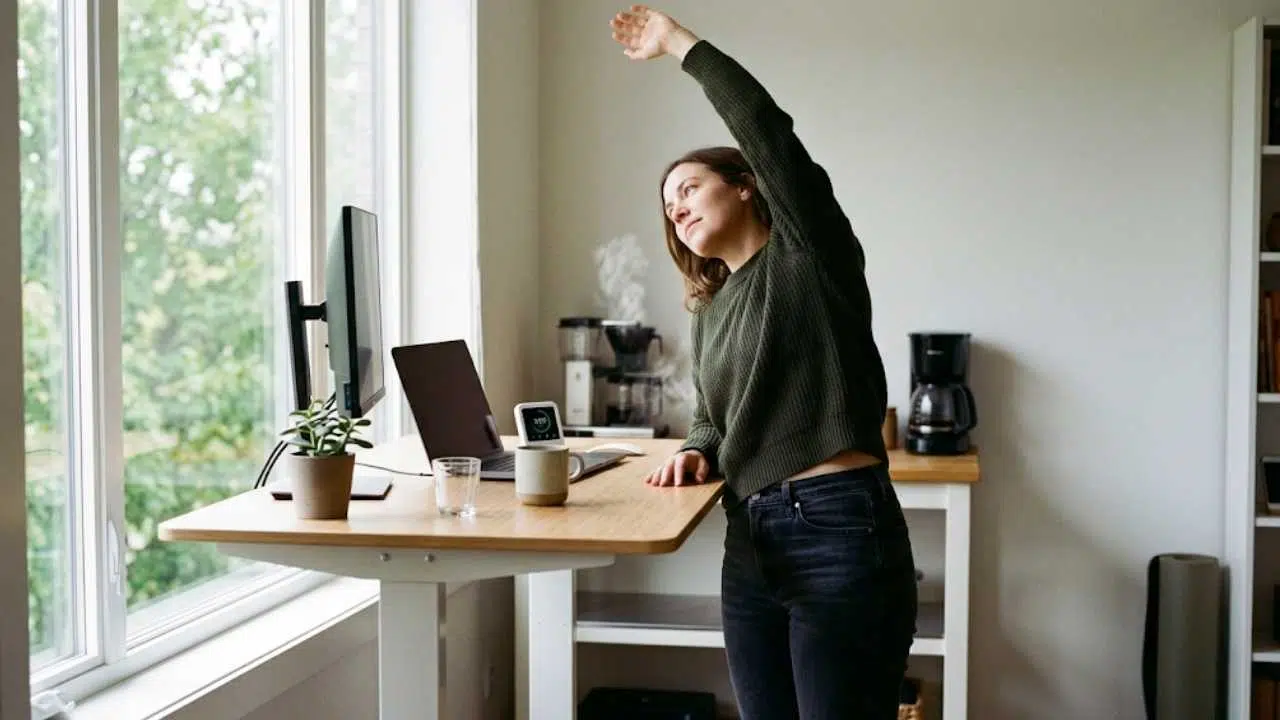
Movement habits sedentary workers can follow should feel practical, not dramatic. Most desk-heavy people do not need another unrealistic fitness promise. They need small ways to move before the body starts complaining.
I learned this through long screen-heavy days. A workout helped, but it did not fully fix the stiffness that came from sitting for hours without interruption. The real change came from adding movement into the workday itself.
That is the key. A sedentary lifestyle fix is not only a gym plan. It is a daily movement system.
If you sit for work, study, writing, editing, design, meetings, or remote tasks, your body needs regular position changes. Micro movements, short walks, mobility breaks, standing calls, and basic strength training all matter. For the corporate athlete, movement is part of performance. Better movement supports focus, energy, posture, mood, sleep, and recovery.
These habits also connect with the best healthy habits because daily movement works best with hydration, nutrition, sleep, recovery, and stress control.
The goal is simple: Sit less, move more often, and make the body feel useful again.
Why Sedentary Lifestyles Need Daily Movement Habits?
A sedentary lifestyle does not only mean “not exercising.” It often means spending long blocks of the day in the same position. You may sit at a desk, sit in traffic, sit during meals, sit during meetings, then sit again at night. Even if you exercise a few times per week, your body still feels the effect of long stillness. The problem is not that sitting is evil. The problem is sitting without enough breaks, variety, and movement. Your hips stay bent. Your shoulders roll forward. Your neck reaches toward the screen. Your back gets tired. Your legs do less work. Over time, this can make the body feel stiff, heavy, and less responsive.
Many people try to solve this with one hard workout. That can help, but it may not fully undo 8 to 10 hours of stillness. A better approach is to spread movement across the day. Short breaks, standing tasks, walking, stretching, and small strength habits all help. Desk job movement works because it lowers the barrier. You do not need to change clothes, travel to a gym, or block an hour. You simply interrupt sitting before it turns into discomfort.
Micro movements matter too. Shoulder rolls, calf raises, ankle circles, glute squeezes, neck resets, and standing hip shifts may look small, but they keep the body from being locked into one shape. The most useful movement habits are not intense. They are frequent. The body likes options, not one position all day.
| Sedentary Lifestyle Problem | What It Feels Like | Movement Habit That Helps |
| Long sitting blocks | Stiff hips and heavy legs | Hourly standing and walking breaks |
| Screen posture | Neck and shoulder tension | Shoulder rolls and chest openers |
| Low daily steps | Low energy and poor circulation | Short walks after meals |
| Back fatigue | Achy lower back | Glute bridges and hip mobility |
| Mental fog | Slower focus | 5-minute movement reset |
| Desk stress | Shallow breathing and tension | Breathing walk or standing stretch |
| Weak posture muscles | Rounded upper back | Rows, wall angels, band pull-aparts |
Daily movement habits give your body more chances to recover from sitting before stiffness becomes the default.
What Makes a Sedentary Lifestyle Fix Actually Work?
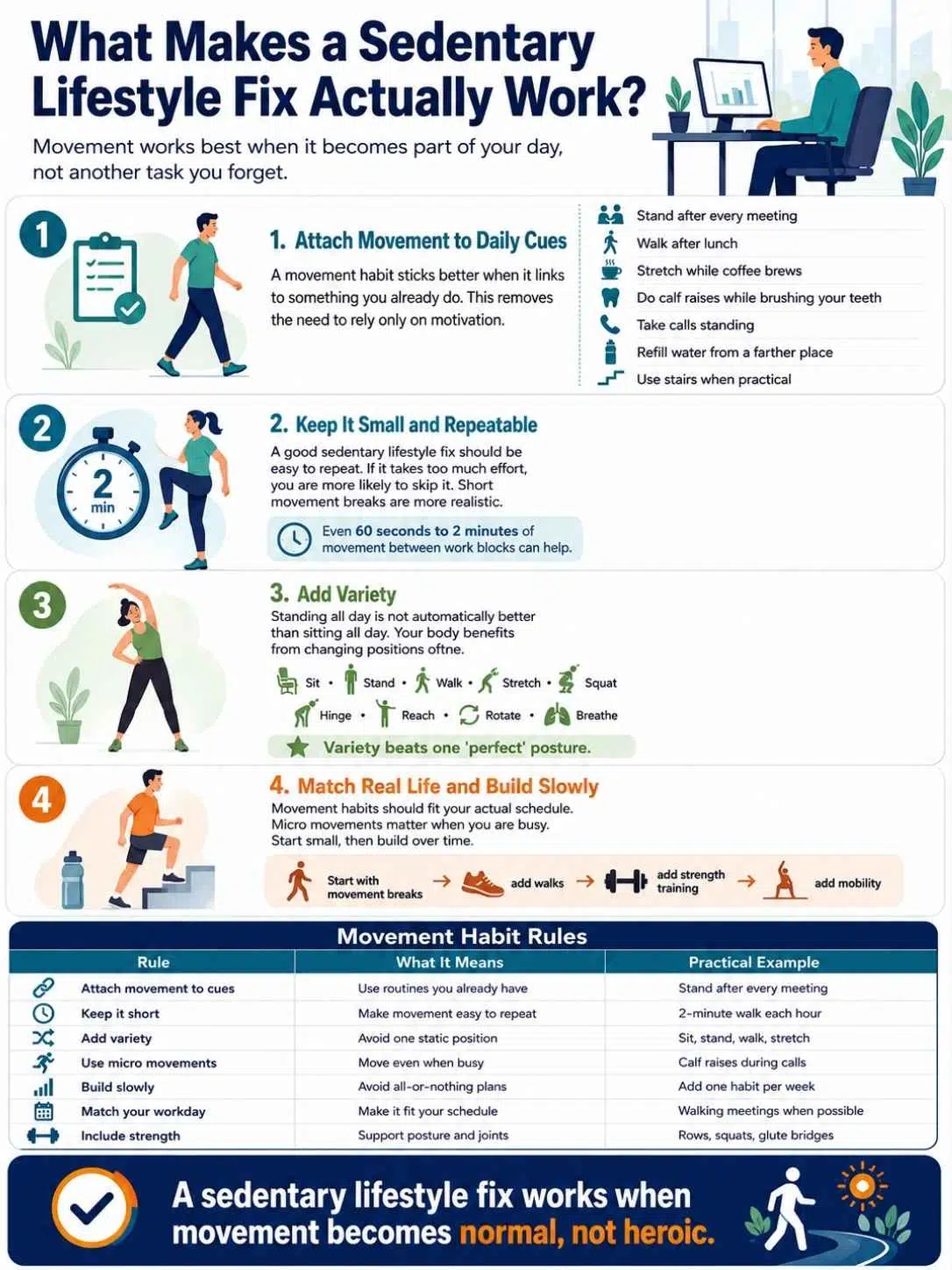
A sedentary lifestyle fix works when movement becomes part of the day, not another task you keep forgetting. That means the habit needs to attach to something you already do. For example, stand after every meeting. Walk after lunch. Stretch when coffee brews. Do calf raises while brushing your teeth. Take calls standing. Refill water from a farther place. Use stairs when practical. These cues make movement easier because they do not depend only on motivation.
A useful movement habit should also be small enough to repeat. If your plan requires a full workout every time you feel stiff, you will skip it often. If your plan asks for 60 seconds of movement between work blocks, it becomes realistic. Another important point is variety. Standing all day is not automatically better than sitting all day. Your body needs position changes. Sit, stand, walk, stretch, squat, hinge, reach, rotate, and breathe. Variety beats one “perfect” posture.
The best habits also respect work reality. You may not be able to leave your desk every 20 minutes. You may have calls, deadlines, clients, classes, or family needs. That is why micro movements matter. Even small shifts can help keep the body engaged. The final piece is progression. Start with movement breaks. Then add walks. Then add strength training. Then add mobility. You do not need to fix everything in one week.
| Movement Habit Rule | What It Means | Practical Example |
| Attach movement to cues | Use routines you already have | Stand after every meeting |
| Keep it short | Make movement easy to repeat | 2-minute walk each hour |
| Add variety | Avoid one static position | Sit, stand, walk, stretch |
| Use micro movements | Move even when busy | Calf raises during calls |
| Build slowly | Avoid all-or-nothing plans | Add one habit per week |
| Match your workday | Make it fit your schedule | Walking meetings when possible |
| Include strength | Support posture and joints | Rows, squats, glute bridges |
A sedentary lifestyle fix works when movement becomes normal, not heroic.
10 Movement Habits for Sedentary Lifestyles
These 10 movement habits are designed for real desk-heavy lives. You do not need to start all of them today. Choose two or three that fit your current routine. If your hips feel tight, start with standing breaks and hip mobility. If your energy drops after lunch, start with a walk. If your neck and shoulders hurt, add upper-body resets. If your steps are low, use walking cues. If your body feels weak, add short strength snacks.
The goal is not to replace workouts. The goal is to make movement part of the day so your body does not spend most of its time inactive. These habits also work well with full body workouts busy people can follow. Strength sessions are important, but daily movement fills the gaps between workouts.
The best part is that most of these habits require no special equipment. A chair, wall, desk, floor space, water bottle, timer, and comfortable shoes are enough.
| Habit | Main Benefit | Best For |
| 1. Stand and reset every hour | Breaks long sitting | Desk workers |
| 2. Use 2-minute walking breaks | Improves circulation and energy | Low-step days |
| 3. Add micro movements during work | Keeps body active | Busy schedules |
| 4. Walk after one meal | Supports daily activity | Lunch or dinner routines |
| 5. Take calls standing or walking | Adds movement without extra time | Phone-heavy work |
| 6. Stretch desk-tight areas daily | Reduces stiffness | Hips, neck, shoulders |
| 7. Build posture-strength snacks | Supports upper back and core | Screen posture |
| 8. Use stairs and distance cues | Adds natural activity | Office and errands |
| 9. Create a 5-minute movement reset | Restores energy | Afternoon slump |
| 10. Track movement lightly | Builds awareness | Beginners |
1. Stand and Reset Every Hour
Standing once every hour is one of the simplest movement habits sedentary workers can build. It does not require equipment, fitness experience, or a big schedule change. It only requires a cue. The cue can be a timer, calendar alert, meeting end, water refill, bathroom break, or task switch. The habit is to stand before your body starts asking loudly.
Standing alone is not magic, but it breaks long stillness. When you stand, you shift your hips, wake your legs, change your posture, and give your eyes and neck a break from the same screen position. The mistake is turning this into a complicated routine. You do not need to stretch for 15 minutes every hour. Stand up. Take a few breaths. Roll your shoulders. Walk to refill water. Sit back down if needed.
If standing every hour feels too frequent, start with three anchor points: mid-morning, after lunch, and mid-afternoon. Once that feels normal, add more. This habit is especially useful for remote workers because home setups often blur work and rest. Hours can pass without natural movement.
| Hourly Reset Step | Time Needed | What It Does |
| Stand up | 10 seconds | Breaks sitting posture |
| Roll shoulders | 20 seconds | Releases upper-body tension |
| Shift weight side to side | 30 seconds | Wakes hips and legs |
| Walk briefly | 1-2 minutes | Improves circulation |
| Refill water | 1 minute | Connects movement with hydration |
| Look away from screen | 20 seconds | Gives eyes a break |
The habit is not “stand all day.” The habit is “do not stay frozen all day.”
2. Use 2-Minute Walking Breaks
A 2-minute walking break sounds too small to matter until you actually use it. It can change how your body feels across a workday. The idea is simple. After a long block of sitting, walk for two minutes. Walk around the room, hallway, office, balcony, building, or outside if possible. The location matters less than the interruption.
Walking breaks help because they bring movement to the legs, hips, spine, and breathing. They also help the brain reset. Many times, a problem that feels stuck at the desk feels clearer after a short walk. The mistake is waiting for a long walk. If you wait until you have 30 free minutes, you may not move at all. A 2-minute walk is easy enough to do between calls, after a task, or before lunch.
These short walks also build steps without needing a separate workout. Over a day, several short walks can add up. For people who struggle with afternoon fatigue, a walking break often works better than immediately reaching for more caffeine.
| Walking Break Cue | What To Do | Why It Helps |
| After a meeting | Walk for 2 minutes | Clears mental residue |
| Before lunch | Walk around the room | Transitions out of work mode |
| After lunch | Walk lightly | Supports energy |
| Before a hard task | Walk and breathe | Improves focus |
| During a phone call | Walk slowly | Adds movement without extra time |
| Afternoon slump | Walk before caffeine | Tests if movement is enough |
Two minutes is not impressive. That is why it works.
3. Add Micro Movements During Work
Micro movements are tiny movements you can do without leaving your workspace. They are useful because busy people cannot always take full breaks. Examples include ankle circles, calf raises, glute squeezes, shoulder rolls, chin tucks, wrist circles, seated marches, gentle spinal rotations, and hand stretches. These movements do not replace exercise, but they keep the body from becoming completely still.
The best time to use micro movements is during low-focus moments: waiting for a file to load, listening during a call, reading a document, watching a training video, or thinking through a problem. A common mistake is dismissing micro movements because they seem too easy. But for sedentary lifestyles, the first goal is not always intensity. It is frequency. Small movement often repeated is better than no movement for hours.
Micro movements are also private and office-friendly. You do not need to do anything dramatic in front of colleagues. You can move your feet, stretch your wrists, or roll your shoulders quietly. This habit is especially useful for people with packed calendars. Even when you cannot take a full break, you can move something.
| Micro Movement | Reps or Time | Best Moment |
| Ankle circles | 10 each direction | During calls |
| Calf raises | 15-20 reps | While standing |
| Shoulder rolls | 10 reps | After typing |
| Chin tucks | 5-8 reps | Screen fatigue |
| Wrist circles | 10 each direction | Keyboard breaks |
| Seated march | 30 seconds | Long meetings |
| Glute squeeze | 10 reps | Sitting reset |
| Gentle spinal twist | 5 each side | Reading breaks |
Micro movements teach your body that work does not require stillness.
4. Walk After One Meal
Walking after one meal is one of the easiest movement habits because it attaches to something you already do. You eat, then you walk. You do not need to walk after every meal. Start with one. Lunch and dinner are usually easiest. A short walk after lunch can reset the workday. A walk after dinner can help the evening feel calmer.
The walk does not need to be intense. Five to 10 minutes is enough to begin. If you have more time, walk longer. If not, keep it short and repeatable. This habit is useful because it turns movement into a daily rhythm instead of a separate event. It also helps people who feel sluggish after meals. Instead of sitting immediately, you give your body gentle motion.
If you work from home, walk outside, around the building, or even inside. If you work in an office, walk the hallway, stairs, courtyard, or nearby area. The key is to choose the meal where the habit has the least friction.
| Meal Walk Option | Time Needed | Best For |
| After breakfast | 5-10 minutes | Starting the day with movement |
| After lunch | 5-15 minutes | Beating afternoon slump |
| After dinner | 10-20 minutes | Calmer evening routine |
| Indoor walk | 5 minutes | Bad weather or limited space |
| Family walk | 10-20 minutes | Social wellness and movement |
| Workday walk | 5-10 minutes | Desk job movement |
One meal walk per day can become a powerful sedentary lifestyle fix because it happens consistently.
5. Take Calls Standing or Walking
Calls are one of the easiest places to add movement because many calls do not require sitting. If you do not need to type, present, or take detailed notes, stand or walk. This habit works because it does not ask for extra time. You are already on the call. You simply change the position.
Standing calls can help reduce sitting hours. Walking calls can add steps and make conversations feel less stiff. Some people even think more clearly while walking, especially during brainstorming or planning calls. The mistake is trying to walk during every call. Some calls require full attention, screen sharing, note-taking, or privacy. Choose the right calls. Listening calls, casual check-ins, voice meetings, and phone conversations are better options.
Keep the movement calm. You do not need to pace aggressively. Walk slowly. Stand tall. Shift weight. Use headphones if helpful. Keep safety and privacy in mind. For remote workers, this habit can turn phone-heavy days into movement-friendly days.
| Call Type | Movement Option | Notes |
| Casual check-in | Walk slowly | Good for low-pressure talks |
| Listening meeting | Stand or shift weight | Works if camera is off |
| Brainstorming call | Walk indoors or outside | Can improve idea flow |
| Client call | Stand only if appropriate | Keep tone professional |
| Long family call | Walk outside | Adds movement and connection |
| Private conversation | Walk in a quiet place | Protect confidentiality |
Standing and walking calls make movement part of work instead of something you must add later.
6. Stretch Desk-Tight Areas Daily
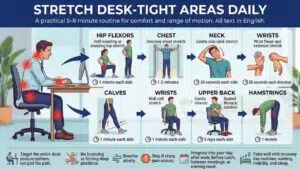
Desk work usually tightens the same areas: hip flexors, chest, neck, wrists, calves, and upper back. A daily stretching habit works best when it targets those areas directly. The goal is not extreme flexibility. The goal is comfort, range of motion, and awareness. Stretching should not hurt. It should feel like the body is getting space back.
A practical desk-stretch routine can take five to eight minutes. Do it after work, before lunch, between meetings, or during your evening reset. The timing matters less than consistency. The mistake is stretching only the area that hurts. For example, lower back discomfort may be connected to tight hips, weak glutes, or long sitting. A better routine looks at the whole desk posture pattern.
Do not bounce or force deep positions. Breathe slowly. Hold each stretch gently. If something creates sharp pain, stop. This habit works well with recovery day routines because stretching is often more useful when paired with walking, mobility, and sleep.
| Desk-Tight Area | Stretch | Time |
| Hip flexors | Half-kneeling or standing hip stretch | 1 minute each side |
| Chest | Doorway chest stretch | 1-2 minutes |
| Neck | Gentle side neck stretch | 30 seconds each side |
| Wrists | Wrist flexor and extensor stretch | 30 seconds each direction |
| Calves | Wall calf stretch | 1 minute each side |
| Upper back | Seated thoracic rotation | 5 reps each side |
| Hamstrings | Gentle forward fold | 1 minute |
Daily stretching gives the body a counter-signal to long sitting.
7. Build Posture-Strength Snacks
Posture is not only about sitting up straight. It is about having the strength and endurance to support your body through the day. A posture-strength snack is a short strength habit that targets muscles desk work often neglects. These include the upper back, glutes, core, and deep neck muscles.
Rows, band pull-aparts, wall angels, glute bridges, dead bugs, bird dogs, and farmer carries can all help. You do not need a full workout. Two or three moves for five minutes can make a difference over time. The mistake is trying to hold perfect posture all day. That becomes tiring and unrealistic. Instead, build strength and change positions often.
This habit is especially useful for people who slump at the laptop, reach forward for the mouse, or feel upper-back fatigue by afternoon. Keep a resistance band near your desk if possible. Visibility matters. If the band is in a drawer, you may forget it. If it is on the desk, you are more likely to use it.
| Posture-Strength Move | Reps or Time | Why It Helps |
| Band pull-apart | 12-15 reps | Trains upper back |
| Wall angels | 8-10 reps | Improves shoulder awareness |
| Glute bridge | 12-15 reps | Activates glutes |
| Dead bug | 8 each side | Builds core control |
| Bird dog | 8 each side | Trains spine stability |
| Farmer carry | 30-60 seconds | Supports posture and grip |
| Chin tuck | 5-8 reps | Helps neck position awareness |
Posture improves better through strength and movement than through constant self-correction.
8. Use Stairs and Distance Cues
Stairs and distance cues add natural movement without needing a workout plan. They work because they turn ordinary tasks into movement opportunities. Use the stairs when it is practical. Park slightly farther away. Use a restroom on another floor if safe. Walk to a farther water station. Stand while waiting. Carry groceries with control. Choose the longer route inside a building.
These actions are small, but they reduce the amount of time your body spends doing nothing. They also create daily activity that does not feel like exercise. The mistake is underestimating normal movement. Many people think only gym workouts count. But daily activity matters too. The body responds to repeated use.
Do not make this extreme. You do not need to turn every errand into a challenge. Just choose one or two distance cues that fit your day. This habit is useful for office workers, apartment residents, students, and anyone whose day includes small movement choices.
| Distance Cue | Movement Upgrade |
| Elevator | Use stairs for 1-3 floors when practical |
| Parking | Park slightly farther away |
| Water refill | Use a farther water source |
| Bathroom break | Walk to a farther restroom |
| Waiting time | Stand or walk slowly |
| Errands | Carry bags with good posture |
| Indoor route | Choose the longer hallway |
Distance cues help movement become part of your environment.
9. Create a 5-Minute Movement Reset
A 5-minute movement reset is for moments when your energy drops, your body stiffens, or your mind starts to drag. It is short enough to do almost anywhere. The reset should include one lower-body move, one upper-body move, one mobility move, and one breathing moment. This gives your body a quick full-system wake-up without turning the break into a workout.
Use it mid-morning, after lunch, before a hard task, or before the final work block of the day. It can be especially helpful before deep work because movement often clears restlessness. The mistake is reaching for caffeine or snacks every time energy drops. Sometimes the body needs movement, not more stimulation.
A 5-minute reset also helps you notice patterns. If you need it every hour, your sleep, hydration, food, or workload may need attention too. Keep it simple. The same sequence repeated daily is better than a new routine every time.
| Minute | Movement | Purpose |
| 1 | March in place | Raises circulation |
| 2 | Bodyweight squats or chair sit-to-stands | Wakes legs and hips |
| 3 | Shoulder rolls and chest opener | Releases screen posture |
| 4 | Hip hinges or standing rotations | Moves spine and hips |
| 5 | Slow breathing | Calms and refocuses |
This reset supports habits for better focus because it gives your brain a clean transition between work blocks.
10. Track Movement Lightly
Tracking movement can help, but it should not become stressful. The goal is awareness, not obsession. A simple tracker can show you patterns. Maybe you move less on meeting-heavy days. Maybe your steps drop when you work from home. Maybe you feel better on days with a lunch walk. That information is useful.
You can track steps, movement breaks, walks, workouts, stretching, or simply whether you interrupted sitting. Use the method that feels easiest. A notebook, habit app, smartwatch, calendar checkmark, or sticky note can all work. The mistake is tracking too much. If the tracking system feels like work, you will stop. Start with one metric.
For example: “Did I take three movement breaks today?” That is enough.
Do not let numbers replace body awareness. A step count can be helpful, but it does not tell the whole story. Strength, mobility, posture, energy, and recovery matter too. Tracking should help you make better choices, not make you feel guilty.
| Tracking Option | What to Track | Best For |
| Step count | Daily walking | People who like numbers |
| Break count | Movement breaks | Desk workers |
| Habit checkmark | Did I move hourly? | Simple tracking |
| Stretch log | Mobility days | Stiff bodies |
| Workout notes | Strength progress | People training weekly |
| Energy note | How movement affected focus | Productivity link |
| Pain or stiffness note | Body feedback | Pattern spotting |
Light tracking turns movement into a visible habit.
A Simple Desk Job Movement Routine
A desk job movement routine should be easy enough to repeat during real workdays. It should not require changing clothes, sweating heavily, or leaving your workspace for long. The routine should include movement at three levels: micro movements during work, short breaks between tasks, and one longer movement block during the day. This gives your body several chances to change position.
Start with morning setup. Put water nearby, keep a resistance band visible, and decide your first break cue. Then use the workday to build movement around natural transitions. Meetings, calls, lunch, coffee, and task switches are all good cues. The most important habit is to stop waiting for discomfort. Move before your body feels locked up. This is the difference between reactive movement and preventive movement.
A simple desk job movement plan can be done in an office or at home. Adjust it based on privacy, space, and schedule.
| Time | Movement Habit | Time Needed |
| Start of work | Shoulder rolls and posture reset | 1 minute |
| Every hour | Stand, walk, or stretch | 2 minutes |
| During calls | Stand or walk if possible | Call length |
| Before lunch | Short walk | 5 minutes |
| After lunch | Easy walk | 5-10 minutes |
| Mid-afternoon | 5-minute movement reset | 5 minutes |
| End of work | Hip, chest, and neck stretch | 5 minutes |
If that feels like too much, start with the minimum version.
| Minimum Desk Movement Plan | Action |
| Morning | Stand and stretch for 1 minute |
| Midday | Walk after lunch for 5 minutes |
| Afternoon | Do 10 chair sit-to-stands |
| Evening | Stretch hips and chest for 3 minutes |
A desk job movement routine works when it becomes part of the workday, not an interruption to it.
Beginner Mistakes That Keep Sedentary Habits Stuck
The first mistake is thinking one workout cancels out the rest of the day. Workouts help, but sitting for long blocks still affects how the body feels. Daily movement breaks matter.
The second mistake is trying to stand all day. Standing all day can also create discomfort if you do not move. The solution is not only standing. The solution is changing positions often.
Another mistake is waiting for motivation. Movement habits should not depend on motivation. They should depend on cues. Stand after a meeting. Walk after lunch. Stretch after work. Refill water when you finish a task.
Many people also ignore strength. Stretching feels good, but posture and joint support often need strength too. Rows, glute bridges, squats, carries, and core work can help build a more resilient body.
Some people go too hard too fast. They buy a standing desk, set a huge step goal, start intense workouts, and then burn out. A better approach is gradual. Add one movement habit at a time. A final mistake is making movement feel like punishment. Movement should help your day feel better. If every habit feels harsh, you will resist it.
| Mistake | Why It Keeps You Stuck | Better Habit |
| Relying only on workouts | Leaves long sitting untouched | Add hourly movement breaks |
| Standing all day | Creates another static posture | Change positions often |
| Waiting for motivation | Makes movement inconsistent | Use cues and reminders |
| Ignoring strength | Posture support stays weak | Add posture-strength snacks |
| Skipping walks | Misses easy daily movement | Walk after one meal |
| Going too hard too fast | Leads to burnout | Build gradually |
| Tracking obsessively | Creates pressure | Track lightly |
| Moving only after pain | Reacts too late | Move before discomfort |
A sedentary lifestyle fix should feel doable enough to repeat.
Movement Habits by Lifestyle Type
Different sedentary lifestyles need different movement habits. A remote worker has different movement barriers than an office worker. A student has different challenges than a founder. A parent may have less predictable time. A content creator may sit for long editing blocks.
The principles stay the same: Break sitting, use cues, move often, stretch tight areas, build strength, and walk when possible. The routine changes based on life.
Remote workers may need stronger break cues because there are fewer natural transitions. Office workers may use stairs, walking meetings, or farther water stations. Students may move between study blocks. Founders may need movement before decision-heavy tasks. Writers and editors may need posture-strength snacks.
A good movement habit should fit the environment. If you share an office, choose subtle micro movements. If you work from home, use larger resets. If you travel, use walking and hotel-room mobility.
| Lifestyle Type | Main Movement Problem | Best Habit to Start |
| Remote worker | Few natural breaks | Hourly stand and reset |
| Office worker | Long meetings | Standing or walking calls |
| Student | Long study blocks | 5-minute movement reset |
| Writer or editor | Screen posture | Chest stretch and band pulls |
| Founder or manager | Back-to-back calls | Walking calls |
| Parent working from home | Unpredictable schedule | Micro movements and short walks |
| Gamer or creator | Long seated sessions | Timed breaks and wrist mobility |
| Frequent traveler | Sitting in transit | Hotel-room mobility and walks |
The best movement plan is the one that fits your real day.
How Movement Habits Support the Best Healthy Habits?
Movement habits support nearly every other healthy routine. When you move more often, your body usually feels less stiff, your energy improves, and your mind gets more breaks from screen pressure. Morning habits for better energy become easier when the body starts the day with light movement. A short walk or mobility reset can help wake the system. Full body workouts busy people can follow become easier when daily movement keeps the body from feeling locked up.
Recovery day routines also benefit from movement. Active recovery, easy walks, and gentle mobility can help you feel better between workouts. Evening habits that improve sleep may improve when the body has moved enough during the day and the mind feels less restless at night. Hydration habits connect naturally with movement breaks. A water refill can become a walking cue. Nutrition habits that work long term connect too, especially when walking after meals becomes part of the routine.
Movement also supports habits for better focus. Short walking breaks and micro movements can reduce mental fog and help you return to work with clearer attention.
| Movement Habit | Related Healthy Habit Topic |
| Morning mobility | Morning habits for better energy |
| Lunch walk | Habits for better focus |
| Standing water refill | Hydration habits |
| Post-meal walk | Nutrition habits that work long term |
| Desk reset | Movement habits sedentary |
| Strength snack | Full body workouts busy |
| Gentle evening stretch | Evening habits that improve sleep |
| Active recovery walk | Recovery day routines |
| Breathing walk | Habits that reduce stress long term |
| Social walk | Social wellness habits |
Movement is not separate from wellness. It is one of the daily signals that tells the body it is still being used.
Final Thoughts
Movement habits sedentary workers can follow do not need to be complicated. You do not need to change your whole life in one week. You need to interrupt sitting more often, walk when possible, stretch the areas your desk tightens, build simple strength, and make movement easier to remember.
Start small. Stand once every hour. Walk after one meal. Add micro movements during calls. Stretch your hips and chest after work. Keep a resistance band near your desk. Use a 5-minute reset when your energy drops. The goal is not to become restless all day. The goal is to stop letting stillness run your body.
A sedentary lifestyle fix works when movement becomes normal. That is how desk job movement becomes sustainable. That is how micro movements become useful. And that is how daily movement supports the best healthy habits for energy, focus, posture, recovery, sleep, and long-term wellness.
Frequently Asked Questions (FAQs) About Movement Habits Sedentary
What are movement habits for sedentary lifestyles?
Movement habits for sedentary lifestyles are small daily actions that break up long sitting. They include standing breaks, short walks, micro movements, stretching, walking calls, posture-strength exercises, and light mobility throughout the day.
What is the best sedentary lifestyle fix?
The best sedentary lifestyle fix is a combination of frequent movement breaks, daily walking, basic strength training, stretching desk-tight areas, and reducing long uninterrupted sitting. One workout helps, but movement throughout the day matters too.
How often should desk workers move?
Desk workers should try to change position regularly throughout the day. A practical goal is to stand, walk, stretch, or move briefly at least once every hour. Even two minutes can help build the habit.
Do micro movements really help?
Micro movements are not a replacement for workouts, but they help reduce long periods of stillness. Ankle circles, shoulder rolls, calf raises, wrist stretches, and seated marches can keep the body more active during work.
What are easy desk job movement ideas?
Easy desk job movement ideas include standing during calls, walking after meetings, using a farther water station, doing chair sit-to-stands, stretching the chest and hips, rolling the shoulders, and taking a short walk after lunch.
Is standing better than sitting?
Standing can help break up sitting, but standing all day is not the full answer. The best approach is changing positions often. Sit, stand, walk, stretch, and move throughout the day.
Can I fix a sedentary lifestyle without going to the gym?
Yes. You can start with walking, movement breaks, stretching, bodyweight exercises, stairs, standing calls, and short home workouts. A gym can help, but it is not required to begin.