Most people do not need another strict food rule. They need a better way to notice what is happening when food becomes rushed, emotional, distracted, or automatic.
A meal can disappear quickly. A work message comes in, the plate is half-finished, and the food barely registers. A stressful evening turns into repeated trips to the kitchen. Lunch happens beside a laptop. A snack starts as “just a few bites” and ends when the packet is empty.
Mindful Eating Practices are useful because they slow that process down. Not dramatically. Not perfectly. Just enough to help you notice hunger, fullness, taste, mood, habit, and satisfaction before the moment runs by itself.
This is not a diet plan. It is not a weight-loss shortcut. It is not a moral test of whether you ate “properly.” Mindful eating is a way of paying closer attention before, during, and after eating. For people who stress-eat, eat quickly, feel guilty around food, or want healthier habits without rigid restriction, that awareness can be a practical starting point.
It should also fit real life. Meals happen during work breaks, family routines, travel, illness, celebrations, tight budgets, and long days. Mindful eating does not require every meal to be quiet, homemade, slow, and perfectly balanced. If the practice makes eating feel more pressured, it needs to be simplified.
What Mindful Eating Actually Means
Mindful eating means bringing attention to the eating experience instead of staying on autopilot.
That attention can include physical hunger, fullness, taste, smell, texture, emotions, thoughts, food environment, and the reason you reached for food in the first place. Sometimes the reason is simple hunger. Sometimes it is stress, boredom, tiredness, loneliness, habit, social pressure, or the pleasure of eating something you enjoy.
None of those reasons automatically makes the eating “bad.” The point is to notice what is true.
A mindful eating check-in may sound like this:
- Am I physically hungry, emotionally unsettled, or both?
- What does this food actually taste like after the first few bites?
- Am I enjoying this, or am I continuing because it is there?
- Would more food feel comfortable, or am I already satisfied?
- Did this meal give me enough energy and satisfaction to continue the day?
These questions are not meant to interrupt every bite. They are small moments of attention. Over time, they can help rebuild trust in body cues that may have been buried under dieting, stress, irregular meals, or years of distracted eating.
Mindful eating overlaps with intuitive eating, but they are not identical. Intuitive eating is a broader non-diet framework that includes body respect, rejecting diet mentality, emotional coping, movement, and gentle nutrition. Mindful eating is narrower. It focuses more directly on awareness during eating and the conditions around meals.
Stress-Eating Is Not Just a Willpower Problem
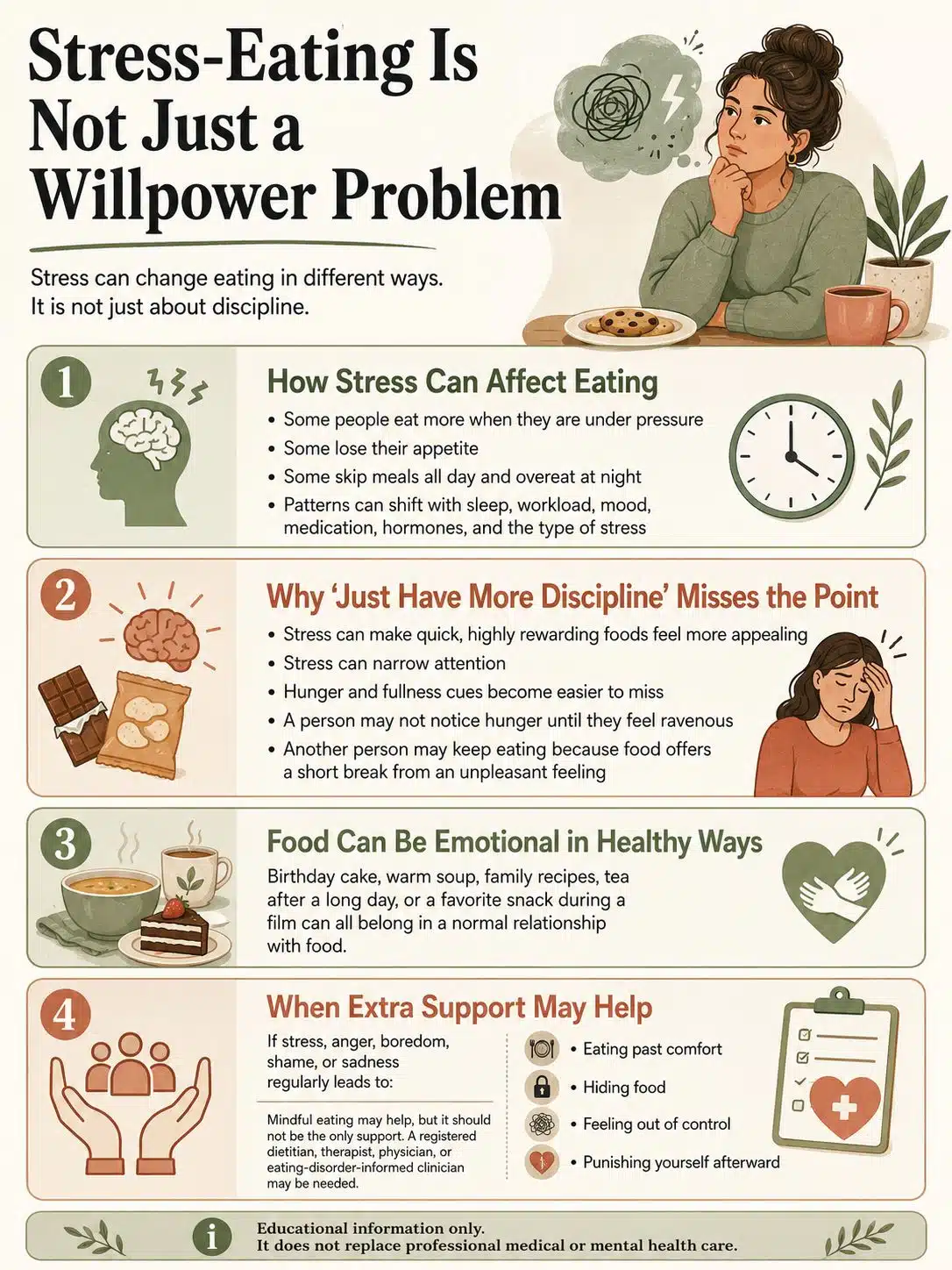
Stress changes eating in different ways. Some people eat more when they are under pressure. Some lose their appetite. Some skip meals all day and overeat at night. Some swing between those patterns depending on sleep, workload, mood, medication, hormones, or the kind of stress they are facing.
That is why “just have more discipline” is usually poor advice.
Stress can make quick, highly rewarding foods feel especially appealing. It can also narrow attention. When the mind is busy handling pressure, hunger and fullness cues become easier to miss. A person may not notice they are hungry until they are ravenous. Another person may keep eating because the food gives a short break from an unpleasant feeling.
Food can also be emotional in healthy ways. Birthday cake, warm soup, family recipes, tea after a long day, or a favorite snack during a film can all belong in a normal relationship with food.
The problem begins when eating becomes the only reliable tool for handling difficult feelings. If stress, anger, boredom, shame, or sadness regularly leads to eating past comfort, hiding food, feeling out of control, or punishing yourself afterward, mindful eating may help but should not be the only support. A registered dietitian, therapist, physician, or eating-disorder-informed clinician may be needed.
Mindful Eating Practices That Are Worth Starting With
The best Mindful Eating Practices are ordinary enough to repeat. A complicated ritual may sound appealing, but it usually disappears when life gets busy.
Pick one or two practices first. Do not turn mindful eating into another self-improvement project that collapses by Thursday.
Pause Before the First Bite
A short pause can change the pace of a meal. It does not need to look like meditation. Put the food down, take one breath, and notice your body.
Ask: “How hungry am I right now?”
A 1-to-10 hunger and fullness scale can help if body signals feel vague. A low number may mean strong hunger: shaky, weak, distracted, irritable, or urgent. A middle number may feel neutral or lightly hungry. A high number may mean fullness, from comfortably satisfied to physically uncomfortable.
Use the scale as language, not law. You do not have to wait for a perfect hunger number before eating. Meal timing may need to follow work breaks, medication schedules, diabetes care plans, pregnancy needs, athletic training, religious practices, or recovery from disordered eating.
The scale is useful only if it makes you more aware. If it makes you anxious or rigid, use a lighter check-in: “Do I need food, rest, comfort, or a proper meal?”
Remove the Strongest Distraction Once a Day
Not every meal has to be silent. Eating with other people can be meaningful and healthy. The bigger issue is eating while mentally absent.
Phones, autoplay videos, inbox checking, work calls, and scrolling make it easier to miss taste, satisfaction, and fullness. For many people, the first realistic step is choosing one meal or snack each day without the strongest distraction.
That might mean breakfast without the phone. Lunch away from the laptop. An evening snack served in a bowl instead of eaten from the packet while watching videos.
A useful test is simple: after eating, can you clearly remember the meal? If not, the distraction probably took over.
Slow Only the First Few Bites
Trying to eat slowly for an entire meal can feel unnatural, especially for people who grew up eating quickly or have short work breaks. So start smaller.
Slow down the first few bites. Notice temperature, texture, smell, saltiness, sweetness, softness, crunch, spice, or freshness. Chew properly. Put the utensil down once if that helps.
Then continue normally. Often, that small beginning changes the rest of the meal without making it feel staged.
This is especially useful for foods that disappear quickly: rice, noodles, cereal, chips, sweets, soft bread, or anything eaten while standing.
Create a Natural Stop Point
Mindful eating becomes harder when the food has no visible boundary. Eating directly from a large packet, grazing from the fridge, or keeping serving dishes within arm’s reach can make “just a little more” happen repeatedly without much thought.
A plate or bowl creates a pause. It gives the brain a visible portion and a natural moment to ask, “Do I actually want more?”
This is not a trick to force smaller portions. Some days you will need more food. The point is that the second serving becomes a choice, not an unnoticed continuation.
This is also useful for people who hate waste. If finishing everything on the plate is automatic, start by serving slightly less and keeping extra available. Saving leftovers is often more respectful to both the food and your body than forcing the last bites when you are already full.
Check Fullness Before the Plate Is Empty
Many people were taught to finish everything served to them. That habit can come from good values: avoiding waste, respecting food, or appreciating the person who cooked. But automatic finishing can disconnect you from fullness.
Pause partway through the meal. Ask whether you are still hungry, comfortably satisfied, or already full.
If you are still hungry, continue. If you are satisfied, stop or slow down. If you are unsure, wait a minute. Fullness is not always loud at first.
This practice is not about leaving food behind to prove discipline. It is about giving your body a chance to speak before the plate decides for you.
Use Emotional Eating as Information, Not Evidence of Failure
Before a stress snack, try naming the feeling without arguing with it.
“This is anxiety.”
“This is boredom.”
“This is tiredness.”
“This is loneliness.”
“This is hunger and stress together.”
Naming the feeling does not mean you cannot eat. It gives you more choices.
Sometimes eating is still the choice. Other times, the body may need a proper meal, sleep, water, movement, a shower, a message to someone, or a break from the source of pressure. The value is in noticing the difference.
One common mistake is turning mindful eating into a rule that says, “If I am emotional, I should not eat.” That can create more guilt and restriction. Emotional eating is not a moral failure. The better question is: “Will food help this feeling in a real way, or is another need asking for attention?”
For example, a planned snack after a long day may be perfectly reasonable. Standing in the kitchen eating random foods while feeling ashamed is a different experience. The food may be similar, but the pattern is not.
Mindful Eating Is Not Anti-Nutrition
Mindful eating should not be used as an excuse to ignore nutrition. It should also not become a softer-looking version of dieting.
Most people benefit from eating patterns that include a variety of vegetables, fruits, whole grains, legumes, protein foods, nuts, seeds, and healthy fats, while limiting frequent reliance on highly processed foods, excess added sugars, excess sodium, and unhealthy fats. The exact foods will vary by culture, budget, access, health needs, and personal preference.
Mindful eating can make nutrition more practical because it connects food choices to lived results.
A sweet breakfast alone may taste good but leave someone hungry again within an hour. The mindful response is not shame. It may be adding eggs, yogurt, lentils, beans, tofu, nuts, fish, or another protein source depending on the person’s culture and diet.
Someone else may notice that skipping lunch leads to intense evening overeating. The useful change may be eating a real lunch, not promising to have stronger willpower at night.
A person who snacks all afternoon may discover the issue is not snacking itself. It may be that breakfast was too small, sleep was poor, or work stress has no outlet.
Good nutrition and mindful eating can work together. Nutrition asks what supports the body. Mindfulness asks what is actually happening in the moment. The two are stronger together than either one alone.
When Mindful Eating May Not Be Enough
Mindful eating is gentle for many people, but it is not the right stand-alone approach for every situation.
If you have an active eating disorder, frequent binge episodes, purging, severe restriction, obsessive calorie tracking, intense fear of weight gain, or medical complications related to eating, self-guided mindful eating may not be enough. It may even become another form of monitoring.
Professional support matters in these cases. Eating disorders are serious health conditions, and recovery often needs structured care.
Mindful eating can also feel difficult for people who become anxious when they focus closely on body sensations. If checking hunger and fullness makes you more distressed, simplify the practice. Notice taste for a few bites instead. Eat one meal without scrolling. Or pause before eating without rating anything.
Food insecurity is another real limitation. Advice like “choose what your body wants” can sound unrealistic when the main issue is budget, availability, family needs, or limited cooking time. In that context, mindful eating may mean noticing which affordable meals keep you full longer, planning steadier meal timing, or eating without guilt when food is available.
The practice should serve the person. If it becomes another source of pressure, it needs to be changed.
A More Realistic Routine for Busy Days
Mindful eating works best when it attaches to moments that already exist.
Morning: Before breakfast or your first drink, check whether you are hungry, rushed, tired, or already stressed. If you are not hungry early but become ravenous later, plan something portable instead of waiting until the day gets out of control.
Midday: Eat away from work if possible. Even ten minutes without email is better than a distracted 30-minute lunch. If leaving the desk is impossible, close the most distracting tab and take the first few bites without multitasking.
Afternoon: Treat cravings as information. Did lunch happen too early? Was it too light? Did a stressful call just end? Did poor sleep make quick energy more appealing? A craving is not always a problem to crush. Sometimes it is a sign that the day has been poorly supported.
Evening: Plate the food before sitting down. Pause once during the meal. Notice whether you are still hungry or simply eating quickly because the day was exhausting.
Late night: Avoid the all-or-nothing argument. If you want food, ask whether you need a snack, comfort, sleep, or decompression. A planned snack eaten calmly is usually better than standing in the kitchen feeling guilty.
None of this requires a perfect schedule. It requires a few repeatable pauses.
What to Try When You Eat Too Quickly
Fast eating is one of the easiest habits to notice and one of the hardest to change. It is often learned early. It can also come from short breaks, shift work, caregiving, school schedules, long commutes, or years of multitasking.
Try small changes rather than a complete overhaul:
- Take three calm breaths before starting.
- Slow only the first few bites.
- Use a smaller spoon for foods you eat very quickly.
- Put the utensil down once during the meal, not after every bite.
- Add foods that require chewing, such as vegetables, fruit, beans, lentils, nuts, or whole grains, where appropriate.
- Avoid saving most of the day’s food for late evening, when hunger can become intense.
Do not turn chewing into a performance. The point is to give your body and mind enough time to register the meal.
How to Handle Cravings Without Fighting Them
Cravings often get stronger when they are treated like enemies. A mindful response is more curious.
First, name the craving clearly. “I want chocolate” is more useful than “I want something.” “I want crunchy and salty” gives you information. “I want food because I am exhausted” gives you even more.
Then ask whether eating the craved food directly would be more satisfying than circling around it. Some people eat several “healthier” substitutes and still eat the original food afterward. A portion of the food they wanted, eaten with attention, may have been calmer and more satisfying.
This does not mean every craving needs to be followed immediately. You can choose the food, delay it, pair it with something more filling, or decide that what you need is not food. The point is to respond honestly instead of moving between restriction and guilt.
Common Mistakes That Turn Mindful Eating Into Another Diet
The first mistake is trying to do it perfectly. You will get distracted. You will eat quickly sometimes. You will miss fullness cues. That does not mean the practice failed. Noticing what happened is part of the practice.
The second mistake is using hunger and fullness as strict permission rules. You do not need perfect hunger to eat. You do not need to stop at the exact right fullness number. Real eating includes social meals, travel days, religious observances, appetite changes, medical needs, celebrations, and family routines.
The third mistake is removing pleasure. Mindful eating should make food more enjoyable, not more clinical. If you spend the whole meal analyzing yourself, you are not present. You are monitoring.
The fourth mistake is expecting weight loss as the main proof that mindful eating works. Mindfulness-based eating approaches may help some people reduce distracted eating, eating in response to external cues, or eating past comfortable fullness. Evidence around emotional eating, binge eating, and weight outcomes is more nuanced and depends on the person, setting, and level of support.
For many people, the better signs of progress are less guilt, steadier meals, better awareness, and fewer chaotic eating episodes.
A Simple Seven-Day Starting Plan
A short experiment is more useful than a dramatic promise.
Day 1: Eat one meal without your phone.
Day 2: Check hunger before two eating moments.
Day 3: Slow the first few bites of one meal.
Day 4: Put one snack in a bowl or plate instead of eating from the package.
Day 5: Pause partway through dinner and check fullness.
Day 6: Notice one emotional trigger before eating.
Day 7: Review what changed. Did you enjoy food more? Did you notice stress sooner? Did one meal fail to keep you full? Did skipping lunch affect evening eating? Did eating without a screen feel calming or uncomfortable?
Keep what helped. Drop what felt forced. Mindful eating is built through repetition, not intensity.
Final Thoughts
Mindful Eating Practices offer a calmer way to work with food. They help you notice hunger before it becomes urgent, fullness before it becomes discomfort, and emotions before they quietly drive the whole meal.
They are not a cure for every eating struggle. They are not a substitute for medical care, nutrition therapy, or mental health treatment when those are needed. But for many people, they create a useful middle path between strict dieting and eating on autopilot.
Start with one ordinary change: put the phone away for one meal, pause before the first bite, plate the snack, or check fullness before the plate is empty.
A healthier relationship with food usually grows from small moments like these. Not perfect control. More attention, repeated often enough that eating becomes less rushed, less guilty, and more connected to what your body and life actually need.