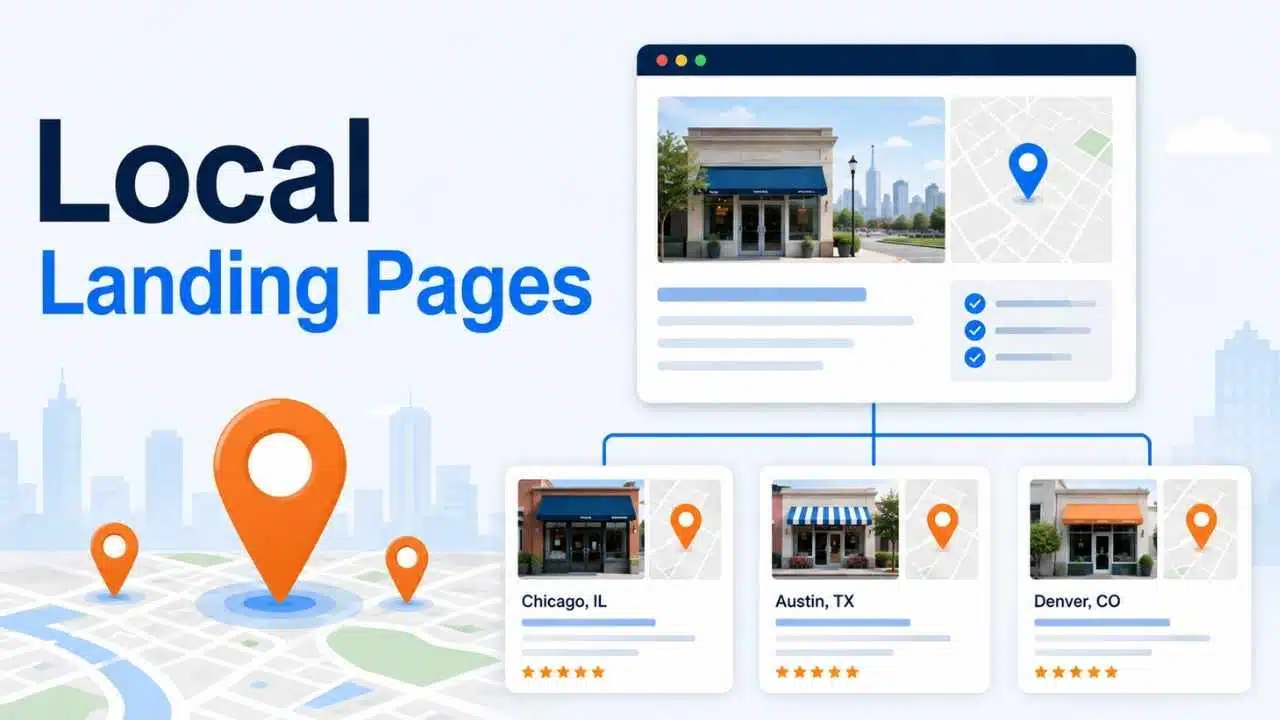
Local landing pages are dedicated webpages designed to attract and convert customers in specific geographic areas by showcasing location-specific details like addresses, business hours, local reviews, and regional services.
A business with twelve physical branches genuine needs twelve distinct location pages. However, a single office servicing 150 surrounding towns rarely requires 150 separate pages. The true value of local landing pages lies in answering local search intent—helping nearby customers decide whether to call, visit, or hire your business.
Mass-producing thin, repetitive city pages creates doorway page issues and risks poor search performance. For modern local SEO, Answer Engine Optimization (AEO), and AI Search, prioritize creating high-value pages only for the specific locations where you have real physical presence, distinct service offerings, or genuine local authority.
What Are Local Landing Pages?
A local landing page focuses on a specific physical business location or a meaningful service area.
For a multi-location company, the structure might look like:
/locations/manchester/
/locations/birmingham/
/locations/bristol/
A service business could use something closer to:
/roofing/glasgow/
/roofing/paisley/
/roofing-east-kilbride/
Those page types solve different problems.
A physical location page represents a real branch, clinic, shop, restaurant, office, or other operating location. It can legitimately contain its own address, opening hours, staff, directions, facilities, photographs, and local services. A service-area page represents a place where the business travels to customers without necessarily maintaining a customer-facing location there.
Do not blur the two. If a company serves Dallas from an office outside Dallas, say that clearly. Creating a page that implies the business operates a Dallas office when it does not creates bad customer information and can become even more problematic if that fiction is carried into Google Business Profile.
When Local Landing Pages Are Worth Building
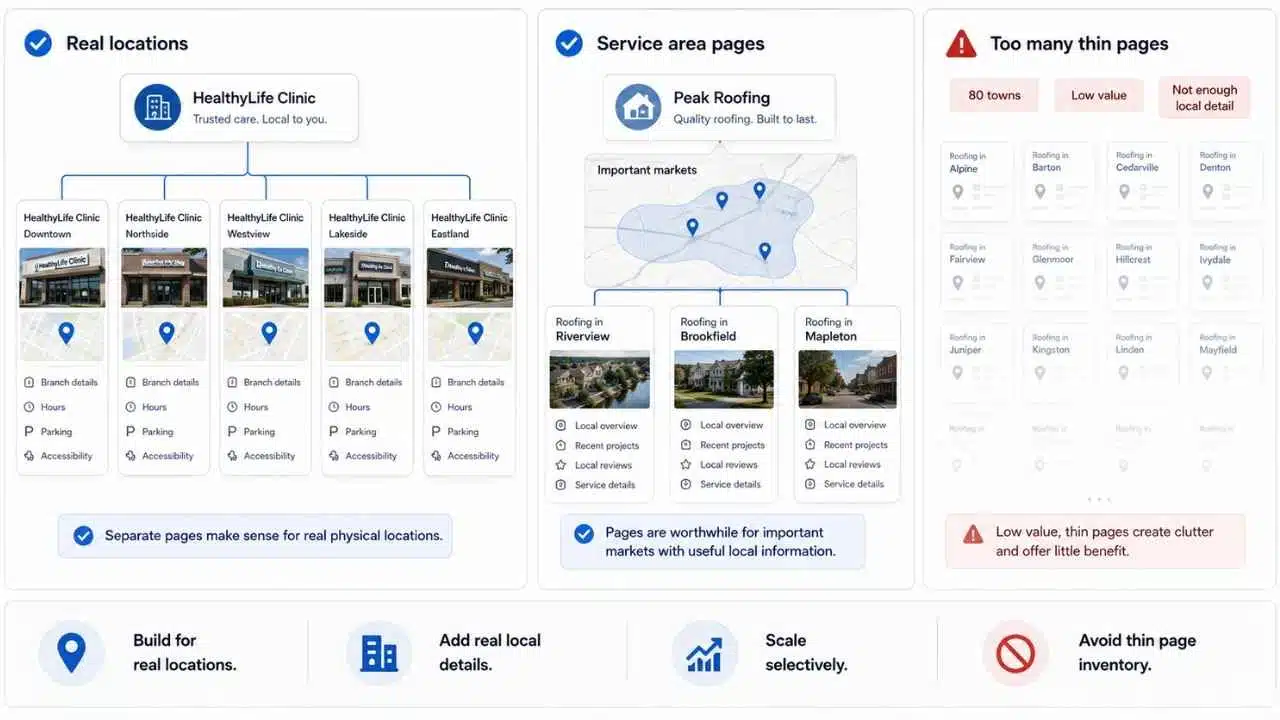
Real business locations are the easiest case. A dental group with seven clinics has seven genuinely different customer journeys. Someone choosing the Bristol branch may need to know which dentists work there, whether orthodontics is available, when the clinic opens, where to park, and whether the building is accessible.
Dedicated pages also make sense for businesses such as:
- restaurants;
- retail chains;
- hotels;
- gyms;
- medical practices;
- banks;
- repair centers;
- franchise networks;
- professional offices.
Google’s LocalBusiness structured-data guidance supports representing individual physical business locations separately. Service-area pages need more judgment.
A roofing company may work across several nearby towns even though it has only one base. Separate pages can be useful where those towns are important markets and the company can provide enough real local information to make the pages useful.
The fact that a crew is willing to drive somewhere is not enough by itself. If a business serves 80 towns but has nothing meaningful to say about 70 of them, publishing 80 pages is likely to produce a lot of thin inventory and very little customer value.
When You Should Not Build Another Location Page
Local SEO often goes wrong when the keyword list becomes the site architecture.
A team finds:
- accountant in City A;
- accountant in City B;
- accountant in City C;
- accountant in City D.
Four URLs are created, even though every page points to the same office, uses the same service copy, shows the same staff, and gives the visitor no information specific to the city.
That is where location expansion starts looking like doorway creation. Google’s spam policies specifically identify pages targeted at different cities or regions that funnel visitors toward the same destination as a doorway-abuse pattern.
There is a useful test before approving any new local page:
Remove the location name from the title and heading. Does the page still contain enough information to distinguish it from the other location pages?
If almost nothing remains, the page either needs more substance or should not exist.
Duplicate Content Is Usually the Wrong Fear
Teams often become obsessed with avoiding a “duplicate-content penalty” and end up rewriting perfectly normal brand information dozens of times.
That is not the problem to solve. Some duplication is expected on multi-location sites. Appointment instructions may be the same. A company description may be shared. Several branches may offer identical core services.
Google does not classify normal duplicate content as a spam violation simply because similar text appears on several URLs. The more serious issue is publishing pages that have no independent reason to exist.
A site containing 100 city pages where only the location name changes may create several problems at once:
- weak user value;
- unnecessary crawling;
- difficult maintenance;
- bloated internal linking;
- competition between similar URLs;
- possible doorway or scaled-content concerns.
Do not chase arbitrary percentages of “unique copy.”
Make the pages useful in different ways because the locations themselves are different.
What a Strong Physical Location Page Should Include
A branch page should answer practical questions before it tries to rank for anything. At minimum, someone should be able to understand where the location is, when it is open, how to contact it, and what they can do there.
Useful information might include:
- accurate address;
- opening hours;
- local contact details;
- services available at that branch;
- booking or enquiry options;
- directions.
Then add the details that actually separate the location from the rest of the business. A medical clinic may need physician names, specialties, accessibility information, parking, public transport, and photographs of the actual facility. Restaurant may need location-specific opening hours, reservation options, seating information, delivery availability, menu differences, and real photos.
A franchise branch might include its local operator, territory, services, relevant promotions, and examples of work from the area. There is no useful reason to force every page to 1,000 words.
A concise branch page that answers the customer’s real questions is stronger than a long page padded with local history and generic service descriptions.
Service-Area Pages Need More Evidence
Service-area pages are easier to mass-produce, which is exactly why they deserve more scrutiny. A contractor can import 200 town names into a template and create 200 URLs quickly. That proves the CMS works. It does not prove the pages are worth publishing.
A useful service-area page may contain:
- services genuinely available in that area;
- scheduling or travel considerations;
- completed projects nearby;
- legitimate local customer examples;
- relevant regulations or property conditions;
- photographs from work in the area;
- clear information about where the business is actually based.
What usually adds little value is generic geography. A paragraph about local housing stock may help if it changes the type of roofing, insulation, drainage, or electrical work customers need.
A paragraph about the town’s founding date, tourist attractions, or population normally does not. Local relevance should come from the business’s relationship with the place, not from facts copied out of an encyclopedia.
Do Not Confuse Website Service Pages With Google Business Profile Service Areas
Google Business Profile has its own service-area rules. Service-area and hybrid businesses can currently specify up to 20 service areas on a Profile. Google also advises that the overall area generally should not extend much beyond roughly two hours of driving time from the business base, while recognizing that some business models legitimately operate farther away.
Those rules apply to the Business Profile. They do not mean a website is allowed only 20 local pages. A regional business may have good reasons to publish more service-area content than it can list individually in its Profile. The website decision should still come back to customer usefulness and real operations.
What should remain consistent is the underlying business information. Do not invent offices, use remote mailboxes as fake locations, or create location claims simply to gain extra local visibility.
Pair Real Locations With Useful Google Business Profile Destinations
A multi-location website and its Google Business Profiles should feel like parts of the same system. When someone has already selected a branch, the website should not make them start over.
Google’s current policy for local business action links is specific: on a multi-location business, an action link should lead to a dedicated landing page for the relevant location rather than a generic page or a different branch.
That makes practical sense beyond compliance. If a customer chooses the Brighton branch and clicks through, the next page should help them act on Brighton—book there, call there, check its hours, or understand its services. Sending every location to the corporate homepage adds unnecessary friction.
Use LocalBusiness Schema for Real Physical Locations
Structured data can help search engines understand a genuine physical branch. Google supports defining individual locations as separate LocalBusiness entities and recommends using the most specific relevant subtype, such as Restaurant, Dentist, or another applicable business category.
Useful information can include:
- business name;
- physical address;
- telephone number;
- opening hours;
- location URL;
- coordinates.
The markup should describe what is actually on the page. This matters particularly for service-area pages. Google’s LocalBusiness rich-result guidance expects a physical address. Do not create an address or coordinates for a branch that does not exist simply because a service page targets that city. Structured data can clarify a location. It should never manufacture one.
Location pages should not exist only as entrances from Google Search. People should be able to find them from the site.
A straightforward structure might be:
/locations/
followed by:
/locations/london/
/locations/bristol/
/locations/cardiff/
Larger organizations may need useful country, state, province, or regional layers. A store locator can help customers search by city or postcode, but important location pages should not depend entirely on someone interacting with a JavaScript search box.
Use crawlable links where practical. Google relies heavily on links to discover pages and understand relationships between them. More importantly, a browsable location structure simply makes sense for users.
Titles and URLs Do Not Need to Shout
Location names belong naturally in page titles.
Something like:
Bristol Dental Clinic | Brand Name
is clear.
A title such as:
Best Dentist Bristol | Cheap Bristol Dentist Near Me | Top Dentist Bristol
is not more local. It is just harder to read.
URLs can be equally simple:
/locations/bristol/
There is little reason to create:
/best-affordable-dentist-bristol-near-me/
The page content, business information, links, reputation, and relevance matter far more than forcing every keyword variation into the slug. Keep titles descriptive and URLs predictable.
Internal Links Should Reflect Real Business Relationships
Internal linking becomes more important as a location network grows. A branch should link to services available there. A service page can help users find branches that provide that service. Regional pages can organize nearby locations.
The temptation is to automate every possible combination. If a business offers 40 services across 80 locations, the database contains 3,200 possible service-location pairs.
That does not mean the site needs 3,200 landing pages. Build a separate combination page when the combination itself has a useful reason to exist: different service availability, meaningful local demand, specific local conditions, a distinct buying process, or enough evidence to make the page genuinely useful.
For many companies, strong service pages plus strong location pages will be cleaner than thousands of mechanically generated combinations.
How Much Content Really Needs to Be Unique?
Enough for the page to stand on its own. Shared brand copy is normal. What matters more is whether the facts that should differ actually differ.
For branch pages, that may mean:
- staff;
- hours;
- address;
- contact information;
- services;
- photos;
- accessibility;
- facilities;
- branch-specific offers;
- relevant local customer proof.
For service areas, uniqueness should come from real projects, operating details, local conditions, and meaningful differences in how the service is delivered. Do not rewrite the same paragraph through synonyms just to make software report a higher uniqueness percentage. That creates different wording without creating different value.
When to Consolidate Local Landing Pages
Local SEO architecture should not grow forever. Some pages should eventually disappear.
Consolidation can make sense when:
- a branch closes;
- two locations merge;
- several service-area pages cover essentially the same market;
- old URLs exist only for keyword variations;
- local pages contain no meaningful independent information;
- automatically generated pages are no longer maintained.
If an old page has a clear replacement, redirecting it to the most relevant surviving page is usually cleaner than leaving it live indefinitely. Canonical tags have their place for genuine duplicate URLs, but they should not become a way to preserve an unnecessary network of low-value landing pages.
A Practical Rule for Scaling Location Pages
Before creating another page, ask four things:
- Is this a real location or a meaningful service area?
- Does somebody in this place need information that the main service page does not provide?
- Can the business prove a genuine relationship with the location?
- Can users reach the page naturally through the site?
If those answers are strong, the page probably has a reason to exist. If the main argument is “this keyword gets searches,” that is not enough.
Final Thoughts
The strongest local landing pages mirror the business rather than the keyword database. Real branches generally deserve dedicated pages because customers need branch-specific information. Service-area pages require more restraint. Build them when the company genuinely serves the place and can provide enough local context, proof, or operational detail to help someone there make a decision.
Do not waste effort rewriting shared company information simply to avoid normal duplication. The bigger risk is creating a large set of interchangeable pages that exist only to catch variations of the same local query. Before publishing another city page, remove the city name and look at what is left. If the remaining page still shows a meaningful relationship between the business and that location, it is probably worth building. If the page collapses without the place name, the SEO opportunity may be real, but the content strategy is not ready yet.