Have you ever felt sure about your marketing skills, but unsure how to turn them into a real business? If that sounds familiar, you are in the right place. Starting a consultancy can feel messy at first because you are building three things at once: your offer, your proof, and your sales process.
The good news is that demand is there. The U.S. Small Business Administration reported more than 21 million new business applications nationwide between 2021 and early 2025, which means a huge pool of owners now need help getting found, earning leads, and making sense of online channels.
A digital marketing consultancy helps businesses make smarter online growth decisions, then turn those decisions into action.
You might advise on SEO, paid ads, content creation, social media marketing, analytics, email funnels, or a mix of those services. Some consultants stay solo for years, while others build a small team once delivery becomes steady.
In this guide, I will walk you through the steps in a simple order, so you can choose a niche, package your services, set pricing, build your brand, and win your first clients without overcomplicating the process.
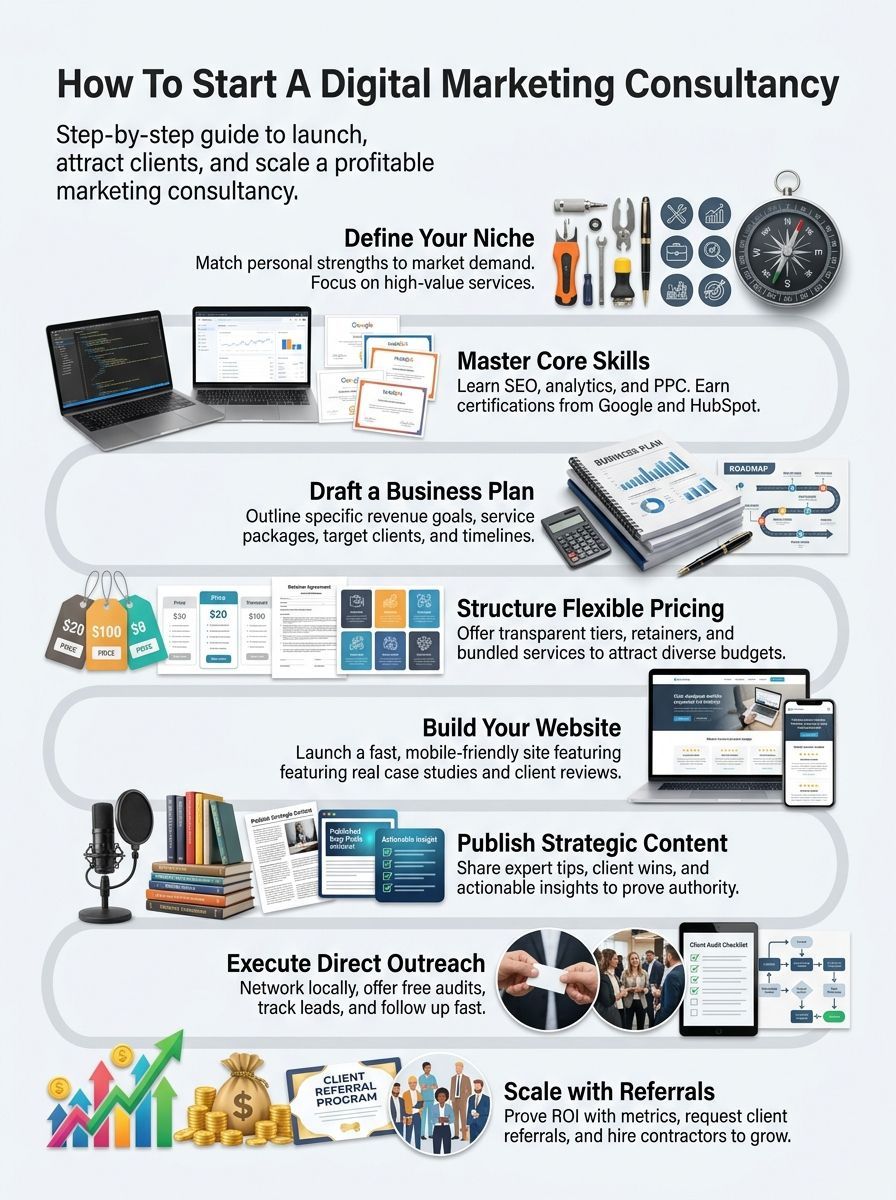
Defining Your Niche and Target Market
If you skip this step, your consultancy usually turns into a string of random projects. A sharp niche makes your offer easier to explain, easier to price, and easier for clients to trust.
Methods for choosing your specialization.
Start with the overlap between three things: what you do well, what businesses already pay for, and what produces measurable results in a short time. For most new consultants, that means choosing one of four practical lanes first: SEO, paid search, social media marketing, or content creation.
A narrow niche works better than a broad label. “I help dentists get more local search leads” is much stronger than “I do digital marketing.”
- SEO: a smart fit if you like research, site structure, and long-term traffic growth.
- Paid ads: a better fit if you enjoy testing budgets, offers, and conversion paths quickly.
- Social media marketing: useful if you can create content systems and keep brand voice consistent.
- Content creation: strong if you can plan topics, write clearly, and connect content to leads or sales.
Run a fast validation test before you commit. Offer a paid audit, a landing page review, or a 30-day pilot to one small group, such as home services, law firms, or e-commerce shops. You will learn more from five sales calls than from weeks of guessing.
One useful lesson from agency owners on Reddit is that early traction usually comes from a specific pain point, not a full menu of services. That is why “Google Ads cleanup for local clinics” often sells faster than a general monthly package.
Techniques for researching and identifying your ideal clients.
Look at buying behavior, not just demographics. Your ideal client is the business owner or marketing lead who already believes marketing matters, has some budget, and feels a problem strongly enough to act now.
Use tools you can access without a huge budget. Google Search Console shows which pages already get impressions, GA4 shows where users come from, and LinkedIn can help you spot roles, company size, and likely decision-makers.
A good target market is specific enough that you can name the problem, the budget pressure, and the result the client expects before the first call.
Build a simple client profile with these fields: industry, revenue stage, team size, lead source, monthly marketing spend, main KPI, and buying trigger. Once you sign your first few clients, compare retention by segment. The best niche is often the one that closes fastest and stays longest.
Building Essential Skills and Expertise
You do not need to master every channel before you start. You do need enough skill to diagnose a problem, recommend the right move, and explain results in plain English.
Key digital marketing skills and certifications needed.
The most useful core stack for a new consultancy is SEO, paid media, content creation, conversion basics, and analytics. If you can connect traffic to leads and leads to revenue, you are already more useful than many generalists.
Focus your learning in this order:
- Traffic acquisition, which includes SEO Search Engine Optimization, paid search, social content, and email.
- Conversion, which covers landing pages, offers, calls to action, and basic A/B testing.
- Measurement, which means GA4, attribution basics, reporting, and CRM hygiene.
- Communication, which includes proposals, client calls, and clear monthly reporting.
For certifications, stick with names clients already recognize. Google states that its Google Ads certifications are available through Skillshop, require a passing score of 80 percent or higher, and stay valid for one year. That makes them useful for proving current paid media knowledge, especially if you want to sell search or display work.
HubSpot Academy also offers free certifications in content marketing, social media marketing, inbound, and digital advertising. These help if your offer leans toward content systems, lead nurture, or small business funnels.
LinkedIn Marketing Academy is worth adding if you want B2B clients. Its certifications are built around LinkedIn campaign planning and measurement, which gives you a clear angle for consultants serving software, recruiting, or professional services firms.
Staying up-to-date with evolving tools and industry trends.
You do not need to read everything. You need a repeatable filter.
- Check official product updates from Google, Meta, LinkedIn, and major SEO tools once a week.
- Keep one test account or demo project where you try new features before using them on client work.
- Save change logs and screenshots, so you can explain platform shifts to clients clearly.
- Review campaign and content results monthly, because trends matter less than what your numbers show.
In practice, the most helpful tools for staying sharp are Google Search Console, GA4, Looker Studio, and one good SEO platform such as Ahrefs or Semrush. Search Console shows search performance and indexing issues, GA4 shows acquisition and engagement, and Looker Studio makes your client reports easier to read.
A common beginner mistake is chasing tactics before learning reporting. If you cannot explain where leads came from, which offer worked, and what the next test should be, clients will struggle to keep paying you.
Crafting Your Business Foundation
A consultancy grows faster when your back-end setup is clean. That includes your business plan, legal structure, pricing logic, and a simple system for cash flow.
Steps to developing a clear business plan, goals, and service offerings.
Your business plan does not need to be long. One lean document is enough if it answers five questions: who you serve, what you sell, how you price it, how you get clients, and what numbers you need each month to stay healthy.
Use concrete goals. “Reach $5,000 in monthly recurring revenue within six months” gives you something to reverse-engineer. “Grow the business” does not.
| Plan Element | What to Define | Why It Matters |
|---|---|---|
| Niche | One industry or problem | Makes positioning sharper |
| Services | Audit, setup, management, reporting | Keeps scope clear |
| Pricing | Hourly, project, or retainer | Protects margin |
| Sales goal | Calls booked, proposals sent, clients closed | Creates a real pipeline |
| Delivery stack | CRM, reporting, project management, invoicing | Prevents chaos as clients grow |
If you are in the U.S., handle the business basics early. The SBA says your business structure affects taxes, daily operations, and personal liability, and the IRS lists online EIN applications as available once your business is legally formed. Even a solo consultant should decide this early because it affects contracts, banking, and tax setup.
Many new consultants begin as sole proprietors to test demand, then move to an LLC once income becomes steady and client risk grows. That shift can make sense when you are signing larger retainers or handling ad spend and vendor relationships.
Structuring pricing models and service packages that attract clients.
Most new consultants price too vaguely. Clear scope sells better than low fees.
A useful starter approach is to offer three options: a one-time audit, a fixed-fee setup project, and an ongoing retainer. This gives cautious buyers a smaller first step while leaving room for recurring work.
| Model | Best Use | Watch Out For |
|---|---|---|
| Hourly | Advisory calls or short strategy work | Clients may focus on time, not outcome |
| Project fee | Audits, launches, landing pages, setups | Weak scope can eat your margin |
| Monthly retainer | Ongoing SEO, ads, reporting, content | Needs clear deliverables and review cycles |
Recent U.S. pricing guides put general freelance digital marketing work far above entry-level rates once strategy and channel management are included. That is why a small fixed-fee audit often works better than trying to win business with bargain hourly pricing.
One practical tip from consultant discussions online is to split setup from ongoing work. Charge once for research, tracking, and account cleanup, then start the retainer when campaigns or recurring deliverables begin. Clients understand that structure quickly, and it protects you from underpricing the messy first month.
Also plan for taxes from day one. The IRS says self-employed people may need to pay estimated taxes quarterly, so build that into your pricing and cash reserve instead of treating every deposit as spendable income.
Establishing Your Brand and Online Presence
Your brand does not need to look huge. It needs to look clear, credible, and easy to contact.
Creating a professional website and portfolio.
A simple website can do the job if it answers the right questions fast: who you help, what you do, what result you aim for, what proof you have, and how to contact you.
- Create a focused home page with one clear promise.
- Add a services page with deliverables, timelines, and starting points.
- Show 2 to 4 case studies, even if some come from pilot projects or your own test properties.
- Include a short contact form and one easy next step, such as a discovery call.
The SBA noted in its 2025 small business trends update that 73 percent of small businesses have a website. That matters because your site is no longer a bonus. It is the basic trust signal many buyers expect before they reply to outreach.
Make the site mobile-friendly and fast. Google’s PageSpeed tools and Think with Google materials keep pointing to the same truth: faster pages tend to support better conversion rates. For a new consultancy, even small speed gains can help more visitors turn into calls.
Your portfolio should show outcomes, not just screenshots. Use a simple before-and-after structure: starting problem, work completed, timeline, and result. If a result is still early, say that clearly. Honest proof beats inflated claims every time.
Social media marketing works better when you stop trying to look polished and start trying to be useful. Short teardown posts, quick SEO tips, and campaign lessons usually attract better-fit clients than generic inspiration.
Pick one main channel based on your audience. LinkedIn fits B2B and professional services. Instagram can work for visual brands, local service businesses, and creators. X or niche communities can help if you are selling ideas to founders and marketers.
The fastest authority builder is simple: teach one useful thing, show one real example, and make one clear point.
Turn one good idea into several assets. A blog post can become a short video, a LinkedIn post, an email, and a checklist. That gives you more reach without forcing you to create from scratch every day.
Track your content with the same discipline you use for client work. In GA4, the user acquisition and traffic acquisition reports help you see how people first found you and which channels keep bringing them back. That helps you spend more time on the formats that actually move leads.
Attracting Clients and Growing Your Consultancy
This is the part most new consultants worry about most, and for good reason. Skill matters, but steady client acquisition is what turns a side project into a business.
Effective strategies for networking, client acquisition, and relationship building.
Start with warm channels before you bet on long-term inbound. Former coworkers, friends who own businesses, local founders, and existing professional contacts are often the fastest path to client one.
Use a simple outreach system each week.
- Choose one niche and one offer.
- Build a list of 25 qualified prospects.
- Send short, personalized messages with one clear observation.
- Offer a paid audit or a specific fix, not a vague “marketing package.”
- Follow up twice with a useful insight, not a pushy nudge.
One pattern that shows up often in agency discussions is that first clients usually come from proof and relationships, not from a brand-new website ranking overnight. That is why outreach, referrals, and warm intros usually beat waiting for SEO in your first six months.
Use a CRM early, even if your pipeline is small. HubSpot’s free tools are built for up to two users, while Zoho CRM’s free edition supports up to three users. Either one is enough to track leads, proposals, follow-ups, and close rates without living in a spreadsheet.
Relationship building is simple, but it takes consistency. Set expectations clearly, answer messages on time, and make your reports easy to read. Clients stay longer when they feel informed and never have to guess what you are doing.
Tips for delivering value, gaining referrals, and scaling your consultancy.
Clients refer you when they can explain your value in one sentence. Help them do that by tying your work to outcomes like qualified leads, booked calls, lower cost per lead, or stronger local search visibility.
- Send monthly reports with 3 parts: what happened, why it matters, and what comes next.
- Ask for referrals right after a visible win, such as a campaign turnaround or a strong lead month.
- Create repeatable processes for audits, onboarding, reporting, and reviews.
- Hire contractors only after your workflow is documented and profitable.
A very common scaling mistake is hiring before your offer is stable. Add help after you know which service package sells best, how long delivery takes, and what gross margin each client leaves you.
Keep your first team small. A freelance designer, paid media specialist, or writer can expand delivery without adding full payroll pressure. That lets you protect cash flow while your consultancy grows at a pace you can manage.
Final Thoughts
You can build a real business from marketing skills if you keep the model simple. The best path for How To Start A Digital Marketing Consultancy From Scratch is to choose a clear niche, package a focused offer, and get proof early.
Learn the channels that matter most, track results carefully, and price your services around scope and outcomes. A short business plan, a clean website, and consistent outreach will take you much further than waiting for everything to feel perfect.
Do strong work for a few clients first.
Then refine your marketing strategy, ask for referrals, and add a small team only when the numbers support it. That is how a new consultancy turns into a steady business.
FAQs about How To Start A Digital Marketing Consultancy From Scratch
1. How do I start a digital marketing consultancy from scratch?
Start a digital marketing consultancy by picking a clear niche, doing market research, setting services and prices, and offering them.
2. What skills and tools do I need?
You need skills like keyword research, the ability to create content, to analyze customer data, and to run marketing automation, these are core. Use a simple website, an email tool, and plain analytics to track search ranking.
3. How do I get my first clients?
Get first clients by pitching low risk work, or by doing a free audit for a local firm that can turn into a retainer. Use sharp marketing materials and case studies, show how you raise search ranking with SEO-friendly content. Talk to people, ask for referrals, and treat early clients like partners, not projects.
4. How should I price my services?
Price with clear packages, add a small results fee if you can, and tweak fees as you learn from customer data.