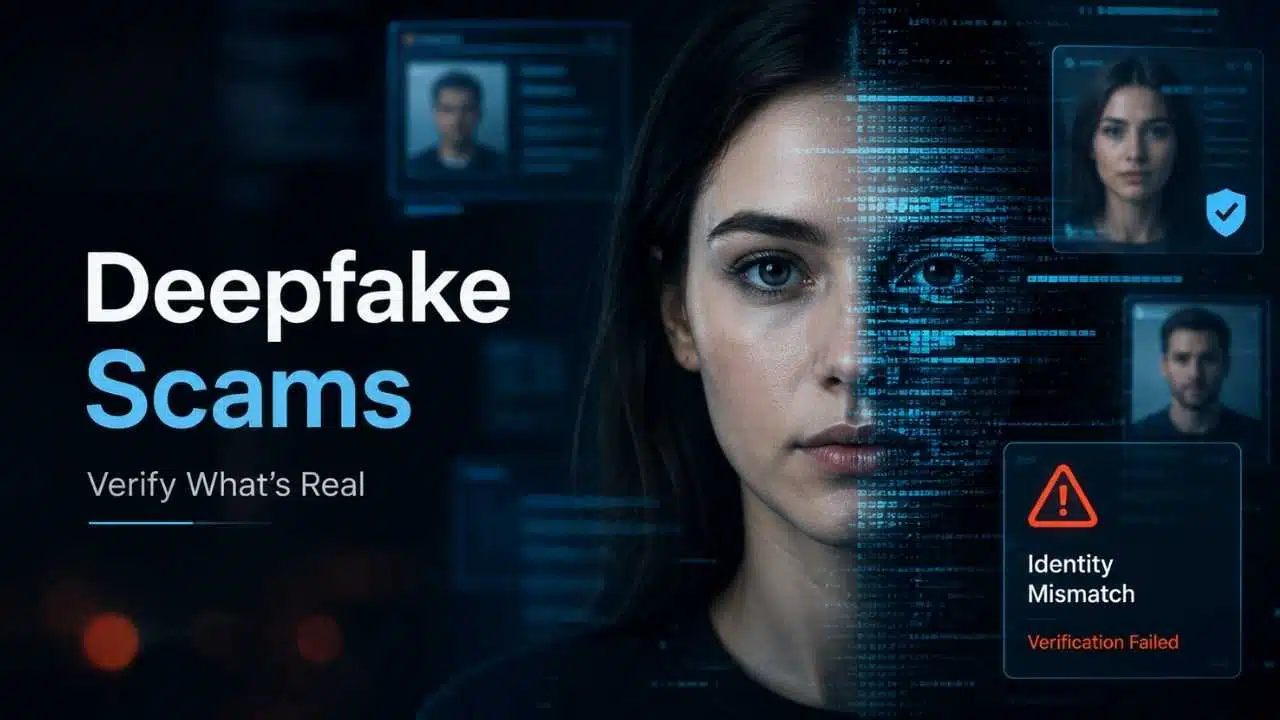
Deepfake scams are sophisticated cyber threats where bad actors use AI voice cloning and synthetic video manipulation to impersonate trusted individuals—such as executives, family members, or bank officials—to steal money, credentials, or sensitive data.
Seeing a familiar face on a video call or hearing a relative’s voice is no longer definitive proof of identity. The most effective defense against deepfake scams is moving beyond technical spot-the-difference detection and establishing strict verification protocols.
For any high-risk financial transfer, password request, or unusual business directive, always confirm the claim through a separate, trusted communication channel before acting. Treating identity verification as an operational rule neutralizes AI impersonation regardless of how convincing the media appears.
What Are Deepfake Scams?
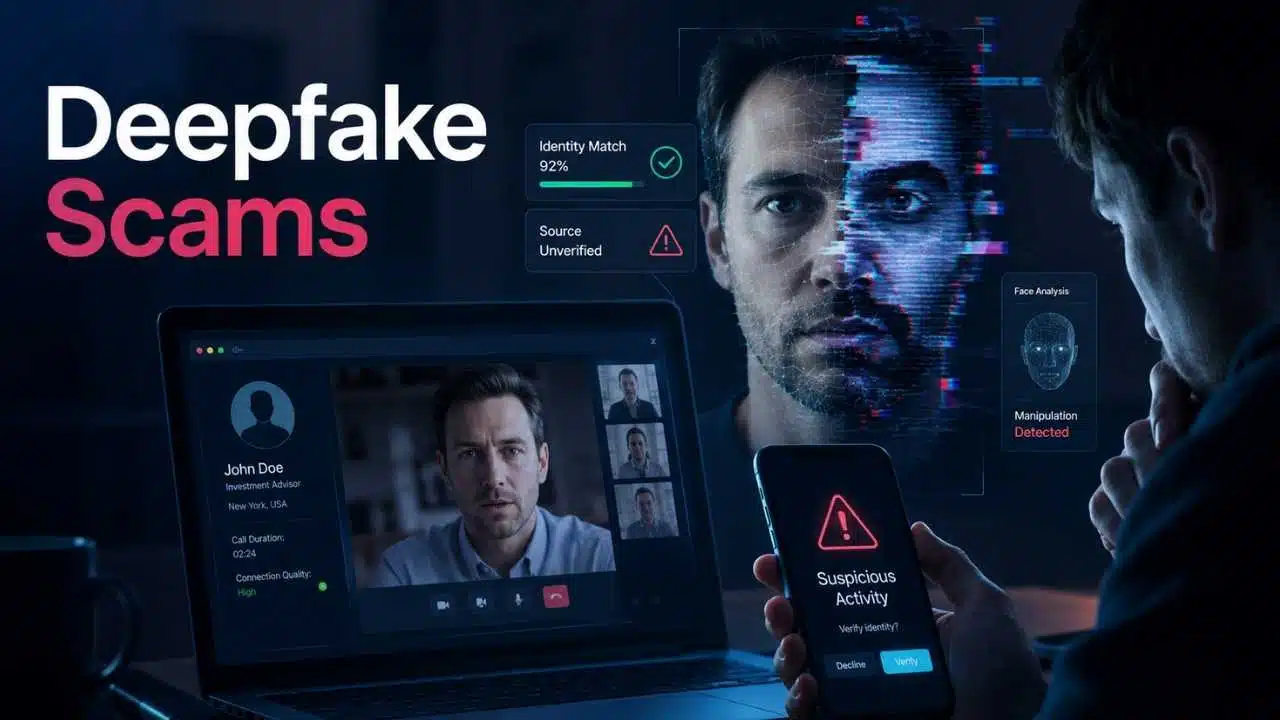
Deepfakes are synthetic or manipulated audio, images, or video created with AI or machine-learning techniques to make someone appear to say or do something they did not actually say or do. In a scam, the media supports impersonation.
That may involve:
- an AI-cloned voice during a phone call;
- a generated or altered face in video;
- manipulated speech and lip movement;
- synthetic images supporting a fake identity;
- fabricated footage of an executive, official, celebrity, or relative.
The FBI has documented criminals using AI-generated video and audio as part of impersonation campaigns, including synthetic videos of officials and real-time video interactions designed to make fraudulent identities appear more credible.
The deepfake does not have to withstand expert analysis. It only has to seem convincing long enough for the victim to follow the request.
Why a Fake Voice Can Be So Effective
A phishing email asks you to trust words on a screen. Voice cloning adds familiarity. If someone hears what appears to be a child, partner, manager, or long-time client, the first instinct may be to respond to the emergency rather than question whether the speaker is genuine.
The FTC has warned that scammers can create cloned voices from short audio samples, including material available online. Its practical advice is to call the supposed family member using a number you already know instead of trusting the incoming voice. The same weakness exists at work.
A finance employee may be accustomed to receiving requests from a senior executive. Add a familiar voice, knowledge of an active project, a spoofed email, and an urgent deadline, and an unusual payment request can suddenly feel routine. The strongest warning sign may not be the voice. It may be the request itself.
Common Deepfake Scam Patterns
The media is new. Most of the fraud underneath it is familiar.
Family emergency scams
The caller claims to be a child, grandchild, partner, or another relative facing an urgent problem: an accident, arrest, hospital visit, lost phone, or legal trouble. A convincing voice makes the story harder to challenge. Sometimes another person takes over the call, posing as a police officer, lawyer, doctor, or friend and explaining where the money needs to go.
The common feature is pressure. The victim is pushed to act before speaking to another family member or checking the story independently.
Executive and payment impersonation
Business attacks may impersonate a CEO, finance director, supplier, customer, or senior manager.
The request might involve:
- an urgent bank transfer;
- revised supplier banking details;
- payment of an unusual invoice;
- gift cards;
- confidential documents;
- login credentials.
The FBI’s business email compromise guidance recommends confirming payment requests independently, particularly when bank details or normal payment procedures suddenly change. A realistic voice or video should not be allowed to override those controls.
Scammers can also impersonate police, government agencies, financial institutions, regulators, or technical-support organizations. The FBI has documented campaigns using AI-generated videos of supposed officials together with spoofed websites and other fraudulent material.
Some schemes even target people who were already scammed, with the impersonator claiming to represent an agency that can recover the lost money. A badge, uniform, official-looking video, or familiar agency name does not establish identity.
Investment and endorsement scams
Synthetic media can make a celebrity, CEO, commentator, or other trusted figure appear to recommend an investment or financial opportunity. The FBI has reported AI-generated voices and videos being used in fraudulent endorsements and investment schemes. If a recognizable person appears in a video promoting an investment, verify the endorsement separately. Do not use the video itself as evidence that the offer is legitimate.
Deepfake Scams Are Not Solved by Spotting Strange Blinking
Advice about deepfakes often focuses on visual defects. Look for strange blinking. Watch the mouth. Check the hands. Listen for robotic speech or mismatched audio. Those clues can still be useful.
Current FBI guidance points to possible signs such as distorted facial features, unusual hands or feet, unnatural movement, strange shadows, inconsistent audio, and poor synchronization. The problem is that none of those signs proves anything by itself.
A normal video call can look bad because of weak Wi-Fi, compression, poor lighting, or a low-quality webcam. Genuine speech can arrive slightly out of sync with the picture. Better synthetic media may also avoid the defects people have learned to expect.
Automated deepfake detectors have similar limits. NIST’s work on synthetic-media detection reflects a broader technical problem: detection performance can fall when systems encounter unfamiliar generators, compressed media, adversarial manipulation, or conditions different from their evaluation data.
A detector can contribute evidence. It should not be treated as a verdict. “Likely AI-generated” is not forensic proof of fraud, and a clean detector result is not proof that the media is genuine.
How to Verify What’s Real Before You Act
When the request matters, verification should move outside the suspicious conversation.
Stop before completing the request
Do not send money while remaining on the call. Do not read out an authentication code because the supposed executive says the request cannot wait. Do not open a new login page, scan a QR code, or upload identity documents simply because the person on the video appears familiar. A few minutes of delay is inconvenient for a legitimate request. For a scammer, it can break the pressure the attack depends on.
Contact the person independently
Use contact information you already trust. If someone claiming to be your daughter calls from an unknown number, hang up and call her usual number.
If an executive contacts the finance team through an unfamiliar WhatsApp account, confirm the request through the company directory, established internal messaging platform, or another known route. Do not use the phone number, email address, link, or QR code supplied by the suspicious person as the independent verification method. The second channel needs to be genuinely separate.
Verify the action as well as the identity
This matters most in business. Suppose a video call appears to show the CFO requesting a large transfer to a new supplier account. Even if the video looks completely normal, ask whether the transaction itself makes sense.
Check:
- whether the supplier exists in normal company records;
- whether the bank details match what was previously approved;
- whether the invoice is in the finance system;
- whether the required approval chain has been followed;
- whether the CFO confirms the request through an established channel.
A payment process that survives a convincing impersonation is far safer than relying on employees to judge whether a face looks synthetic.
A Family Verification Phrase Can Be Useful
The FBI recommends families consider creating a secret word or phrase as an additional identity check. Choose something deliberately. A pet’s name, birthday, school, hometown, mother’s maiden name, or sibling’s name is weaker because that information may already be public or exposed through previous data breaches.
The phrase should also remain private rather than becoming a joke shared on social media. Even a good phrase is only one layer. If a supposed family member suddenly needs a large payment, call them or another trusted relative through a known number as well.
Businesses Need Approval Processes That Survive Deepfakes
Companies should plan on the assumption that a convincing synthetic voice or video may eventually fool someone. That means the high-risk action should require more than the conversation itself.
Useful controls can include:
- two-person approval for significant transfers;
- callbacks to previously verified numbers;
- independent confirmation of bank-account changes;
- approval inside the normal finance platform;
- extra review when a request bypasses routine procedure;
- escalation when secrecy or unusual urgency is involved.
This does not require treating every executive call as suspicious. It means an email, voice note, or video call should not be able to single-handedly authorize a high-risk transaction. Deepfakes make established anti-fraud controls more important, not outdated.
Content Credentials Can Add Context, Not Certainty
Provenance offers another way to examine digital media. The C2PA standard supports Content Credentials, which can carry cryptographically verifiable information about where an asset came from, which tools were involved, and some changes made during its history. That can be useful when the media, device, publisher, or editing software supports the standard. But Content Credentials are not a truth detector.
C2PA does not claim that provenance can determine whether a statement inside a video is true. A legitimately captured video could still contain a person making a false statement.
The reverse also matters: the absence of Content Credentials does not prove a file is fake. Adoption is not universal, and credentials can be lost during some editing or distribution workflows. For a suspected financial scam, independently calling the real person is usually far more useful than spending ten minutes inspecting metadata.
Look at the Request, Not Just the Media
The behavior around a suspicious call often matters more than tiny flaws in the video.
Stop and check when an unexpected contact:
- demands immediate action;
- asks you to keep the request secret;
- changes normal payment details;
- requests cryptocurrency or gift cards;
- wants passwords or multi-factor authentication codes;
- sends an unfamiliar login or payment link;
- claims normal procedures cannot be followed;
- contacts you from a new number or account;
- resists independent verification.
None of these proves a deepfake is involved. They do tell you the request deserves scrutiny. A better question than “Does this voice sound artificial?” is often: Why does this person need me to bypass the normal process?
What to Do If You Already Sent Money or Information
If you realize you may have responded to a scam, speed matters. Contact the bank, card issuer, payment service, money-transfer company, gift-card provider, or other financial institution involved. Report the transaction as fraudulent and ask whether it can be stopped, recalled, or reversed.
Recovery is not guaranteed. Cryptocurrency payments are particularly difficult because transfers are typically not reversible. If you disclosed a password, change it immediately and change it anywhere else you reused it. Review account sessions and multi-factor authentication settings where the service allows. If you gave away an authentication code, treat the affected account as potentially compromised.
For a business incident, preserve the relevant emails, messages, telephone numbers, video files, payment details, timestamps, and account information. Contact the organization’s security or fraud team and the financial institution involved.
Reporting procedures differ by country, so use the legitimate police, financial, consumer-protection, or cybercrime reporting service for your jurisdiction.
Do Not Let Deepfakes Turn Into an Excuse to Believe Nothing
Synthetic media creates another problem: genuine evidence can be dismissed simply by claiming that AI produced it. The practical response is not to distrust everything. Match the amount of verification to the consequence of being wrong. A casual video from a friend does not need forensic analysis. A surprise request to send a large payment to a bank account you have never used does.
The media itself may even be real while the request is fraudulent. An attacker could compromise a genuine account rather than generating a fake face or voice. That is another reason to verify the action, not just the media.
Final Thoughts
The difficult part of deepfake scams is not that every fake will become impossible to detect. It is that familiar voices and recognizable faces can no longer carry enough trust for high-risk decisions on their own.
You do not need to identify the AI model or find a visual glitch before refusing an unusual request. When money, account access, sensitive information, or unexpected authority is involved, stop the interaction and verify through a channel you already trust.
Families can use private verification phrases. Businesses can build callbacks, second approvals, and independent payment checks into normal procedures. Detection tools and Content Credentials may add useful context, but neither should replace identity and transaction verification. For important requests, the most reliable habit is simple: verify the person somewhere else before acting on what you see or hear.