A 30-minute meeting rarely costs only 30 minutes. Someone prepares an update. Six people stop what they are doing to attend. The discussion ends without a firm decision, so the messages start afterward. Two colleagues arrange another call because they left with different ideas about what was agreed. By the end of the week, that short meeting has created more work than it settled.
This is the problem behind meeting debt. I find the term useful because it moves the conversation beyond whether there are simply too many meetings. The better question is whether a meeting keeps creating costs after it ends: broken focus, repeated explanations, delayed decisions, unclear ownership or duplicated work.
Paying down meeting debt does not mean clearing the calendar. Some discussions deserve to happen live. Difficult decisions, sensitive feedback and genuine collaboration often improve when people can ask questions and respond in the moment. The aim is to remove the meetings that no longer earn their place and make the necessary ones more decisive.
What Is Meeting Debt?
Meeting debt is the accumulated cost of recurring or ineffective meetings. It includes the scheduled time, but also the preparation, interruption, clarification, follow-up and rework that surround it.
This is still an emerging workplace term, not a standardized academic measure. It can describe recurring meetings that have outlived their purpose or, more broadly, the extra work created when meetings fail to produce clear decisions. In both cases, the cost continues while the value has faded.
Meeting debt is closely related to meeting overload and meeting fatigue, but they describe different things:
- Meeting overload means a person or team has more meetings than they can reasonably absorb.
- Meeting fatigue is the exhaustion associated with attending or participating in meetings.
- Meeting debt is the continuing operational cost before, during and after them.
A calendar does not need to look full for a team to carry this debt. One weekly meeting can be enough if it repeatedly interrupts the wrong people, ends without a usable outcome and leads to another round of discussion.
How Meeting Debt Builds
Most recurring meetings start for a legitimate reason. A new project needs close coordination, or a launch requires frequent risk checks.
The circumstances eventually change, but the invitation stays. Because the meeting is already on the calendar, it renews itself without anyone actively choosing it again. People may sense that it has become less useful, yet cancelling it can feel awkward. Attendance becomes routine.
Meetings also multiply to compensate for weaknesses elsewhere. Unclear ownership produces alignment calls. Scattered information produces status meetings. If nobody trusts a written update to be read, putting everyone in the same room can feel safer.
Common causes include:
- Recurring meetings with no clear owner or review date
- Invitations sent to everyone who might need context
- Routine information delivered verbally instead of kept in a shared place
- Discussion beginning before anyone knows what must be decided
- Decisions recorded without an owner or deadline
- Several meetings covering the same project from slightly different angles
- Hybrid sessions in which remote participants struggle to contribute
- A culture that makes declining an invitation look uncooperative
A missing agenda is a warning sign, but an agenda is not proof of value. A polished list of topics can still lead to no decision, no owner and no movement.
The Cost You See and the Cost You Miss
The debt comparison is helpful because it separates the visible cost from the cost that quietly compounds.
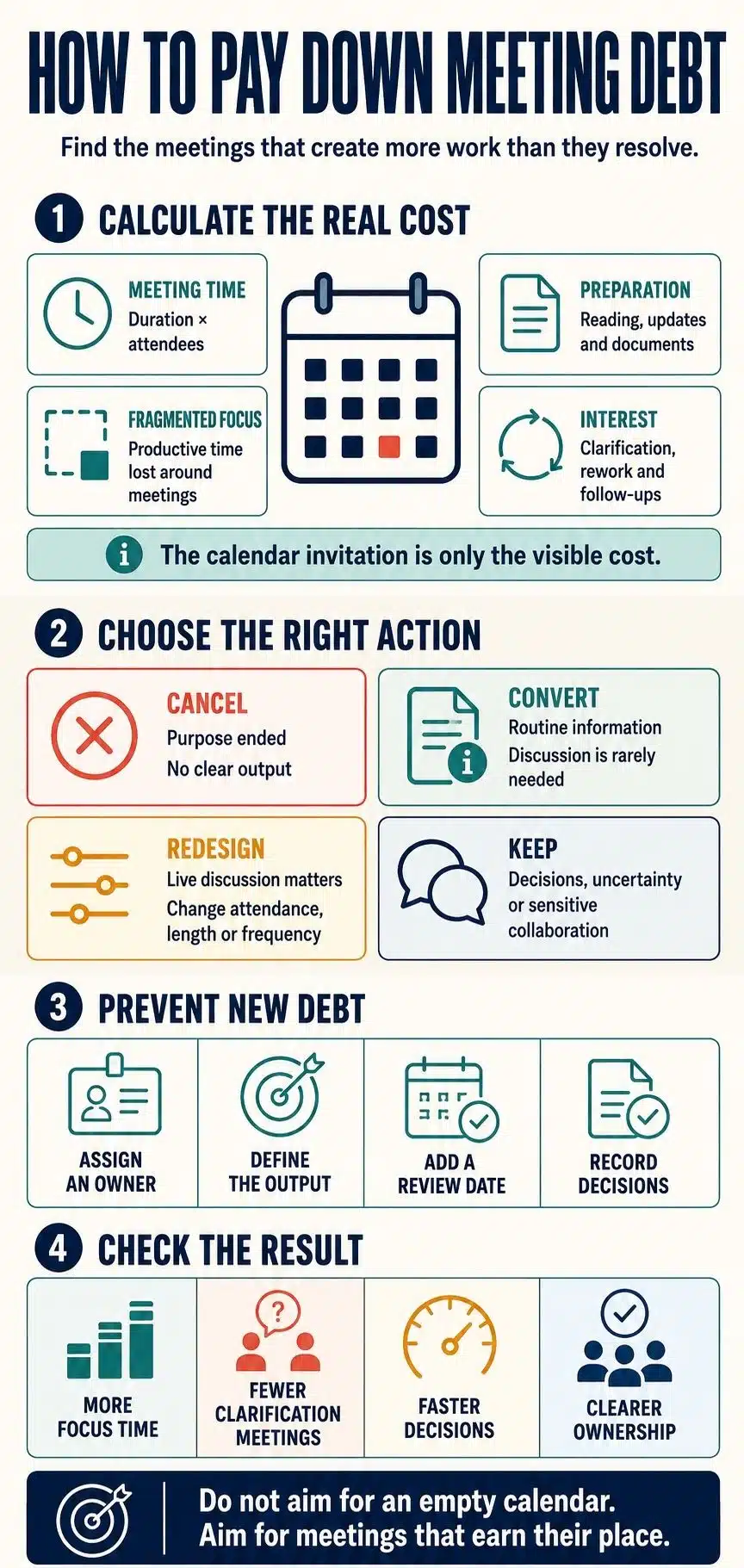
The principal is the meeting time multiplied across everyone required to attend. A one-hour meeting with eight people uses eight participant-hours before anyone prepares a slide or writes a follow-up.
The interest is less visible. It includes preparation, task switching, delayed work, repeated explanation, corrective work and any extra call needed to settle what the first one left unclear.
In a 2026 vendor-commissioned survey of more than 2,300 knowledge workers across seven markets, respondents considered 58% of their meeting time unnecessary. Nearly six in ten meetings led to further discussion or work to clarify decisions and next steps. These self-reported findings are not a universal measure, but they illustrate the cost beyond the calendar.
Research on “meeting hangovers” found that more than a quarter of workplace meetings produced lingering negative effects, including reduced focus, engagement or productivity. A tense or confusing call can damage a much larger work period.
This does not mean fewer meetings are automatically better. Meetings can improve participation and creative contribution up to a point; the benefit declines as the load becomes too heavy. That threshold varies by role and team.
I would therefore judge a meeting by what it resolves, not simply by how long it lasts. A two-hour workshop that settles a difficult decision may be cheaper than a 20-minute weekly update that achieves little and keeps coming back.
Signs Your Team May Be Carrying Meeting Debt
General frustration is difficult to act on. Repeated, observable patterns are more useful.
Look closely when:
- The same issue returns in several consecutive meetings.
- Participants leave with different accounts of what was decided.
- Another call is routinely needed to interpret the first one.
- Most attendees neither contribute nor make decisions.
- People regularly work on unrelated tasks during the session.
- Important work moves into the evening because the day is too fragmented.
- Updates are read aloud even though the information already exists elsewhere.
- Meetings end without named owners, deadlines or recorded decisions.
- Nobody can explain what would go wrong if the series paused for a month.
One sign does not prove that a meeting is wasteful. A quiet participant may be learning or monitoring risk. Look for patterns across several sessions.
How to Audit Your Meeting Debt
Start with recurring meetings. A poor one-off session wastes time once; an ineffective weekly series keeps charging the team. Review at least four weeks so a launch, reporting deadline or incident does not distort the picture.
For each recurring meeting, record:
- Its owner and original purpose
- The decision, action or other output it should produce
- Its length, frequency and required participants
- Normal preparation and follow-up work
- The last meaningful outcome
- Whether the same information is already available elsewhere
- The date on which the meeting will next be reviewed
Then make one of four decisions:
| Decision | When it fits | Action |
| Cancel | The purpose has ended, the output is unclear or another meeting duplicates it | Remove the series |
| Convert | The meeting mainly distributes routine information | Replace it with a written update, recording or dashboard |
| Redesign | Live discussion helps, but the meeting is too long, frequent or crowded | Reduce its duration, cadence or attendance |
| Keep | It resolves uncertainty, supports an important decision or handles work that benefits from live discussion | Protect it and improve its structure |
This is not a cancellation contest. A careless purge can remove conversations that prevent mistakes, surface concerns or keep people connected. The point is to see whether each meeting still serves the work.
How to Pay Meeting Debt Down
Paying meeting debt down does not mean cancelling every meeting. It means reviewing recurring commitments, removing sessions that no longer serve a purpose, moving routine updates to asynchronous channels, and redesigning meetings that still require live discussion. I would start with the meetings that create the most follow-up work, confusion, or fragmented focus, then check whether each change actually improves coordination and decision-making.
Give Every Recurring Meeting an Exit
A new recurring meeting needs an owner, a purpose, an expected output and a review or expiry date. “Weekly until we no longer need it” leaves nobody responsible for deciding when that point arrives.
A launch review, for example, could run for six weeks and then expire unless its owner renews it for a stated reason.
Begin With High-Interest Meetings
The longest meeting is not always the best first target. Look for sessions that repeatedly produce clarification, corrective work or another call.
Three questions can expose the problem:
- What became clearer because we met?
- What decision or action can now move forward?
- What additional work did the meeting create?
If the answer to the third question repeatedly outweighs the first two, the meeting needs to be cancelled or rebuilt.
Remove Passive Attendance
Required attendees should be there to decide, provide essential information, challenge an assumption or own the resulting work.
People who only need the result can receive a concise record afterward. Making someone “optional” helps only when declining is genuinely safe. If absence is quietly treated as low commitment, the calendar label changes nothing.
Move Routine Reporting Out of the Room
Reading numbers, listing completed tasks and repeating information already stored in a dashboard rarely requires live attendance.
An asynchronous replacement still needs structure: a known location, an owner, a response window and a clear reason to escalate into conversation. Otherwise, one status meeting can become dozens of disconnected messages.
Give Necessary Meetings a Specific Job
“Discuss the project” invites drift. “Choose between two launch dates after reviewing delivery risks” gives the meeting a job.
For an important meeting, make four things clear:
- The decision, solution or outcome required
- The information participants should review beforehand
- The person who makes the final call if consensus is not possible
- The topics that are outside the session’s scope
Finish by recording the decision, the owner, the deadline and any unresolved risk. A transcript may preserve everything people said, but it is not a substitute for a clear decision record.
Protect Workable Blocks of Time
Five empty half-hour gaps do not necessarily provide two and a half useful hours. Writing, analysis, design and technical work often need longer uninterrupted blocks.
Where possible, group meetings into part of the day and protect larger blocks elsewhere. Managers, support teams and client-facing staff may need more live coordination than individual contributors doing concentrated work.
Check What Happened After the Change
Review the result after four to six weeks. Did decisions become slower? Did coordination weaken? Did one removed meeting return as an exhausting message thread?
If so, improve the replacement or restore a smaller, better-designed meeting. The change has worked only when coordination takes less effort without weakening decisions.
Avoid Replacing Meeting Debt With Message Debt
“This meeting could have been an email” is sometimes exactly right. It is not a complete way to organize work.
Messages become expensive when they lack context, reach too many people, span several channels or carry no response expectation. A confusing thread can take longer to resolve than a focused ten-minute conversation.
Teams working asynchronously need:
- One known place for project status and decisions
- Reasonable response windows
- A clear way to flag urgent issues
- An escalation path when written discussion stalls
- Named ownership instead of requests addressed to “everyone”
- Permission to move a confused thread into a live conversation
Sensitive feedback, unresolved conflict, complex decisions and incident response often benefit from immediate questions and clarification. Time spent building trust also has value, even without a neat action item.
My test is straightforward: will speaking at the same time materially improve the outcome? If it will, hold the meeting. If it will not, use a clearer and less disruptive format.
Final Thoughts
Meeting debt is not evidence that meetings are inherently bad. It is what develops when recurring commitments stop receiving attention.
I would begin with the sessions that create the most follow-up: the meeting after which people still do not know what was decided, the status call that repeats a dashboard, or the weekly series nobody feels authorized to stop. Cancel what has expired, convert routine reporting, and redesign the conversations that still matter.
The best result is not an empty calendar. It is a workday in which a meeting settles something important and then lets people return to their work.
Frequently Asked Questions on Meeting Debt
1. What is a simple example of meeting debt?
A weekly status meeting continues after updates move to a shared dashboard. Eight people still attend, little is decided, and follow-up messages repeat the same information. The meeting time and extra coordination are both debt.
2. How is meeting debt different from having too many meetings?
Too many meetings describes volume. Meeting debt includes the wider cost: preparation, disrupted focus, unclear decisions, follow-up discussions and rework. A team can carry significant debt even when it has relatively few meetings.
3. Which recurring meeting should a team cancel first?
Start with one whose purpose has ended, output is unclear or content duplicates another source. If nobody can explain what would fail without it, pause the series for a few weeks and watch what happens before deciding whether to remove it permanently.
4. Do meeting-free days reduce meeting debt?
They can protect focus time, but they are not a universal fix. Some roles need frequent coordination, and meetings may simply move to other days or turn into more messages. The policy works better when teams set clear exceptions and asynchronous response rules.
5. Can AI tools solve meeting debt?
AI can produce transcripts, summaries and draft action items, which may reduce administrative work. It cannot decide why a meeting exists, who needs to attend or whether a decision is sound. Those questions still require human judgment and clear ownership.