Artificial intelligence is no longer an isolated subject reserved just for computer scientists and robotics engineers. It is actively reshaping how we work, learn, communicate, and live our daily lives. If you want to grasp where this rapidly accelerating technology is heading, you do not need to enroll in a university course or learn how to write complex code.
You just need the right reading material. Many of the most important conversations about the future of machine learning are happening in plain English, not Python or C++. If you are looking for the most accessible and practical books to understand AI, the best place to start is by avoiding the heavy engineering textbooks entirely.
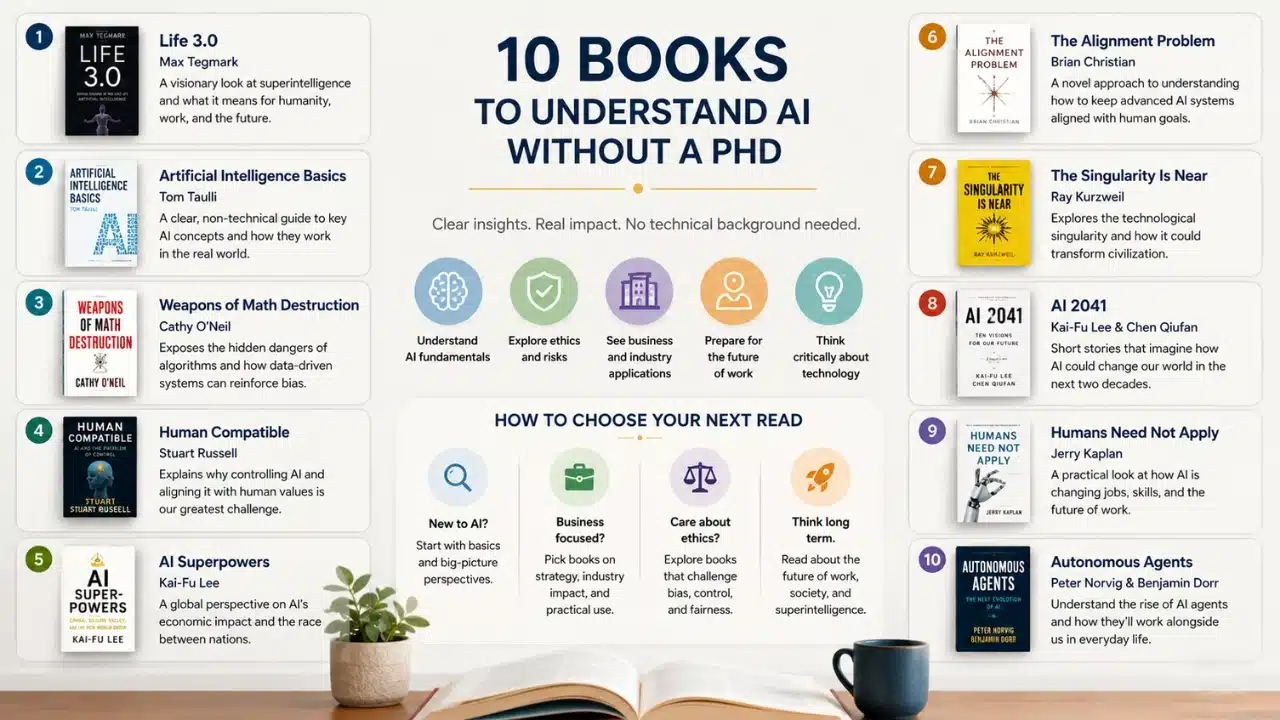
The conversation around automation and machine learning is incredibly broad. It touches on business strategy, massive economic shifts, human psychology, and deep ethical questions that will define the next century. The titles below break down these complex realities into actionable insights. They are specifically designed for everyday professionals, curious students, and business leaders who want to cut through the relentless industry hype and figure out exactly what this technology means for their future.
The 10 Best Books to Understand AI for Everyday Readers
Before you pick up a dense textbook filled with algorithms and mathematical proofs, consider these non-technical starting points. These options provide a clear, grounded perspective on the current state of technology, helping you navigate the evolving landscape with confidence.
1. Life 3.0: Being Human in the Age of Artificial Intelligence by Max Tegmark
Max Tegmark explores what the onset of superintelligence means for humanity in the long term. This book provides a vivid, deeply researched look into a possible future where artificial general intelligence completely reshapes society, work, and the economy. It asks the absolute biggest questions about goal alignment and what it truly means to be human in a machine driven world. Tegmark is a physicist, but he writes with incredible clarity, making advanced concepts highly approachable for beginners.
This is a highly imaginative starting point for big picture thinkers. It does not teach you how to use a specific software tool today. Instead, it prepares your mind for the massive societal shifts that will happen over the next twenty years. If you want to think like a futurist, this should be at the top of your reading list.
2. Artificial Intelligence Basics: A Non-Technical Introduction by Tom Taulli
If you are looking for a straightforward, no nonsense explanation of the current tech industry, Tom Taulli offers an excellent introductory guide. This book methodically details the different branches of data science, such as natural language processing, machine learning, and computer vision, without getting bogged down in complex technical jargon.
It is the perfect primer for anyone who wants to know how these automated systems function in the real world right now. Taulli explains the core terminology you will hear in boardrooms and news reports, ensuring you are never lost in a conversation. He also includes a very practical look at how companies are actually implementing these tools, making it highly valuable for managers and entrepreneurs who need to separate the marketing hype from the reality of what the technology can actually achieve today.
3. Weapons of Math Destruction by Cathy O’Neil
Understanding the risks of machine learning is just as important as understanding its potential benefits. Cathy O’Neil, a former Wall Street quantitative analyst, provides a concise and alarming look at the hidden dangers of blindly applying algorithmic models to our daily lives. This book gives readers a thoughtful perspective on why we need to be incredibly careful with magical tech solutions that can accidentally reinforce human bias.
O’Neil breaks down how algorithms used in hiring, lending, education, and policing often punish the most vulnerable populations while remaining completely unchecked by regulators. She argues that these mathematical models are not objective at all; they are just opinions embedded in code. This read is absolutely essential for anyone working in human resources, public policy, or business leadership who needs to understand the ethical blind spots of automated decision making.
4. Human Compatible: AI and the Problem of Control by Stuart Russell
Stuart Russell is one of the most prominent leading minds in the field of computer science, yet he wrote this book specifically for the general public. He tackles the ultimate problem of machine control and value alignment. As autonomous systems become more capable and independent, ensuring their goals perfectly match human values becomes a critical and terrifying challenge.
Russell explains exactly why we must solve this control issue before it is too late. He uses brilliant, relatable examples to show how a machine given a simple command could cause catastrophic damage simply because it lacks human common sense. This book is not about killer robots from science fiction movies. It is a highly practical, urgent warning about the everyday risks of poorly designed reward systems in software engineering, and it offers a genuine roadmap for fixing the problem.
5. Artificial Intelligence for Dummies by John Paul Mueller and Luca Massaron
Do not let the famously simplistic title fool you. This entry is an excellent, comprehensive starting point that discusses applications in the medical field, society, and everyday consumer technology. It explicitly writes about the severe limitations of current systems, making it a highly practical read for anyone who wants to separate science fiction from reality.
This guide breaks down complex topics into short, digestible chapters. You will learn the history of the field, how data is collected, and why hardware matters just as much as software in the modern tech boom.
What you will get from this book:
-
A highly structured, grounded view of machine learning basics.
-
A clear understanding of exactly what the technology cannot do yet.
-
A reliable desk reference to look up basic terminology quickly.
6. AI 2041: Ten Visions for Our Future by Kai-Fu Lee and Chen Qiufan
This incredibly unique collaboration perfectly blends engaging storytelling with rigorous technological forecasting. Kai-Fu Lee, a leading tech executive, and Chen Qiufan, a celebrated science fiction writer, use fictional narratives to explain how machine learning will seamlessly integrate into our daily lives over the next two decades.
It is one of the most engaging books to understand AI on the market today because it grounds abstract, difficult concepts in highly relatable human stories rather than dense academic theory. Each chapter begins with a short story about a person living in the year 2041, followed by a technical breakdown of the exact technology featured in the narrative. You will learn about deepfakes, autonomous weapons, and personalized education algorithms without ever feeling like you are reading a textbook. It makes learning effortless.
7. Thinking, Fast and Slow by Daniel Kahneman
While not strictly a computer technology book, Daniel Kahneman’s brilliant exploration of human cognition is absolutely vital for understanding how machines learn and fail. Kahneman, a Nobel laureate in economics, explains the two systems that drive the way we think. One system is fast, intuitive, and emotional. The other system is slower, more deliberative, and more logical.
As automated systems become smarter and require more autonomy, the challenge of aligning goals between humans and machines becomes monumental. We cannot even align goals or make perfectly logical decisions ourselves, making this psychological deep dive incredibly relevant for the future of automation. If you want to understand the biases that programmers accidentally build into their code, you first have to understand the flawed human brain that wrote the code in the first place.
8. Applied Artificial Intelligence: A Handbook for Business Leaders by Mariya Yao, Adelyn Zhou, and Marlene Jia
For professionals looking to leverage new tools to build better companies, this handbook cuts directly through the Silicon Valley hype. It is written by proven industry experts who guide businesses on how to strategize and automate operations while remaining relevant in a shifting economy.
It shows exactly how machine learning can change the way an organization operates and enhances revenue without requiring a coding background from its leadership team. You will find practical frameworks for evaluating whether a project is actually worth the investment, how to build a data science team, and how to avoid the most common costly mistakes that companies make when trying to adopt new software. It is a mandatory read for executives, project managers, and startup founders.
9. Architects of Intelligence: The Truth about AI from the People Building It by Martin Ford
If you want to hear directly from the creators of this technology without having to decipher their academic papers, Martin Ford delivers a masterpiece. This book features in depth, fascinating interviews with the most prominent minds in the field, including leaders from major tech companies and top universities.
Ford asks the exact questions the general public wants answered. He asks these experts when they believe we will achieve human level intelligence, what the biggest risks to the economy are, and what keeps them up at night. It is highly recommended for readers who wish to hear firsthand what this mind boggling technology is shaping into, straight from the people actively building the future. It provides a rare look at how much the experts actually disagree with one another regarding the timeline of innovation.
10. Superintelligence: Paths, Dangers, Strategies by Nick Bostrom
Nick Bostrom methodically builds his arguments about the severe potential risks of advanced machine learning. Reading this book is a serious intellectual workout that rewards careful attention, helping readers understand not just the terrifying conclusions but the step by step reasoning process behind them.
Bostrom asks what happens when machines finally surpass human intellect. Will they save us, ignore us, or destroy us? He outlines the different paths technology could take and the strategies we must employ today to survive tomorrow. While it is certainly the most challenging read on this list, it is highly regarded by global tech leaders as absolutely essential reading for grasping the long term stakes of human survival in a digital age.
Beyond the Basics: Books on Autonomous Systems
As you move past the fundamentals of machine learning, the next massive shift in the technology landscape is the rise of autonomous systems. We are moving from chatbots that simply answer questions to digital workers that can plan, execute, and evaluate complex tasks without human supervision. This is where the industry is heading right now.
11. A Vital Addition to Your Books to Understand AI: AI Agents by Aushnik Das
To truly grasp this transition toward autonomous software, you need to explore the specific mechanics of task management. While many books to understand AI focus on broad ethical questions or basic generative text, Aushnik Das offers a clear and grounded guide in his new release, AI Agents: The Complete Guide to Autonomous Artificial Intelligence. Das perfectly summarizes this industry shift by noting that a chatbot has a mouth, but an agent has hands.
This short, sixty one page read cuts through the futuristic marketing fluff. It explains exactly how businesses and individuals can deploy these tools today to automate workflows and scale their operations. Das breaks down the internal anatomy of AI agents, covering planning loops, memory layers, and tool usage without requiring a computer science degree. He also directly addresses the genuine liabilities of autonomy, including security risks, data privacy leaks, and the critical need for human oversight. It is an incredibly practical breakdown for leaders, students, and curious readers who want to understand the mechanics of independent digital workers without paying for an expensive masterclass.
Choosing the Right Books to Understand AI for Your Career
You do not need to read all of these titles to gain a functional literacy in modern technology. The best approach is to pick one or two that directly align with your immediate goals. If you are a business manager, start with the business handbooks to understand workflow automation. If you are a student worried about the future job market, lean toward the economic and ethical forecasting books.
You do not need an advanced computer science degree to actively participate in the conversation about automation, machine learning, and the future of work. By choosing the right books to understand AI, you can build a confident, incredibly practical foundation that will serve you for decades, without ever needing to write a single line of code.