Setting realistic fitness goals sounds easy until you are the one trying to do it. Most beginners start with excitement, not a plan. They tell themselves they will work out every day, eat perfectly, wake up early, lose weight fast, drink more water, sleep better, and completely change their lifestyle in one month. I understand why that happens. When someone finally decides to start their fitness journey, the motivation feels strong, and it is tempting to build a big plan around that emotion.
But motivation is not a stable foundation. Real life gets involved quickly. Work pressure increases. Sleep gets disturbed. Muscles get sore. Social plans happen. Some days you simply do not feel like exercising. That is where unrealistic fitness goals collapse. That is why setting realistic fitness goals matters so much. A realistic goal does not make you lazy or less ambitious. It gives your ambition a structure that your body, schedule, and mind can actually handle.
For beginners, the goal should not be to train like an athlete from day one. The goal should be to build trust with your body. You need goals that help you show up, recover properly, and improve without feeling punished. This article is designed as a practical cluster guide under the larger Beginner’s Complete Fitness Guide, helping readers move from “I want to get fit” to “I know exactly what to do this week.”
Why Setting Realistic Fitness Goals Matters?
Setting realistic fitness goals matters because beginners usually do not fail from lack of desire. They fail from poor planning. A goal that looks inspiring on Sunday night can feel impossible by Wednesday evening if it ignores your current fitness level, job routine, sleep, stress, and energy. A realistic goal gives your fitness journey direction. Without direction, every workout becomes a random decision. You may do cardio one day, copy a social media routine the next day, skip three days, then punish yourself with an intense workout. That pattern feels busy, but it rarely creates steady progress.
I have noticed that beginners who set realistic goals usually build confidence faster. They do not need to guess whether they are succeeding. They know what they planned, they know what they completed, and they know what to adjust. This makes fitness feel less emotional and more manageable. Realistic goals also protect you from burnout. If you go from no workouts to six workouts per week, your body may not recover well. Your joints, muscles, tendons, and nervous system all need time to adapt. A smart goal gives your body a clear but manageable signal.
For desk workers and busy professionals, this is even more important. If your body already deals with long sitting, screen fatigue, tight hips, poor posture, and stress, your first fitness goal should support recovery and energy. It should not create another layer of pressure.
| Why Realistic Goals Matter | What Happens Without Them | Better Beginner Approach |
| They create direction | You do random workouts without structure | Follow a simple weekly plan |
| They reduce frustration | You expect fast results and feel disappointed | Track small weekly wins |
| They protect recovery | You train too hard too soon | Increase slowly every few weeks |
| They build confidence | You feel like you are failing often | Set goals you can complete repeatedly |
| They improve consistency | You depend only on motivation | Build routine-based habits |
| They improve decision-making | You keep changing plans | Review progress before adjusting |
| They support long-term health | You chase quick transformation | Build habits you can maintain |
A realistic fitness goal is not a small dream. It is a practical bridge between who you are now and who you are trying to become.
The Biggest Mistake Beginners Make With Fitness Goals
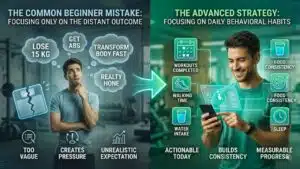
The biggest mistake beginners make is setting goals based only on outcomes. They say, “I want to lose 15 kg,” “I want abs,” “I want to look fit,” or “I want to transform my body fast.” These goals are understandable, but they are incomplete. An outcome goal tells you what you want. It does not tell you what to do today. That is where many beginners get stuck. They focus so much on the final result that they forget to build the daily process that creates it.
From experience, the beginners who make the most progress usually focus on behavior first. They track workouts completed, walking time, strength improvements, sleep, water intake, and food consistency. These actions may feel less exciting than chasing a dramatic transformation, but they are far more useful. For example, “I want to lose weight” is vague. A stronger beginner goal is: “For the next four weeks, I will walk for 25 minutes four days per week, strength train twice per week, and eat a protein-rich breakfast five days per week.” That goal gives your body repeated signals. It also gives your mind a clear target.
Another common mistake is setting goals that punish the body. Beginners often think pain, hunger, and exhaustion prove commitment. They do not. A good fitness goal should challenge you, but it should not make your life miserable.
| Weak Goal | Why It Fails | Better Realistic Goal |
| I want to get fit | Too vague and hard to measure | I will complete 3 workouts per week for 4 weeks |
| I want to lose weight fast | Creates pressure and crash dieting | I will walk 100–120 minutes weekly and improve meals |
| I want abs | Too appearance-focused for beginners | I will train core twice weekly and improve nutrition |
| I will work out every day | Too aggressive for most beginners | I will train 3 days and walk 2 days weekly |
| I will stop all junk food | Too restrictive and hard to sustain | I will prepare 4 balanced dinners weekly |
| I will transform in 30 days | Unrealistic expectation | I will build a 30-day consistency habit |
| I will do intense cardio daily | Recovery may suffer | I will start with moderate walking and progress slowly |
The better approach is to connect every big goal to repeatable actions. That is where real progress starts.
What Makes a Fitness Goal Realistic?
A realistic fitness goal matches your current life. That includes your schedule, body weight, energy, sleep, stress, training history, injuries, and confidence level. If your goal ignores these things, it may sound good but fail quickly. A realistic goal should stretch you slightly, not shock your system. If you currently do not exercise at all, three workouts per week may be realistic. Six workouts per week may be too much. If you currently walk 2,000 steps per day, jumping to 12,000 steps daily may create foot, knee, or lower-back discomfort. A better goal would be adding 1,000–2,000 steps gradually.
One method that works well is the SMART goal structure. Your goal should be specific, measurable, achievable, relevant, and time-bound. This sounds simple, but it changes everything. Instead of “I should exercise more,” you write, “I will do two 30-minute full-body workouts every Monday and Thursday for the next four weeks.”
The “achievable” part is where beginners need to be honest. A goal can be inspiring and still unrealistic. If the plan only works during a perfect week, it is not ready. Your goal should survive a normal week with work, family, tiredness, and unexpected interruptions. A good goal should also include a review point. You do not need to commit to one plan forever. Follow it for two to four weeks, check how your body responds, then adjust.
| SMART Element | What It Means for Fitness | Beginner Example |
| Specific | The action is clear | Walk for 25 minutes after lunch |
| Measurable | You can track it | Complete 4 walks this week |
| Achievable | It fits your current ability | Start with 2 strength days, not 6 |
| Relevant | It connects to your real goal | Strength training for posture and energy |
| Time-bound | It has a review period | Follow the plan for 4 weeks |
| Recoverable | Your body can handle it | Include rest days and easy days |
| Flexible | It can survive real life | Shorten workouts when busy instead of skipping |
A realistic fitness goal should make you think, “This will take effort, but I can do it.” That feeling is the sweet spot.
Start With Your Baseline Before Setting Goals
Before setting realistic fitness goals, you need to understand your starting point. Many beginners skip this step and choose goals based on what they wish they could do. That usually leads to frustration. Your baseline is not a judgment. It is information. It tells you where your body is right now. It helps you choose the right workout intensity, walking target, strength level, recovery plan, and schedule.
A simple baseline check can include walking ability, sleep quality, pain, posture, energy level, daily steps, and basic strength. You do not need advanced testing. You need practical awareness. Can you walk 20 minutes comfortably? Can you do five wall push-ups? Do your knees hurt during stairs? Do you sleep enough to recover from workouts?
For desk workers, I would also check stiffness. If your hips, neck, shoulders, or lower back feel tight by evening, your goal should not only be “lose weight.” It should also include mobility, walking breaks, and strength training for posture.
Your baseline also helps prevent ego-driven mistakes. A person who used to be active years ago may remember old abilities and try to restart at that level. That is a fast way to feel sore, discouraged, or injured. Your body needs to rebuild from where it is now, not where it used to be.
| Baseline Area | Question to Ask Yourself | Why It Matters |
| Daily movement | How much do I walk now? | Helps set step and cardio goals |
| Walking capacity | Can I walk 20 minutes comfortably? | Shows cardio starting point |
| Strength | Can I do chair squats or wall push-ups? | Helps choose beginner exercises |
| Mobility | Do my hips, shoulders, or back feel stiff? | Shows where warm-ups should focus |
| Pain | Do I have recurring joint or back pain? | Helps avoid unsafe movements |
| Sleep | Do I sleep at least 7 hours most nights? | Affects recovery and energy |
| Stress | Is my work or life stress high? | Affects workout tolerance |
| Schedule | When can I realistically train? | Helps build a routine that lasts |
| Confidence | Do I feel nervous or ready? | Helps choose the simplest first step |
Once you know your baseline, your goals become smarter. You stop guessing and start planning.
How to Set Realistic Fitness Goals Step by Step?
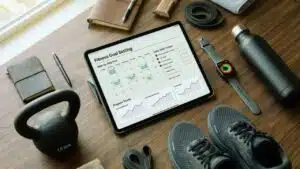
Setting realistic fitness goals becomes easier when you follow a step-by-step process. Beginners often make the mistake of starting with the final destination. A better method is to start with the next repeatable action.
First, choose your main reason. Do you want more energy? Weight loss? Better strength? Less stiffness? Better posture? More confidence? Better heart health? Your main reason helps you choose the right type of goal.
Second, choose one or two simple actions. If your goal is better energy, walking and sleep may matter most at first. If your goal is strength, two full-body workouts per week may be enough. If your goal is weight loss, combine walking, strength training, and food awareness.
Third, attach the action to a schedule. “I will work out more” is weak because it leaves too much room for delay. “I will train Monday and Thursday after work” is stronger because it gives your goal a place in your week.
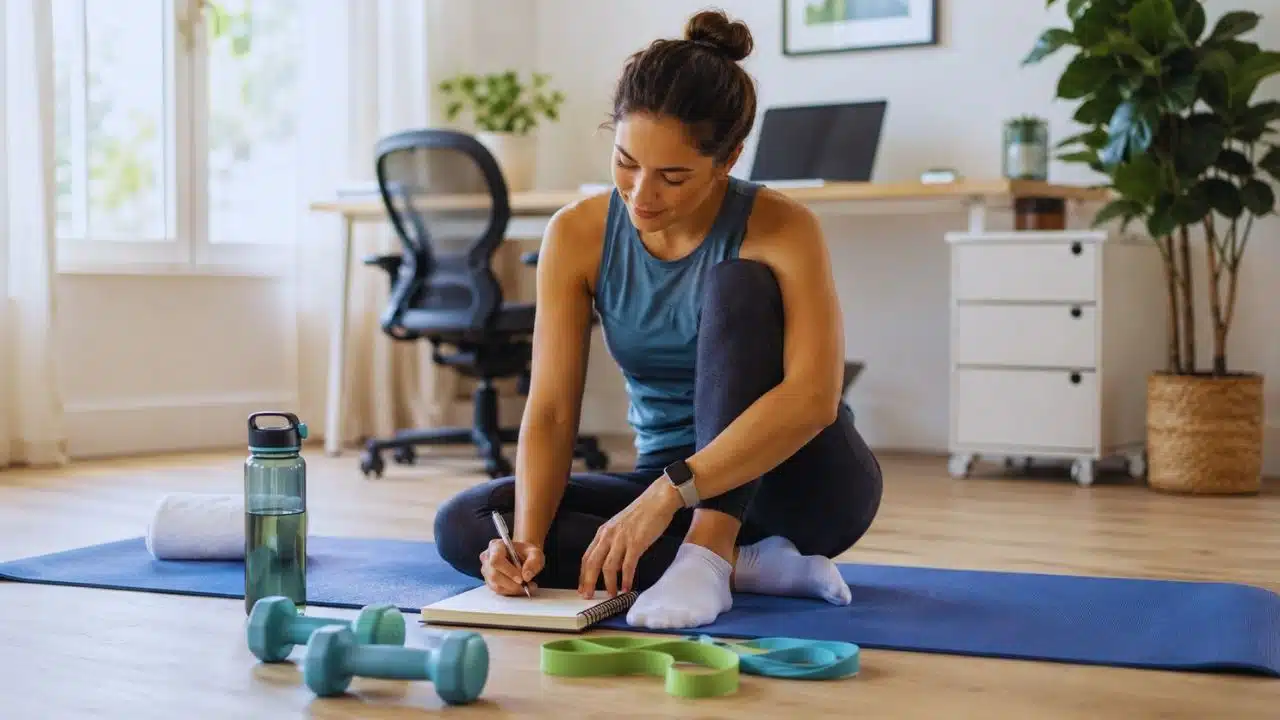
Fourth, track completion. Do not rely on memory. Use a note, calendar, spreadsheet, app, or paper checklist. Tracking is not about obsession. It is about evidence. When motivation drops, evidence keeps you grounded.
Fifth, review after two to four weeks. If the plan was too easy, increase slightly. If it was too hard, reduce it. If it worked well, repeat it and build from there.
| Step | What to Do | Practical Example |
| 1. Choose the main reason | Pick one priority | More energy and better posture |
| 2. Choose simple habits | Select repeatable actions | Walk 25 minutes and strength train twice weekly |
| 3. Make it measurable | Add numbers | 3 walks and 2 workouts per week |
| 4. Schedule it | Put it on your calendar | Monday, Thursday, Saturday |
| 5. Track it | Record completion | Use notes app or calendar checkmarks |
| 6. Review it | Check after 4 weeks | Add 5 minutes or 1 extra set |
| 7. Protect recovery | Avoid overload | Keep 1–2 easier days weekly |
| 8. Adjust gradually | Change one thing at a time | Increase walking before adding intense cardio |
This process keeps fitness simple enough to follow. That is exactly what beginners need.
Realistic Fitness Goals for Different Beginner Types
Not every beginner should set the same goal. This is where generic fitness advice often fails. A busy office worker, an overweight beginner, a parent, a student, and someone returning after a long break all need different starting points. A desk worker may need a goal around movement breaks, walking, mobility, and posture-focused strength. Someone who feels breathless quickly may need gentle cardio progression. A beginner focused on fat loss may need walking, strength training, sleep, and meal consistency. A returning beginner may need to start below their old ability level.
I have found that the best beginner goals feel personal. They match the person’s real obstacles. If time is your biggest issue, short workouts are better than long ones. If joint pain is your biggest issue, low-impact movement matters. If energy is your biggest issue, sleep and nutrition cannot be ignored. This is why goal-setting should not be copied blindly from influencers. Their routine may not match your body, schedule, or responsibilities. You need a goal that works inside your actual week.
| Beginner Type | Realistic First Goal | Why It Works |
| Desk worker | Walk 20 minutes daily and strength train twice weekly | Reduces sitting impact and builds strength |
| Overweight beginner | Low-impact cardio 3 days and chair-based strength 2 days | Protects joints while building consistency |
| Busy parent | Three 20-minute home workouts weekly | Fits limited time and unpredictable schedules |
| Complete beginner | Walk 15–20 minutes, 4 days weekly | Simple and low barrier |
| Returning beginner | Train at 50–60% of old ability for 4 weeks | Prevents ego-driven overload |
| Stressed professional | Short workouts plus a sleep goal | Supports recovery and consistency |
| Weight-loss beginner | Walk, strength train, and improve protein intake | Combines movement and nutrition |
| Low-confidence beginner | Start with private home workouts | Reduces fear and builds comfort |
A realistic goal should feel like it was designed for your life, not borrowed from someone else’s highlight reel.
How to Set Weight Loss Goals Without Becoming Extreme
Many people begin fitness because they want to lose weight. That is a valid goal. But weight-loss goals can become harmful when they are rushed, overly restrictive, or based only on appearance. The smarter approach is to focus on behaviors that support fat loss. These include walking more, strength training, eating enough protein, improving meal quality, drinking water, sleeping better, and reducing frequent high-calorie snacking. These actions are more useful than simply saying, “I want to lose weight fast.”
Weight can also fluctuate for many reasons. Water retention, salt intake, digestion, stress, hormones, soreness, and sleep can all affect the scale. Beginners often panic when the scale does not move for a few days. That panic can lead to extreme dieting, which usually backfires.
Strength training is important during weight loss because it helps protect muscle. Many beginners focus only on burning calories. But if you lose weight without maintaining strength, you may feel smaller but weaker. A better goal is improving body composition, not just lowering the number on the scale. A realistic fat-loss goal should include both movement and nutrition habits. It should not require starvation. It should not remove every enjoyable food. The best plan is one you can repeat without feeling trapped.
| Weight-Loss Goal Type | Poor Version | Better Version |
| Scale goal | Lose 10 kg as fast as possible | Lose weight gradually while building habits |
| Cardio goal | Burn calories every day | Walk 120–150 minutes weekly over time |
| Food goal | Cut all carbs | Build balanced meals with protein and fiber |
| Strength goal | Avoid weights until weight drops | Strength train 2 days weekly |
| Tracking goal | Weigh daily and panic | Watch weekly trends and habit consistency |
| Snack goal | Never eat snacks again | Replace frequent low-value snacks gradually |
| Meal goal | Eat perfectly every day | Prepare 4–5 balanced meals weekly |
The goal is not to suffer until the weight drops. The goal is to build a lifestyle that makes healthy weight management easier.
How to Set Strength Goals as a Beginner?
Strength goals are some of the best goals beginners can set because they are positive and measurable. Instead of only focusing on becoming smaller, you focus on becoming more capable. A beginner strength goal does not need to involve heavy lifting. It can be as simple as doing 12 controlled chair squats, completing 10 incline push-ups, holding a plank for 30 seconds, carrying groceries without struggling, or learning how to hip hinge properly.
Strength training also gives beginners confidence. When you notice that stairs feel easier, your posture improves, or your back feels more supported, fitness becomes more meaningful. You start to see exercise as something that helps daily life, not just appearance. The key is to start with movement quality. Learn the basic patterns first: squat, hinge, push, pull, carry, and core control. These patterns show up everywhere in real life. Sitting down, standing up, lifting bags, pushing doors, pulling objects, and carrying loads all require strength.
Beginners should avoid rushing into heavy weights before they understand form. A clean bodyweight squat is more valuable than a sloppy weighted squat. Once the movement feels stable, you can progress by adding reps, sets, resistance, or range of motion.
| Strength Goal | Beginner Starting Point | Progression |
| Squat strength | 2 sets of 8 chair squats | Add reps, then lower chair height |
| Push strength | Wall push-ups | Move to incline push-ups |
| Pull strength | Resistance band rows | Increase band tension slowly |
| Core control | Dead bug | Add slow tempo or more reps |
| Grip strength | Light farmer carry | Increase time or weight |
| Lower-body control | Low step-ups | Increase step height slowly |
| Hip strength | Glute bridges | Add pauses or single-leg variations |
| Posture strength | Band pull-aparts | Add reps and better control |
Strength goals should make you feel more capable in your everyday body. That is powerful motivation for beginners.
How to Set Cardio Goals Without Burning Out?
Cardio goals should begin with comfort and consistency, not punishment. Many beginners go too hard too soon because they think cardio must feel miserable to work. That is not true. Walking is one of the best starting points. It is simple, low-cost, beginner-friendly, and easy to recover from. For many people, especially desk workers, walking regularly can make a noticeable difference in energy, mood, stiffness, and stamina.
If walking feels too easy later, you can increase pace, add hills, extend duration, or include short intervals. But beginners should usually increase time before intensity. This helps the body adapt without creating unnecessary soreness or joint discomfort. The talk test is useful. During moderate cardio, you should be able to talk but not sing comfortably. If you are gasping, dizzy, or unable to continue, the intensity is too high for your current level.
Cardio goals should also fit your personality. If you hate running, do not start with running. Try walking, cycling, swimming, rowing, dancing, or low-impact cardio. The best cardio is the one you can repeat.
| Cardio Goal | Beginner Version | Progression |
| Walking | 20 minutes, 3 days weekly | Add 5 minutes weekly |
| Brisk walking | 10 minutes inside a walk | Increase brisk sections slowly |
| Cycling | 15 minutes easy pace | Add time before resistance |
| Stairs | 1–2 flights slowly | Add repetitions gradually |
| Jogging | Walk-jog intervals | Increase jogging time slowly |
| Desk-worker movement | 5-minute walking breaks | Add 2–3 breaks daily |
| Weekend cardio | One longer easy walk | Add distance gradually |
| Low-impact cardio | Swimming or elliptical | Increase duration first |
A realistic cardio goal should leave you feeling trained, not destroyed. You should recover well enough to do it again.
How to Track Fitness Goals Without Overcomplicating It?

Tracking your goals helps you see progress clearly. Beginners often feel like nothing is changing because they rely only on memory or the mirror. But when you track workouts, walking time, reps, sleep, and energy, small improvements become visible. Tracking does not need to be complicated. You can use a notebook, notes app, calendar, spreadsheet, habit tracker, or fitness app. The method does not matter as much as consistency. If it takes too much effort, you will stop using it.
The simplest tracking system I recommend for beginners includes three things: workouts completed, walking or cardio minutes, and one recovery marker like sleep or energy. That is enough to understand whether your plan is working. For strength training, write down exercises, sets, reps, and weight if used. For cardio, track minutes and how it felt. For nutrition, you can track protein servings or meal consistency instead of counting every calorie. Tracking should support awareness, not create anxiety.
The best part of tracking is that it turns progress into evidence. If you went from 8 chair squats to 15, from walking 15 minutes to 30, or from one workout per week to three, you are improving.
| What to Track | Simple Method | Why It Helps |
| Workouts | Calendar checkmark | Shows consistency |
| Strength | Sets and reps | Shows physical progress |
| Cardio | Minutes walked | Shows stamina growth |
| Sleep | Hours or quality rating | Shows recovery pattern |
| Energy | 1–5 rating | Helps adjust intensity |
| Body weight | Weekly average if useful | Shows longer trend |
| Meals | Protein servings or meal photos | Supports nutrition awareness |
| Mood | Quick note after workouts | Shows mental benefits |
| Pain or soreness | Short daily note | Helps prevent overtraining |
Do not track everything from day one. Start with what matters most, then add details only if they help.
When Should You Adjust Your Fitness Goals?
Fitness goals should not stay frozen forever. A good goal changes as your body adapts. The mistake is changing too soon or refusing to change at all. Beginners often change goals after one bad week. That is usually too soon. A stressful workweek, poor sleep, or missed workout does not mean the plan failed. You need to look at patterns over two to four weeks.
You should adjust your goal if it is consistently too easy, too hard, painful, boring, or unrealistic for your schedule. If you complete everything easily for two weeks, add a small challenge. If you miss most sessions, reduce the plan. If soreness lasts too long, lower the volume. If pain appears, modify the exercise. The key is to adjust one thing at a time. Do not add more workouts, more sets, more cardio, and stricter nutrition all in the same week. That makes it hard to know what is working.
I like to use a simple review question: “Did this goal help me become more consistent, stronger, healthier, or more aware?” If yes, keep building. If no, change the structure.
| Situation | What It Means | Smart Adjustment |
| Goal feels too easy | Your body adapted | Add reps, time, or resistance |
| You miss sessions often | Plan may be too demanding | Reduce frequency or duration |
| You feel sore for days | Volume may be too high | Lower sets or intensity |
| You feel bored | Plan needs small variety | Change one exercise, not everything |
| You feel pain | Movement may not suit you | Modify exercise or seek guidance |
| Energy is low | Recovery may be weak | Improve sleep and nutrition |
| Progress stopped | Body adapted | Add small progression |
| Schedule changed | Routine no longer fits | Move workouts to better time slots |
Adjusting a goal is not failure. It is smart coaching.
Common Mistakes to Avoid When Setting Fitness Goals
Fitness goal mistakes are common because beginners often start from emotion. They feel frustrated with their body, so they create a harsh plan. They feel inspired by someone else, so they copy a routine. They want quick results, so they ignore recovery. These reactions are normal, but they are not always useful. One common mistake is setting too many goals at once. A beginner may try to lose weight, gain muscle, run, stretch, meal prep, drink more water, cut sugar, sleep earlier, and train every day. That is too much change at once. A better plan starts with two or three habits.
Another mistake is using shame as motivation. If your goal sounds like punishment, you will eventually resist it. Fitness should make you feel more capable, not constantly guilty. Beginners also forget that missing a day is normal. The all-or-nothing mindset destroys progress. Missing one workout is not the problem. Quitting for two weeks afterward is the problem.
| Mistake | Why It Hurts | Better Choice |
| Setting too many goals | Creates overwhelm | Choose 2–3 key habits |
| Expecting fast results | Creates disappointment | Track 4-week progress |
| Ignoring recovery | Causes fatigue and soreness | Schedule rest days |
| Copying influencers | Plan may not fit your body | Match goals to your baseline |
| Using punishment mindset | Reduces enjoyment | Focus on strength and energy |
| Only tracking weight | Misses other progress | Track workouts, stamina, and sleep |
| Going all-or-nothing | One mistake becomes quitting | Restart at the next session |
| Training through pain | Increases injury risk | Modify or stop painful movements |
Avoiding these mistakes makes your fitness journey calmer and more sustainable.
A 30-Day Realistic Fitness Goal Plan for Beginners
A 30-day goal plan is a great starting point because it gives beginners enough time to build momentum without feeling trapped. The goal is not to completely transform your body in one month. The goal is to prove that you can follow a simple system. This plan combines walking, strength training, nutrition, and recovery. It is beginner-friendly because it does not demand perfection. It gives you structure but leaves room for real life.
In week one, the focus is simply starting. Do not try to impress yourself. Learn the routine. In week two, repeat the habits. In week three, add a small amount of progress. In week four, review what worked and prepare for the next phase. The most important part of a 30-day plan is consistency. Even if the workouts feel simple, they are teaching your brain and body that fitness is now part of your week.
| Week | Fitness Goal | Nutrition Goal | Recovery Goal |
| Week 1 | Walk 20 minutes, 3 days; strength train 1–2 days | Add protein to breakfast | Sleep 30 minutes earlier twice |
| Week 2 | Walk 25 minutes, 3 days; strength train 2 days | Add vegetables to 1 meal daily | Stretch 5 minutes after workouts |
| Week 3 | Walk 30 minutes, 3 days; strength train 2 days | Prepare 2 balanced meals | Take 1 full rest day |
| Week 4 | Walk 30 minutes, 4 days; strength train 2 days | Reduce one low-value snack habit | Review progress and adjust |
Example 30-Day Goal Statement
“For the next 30 days, I will complete two beginner strength workouts weekly, walk at least three days weekly, add protein to breakfast, and sleep earlier on two work nights. I will track my workouts in my notes app and review progress after four weeks.”
That statement is realistic because it is clear, measurable, and not extreme. It gives you enough challenge to grow without overwhelming your life.
Best Tools for Setting and Tracking Fitness Goals
You do not need expensive tools to set realistic fitness goals. In fact, beginners often do better with simple tools because fewer options mean less confusion. A notebook, calendar, or notes app can be enough. That said, the right tools can reduce friction. A smartwatch can help track steps and heart rate. A workout app can store routines. A habit tracker can show consistency. A water bottle on your desk can remind you to drink more. Resistance bands near your workspace can make short strength sessions easier.
For desk professionals, ergonomic tools also matter. If your work setup creates neck pain, wrist strain, tight hips, or lower-back discomfort, your fitness plan has to work harder. A better chair, standing desk, footrest, monitor height, and movement breaks can support your bigger wellness goal.
Recovery tools can also help, but they should not replace the basics. Foam rollers, massage balls, stretching straps, and mobility tools are useful, but sleep, nutrition, and smart training still matter more.
| Tool | Best For | Beginner Tip |
| Notes app | Simple workout tracking | Record exercises, sets, reps |
| Calendar | Scheduling workouts | Treat workouts like meetings |
| Habit tracker | Building consistency | Track only 2–3 habits first |
| Smartwatch | Steps and heart rate | Use data calmly, not obsessively |
| Food journal | Meal awareness | Track patterns, not perfection |
| Resistance bands | Home strength training | Keep them visible |
| Water bottle | Hydration | Place it on your desk |
| Foam roller | Light recovery | Use after workouts or long sitting |
| Ergonomic chair | Desk-worker comfort | Support posture during long work hours |
| Standing desk | Reducing sitting time | Alternate positions throughout the day |
For readers following the Corporate Athlete lifestyle, this is where fitness, work, and recovery connect. HappinessFit.com can naturally support this kind of practical wellness approach by helping readers think beyond workouts and build healthier daily systems.
How Setting Realistic Fitness Goals Supports the Bigger Fitness Journey?
Setting realistic fitness goals is the first step that makes the rest of the fitness journey easier. Once your goals are clear, your workout routine becomes easier to choose. Your nutrition decisions become less random. Your recovery habits feel more important. Your progress becomes easier to measure.
For example, if your goal is better stamina, cardio should be part of your plan. If your goal is better posture, strength training and mobility should matter. If your goal is fat loss, walking, strength training, nutrition, and sleep all need attention. If your goal is general health, consistency matters more than intensity.
This is why setting goals connects directly to the broader Beginner’s Complete Fitness Guide. A beginner does not need every detail on day one. But they do need direction. Goals provide that direction. A realistic goal also helps you avoid distraction. Fitness content online can be noisy. One day you hear cardio is best. The next day someone says only strength matters. Then someone else says nutrition is everything. Clear goals help you filter advice and choose what actually fits your purpose.
| Bigger Fitness Area | How Realistic Goals Help |
| Workout routine | Helps choose exercises and weekly schedule |
| Cardio training | Helps set walking, cycling, or endurance targets |
| Strength training | Helps track reps, sets, and resistance |
| Nutrition | Helps align meals with energy and recovery |
| Sleep | Helps protect progress and reduce fatigue |
| Recovery | Helps prevent burnout and overtraining |
| Body signals | Helps you know when to push or slow down |
| Motivation | Gives you proof of progress |
| Long-term health | Keeps habits sustainable |
| Confidence | Makes fitness feel achievable |
When your goals are realistic, fitness becomes less confusing. You stop chasing every trend and start building your own path.
Final Thoughts
Setting realistic fitness goals is not about thinking small. It is about starting smart. Most beginners do not need a harsher plan. They need a clearer one. They need goals that match their body, schedule, energy, and recovery. They need goals that create confidence instead of guilt. They need a system that can survive normal life.
Start with a goal you can repeat for 30 days. Walk more. Strength train twice weekly. Eat better without becoming extreme. Sleep enough to recover. Track your progress. Then review and adjust. That is how fitness becomes real.Not through one perfect week. Not through punishment. Not through copying someone else’s routine. Real progress comes from realistic goals repeated long enough to change how your body feels, moves, and performs.
Frequently Asked Question (FAQs) About Setting Realistic Fitness Goals
What Is an Example of a Realistic Fitness Goal?
A realistic beginner fitness goal could be: “I will complete two full-body workouts per week and walk for 25 minutes three times per week for the next 30 days.” This goal works because it is specific, measurable, and achievable. It also gives the beginner enough room to recover.
How Many Fitness Goals Should a Beginner Set at Once?
Most beginners should start with two or three goals. One can focus on exercise, one on nutrition, and one on recovery. Too many goals at once can create stress and make the plan harder to follow.
Is Losing 10 Kg a Realistic Fitness Goal?
Losing 10 kg can be realistic over time, but it is usually not a good short-term beginner goal. A better starting point is to focus on behaviors that support fat loss, such as walking regularly, strength training, eating balanced meals, and improving sleep.
How Long Should I Follow a Fitness Goal Before Changing It?
Follow a beginner fitness goal for at least two to four weeks before making major changes. This gives you enough time to see whether the plan fits your body, schedule, and recovery. One bad day does not mean the goal is wrong.
Should My Fitness Goal Focus on Weight or Strength?
It depends on your main priority, but beginners usually benefit from including strength goals even if weight loss is the main goal. Strength training helps build muscle, improve posture, and support long-term body composition.
What If I Miss a Workout?
Missing one workout does not ruin your goal. The best response is to continue with the next planned session. Beginners make progress by returning quickly, not by being perfect every day.
How Do I Know If My Fitness Goal Is Too Hard?
Your goal may be too hard if you miss sessions often, feel exhausted for days, experience recurring pain, or dread every workout. Reduce the frequency, duration, or intensity until the plan becomes repeatable.