A transcript is good at recording where someone studied and which courses they passed. It is less useful when a hiring manager wants to know something more immediate: what can this person actually do?
That question sits at the center of competency-based education.
CBE organizes learning around defined competencies and asks students to demonstrate that they have met them. The emphasis moves away from simply completing a prescribed amount of instruction and toward evidence of learning.
That sounds like a modest change. In practice, it can alter how courses are designed, how students progress, and—most importantly—how they are assessed.
It also explains why competency-based education has attracted attention from employers. Companies are trying to identify skills more precisely, train existing employees more efficiently, and rely less heavily on broad proxies such as a degree title or years in a previous job.
CBE does not solve all of those problems. It is useful mainly when the evidence behind the competency is strong.
That is the part worth examining.
CBE Makes More Sense When You Look at the Assessment
The term “competency-based” covers several types of program.
In the United States, the Department of Education distinguishes between CBE programs that still operate through credit or clock hours and direct-assessment programs where progress is measured more directly through demonstrated knowledge and skills.
Outside the United States, qualification systems and terminology differ. There is no single worldwide CBE template.
Nor does CBE automatically mean online, self-paced, or accelerated.
A student may still work with instructors, complete assignments, follow deadlines, and study within an academic term. What changes is the role of demonstrated performance.
Take a course that claims to prepare students to analyze business data. A conventional transcript might show that the student passed the course with a particular grade.
A competency-based program has an opportunity to say something more precise. The student may have been required to organize an untidy dataset, choose an appropriate analytical method, explain why that method was suitable, identify limitations in the data, and present a recommendation.
The important part is not that CBE uses practical assignments while traditional education does not. Many excellent traditional programs already use demanding projects, laboratories, clinical placements, studios, research work, and internships.
The difference is that CBE deliberately connects progression to defined demonstrations of competence.
That puts assessment quality under a brighter light.
A program claiming that graduates can negotiate, diagnose, lead, design, troubleshoot, or make professional judgments should not rely mainly on simple recall tests. Multiple-choice exams have legitimate uses, particularly for checking factual and conceptual knowledge. They are not convincing evidence of every kind of performance.
The Competency-Based Education Network’s quality framework reflects this distinction. It calls for competencies that can actually be measured and for assessments that match the level and nature of the ability being claimed.
That requirement sounds basic. It is also where weak CBE programs become easy to spot.
If the marketing describes sophisticated professional capability and the assessment amounts to short quizzes, the credential is not providing much additional evidence.
Western Governors University Shows What the Model Looks Like at Scale
Competency-based education is sometimes discussed as if it were still an experimental idea. Western Governors University makes that difficult to argue.
WGU has built its degree model around competency-based progression. Students demonstrate mastery rather than earning credit simply by remaining in a classroom for a set amount of time. Its academic materials describe measurable competencies and assessments tied to those competencies.
The interesting part is not the institution’s use of the CBE label. It is how the model changes the student’s route through a program.
Someone who already understands part of the material does not necessarily need the same amount of instructional time as someone learning it for the first time. Progress is tied to proving mastery.
That feature is particularly relevant for adults who arrive with years of work experience.
It is also easy to misunderstand.
Competency-based progression does not mean students can skip knowledge they do not have. An experienced IT professional may move quickly through familiar material and struggle for weeks with something new. A career changer entering the same program may need far more instruction across the board.
The flexibility is real. The promise of effortless speed is not.
That distinction should matter to anyone comparing CBE programs. “Move at your own pace” is attractive marketing copy. A more useful question is what happens when the learner does not master something on schedule.
How much feedback is available? Can an assessment be attempted again? What academic support is provided? Are there limits on progression? Those details determine whether flexibility feels useful or simply leaves a struggling student on their own.
Why Employers Are Paying More Attention to Demonstrated Skills
The employer interest in CBE makes more sense when placed alongside broader changes in hiring.
The World Economic Forum’s Future of Jobs Report 2025 included responses from more than 1,000 employers representing over 14 million workers across 55 economies. Sixty-three percent of surveyed employers identified skills gaps as a major barrier to business transformation. Eighty-five percent expected to prioritize upskilling their workforce, while 70% planned to hire people with new skills.
That is a substantial workforce problem.
The tempting interpretation is that employers are abandoning degrees in favor of skills. The evidence does not support such a clean break.
OECD analysis published in 2026 shows that employers still rely heavily on work experience and continue to use university qualifications. Pre-employment tests, short courses, certificates, apprenticeships, and other forms of skills evidence are being added to the mix.
Hiring is becoming less dependent on a single signal.
That is where CBE has a legitimate advantage.
A degree title such as “Information Technology” or “Business Administration” is broad. Two people with the same degree can leave university with very different strengths.
Competency evidence can make the conversation more concrete.
A hiring manager can ask what the applicant built, analyzed, presented, diagnosed, or defended. If the assessment was substantial, the candidate should be able to explain the task, the standard, the decisions made, and the feedback received.
That is useful information.
Employers do not need to prefer competency-based degrees. They need to become better at asking what evidence sits behind any qualification.
Adult Learners Have the Clearest Case for CBE
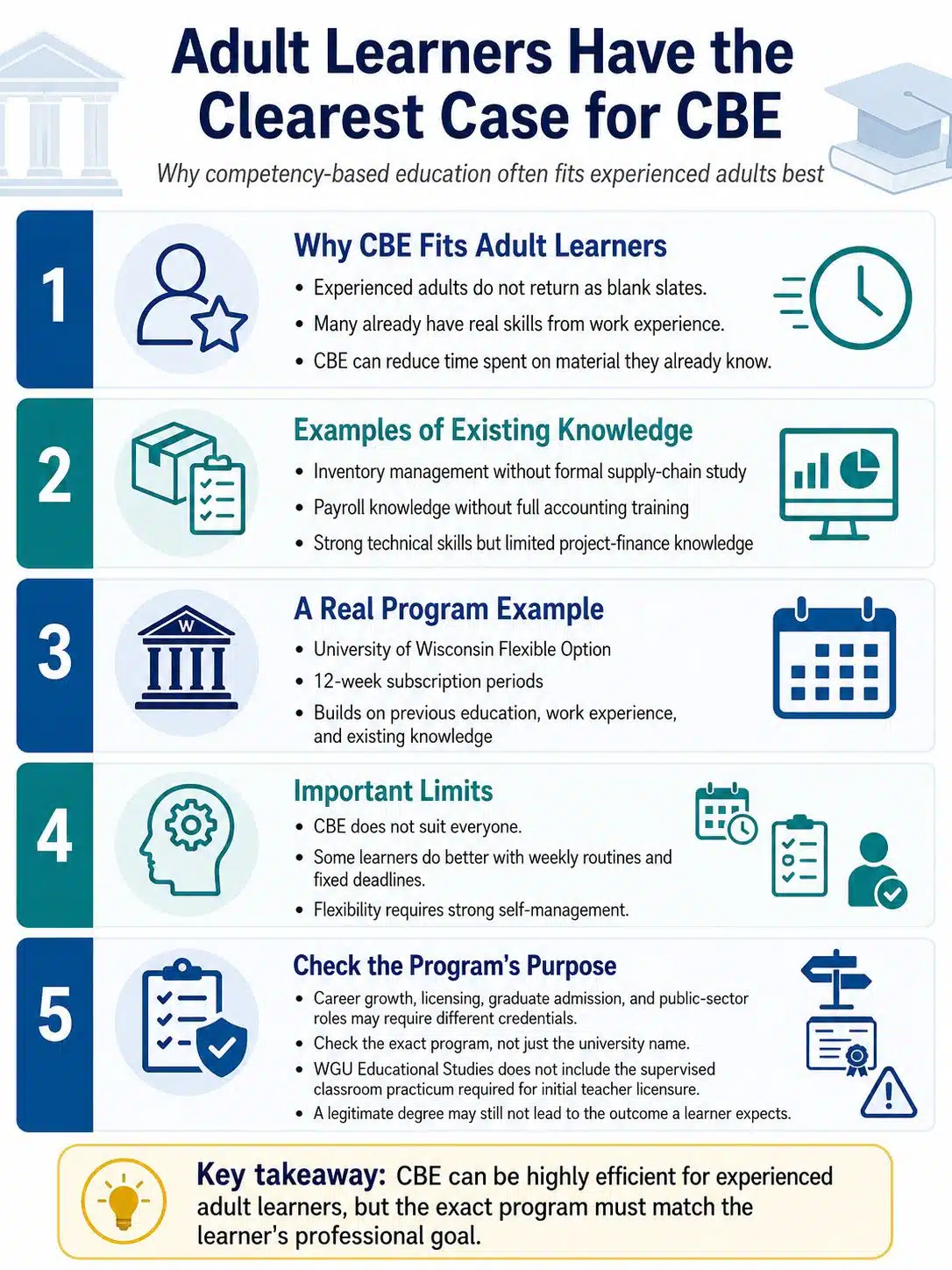
Some claims made for competency-based education are speculative or overly broad. The adult-learning case is much easier to defend.
Experienced adults rarely return to education as blank slates.
Someone may have spent years managing inventory without formal study in supply-chain management. Another person may understand payroll operations but lack broader accounting knowledge. A software professional may be highly capable technically and completely unfamiliar with project finance.
Requiring all of these learners to spend identical amounts of time covering material they already understand can be inefficient.
The University of Wisconsin’s Flexible Option provides another real example of how competency-based structures can address this. Its CBE programs operate through 12-week subscription periods and allow learners to build on previous education, work experience, and existing knowledge.
The model will not suit everyone.
Students who rely heavily on weekly classroom routines, fixed deadlines, and frequent instructor direction may find a more traditional structure easier to manage. Flexibility demands more self-management than promotional material sometimes acknowledges.
There is also a practical question that should come before pacing: What will the credential be used for?
Someone studying for career development inside an existing company has different requirements from someone seeking professional licensing, graduate admission, public-sector employment, or international recognition.
Those readers should check the exact program—not simply the university name.
A useful example appears in WGU’s own program documentation. Its Educational Studies pathway includes education-related study but does not provide the supervised classroom practicum required for initial teacher licensure. That does not make the program deficient. It means the program serves a different purpose.
A learner who misses that distinction could complete a legitimate degree and still discover that it does not lead to the professional outcome they assumed.
That is not a CBE-specific problem, but flexible and alternative program formats make careful checking especially important.
There Is Such a Thing as Too Many Competencies
One of the stranger outcomes of skills-based education is the temptation to describe everything as a separate skill.
Large competency frameworks can contain dozens—or hundreds—of individually named abilities.
Precision is useful until it stops resembling actual work.
A project does not present itself as a neat sequence of “stakeholder communication,” followed by “risk management,” followed by “budget control.” A supplier delay may create a financial problem, an operational risk, a difficult client conversation, and a scheduling decision at once.
Competence means combining knowledge and judgment when several things are going wrong together.
This is why large, integrated assessments often tell us something that a long list of small skill checks cannot.
A substantial capstone project, technical simulation, clinical assessment, or case analysis can force a learner to decide which skills matter and how to use them together.
The most sophisticated-looking competency framework is not automatically the strongest one.
Sometimes it is just the one with the most boxes.
Employers Can Make the Same Mistake Inside Their Own Training Programs
Companies increasingly build internal skills frameworks for hiring, promotion, and employee development.
Done well, these can expose real gaps.
Done badly, they produce a spreadsheet full of words such as “leadership,” “strategic thinking,” “commercial awareness,” and “stakeholder management,” followed by managers assigning scores based largely on impression.
That is not meaningful competency assessment.
Corporate training also tends to reward completion because completion is easy to record. A dashboard can show that 94% of managers finished a leadership program. It is much harder to show that those managers now give better feedback, make better decisions, or handle underperformance more effectively.
CBE’s most useful lesson for employers may therefore have little to do with hiring CBE graduates.
It is the insistence that learning should eventually produce observable evidence.
Before adding another course to a learning platform, an organization can ask a harder question: what should an employee be able to do differently after completing it?
If nobody can answer that clearly, measuring completion rates will not fix the problem.
Employer Input Should Have Limits
Workforce relevance matters, especially in professionally oriented education. Employers can help institutions identify emerging skill needs and explain where new hires commonly struggle.
They should not design the entire curriculum.
A qualification built too tightly around current software, current job descriptions, or the needs of a handful of large employers can date quickly.
That risk is particularly obvious now.
The World Economic Forum expects rapid growth in demand for AI, data, cybersecurity, and other technology-related skills. At the same time, employers continue to place considerable weight on analytical thinking, resilience, leadership, collaboration, and adaptability.
Those broader capabilities are harder to tie to a single software platform. They are also more likely to survive the next software change.
Education has to prepare people for the job that exists now without assuming the job will look identical five years from now.
A good competency framework should reflect both realities.
“Competency-Based” Is Not a Quality Seal
This may be the most useful warning in the entire discussion.
CBE describes an educational approach. It does not certify that the institution is reputable, the assessments are difficult, the teaching is good, or the qualification will be recognized.
Students still need to check accreditation or other forms of institutional recognition appropriate to their country.
Professional requirements deserve even closer attention.
Nursing, engineering, teaching, accounting, law, and other regulated fields can involve specific degree requirements, supervised practice, examinations, registrations, or licences. Completing a competency-based course in the subject does not automatically satisfy those rules.
The requirements also vary by jurisdiction.
A qualification suitable for professional practice in one country may not carry the same recognition somewhere else. Anyone considering an expensive program for a regulated career should verify the licensing route before enrolling.
Do not assume that “industry aligned” means “professionally qualifying.”
Those are different claims.
What a Hiring Manager Should Ask Instead of “Is This CBE?”
The CBE label itself does not deserve much space in a job interview.
The work behind the credential does.
A hiring manager evaluating an unfamiliar program can ask:
- What competencies were required?
- What did you actually have to produce or demonstrate?
- How was the work assessed?
- Was there a defined performance standard?
- Did you complete any substantial projects, simulations, practical assessments, or portfolios?
- What was the most difficult competency to demonstrate?
- What feedback did you receive?
Those questions work just as well for someone with a conventional degree.
That is worth emphasizing because the debate around competency-based education can become unnecessarily binary. The choice is not between an old-fashioned degree that measures nothing useful and a modern competency program that proves everything.
Some conventional degrees provide excellent evidence of performance. Some CBE credentials provide very little.
Employers should judge the evidence.
A Credential Should Be Able to Show Its Work
Competency-based education is at its best when it makes an educational claim more specific.
Instead of saying that somebody studied project management, data analysis, cybersecurity, teaching, or business communication, a strong program can explain what that person had to demonstrate and what standard they had to meet.
That is useful to employers.
It is also useful to students because it makes the promise of the program easier to inspect before they spend time or money on it.
The CBE label should therefore be treated as a starting point rather than an endorsement.
Look at the assessments. Look at the level of work required. Check recognition. Check professional requirements separately. For adult learners, examine what “flexible” actually means once deadlines, reassessment, instructor access, and support are taken into account.
A credible credential should be able to show its work.
When it can, competency-based education has real value. When it cannot, changing the language from “courses” to “competencies” does not improve much.