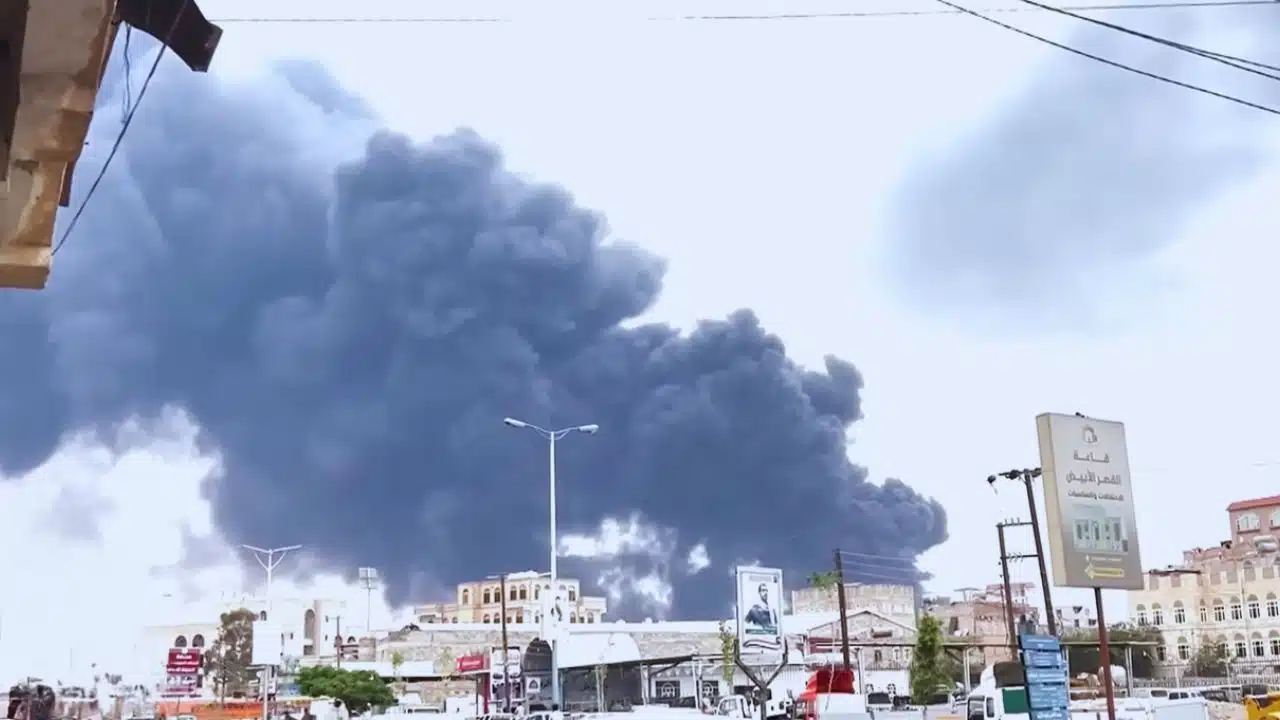
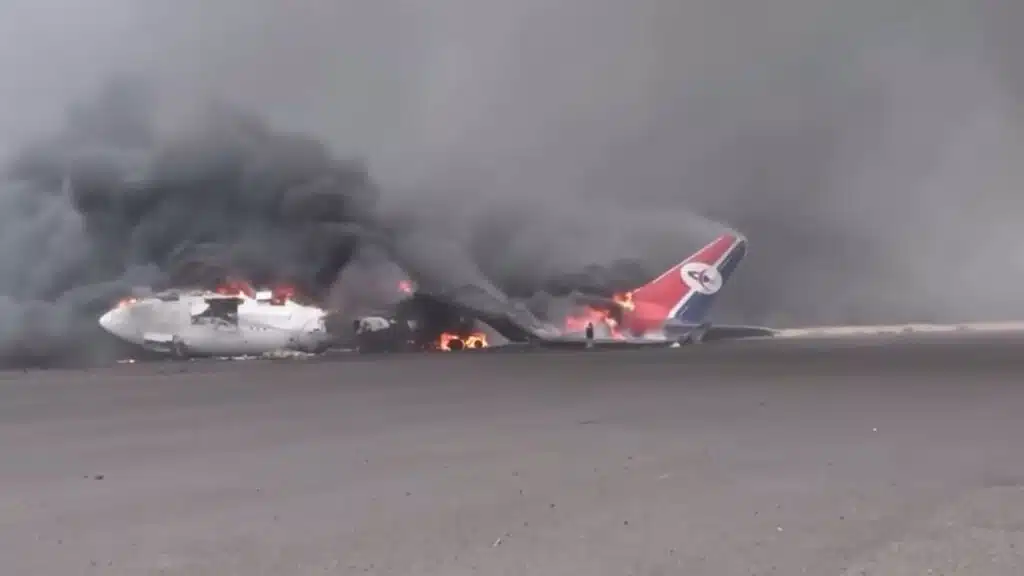
On Tuesday, May 6, 2025, Israel conducted a series of powerful airstrikes targeting Sanaa International Airport, the primary airport in Yemen’s capital, which is controlled by the Houthi rebel group. According to multiple eyewitness accounts and airport officials, the attack caused catastrophic damage, destroying key infrastructure and disabling the airport entirely.
Three civilian aircraft, including jets operated by Yemenia Airways, were directly hit and rendered inoperable. The departures hall, runways, and parts of the al-Dailami military airbase adjacent to the airport were also struck. The Houthis claimed that at least three people were killed, though casualty figures could not be independently verified at the time of reporting.
Reuters reported that airport operations have been completely halted, with one official calling the destruction “total and unprecedented.”
Background: Missile Fired at Israel Sparks Retaliation
The Israeli assault followed just two days after the Iran-backed Houthi movement launched a long-range ballistic missile from Yemen that reached close proximity to Ben Gurion International Airport—Israel’s busiest air hub near Tel Aviv. The missile landed on a road near the airport’s main terminal, injuring at least six civilians, according to Israeli emergency services.
The incident marked a significant escalation, with Israeli authorities temporarily halting flights and scrambling air defenses, which failed to intercept the missile.
Netanyahu: “We Will Hold Our Enemies Accountable”
In a firm response, Israeli Prime Minister Benjamin Netanyahu addressed the nation in a recorded statement. He warned that any force threatening Israel’s security would be “held accountable” and emphasized Israel’s right to defend itself:
“Whoever attacks Israel bears responsibility for their own blood,” Netanyahu stated. “Our choice of when to respond, how to respond, and on which targets to respond is a strategic decision we make every time.”
The Israel Defense Forces (IDF) later released a statement confirming the strikes and describing the targeted infrastructure in Sanaa as being used to “transfer weapons and operatives” by the Houthis.
Further Targets: Power Stations and a Cement Factory Also Bombed
Beyond the airport, Israeli fighter jets also struck additional infrastructure in northern Sanaa, including:
- Power stations, which Israel called “significant electricity supply infrastructure” used by the Houthis.
- The al-Imran Cement Factory, a key industrial site in the region.
While the full extent of damage is still being assessed, local residents reported widespread power outages and industrial disruption.
Israel Also Hits Hodeidah Port: Civilian Death Toll Rises
On Monday, May 5, a day before the airport strikes, Israel launched airstrikes on the port city of Hodeidah—Yemen’s primary entry point for food and humanitarian supplies. The Houthis reported that the strike killed at least four civilians and wounded 35 others.
The Red Sea port of Hodeidah is a critical artery for Yemen, importing around 80% of the country’s food and essentials. The attack has heightened fears of worsening the humanitarian crisis in a country already devastated by civil war and famine.
The Houthis accused both Israel and the United States of coordinating the strike, although a U.S. defense official told AFP that American forces were not involved in any of the airstrikes.
Houthi Response: “Failed Terrorism” and Renewed Threats
Mohammed Ali al-Houthi, a senior political figure within the Houthi movement, responded defiantly in an interview with a Houthi-linked TV channel, dismissing the Israeli airstrikes as “failed terrorism.”
He further vowed that the Houthis would continue to support Gaza and warned that more retaliation was coming:
“Support for Gaza continues. The response is coming, and Netanyahu must prepare his resignation,” he declared.
Shortly after the Israeli strike, the Houthis reiterated their intention to impose an aerial blockade on Israel, targeting airports and civilian infrastructure in retaliation for the war in Gaza.
Trump Announces U.S.-Houthi Ceasefire: But Not With Israel
In a surprising twist, former U.S. President Donald Trump, who recently returned to the White House, announced on Tuesday that the United States would cease its military operations against the Houthis, citing a mutual agreement.
“The Houthis just don’t want to fight, and we will honor that. They have capitulated,” Trump said at a joint press conference with Canadian Prime Minister Mark Carney.
According to Omani mediation sources, the U.S. and the Houthis agreed on a ceasefire deal under which both sides promised to:
- Avoid military engagement.
- Ensure the safety of commercial shipping routes in the Red Sea.
However, Houthi spokespersons later clarified that this ceasefire does not apply to Israel, indicating the likelihood of further attacks from Yemen targeting Israeli assets.
Regional Ramifications: A Deepening Middle East Conflict
This latest round of airstrikes marks a significant geopolitical escalation in the Middle East, further expanding the scope of the Israel-Hamas conflict beyond Gaza’s borders. With Iran-backed proxies such as Hezbollah in Lebanon and now the Houthis in Yemen taking part, Israel finds itself confronting threats on multiple fronts.
The U.S.-brokered ceasefire with the Houthis may bring temporary relief to Red Sea maritime routes and reduce direct U.S. involvement in Yemen. But Israel’s continued strikes and the Houthis’ stated commitment to retaliate suggest that the crisis is far from over.
Humanitarian Concerns Mount
International humanitarian groups have expressed deep concern over the strikes, particularly on civilian infrastructure like airports and seaports. With Yemen already facing one of the world’s worst humanitarian crises, aid organizations warn that further destruction of critical infrastructure could lead to massive civilian displacement, food shortages, and blockages in medical aid delivery.
The United Nations has not yet officially commented on the recent strikes but has previously urged all parties to respect international humanitarian law and avoid targeting civilian facilities.
The Shadow War Expands
What began as a missile exchange has quickly evolved into a wider regional confrontation, drawing in multiple countries and armed groups. With the Houthis targeting Israel in solidarity with Gaza and Israel responding with overwhelming force, the prospect of a broader regional war looms.
The world watches closely as diplomatic channels remain strained and the region inches closer to a potentially larger and more devastating conflict.
The Information is Collected from BBC and CNN.