

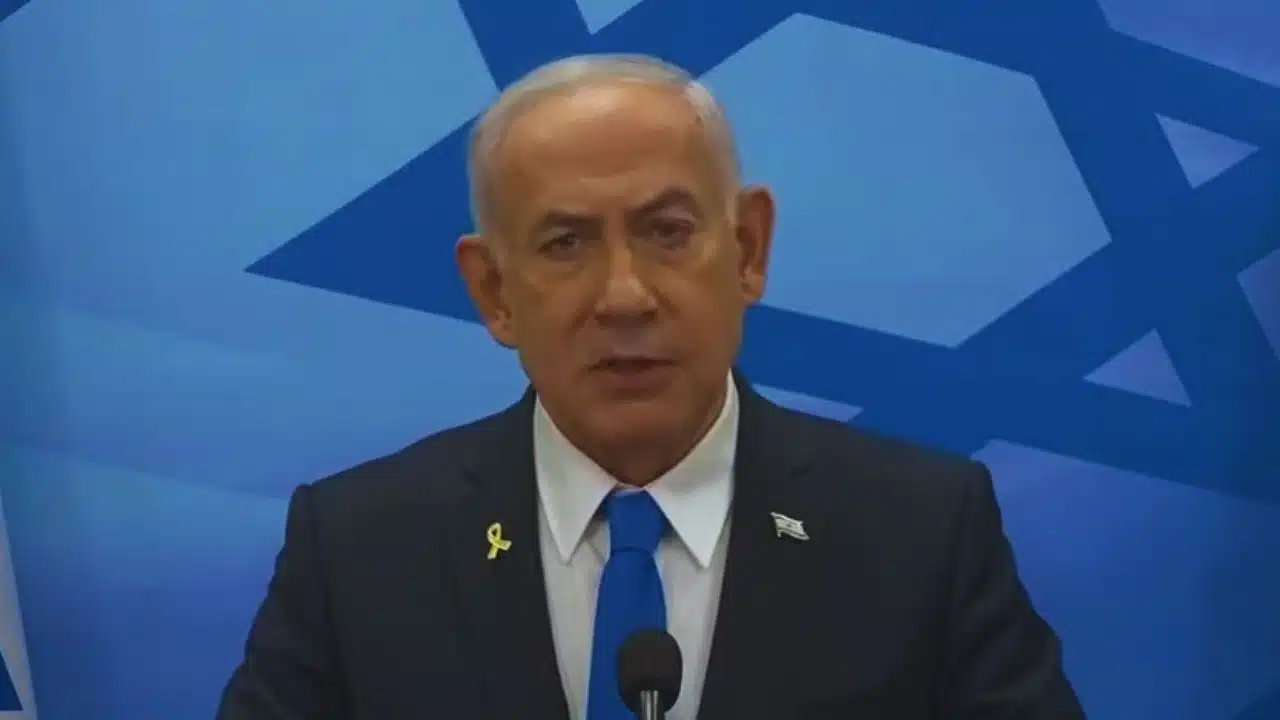
Israeli Prime Minister Benjamin Netanyahu has pledged to continue the country’s military offensive in Gaza, asserting that the conflict is a matter of national survival. His statement comes as discontent within Israel continues to grow, especially among military reservists, veterans, hostage families, and opposition politicians, many of whom are calling for a ceasefire in exchange for the return of Israeli hostages held by Hamas.
Netanyahu’s Pre-Recorded Address: A Call for “Perseverance and Victory”
In a pre-recorded video released on Saturday night, Netanyahu doubled down on his insistence that the war must continue, stating that Israel has “no choice but to fight on” to protect its sovereignty and citizens. The long-time Israeli leader framed the conflict as existential, saying, “We are fighting for our very existence. We must persevere until total victory is achieved.”
He emphasized that the war’s central objectives are to dismantle Hamas’ military infrastructure, prevent future attacks on Israel, and bring home the 59 hostages believed to still be held in Gaza. He did not specify a timeline or clear path to achieving these goals.
Netanyahu defended the continuation of the war by referencing Hamas’ recent rejection of a ceasefire proposal brokered by intermediaries. The Israeli plan had called for disarmament in Gaza and a temporary cessation of hostilities but did not offer a permanent end to the war or a full withdrawal of Israeli forces—terms Hamas views as non-negotiable.
“If we surrender to Hamas’s demands now,” Netanyahu said, “all the achievements made through the bravery of our soldiers, the sacrifices of our fallen, and the suffering of our wounded heroes will be for nothing.”
Trump’s Vision Cited as Strategic Justification
In a surprising twist, Netanyahu referenced former U.S. President Donald Trump’s controversial ideas about Gaza’s future. He claimed that if Hamas remains in power, “President Trump’s important vision could never be realized.” Trump has previously proposed a radical redevelopment of Gaza, suggesting that Palestinians be relocated and the coastal territory transformed into a resort-like “Riviera of the Middle East.” He also floated the idea that the U.S. could take ownership of the territory—an idea that has received no international traction and is widely seen as unfeasible and deeply problematic.
Netanyahu’s invocation of Trump’s vision was seen by some as an attempt to align himself with a key U.S. political figure, especially amid growing international scrutiny of Israel’s military conduct in Gaza.
Backlash from Hostage Families: “No Plan in Sight”
One of the sharpest criticisms came from the Hostage Families Forum Headquarters, a group representing the families of Israeli hostages. In a direct response to Netanyahu’s video, the group released a statement accusing the Prime Minister of offering empty rhetoric instead of concrete solutions.
“Many words and slogans will not succeed in hiding the simple truth — Netanyahu has no plan,” the forum declared. “It’s no surprise there was no time for questions — otherwise, he would have had to answer the most basic one: What exactly is the State of Israel doing to immediately bring back all 59 hostages?”
The families have been pressing the government to prioritize a deal with Hamas that ensures the return of all hostages, even if it means halting military operations. Their growing activism has included protests, public speeches, and direct meetings with Israeli lawmakers.
Spokesperson Controversy: “It’s Not Possible to Bring Everyone Back”
Just before Netanyahu’s speech was released, his spokesperson Omer Dostri made a highly controversial statement in an interview with Channel 12 News. Dostri claimed that “it’s not possible to bring everyone back” and dismissed any hopes for a comprehensive hostage deal as political “spin.”
“Right now, it’s not possible to make a single ‘all for all’ deal, because Hamas is demanding an end to the war and a withdrawal from Gaza,” Dostri explained.
His remarks ignited a political firestorm, with opposition leader Yair Lapid accusing the government of giving up on the hostages. “If this is the Prime Minister’s official stance, he should stand up and say it himself,” Lapid said. “If not, he should apologize on behalf of his spokesperson.”
Notably, Netanyahu’s speech made no mention of Dostri’s comments, leaving the public and lawmakers without clarification on the government’s true intentions regarding the hostages.
Reservists and Public Opinion Shift Toward Ceasefire
Beyond the political elite, the most profound pressure may be coming from within Israel’s military community. Thousands of reservists, including those from elite units such as intelligence divisions and combat brigades, have signed open letters urging the government to accept a ceasefire deal in exchange for the hostages’ release. They argue that continued fighting without a clear hostage recovery plan is morally and strategically unacceptable.
Public sentiment is shifting as well. A recent poll conducted by Israel’s Channel 12 News showed that nearly 70% of Israelis support a deal to release the hostages, even if it means ending the war. That support spans political affiliations, including a majority of voters from Netanyahu’s own coalition.
These developments represent a major departure from the early days of the conflict, when public support for military action was nearly unanimous. The longer the war drags on, the more citizens appear to prioritize humanitarian concerns and the safe return of hostages.
Gaza Ceasefire Deal Collapsed in March
A previous temporary ceasefire in Gaza, which lasted two months, ended on March 18 when hostilities resumed. During that pause, 33 Israeli hostages and five Thai nationals were released. However, negotiations for a broader deal fell apart.
Both Israel and the United States blamed Hamas for the collapse of talks. Hamas, in turn, accused Israel of failing to meet its commitments, including aid deliveries and prisoner releases.
Since then, there has been a renewed escalation in violence, with Israel intensifying its air and ground assaults across the Gaza Strip.
Wider Regional Tensions: Iran Mentioned in Netanyahu’s Remarks
Toward the end of his statement, Netanyahu shifted attention to Iran, Israel’s longtime regional adversary. His comments came just hours after the United States and Iran concluded a second round of indirect negotiations over Tehran’s nuclear program.
“I’m committed to preventing Iran from getting a nuclear weapon,” Netanyahu stated. “I will not give up on this, I will not let go.”
While unrelated to the immediate crisis in Gaza, his reference to Iran underscores the broader regional dynamics shaping Israel’s military and diplomatic strategy.
A Divided Nation in the Midst of War
As Israel’s military operations in Gaza continue, Prime Minister Netanyahu remains firm in his position that the war must go on. However, growing divisions at home—from military veterans, opposition leaders, hostage families, and the wider public—suggest that the government’s current strategy faces increasing scrutiny.
Without a clear and unified path forward, the country remains caught between its security goals and a humanitarian crisis that deepens by the day. The question remains: how long can Netanyahu resist mounting domestic and international pressure to change course?
The Information is Collected from CNN and Yahoo.
























