
Choosing the right social media platform can feel like a guessing game, especially when every year brings a new list of “must-use” platforms. But following trends alone does not guarantee that your content will reach the right people. A platform may have millions of active users, yet still be a poor fit for your audience, content style, or business goals.
In this guide, we’ll explore how to choose social platforms based on what your audience actually does—not simply what is trending. By understanding their habits and matching them with the strengths of each platform, you can build a more focused social media strategy and spend your time where it is most likely to produce meaningful results.
What Does Audience Behavior Mean in Social Media Marketing?
Audience behavior in social media marketing refers to what real users actually do on a platform, what they search for, how long they stay, what they save or share, and how often they return, rather than simply how many accounts exist there. It is the difference between knowing a platform has a billion users and knowing whether the specific people a business wants to reach are among the active, engaged ones.
Behavior data typically includes:
- Time spent per session and per day on a given platform
- Search and discovery activity (many users now treat social platforms as search engines)
- Content format preference, video, carousel, text post, or livestream
- Frequency of interaction with brand accounts versus personal accounts
- Purchase or inquiry behavior that follows social discovery
This matters because a platform can be enormous and still be the wrong choice for a given audience. A business targeting procurement managers will find more useful behavior on LinkedIn than on a platform with triple the total users but almost no professional audience overlap.
Platform Popularity vs. Audience Fit: What’s the Real Difference?
Platform popularity measures total user volume across the internet; audience fit measures whether the specific people a business targets are active, engaged, and receptive to that business’s content on that platform. A platform can rank high on every trend list and still be a poor fit for a narrow target audience.
How Do I Find Where My Target Audience Actually Spends Time Online?
Finding where a target audience actually spends time online starts with native platform analytics, website referral data, and direct audience research, not assumptions based on where a brand’s competitors post. Combine at least three data sources before committing budget to a platform.
Practical steps:
- Pull referral traffic data from Google Analytics (or GA4) to see which social platforms already send visitors.
- Check native analytics inside Instagram, Facebook, LinkedIn, and TikTok for audience demographics, active hours, and content type performance.
- Run a short audience survey asking where customers already follow brands like yours.
- Review customer service and sales conversations for mentions of specific platforms.
- Use social listening tools to track where your brand, product category, or competitors get discussed organically.
What Tools Help Track Where Your Audience Is Most Active?
Several tool types help confirm where an audience is most active: native analytics dashboards (Instagram Insights, Facebook Audience Insights, LinkedIn Analytics, TikTok Analytics, Pinterest Analytics), third-party social media management platforms like Sprout Social and Hootsuite, social listening tools such as Brandwatch, and website analytics that show social referral behavior. Pairing at least one native tool with one listening tool gives a fuller picture than either alone.
What Metrics Show Real Audience Behavior vs. Vanity Metrics?
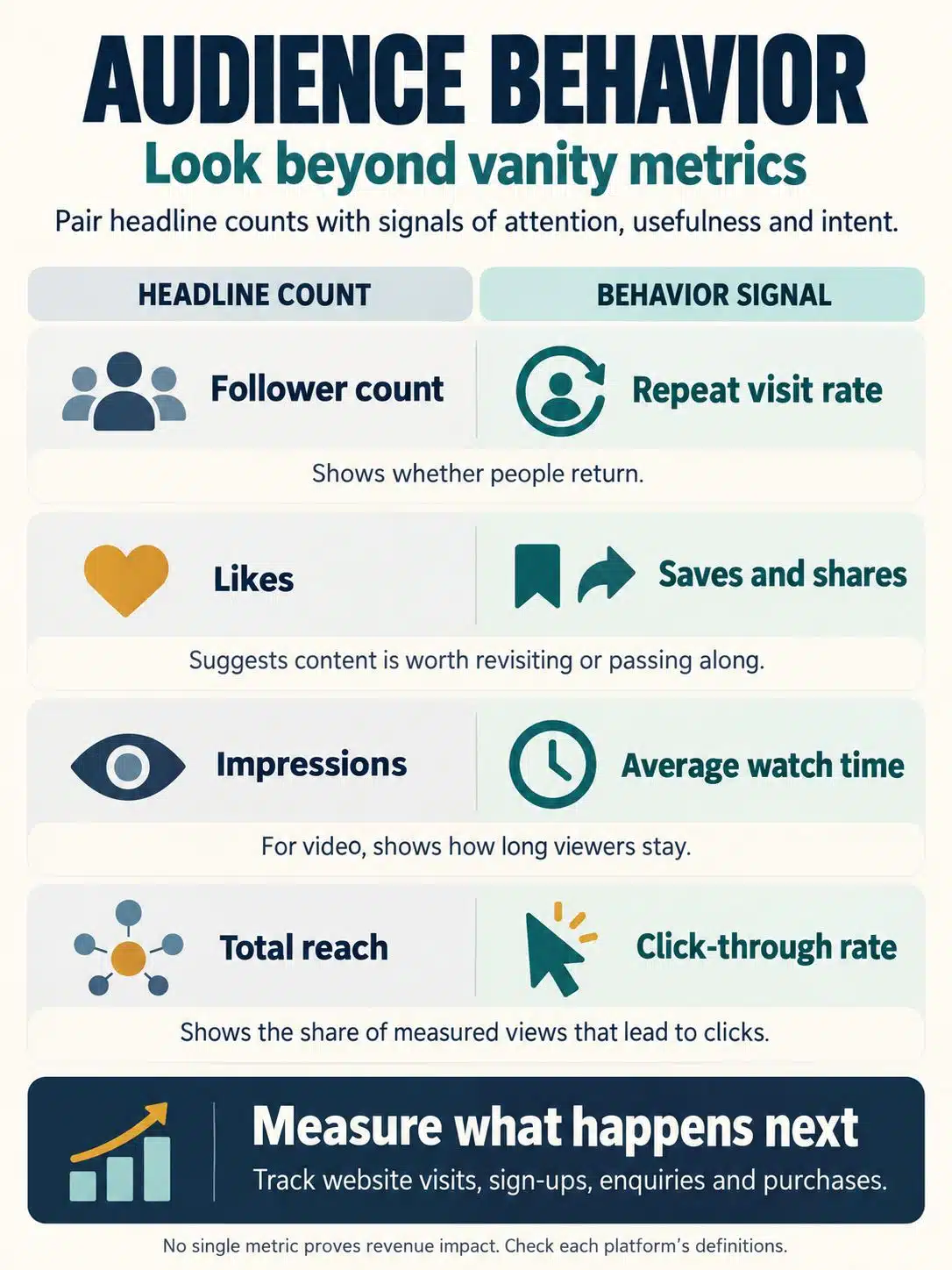
Real audience behavior shows up in time spent, save rate, click-through to a website, repeat visits, and conversion-adjacent actions, not in raw likes or follower counts. Vanity metrics look good in a report but rarely predict revenue.
| Vanity Metric | Behavior Metric | What It Actually Tells You |
|---|---|---|
| Follower count | Repeat visit rate | Whether the audience returns, not whether it simply exists |
| Likes | Saves and shares | Whether content is useful enough to revisit or pass along |
| Impressions | Average watch time | Whether the audience actually stays for the content |
| Total reach | Click-through rate | Whether reach converts into real site or product interest |
Should I Follow Trends or Focus on Where My Audience Already Is?
Focus on where the audience already is first, and treat trend lists as a secondary signal, not a primary one. Trend lists reflect what is growing across the entire internet; they say nothing about whether a specific brand’s audience is adopting that trend.
Decision rule: Follow a trending platform or format only after audience data confirms your audience segment is already moving there in measurable numbers. Operational data from teams managing large volumes of social media posts increasingly shows marketers deprioritizing trend-chasing in favor of behavior-verified platform choices, because chasing every new app spreads budget and content thin across audiences that were never there to begin with.
There is a real cost to chasing trends blindly: content built for a platform’s “moment” often ages fast, and teams end up maintaining a presence on a platform their actual audience barely visits.
How to Choose the Right Social Media Platform for You and Your Audience
Choosing the right social media platform is a six-step process that starts with audience and goals, moves through research and competitor analysis, and ends with a small test before full commitment. Skipping any step usually means discovering the mismatch after budget is already spent.
Choosing Right Social Platforms Checklist
1. Decide on Your Target Audience and Goals
Start by defining exactly who the target audience is, age range, profession, buying stage, and content habits, and what the marketing goal actually is (awareness, leads, community, or direct sales). A platform that is excellent for brand awareness may be weak for direct B2B lead generation, and vice versa.
2. Research the Different Platforms
Every major platform rewards different content and audience behavior. Facebook still works well for community groups and local business audiences; Instagram favors visual storytelling and younger consumer audiences; LinkedIn works for B2B audience targeting and professional content; Pinterest drives product discovery for lifestyle and home brands; TikTok and YouTube reward video marketing and discovery-driven browsing; Snapchat and WhatsApp skew toward direct, personal communication with younger or international audiences.
3. Analyze Your Competitors’ Audience Behavior
Look at where competitors’ audiences actually comment, share, and ask questions, not just where competitors post. A competitor might post daily on one platform out of habit while their most engaged audience quietly lives somewhere else; checking comment quality and response patterns across platforms reveals the gap between posting activity and real audience behavior.
4. Consider the Type of Content You Want to Create
A brand built around quick visual demonstrations usually finds a stronger audience on video-first platforms like TikTok, Instagram Reels, and YouTube Shorts; a brand built around long-form expertise, data, or analysis usually finds a stronger audience on LinkedIn or written-content platforms, including niche communities on Reddit. If a team cannot sustain consistent video production, picking a video-first platform purely because it is trending will backfire.
What Questions Should I Ask Before Choosing a Social Platform?
Before choosing a platform, ask whether the target audience is verifiably active there, whether the format matches what the team can produce, and whether the platform’s role fits the marketing goal. Answering these honestly prevents picking a platform because it is popular rather than because it fits.
Key questions to ask:
- Where does data show this audience spending real time, not just holding an account?
- Does this platform support the content format our team can realistically produce, video, image, or text?
- Is this platform built for discovery, community, or direct selling, and does that match our goal?
- What are competitors’ most engaged audiences doing on this platform specifically?
- Can we sustain a consistent presence here for at least two quarters before judging results?
- Does this platform fit a B2B audience, a B2C audience, or both?
Common Mistakes When Picking Social Media Platforms for Business
The most common mistake is choosing a platform based on trend coverage or competitor presence instead of verified audience behavior. Several related mistakes compound this problem.
- Chasing every new app. Spreading a small team across five or six platforms usually produces weak content everywhere instead of strong content somewhere.
- Confusing reach with fit. A platform with a massive total audience is not automatically right for a narrow target audience.
- Ignoring B2B vs. B2C differences. A B2B audience researching software rarely behaves like a B2C audience browsing fashion; platform choice should reflect that split.
- Skipping the test phase. Committing a full year’s content calendar to an unproven platform wastes resources that a short test would have protected.
- Treating one platform like all platforms. Content format, tone, and posting cadence that work on Instagram rarely transfer directly to LinkedIn or Pinterest without adjustment.
How Often Should I Review Audience Behavior to Switch Platforms?
Review audience behavior data at least once per quarter, and sooner if a platform changes its algorithm, a competitor’s audience visibly migrates, or engagement on a current platform drops sharply. Annual reviews are too slow for how fast audience behavior moves in 2026.
Triggers that justify an off-schedule review include a major platform policy or algorithm change, a noticeable drop in reach or engagement that is not explained by content quality, and early signs that a meaningful share of the audience is adopting a new platform or format. Expert outlooks for 2027 point to social search and multi-platform audience journeys becoming even more central, which means behavior reviews will likely need to happen more often, not less.
Do I Need to Be on Every Platform or Just the Right Ones?
No. Most brands perform better focusing on two to four platforms that match verified audience behavior rather than spreading thin across every available platform. Near-universal social media adoption does not mean every platform deserves equal investment.
Key 2026 Social Media Platform Statistics
Social media use remains close to universal worldwide in 2026, with the majority of internet users active on at least one platform and most adults using several platforms regularly rather than just one. This multi-platform behavior is exactly why audience-behavior-based selection works better than picking a single trending app.
What Are the Biggest Social Media Platforms in 2026?
Facebook, YouTube, Instagram, WhatsApp, and TikTok remain among the largest platforms by active users worldwide heading into 2026, with each counting well over a billion monthly users. Facebook and YouTube continue to lead in sheer scale, while TikTok has closed much of the gap through strong daily engagement rather than total sign-ups alone.
Which Platforms Do Marketers Use Most?
Marketers in 2026 report the heaviest usage on Instagram, Facebook, and LinkedIn for organic and paid social campaigns, reflecting where audiences already engage rather than where new apps are generating buzz. B2B marketing teams lean most heavily on LinkedIn, while B2C and e-commerce teams split budget across Instagram, Facebook, TikTok, and increasingly Pinterest for product discovery.
What Is the Fastest-Growing Platform?
TikTok continues to post the fastest audience growth rate among major platforms, with engagement intensity (time spent and session frequency) growing alongside total user count rather than lagging behind it. That combination, growth plus deep engagement, is what makes a platform worth testing, not growth numbers alone.
Which Generations Use Which Platforms?
Generational usage patterns differ sharply enough that age segment should directly shape platform selection. Gen Z (born roughly 1997 to 2012) shows the heaviest activity on TikTok, Instagram, and YouTube, and increasingly treats these platforms as primary search and product discovery engines. Millennials split time across Instagram, Facebook, and YouTube. Gen X leans toward Facebook and YouTube. Baby Boomers remain most active on Facebook, with lighter but growing use of YouTube and Pinterest.
| Generation | Primary Platforms | Behavior Signal |
|---|---|---|
| Gen Z | TikTok, Instagram, YouTube | Uses platforms as search engines first |
| Millennials | Instagram, Facebook, YouTube | Mixes personal and discovery use daily |
| Gen X | Facebook, YouTube | Longer, less frequent sessions overall |
| Boomers | Facebook, Pinterest | High trust in familiar networks |
Other Interesting Social Media Platform Statistics
Engagement intensity, measured in time spent and repeat visits, has become a more reliable planning signal than raw reach for most teams going into 2026. Platform roles across the marketing funnel are also becoming more defined: short-video platforms tend to drive top-of-funnel awareness, while platforms like LinkedIn and Pinterest increasingly drive mid-to-bottom-funnel research and purchase intent.
How to Create and Adjust Social Media Content Using AI
AI tools can take one piece of core content and adapt its length, tone, and format for each platform’s audience without rewriting from scratch every time. This matters because audience behavior differs by platform even when the underlying message stays the same.
Repurpose Content Across Platforms
A single blog post or video script can become a LinkedIn article, an Instagram carousel, a TikTok script, and a Pinterest pin description with the right adjustments. AI-assisted repurposing tools speed this up, but the editorial judgment about which platform’s audience actually wants that format still has to come from behavior data, not convenience.
Change Tone for Different Audiences
A B2B audience on LinkedIn generally responds to a more formal, data-driven tone, while a B2C audience on TikTok or Instagram responds better to a conversational, direct tone. AI writing tools built on machine learning models can shift tone quickly across drafts, which helps teams maintain one consistent message while matching each platform’s expected voice.
Shorten or Lengthen Text for Captions and More
Caption length requirements vary widely: a LinkedIn post can run several paragraphs, while a TikTok caption usually works better short and direct. Tools like Wordtune apply practical writing techniques to shorten or lengthen the same core message for each platform’s format. Get Wordtune free to test how quickly a single paragraph can become a short caption or an expanded post without losing the original point.
Final Thoughts
Choosing the right social media platform is not about following trends or trying to be everywhere. It is about understanding where your audience spends time, what content they engage with, and how they prefer to interact with brands.
Use audience insights, engagement data, and your own performance results to identify the platforms that genuinely fit your goals. Remember that audience behavior can change, so review your strategy regularly and adjust when needed.
Ultimately, the best social media platform is not necessarily the most popular one—it is the one where your audience is paying attention. Focus on those platforms, create content that fits their habits, and your social media efforts are more likely to deliver meaningful results.
Frequently Asked Questions
Audience behavior shows where your target customers actually spend time and what type of content they prefer. This can help you focus your efforts on platforms that are more likely to deliver meaningful engagement and results.
Review your website analytics, social media insights, customer demographics, surveys, and engagement data. You can also research where competitors and similar audiences are most active.
No. Maintaining a strong presence on a few relevant platforms is usually more effective than spreading your resources across too many networks.
4. What audience behaviors should I consider when choosing a platform?
Look at factors such as the content people watch, share, save, comment on, search for, and interact with. Also consider when and how frequently they use each platform.