
Subscription commerce platforms for UK independent publishers need to do more than collect a monthly payment. They must connect the reader’s purchase to the right articles, newsletters, or print issues, make renewals manageable, and leave a small editorial team enough time to publish. These ten options cover different business models, from a journalist launching a paid newsletter to a specialist publisher managing digital access and magazine subscriptions.
For a publication starting from scratch, Ghost, Substack, and Beehiiv are sensible places to begin a comparison. Memberful and MemberPress deserve attention when an existing website matters. Steady suits a supporter-membership approach, while Pelcro, Abacus, Piano, and Chargebee address more involved subscription operations. The right choice depends on what you sell, how readers receive it, and who will maintain the system.
How We Selected These Subscription Commerce Platforms for UK Publishers
This is a research-led shortlist, not a hands-on performance ranking. We reviewed official product pages, payment documentation, and commercial information on 12 November 2026. Selection focused on publishing relevance, UK payment or market suitability, access management, operating costs, and implementation requirements. Numbering organises the list; it does not award a universal first place.
“For UK” means relevant to a UK publishing operation, not necessarily headquartered or hosted in Britain. Supporting pounds does not establish UK data residency. Features may depend on the plan, payment provider, and contract. Where a complete deployment cost could not be established publicly, we identify what to request rather than inventing a price.
A Quick Comparison of the 10 Platforms
| Platform | Publishing model | UK relevance | Key commercial consideration |
|---|---|---|---|
| Ghost | Publication website and newsletter | GBP subscription pricing supported | Hosting plan and payment processing; no Ghost revenue share |
| Substack | Newsletter and paid publication | GBP local pricing supported | 10% platform fee, plus payment-related charges |
| beehiiv | Newsletter business | GBP paid tiers documented | Eligible paid plan; 0% subscription revenue share |
| Memberful | Membership layer or hosted member content | UK English localisation; confirm payment setup | Standard: US$49 monthly plus 4.9%, before processing |
| MemberPress | WordPress membership website | Bacs through Stripe for eligible UK accounts | Annual licence, plan-specific fees and site upkeep |
| Steady | Reader-supported membership | GBP and eligible GB Direct Debit payments | 10% commission, payment costs and applicable tax treatment |
| Pelcro | Print and digital subscription operations | UK Bacs through Stripe documented | Price deployment scope, integrations and migration |
| Abacus ADvance | Specialist publishing and fulfilment | London operation; Direct Debit workflows | Request a scoped proposal and implementation plan |
| Piano Subscriptions | Audience conversion and subscription management | UK market presence and publisher deployments | Confirm modules, commercial terms and integration effort |
| Chargebee | Subscription billing behind a publishing product | GBP price modelling and publisher solution | Billing configuration plus connected content delivery |
Platform fees and payment processing are different costs. Dollar-denominated software prices are not pound prices. Compare the subscription product you actually need, including annual commitments, renewal rates, tax, exchange costs and paid integrations.
1. Ghost: A Publication Website With Paid Membership Built In
Ghost brings a publishing website, email newsletters, and member subscriptions into one editorial system. That makes it a useful starting point for a local newsroom or specialist publication that wants its website and reader relationship to sit under its own brand. Its documentation includes GBP subscription pricing, with payments connected through Stripe.
The attraction is the relationship between publishing and access. You can build a free audience and sell premium content without first assembling a separate publishing system and membership application. Ghost says it takes no percentage of subscription revenue. Managed hosting and payment processing still cost money, and the hosted plan must include the paid-subscription features you need.
For an independent publisher, member-count pricing deserves particular attention: a growing free audience can affect the hosting tier before paid income catches up. Obtain a price for your expected total membership, not only paying readers. Treat print dispatch, sophisticated corporate licensing, and unusual checkout requirements as separate evaluation questions. Ghost is a strong candidate when the website and newsletter are the product; a complex fulfilment operation needs a wider assessment.
2. Substack: A Straightforward Route to a Paid Newsletter
Substack suits a writer or small editorial team whose core offer is a recurring newsletter with a web archive. Publishing and subscriptions share an environment, and its network features provide another route for readers to discover a publication. Discovery is an opportunity, however, rather than a subscriber-growth guarantee.
The commercial model is easy to identify: publishing is free, while paid subscriptions incur Substack’s 10% platform charge alongside Stripe-related costs. Its current help pages describe GBP local pricing for England, Scotland, Wales and Northern Ireland. Do not copy US card-processing examples into a UK budget; confirm the charges for your account, payment method and settlement currency.
This model can make an early experiment easier to fund because the platform’s revenue share follows paid income. At a larger scale, that share becomes a material recurring expense. Check the differences between web and in-app purchases, as well as domain configuration and export options. Substack is most compelling when speed and a familiar subscription experience matter more than deeply customised commerce or print operations.
3. Beehiiv: Newsletter Commerce With Growth Tools
Beehive is worth assessing when the newsletter is both the editorial product and the main acquisition channel. Its paid-tier documentation lists GBP and recurring monthly, quarterly, and annual options. Trials and discount offers give publishers ways to test a proposition without rebuilding checkout for every campaign.
The platform advertises a 0% share of paid-subscription revenue. That does not make a paid publication free to operate: the appropriate software plan and payment processing remain part of the bill. Its October 2026 pricing changes are especially relevant when comparing older reviews. At the 1,000-subscriber setting reviewed, Lite displayed US$49 per month billed yearly; this is an annual commitment equivalent, not a monthly-billing quote.
A niche trade newsletter can compare the value of these tools against the staff time needed to connect separate services. Verify which plan includes the number of paid tiers, group access and integrations you require. If a full magazine archive, print entitlement or complex company account is central to your business, demonstrate that journey explicitly before committing. A polished newsletter workflow alone does not establish suitability for every publishing model.
4. Memberful: Membership Commerce Around an Existing Brand
Memberful offers membership sales and management, a hosted website and newsletter option, and integrations including WordPress. This gives an established publisher a choice: add a membership layer around its existing site or use more of Memberful’s hosted experience. Its product range includes group plans, gifts, trials and downloads, and useful building blocks for a specialist subscription.
Standard pricing was US$49 a month plus a 4.9% transaction fee when checked, with payment processing additional. The combination matters: Memberful is not simply a fixed-fee alternative to a revenue-share platform. Its UK English locale is useful for reader-facing dates and presentation, but publishers should confirm their exact currency, Stripe account and settlement configuration before launch.
A practical use case is a publication bundling premium articles with a private podcast or member community. Ask the team to demonstrate how cancellation changes access in every connected service. The decision is less about the length of the feature list than whether one purchase creates a coherent membership. Include external community, email and website costs where those services remain part of your chosen setup.
5. MemberPress: Paid Access Within WordPress
MemberPress is a WordPress membership plugin, making it relevant to publishers that want to keep their existing content system. Its access rules can support a paid section or membership offering while the wider WordPress site continues to handle publishing. The commercial appeal is control over a familiar website, provided someone is responsible for maintaining it.
There is a specific UK payment connection: MemberPress documents Bacs through Stripe for users with UK bank accounts, with payments in pounds sterling. Availability depends on the required Stripe configuration. Test the waiting period between a Direct Debit submission and confirmation, rather than assuming it behaves like an immediate card payment.
Check plan-level fees carefully. The pricing page reviewed showed a 4.9% transaction fee on Launch, while Growth and Scale advertised no MemberPress transaction fee. Processor charges remain separate. Annual introductory pricing should also be distinguished from renewal pricing. Budget for hosting, backups, updates, and troubleshooting. This is a credible option for a publisher comfortable with WordPress operations, but retaining that control also means retaining operational responsibility.
6. Steady: A Membership Model for Reader Support
Steady is relevant when readers are supporting an ongoing editorial mission through memberships. Its model can work for a small independent outlet whose value proposition includes keeping reporting available, alongside any member benefits. That is a different starting point from treating every article as an individually gated product.
The UK payment details are concrete. Steady lists GBP memberships with PayPal, Apple Pay and card options, plus Direct Debit when the member’s billing country is GB. Its help centre explains that Steady acts as the publication’s subscription agent, and the bank statement charge appears under Steady. Explain that clearly in onboarding so a legitimate renewal does not look unfamiliar.
Steady states a 10% commission, with payment costs and relevant VAT treatment considered separately. Ask for an example settlement statement for your proposed membership mix. Before choosing it, map how someone receives benefits on your website and what happens when the membership ends. A supporter proposition can be simple, but access, communication and reconciliation still need to work together.
7. Pelcro: Connecting Print and Digital Subscription Operations
Pelcro combines subscription management with paywalls and support for print and digital products. It merits a closer look when a publisher has moved beyond a single newsletter and needs reader accounts, recurring payments and access rules to remain aligned. Its product materials also describe group licences and commerce for items such as back issues.
For UK publishers, its payment documentation explicitly includes Bacs through Stripe. It also explains delayed payment confirmation and subscription activation behaviour. That detail matters operationally: your welcome message should not promise immediate access if the configured payment journey waits for confirmation.
A specialist magazine could ask Pelcro to demonstrate a digital subscriber upgrading to a print bundle, changing address and later cancelling the renewal. Include the fulfilment export and accounting reconciliation in that demonstration. Request a scoped commercial proposal covering required features, migration and integrations. Pelcro’s FAQ says its prices are in US dollars and that it does not add transaction fees above the processor’s charges; confirm how those statements apply to your proposed contract. The broader feature set makes implementation planning more important.
8. Abacus ADvance: Subscription and Audience Operations for Specialist Publishers
Abacus ADvance deserves attention from publishers handling a mixture of subscriptions, audience records and fulfilment. Its documentation describes data from registrations, orders and events, alongside print distribution, fulfilment and payment-management workflows. Abacus’s London presence also makes it a locally relevant supplier to evaluate.
The practical distinction is operational breadth. A magazine business may need to know who should receive the next issue, which payments failed and which customers have changed their details. These jobs can become difficult when print records and digital access are maintained independently. Abacus documents Direct Debit management and corporate-subscription workflows, while its Webvision Cloud publishing product supports access control and commerce.
Clarify the boundary between ADvance, Webvision Cloud and any third-party website in the proposal. Do not assume every capability is included in one licence. Ask the vendor to demonstrate your actual issue schedule, renewal process and corporate-access scenario, with named implementation responsibilities. This is a more relevant conversation for an established specialist publisher than for a writer seeking the lightest possible newsletter launch.
9. Piano Subscriptions: Managing Offers and Reader Conversion
Piano Subscriptions brings together subscription journeys, offers and access-related capabilities. Its documentation covers flexible terms and site-licensing arrangements, while its management-and-billing product connects registration, pricing and renewals. UK publisher deployments and a UK market presence support its relevance to this shortlist.
Piano becomes interesting when a publisher needs to vary the experience for different audiences: a visitor arriving for the first time, a registered reader and a renewing customer may need different offers. That requires an organisation capable of maintaining those rules and evaluating whether the changes help. A more configurable platform does not remove the need for an editorial and commercial strategy.
Before buying, define which Piano components you need and how they connect to your existing content system, analytics and payments. Request a demonstration of GBP checkout, cancellation, customer-service permissions and reporting with your intended configuration. An independent multi-title publisher may justify this scope; a small publication with one offer should compare the operating burden against simpler tools. There is no defensible universal price here without a specific proposal.
10. Chargebee: Billing Infrastructure for a More Complex Publishing Business
Chargebee is a subscription billing platform with a dedicated media and publishing proposition. Its product catalogue supports modelling plans and prices, including GBP examples, while its billing tools address renewals, invoicing and payment recovery. It belongs on this list as commerce infrastructure behind a publication.
That distinction matters. Choosing Chargebee does not by itself supply a finished editorial website, newsletter publishing workflow or print dispatch operation. Those pieces must connect correctly to the billing and entitlement arrangements. A specialist information business selling several products or business subscriptions may have enough complexity to justify that separation.
Ask for a demonstration of the entire journey from purchase to access, including what happens when a payment fails or a plan changes. Identify which system is authoritative for subscriber status and who fixes a broken synchronisation. Commercial evaluation should include the billing plan, payment services, implementation and ongoing integration work. For a publisher with suitable technical support, that flexibility can be useful; for a solo newsletter, it may introduce more work than the business requires.
How to Compare the Real Cost in Pounds
Start with total annual operating cost: software, platform revenue share, payment charges, migration, connected services and staff maintenance. Keep VAT and foreign-exchange assumptions visible. A provider charging no revenue share may still be more expensive at a small scale because of fixed costs.
Consider an illustrative publication with 500 paying readers at £8 per month. Gross monthly subscription receipts would be £4,000 before refunds and tax. A 10% platform fee alone would be £400. This is arithmetic for comparison, not a forecast or a complete Substack or Steady invoice. A competing fixed-cost setup must be evaluated with its own processing charges, implementation and staff time included.
For two hypothetical offers with otherwise identical costs, divide the fixed monthly charge by the percentage fee avoided to estimate the revenue crossover. For example, £100 divided by 10% gives £1,000. Real contracts rarely have identical exclusions, so use this calculation to frame questions rather than declare a winner.
UK Checks to Complete Before Signing
Ask vendors to show GBP checkout, receipts and refunds with your proposed account. Establish whether the software invoice and reader payments use different currencies. If Direct Debit matters, verify Bacs specifically, including mandates, failed payments and access while payment is pending. Our guide to UK Direct Debit tools explains the collection layer; it should not be confused with a publishing paywall.
Tax treatment follows the product supplied. HMRC’s electronic-publication guidance explains that certain e-publications qualify for zero-rating, with exclusions and specific considerations for bundles. Do not assume a package containing video, community benefits or other services has the same treatment as an eligible digital newspaper. Have the actual offer classified before configuring checkout.
Request the data-processing agreement, hosting and subprocessor details, export format and deletion process. Also demonstrate reader cancellation, renewal notices and customer-service access. These are procurement checks, not claims that every product provides the same controls or that using a particular vendor makes a publication compliant.
A Practical Trial for Your Shortlist
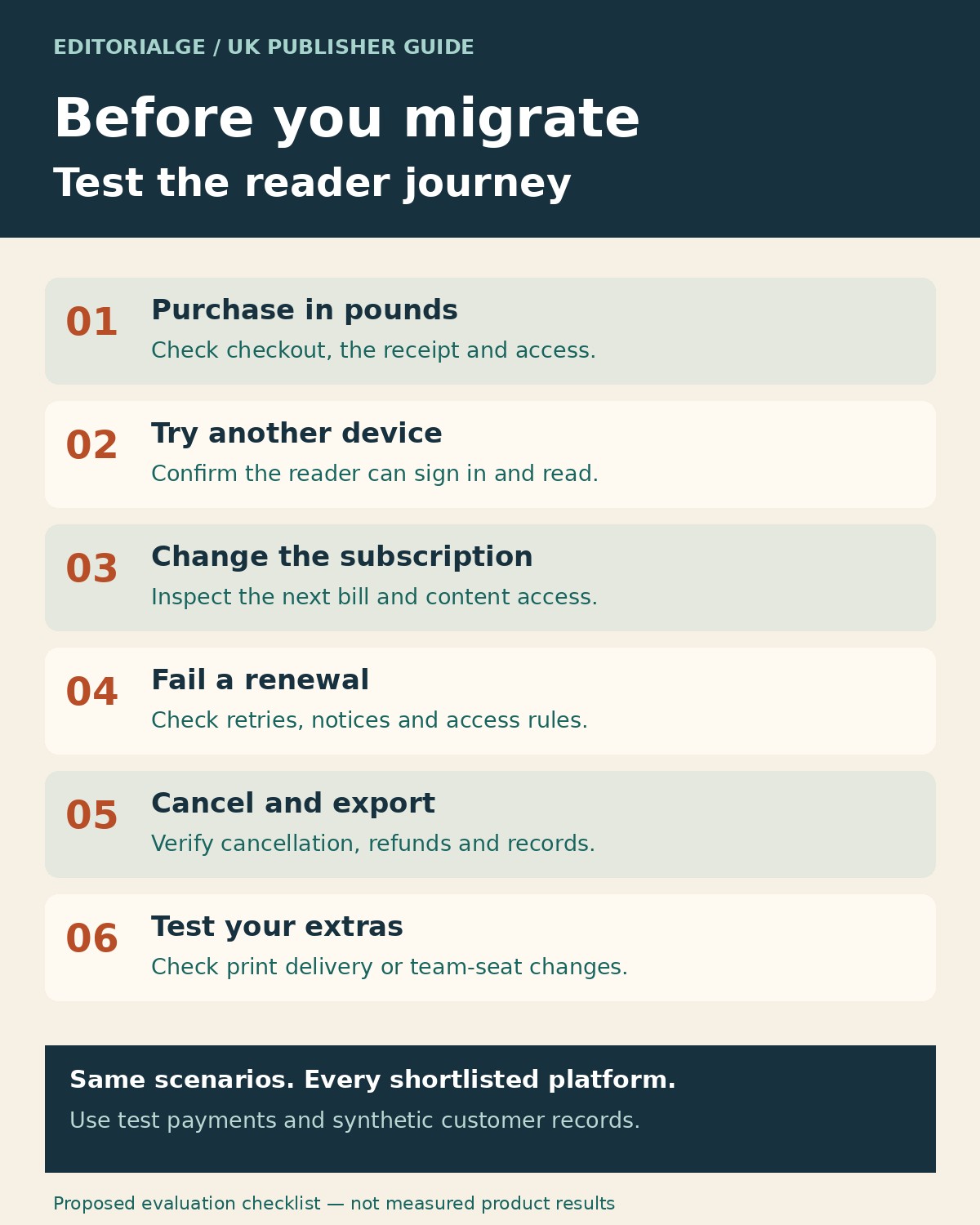
Choose two or three candidates that match your publishing model. Run the same scenarios with synthetic customer details and test payments before migrating a live audience. This proposed checklist is an evaluation method, not a report of tests conducted for this article.
- Buy a monthly GBP plan and open the promised content on a second device.
- Buy an annual or gift plan if your proposed offer includes one.
- Change a plan and inspect the next bill, access rights and customer message.
- Simulate a failed renewal and document the recovery and access rules.
- Cancel, refund and export the record; check that all connected services agree.
- For print or team subscriptions, test an address or seat change through to fulfilment.
Record where staff intervention was necessary, how long each task took and which system held the authoritative record. Before migration, reconcile active subscriptions, billing dates, legacy prices, consent records and access permissions. An email-list export alone is not evidence that recurring payments can move intact.
After launch, measure renewals by subscriber cohort as well as total revenue. Editorialge’s explanation of cohort analysis helps separate a growing audience from improving retention.
Choose the Platform That Fits Your Publication
The most useful Subscription Commerce Platforms for UK independent publishers are the ones that match the product and the people running it. Start with Ghost, Substack or beehiiv for a newsletter-led publication; compare Memberful and MemberPress around an existing website; and consider Steady for a supporter-membership model. Explore Pelcro, Abacus, Piano or Chargebee when fulfilment, audience operations or billing complexity warrants a broader system.
Make the final decision after a GBP checkout trial, a complete cost comparison and a demonstrated exit path. A platform earns its place when readers can subscribe, receive what they paid for and manage their membership without creating avoidable work for your newsroom.