

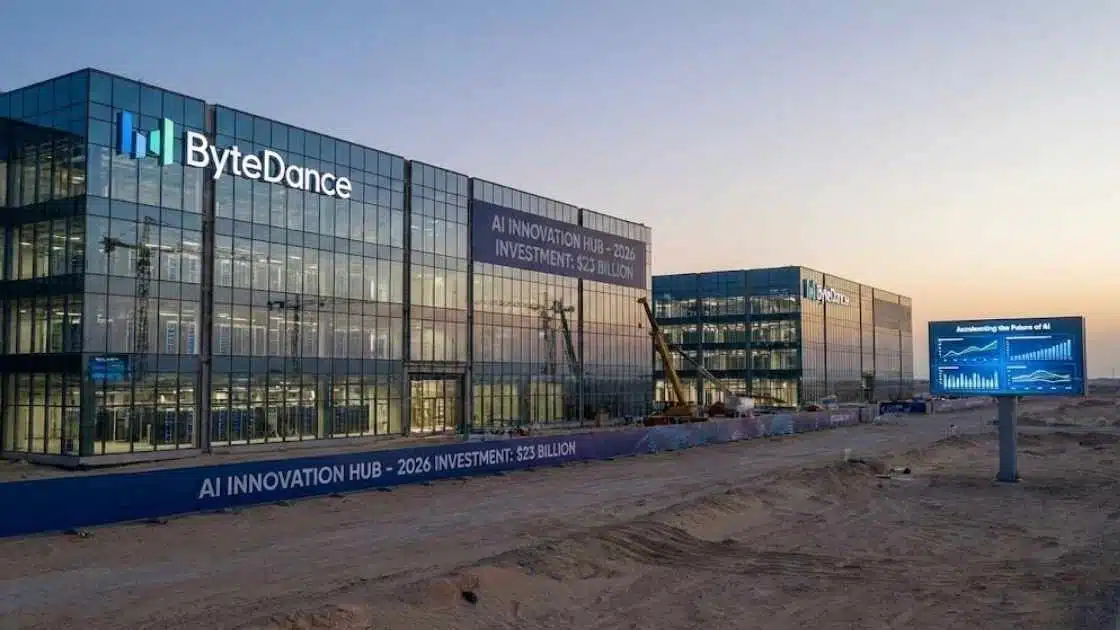
ByteDance is preparing to invest about 160 billion yuan (around $23 billion) in AI infrastructure in 2026, with roughly half earmarked for AI processors, as it scales data centers and computing capacity to support fast-growing consumer AI products while navigating U.S. chip curbs and shifting export rules.
Why ByteDance is ramping up AI spending in 2026
ByteDance—best known globally as TikTok’s owner and in China as the company behind Douyin—has been accelerating investment in the “plumbing” of artificial intelligence: data centers, networking gear, and the specialized chips needed to train and run large AI models.
The latest plan points to a bigger 2026 budget than the prior year, reflecting two pressures at once:
- User demand for AI apps is rising quickly: especially in consumer chatbots and AI features embedded inside social and video platforms.
- Compute is the bottleneck: model quality, speed, and cost are increasingly tied to access to high-end graphics processing units (GPUs) and the infrastructure to deploy them at scale.
How big is the 2026 budget—and where it may go
A 160 billion yuan capital expenditure plan would place ByteDance among the world’s heavy AI spenders, even if it remains far smaller than the combined AI infrastructure outlays of the largest U.S. tech firms.
Planned capex snapshot
| Company/Group | Period | Spending figure (reported/estimated) | What it largely supports |
| ByteDance | 2026 | 160B yuan (~$23B) | Data centers, networking, AI compute |
| ByteDance | 2025 | 150B yuan | Continued AI infrastructure buildout |
| Major U.S. tech firms (combined) | 2025 | Roughly $350B–$400B (range of estimates) | Large-scale AI data centers and compute expansion |
What matters: ByteDance’s plan signals sustained, multi-year AI infrastructure building, not a one-off spike—while also highlighting the gap in absolute dollars versus U.S. hyperscalers.
The chip constraint—and the partial opening for Nvidia’s H200
For Chinese AI builders, hardware access has been shaped by U.S. export restrictions that limit which advanced chips can be sold into China. These rules pushed companies to do three things:
- Optimize models to use less compute
- Rely more on domestically available chips
- Use overseas capacity (including renting or leasing compute abroad) where legally permitted
A key development now is the possibility of Nvidia H200 exports to China under a new policy direction that would allow shipments to approved buyers, subject to licensing and other conditions. Separate reports indicate Nvidia has been preparing to start H200 shipments to China around mid-February 2026, with early deliveries potentially equivalent to tens of thousands of chips, although approvals on the China side have also been described as pending in some coverage.
What an H200 matters for
The H200 is a high-end AI chip that can substantially improve throughput for both training and inference (running AI services at scale). For a company operating mass-market AI products, even incremental gains in chip access can translate into:
- faster responses,
- more simultaneous users,
- lower cost per query,
- more room to add multimodal features (voice, image, video).
ByteDance’s reported H200 interest—and what it implies
ByteDance has been linked in reporting to an initial interest in about 20,000 H200 units. If that scale materializes (and if pricing estimates hold), it suggests a strategy of pairing large domestic buildouts with opportunistic imports when export channels open—even partially.
That does not mean ByteDance will rely only on one supplier. Chinese AI infrastructure builds typically mix:
- imported GPUs when possible,
- domestic chips where performance and availability fit,
- and capacity outside China for certain workloads.
Doubao’s growth puts real pressure on compute supply
ByteDance’s AI push is not only about building models—it is also about serving millions of daily users.
Its chatbot Doubao has been tracking as one of China’s most-used consumer AI assistants. Market data published by a leading China-based analytics provider shows Doubao reached about 157 million monthly active users in August 2025, and later reports cite continued growth into the fall.
This kind of consumer usage is compute-intensive in a different way than “frontier model” research. It demands:
- large inference fleets (chips running live queries),
- reliability and low latency,
- and a cost structure that can support high engagement without burning cash per request.
The overseas compute workaround is becoming part of the playbook
Because the strictest chip limits focus on physical shipments, some Chinese companies have looked for lawful ways to access high-end compute outside China, including through cloud services and data centers located overseas.
Recent reporting has highlighted how cloud-based access to restricted chips—when located outside restricted geographies—can create a practical path to advanced compute without directly importing the hardware into China. This approach can be especially useful for burst capacity, peak demand, or training runs that require the most advanced chips.
For ByteDance, which already operates large global infrastructure for short-video and recommendation systems, expanding AI-related overseas capacity can also be operationally familiar—even if geopolitically sensitive.
A widening AI investment gap—still, but not one-way
Even if ByteDance spends $23 billion in 2026, the U.S. spending scale remains much larger. The biggest U.S. firms are simultaneously:
- building massive new data centers,
- securing long-term power supply,
- and investing heavily in custom chips and networking.
The gap is not only money. It is also about energy, land, and grid access—which is why U.S. firms have been pursuing power-generation and energy infrastructure deals tied to AI growth.
Still, the Chinese AI market has two advantages that can reduce the spending disadvantage:
- Huge consumer distribution through super-app ecosystems and mobile-first products
- Strong incentives to build efficient models that reduce compute needs per output
ByteDance’s core strength—shipping highly engaging consumer products—fits the second advantage particularly well.
Timeline: Export controls and the 2026 compute race
| Date | Event | Why it matters |
| Oct 2023 | U.S. updates advanced computing export controls | Tightened the ceiling on what AI chips can be sold to China |
| 2024–2025 | Chinese firms intensify efficiency gains and domestic sourcing | Model and systems optimization becomes a competitive edge |
| Early Dec 2025 | Policy direction shifts toward allowing H200 sales to approved China customers (with conditions) | Potentially re-opens a channel for higher-end Nvidia chips |
| Mid-Feb 2026 (target) | Nvidia plans to begin H200 shipments to China (reported) | Could influence how fast Chinese firms scale inference and training capacity |
What to watch next in 2026
Several concrete indicators will show whether ByteDance’s 2026 plan becomes a true step-change:
- Data center build pace: new capacity announcements, power deals, and network equipment orders
- Actual chip deliveries: whether H200 shipments proceed at scale and on what terms
- Doubao monetization: if the product shifts from growth-first to revenue-per-user expansion
- Model competitiveness: whether ByteDance’s models close quality gaps while keeping costs down
- Regulatory shifts: export licensing, tariffs/fees, and China-side approvals that could slow or speed imports
Final Thoughts
ByteDance’s planned 2026 AI infrastructure push reflects a clear bet: consumer AI adoption in China is large enough—and moving fast enough—to justify sustained, tens-of-billions-level spending on chips and data centers. Whether that investment translates into an enduring edge will depend on chip access, infrastructure execution, and ByteDance’s ability to keep Doubao and AI features tightly integrated with the habits that made its video platforms dominant.






















