A Brazilian seller moving orders out of Instagram messages needs more than a good-looking product page. The store has to accept the customer’s payment method, calculate delivery for a Brazilian address and keep a paid order separate from an unanswered inquiry. These 12 digital storefront platforms for Brazilian social sellers offer different ways to handle that work, from locally focused hosted stores to more configurable international systems.
The right choice depends on what has become difficult. A seller taking a handful of orders through WhatsApp may need a reliable catalog and payment link. A clothing business selling through social channels and marketplaces may care more about stock control. A creator with an established website might prefer adding a store to that site rather than rebuilding everything.
This comparison focuses on the storefront behind the social post: where buyers see the product, choose a variation and place an order. A link-in-bio page alone does not qualify, and neither does a payment processor without a storefront.
How the Platforms Were Selected
The shortlist is based on official product pages, Brazilian payment documentation and published plan information checked on November 12, 2026. Each service provides a storefront or store-building system and has a documented route relevant to Brazilian merchants. The list includes Brazilian-market services and international platforms with local payment connections; it is not a list of twelve Brazilian-founded companies.
Selection considered the path from a social conversation to an order, payment setup, everyday administration and the cost of running the store. The numbered order is for navigation, not a performance ranking. Editorialge has not opened merchant accounts or measured conversion rates for these products. The fit assessments below are editorial judgments based on their documented capabilities.
Prices, promotions and gateway eligibility can change. Where an exact charge matters to the comparison, its billing condition is stated. Elsewhere, the more useful question is which layers of cost apply—not which provider happens to advertise the smallest introductory figure.
Digital Storefront Platforms for Brazilian Social Sellers at a Glance
| Platform | Strongest fit | Brazil payment route | Check before committing |
|---|---|---|---|
| Nuvemshop | A first store with local payment and shipping options | Nuvem Pago; other providers depend on plan | Payment approval and plan restrictions |
| Loja Integrada | Moving chat sales into an organized store | Pagali, including Pix | Pagali version and order-linked payment features |
| Bagy | A store alongside social and live selling | Pagamentos by Bagy | Introductory pricing and paid extras |
| Yampi | A storefront with checkout selling tools | Supported gateways; Pix listed | Per-paid-order fee as well as processing |
| Cartpanda | Checkout-led selling with a low entry subscription | Gateway configuration for Brazilian sales | Checkout fees and the actual selling plan |
| Tray | Social selling alongside marketplaces | Tray Pagamentos and integrations | Channel costs and catalog synchronization |
| UOL Host Loja Virtual | A small catalog with bundled business services | Integrated PagBank; Pix listed | Product caps and annual billing |
| Wix | A visual brand site with a store | Wix Pagamentos Brasil | BRL setup and provider eligibility |
| Shopify | A store needing a wider app ecosystem | Brazil-compatible third-party providers | Local payment setup and added fees |
| WooCommerce | A WordPress store with technical support | Extensions such as Mercado Pago | Maintenance and integration ownership |
| Ecwid | Adding commerce to an existing website | Mercado Pago integration supports Brazil | Exact payment methods and plan limits |
| Jumpseller | A hosted store with social-order automation options | Brazilian gateway integrations | WhatsApp setup and feature-level charges |

1. Nuvemshop: A Practical Starting Point for a Brazil-Focused Store
Nuvemshop belongs on the first shortlist when the aim is to move from answering every purchase request in a chat to keeping a proper product catalog. Its Brazilian offering brings together a hosted store, Nuvem Pago and Nuvem Envio, with further integrations available through its app ecosystem.
The attraction is the local combination rather than any single feature. A seller can evaluate the store, payment route and shipping setup within the same product family. That makes it a sensible comparison point for someone who does not want to assemble a WordPress stack.
Its Começo plan is advertised without a monthly subscription. The pricing page distinguishes Nuvemshop’s sales commission from payment processing: using Nuvem Pago can remove the platform’s commission on listed plans, but processing charges remain. The free tier also differs from paid plans in payment choice and customization. Check those restrictions before assuming the cheapest option will support an existing gateway or preferred design.
2. Loja Integrada: Useful When Sales Still Begin in a Conversation
Loja Integrada combines a storefront with its Pagali payment service and Enviali delivery offering. Its particular relevance to social sellers is the documented route from a conversation to a payment request.
Pagali V2’s help page describes payment links that can be shared through WhatsApp, social channels or email. It also makes an important distinction: payment links are available across plans, while a manual order with a payment link requires the Aceleração plan or above. A charge that gets paid and an order that updates the store’s records are not necessarily the same workflow.
This makes Loja Integrada worth considering for sellers who want to keep personal conversations while reducing payment administration. Check which Pagali version is enabled in the account; the company documents V2 migration as gradual, and V1 instructions should not be applied indiscriminately. Ask for a demonstration showing where the order appears after a customer pays.
3. Bagy: Worth Comparing for Sellers Who Use Live Product Demonstrations
Bagy’s published plans combine store creation, a visual editor, transparent checkout and connections to Pagamentos by Bagy, Envios by Bagy and Correios. Its feature table also lists manual orders and Liveshop, making it relevant to sellers whose product launches involve conversations and live demonstrations.
A fashion or accessories seller might value that combination more than extensive code customization. The question to ask is whether the required live-selling feature is included in the selected plan or billed separately. Bagy’s table shows different treatment across tiers.
Read the renewal line as closely as the headline price. At the research check, the Impulso offer displayed R$49 per month for the first 12 months, then R$99. Its zero platform sales-fee offer with Bagy payments does not remove payment processing charges. Compare the second-year cost and the required add-ons before choosing an annual commitment.
4. Yampi: A Storefront for Sellers Who Want More Control Over Checkout Offers
Yampi provides a complete store as well as a checkout product. That matters because a seller evaluating it does not have to treat it solely as an extra checkout attached to another platform.
Its plan page lists order bumps, abandoned-cart recovery and unlimited product registration. An order bump is an extra item offered during checkout; it may suit a seller with a genuinely useful add-on, such as a matching accessory. Its presence is not evidence that customers will buy more.
Yampi’s Basic plan has no monthly subscription but lists a 2.5% charge per paid order. Payment-provider charges must also be considered. This can be an accessible entry route, yet the fee grows with sales. Before choosing it, calculate the charge at the business’s expected order value and volume, then compare a paid alternative on the same assumptions. Vendor claims about superior conversion are not a substitute for a store-specific trial.
5. Cartpanda: Look Past the Small Monthly Number
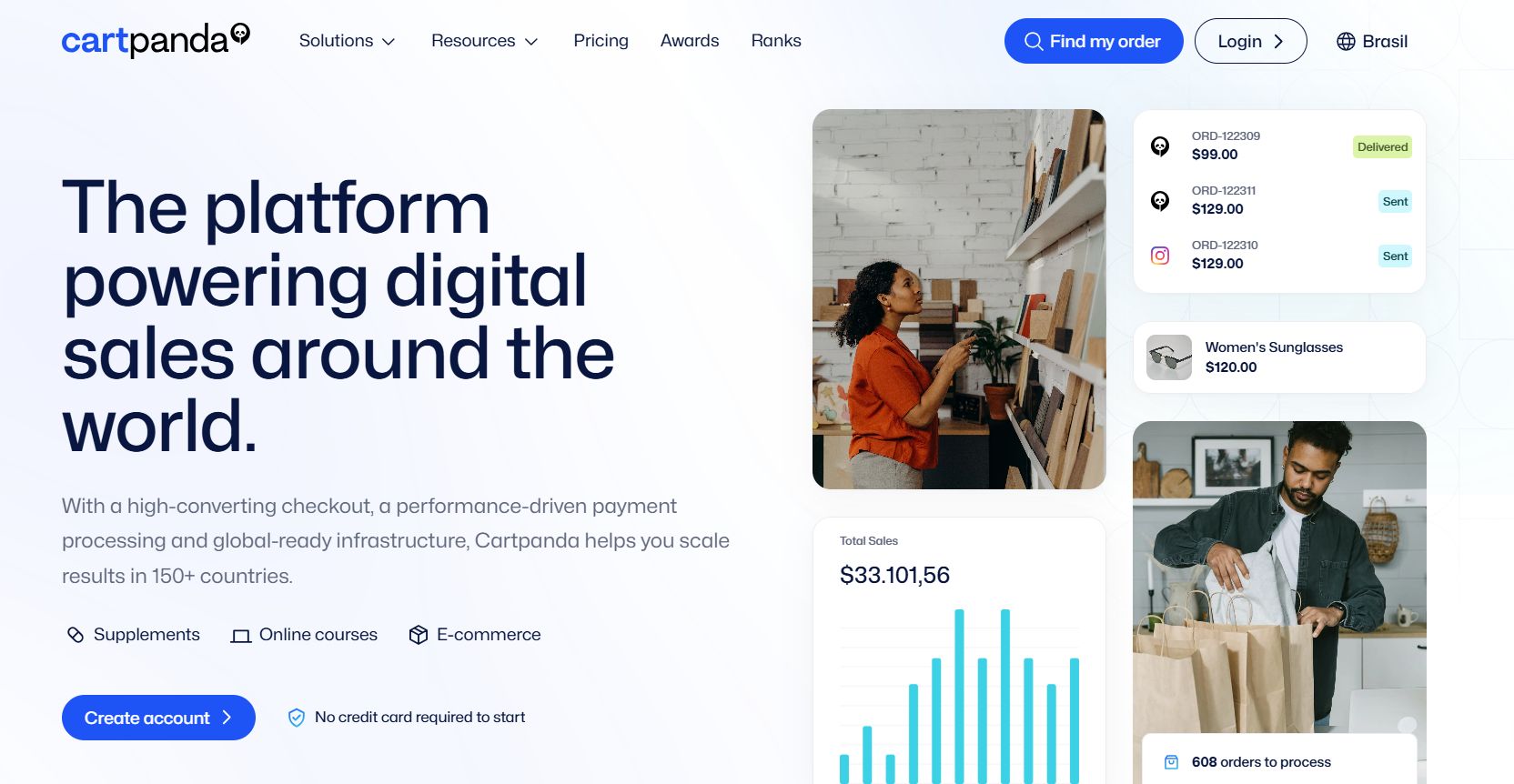
Cartpanda emphasizes checkout and the administration of physical and digital sales. Its Brazilian site presents one-page and three-step checkout options, while its help center separates the subscription, checkout fee and gateway charges.
That fee structure is the main reason to examine it carefully. The published Light plan is R$4.99 per month plus a 2.5% BRL checkout fee. The free Básico plan is described as suitable for affiliates; selling the merchant’s own products requires Light or above. A free account therefore should not be mistaken for a free operating storefront.
Cartpanda is most relevant when the checkout itself is central to the sales process and someone will monitor its costs and order flow. Confirm the current store-builder setup, the Brazilian payment methods enabled for the account and how fulfillment data leaves the system. Its international fee schedule should not be used to estimate domestic Brazilian sales.
6. Tray: For a Business Selling Beyond Its Social Audience
Tray is a stronger candidate when social selling is only part of the operation. Its product offering includes a store, marketplace connections, social channels, Tray Pagamentos and Tray Envios. Mercado Livre, Shopee and TikTok Shop appear among its documented channels.
For a seller sharing the same stock across several destinations, the practical appeal is having those channels around a central commerce platform. A broader feature set also means more configuration. A seller with ten products and no marketplace plans may have little reason to pay for complexity that will sit unused.
Bring a specific stock example to the demonstration: one item, two sizes, and the last unit available through more than one channel. Ask what updates automatically and what needs an integration. Also separate fees for the seller’s own store from marketplace charges. A platform’s supported-channel list does not establish that every connection is included, approved or configured for a particular merchant.
7. UOL Host Loja Virtual: A Bundled Option for a Modest Catalog
UOL Host’s Loja Virtual, also presented as Loja VirtUOL, packages a storefront with services such as professional email and domain benefits on listed plans. Its page documents PagBank integration, Pix acceptance and connections with social and marketplace channels.
This is worth considering when a seller would otherwise purchase those basic services separately. Product caps are an important comparison point: the displayed Essencial plan permits up to 300 registered products. Check how variations are counted for the actual catalog rather than judging capacity from the number of product families alone.
The page presents some prices as a monthly equivalent alongside an annual total. Use the amount charged at checkout, and verify renewal and domain terms. UOL Host’s no-platform-sales-fee claim should also be separated from PagBank processing. This entry evaluates the UOL-branded service package; it does not imply that every listed provider uses an unrelated underlying technology stack.
8. Wix: When the Brand Website Matters as Much as the Catalog
Wix suits a business that needs product pages alongside a portfolio, brand story or other substantial website content. Its visual website tools make it a different proposition from choosing a platform primarily for checkout offers.
The local payment route is explicit. Wix’s support documentation says Wix Pagamentos Brasil supports cards, boleto and Pix, with the site currency set to Brazilian reais. It also notes that this provider currently accepts only credit cards issued in Brazil. That limitation matters if followers abroad are expected to buy from the same store.
A maker, designer or small lifestyle brand should compare Wix’s presentation tools with the actual checkout and delivery setup, not just its templates. Confirm that the chosen plan accepts payments, complete provider verification and test a product purchase from a phone. The ability to create a website without paying is not the same as having a fully configured selling plan.
9. Shopify: A Wider Ecosystem, With Brazilian Payments to Configure
Shopify makes sense for a seller who expects to need additional apps, more specialized store functions or a broader operation over time. Its ecosystem is a reason to investigate it, not a reason to ignore the work required for a Brazilian checkout.
Shopify’s Brazilian guidance states that Shopify Payments is not available to businesses based in Brazil at the research date. Local merchants therefore need an eligible third-party provider. Mercado Pago documents a Shopify Pix integration, but installing an app and activating a verified payment account remain separate steps.
Budget for the subscription, required apps, gateway processing and any applicable Shopify third-party transaction fee. Then examine the complete buyer journey: a product link opened from Instagram, a variation selected, a Brazilian address entered and the payment completed. Choose Shopify because its ecosystem solves an identifiable requirement, rather than assuming its international prominence makes local setup automatic.
10. WooCommerce: More Control for a Seller With Technical Help
WooCommerce is the alternative for a business that wants to run its store on WordPress and control more of the implementation. The official WooCommerce marketplace lists a Mercado Pago extension, including transparent checkout and Checkout Pro options.
That flexibility can be valuable when the business already has a WordPress site or needs a particular content-and-commerce arrangement. It also shifts responsibility toward the merchant and whoever maintains the site. Hosting, backups, updates and compatibility need an owner.
A free core plugin does not make the resulting store free to operate. Include hosting, paid extensions and maintenance in the comparison. Before a social campaign sends traffic to a new product page, test payment status updates and shipping calculations with the installed plugin versions. WooCommerce is a reasonable choice with dependable technical support; it is a demanding choice for a solo seller who wants no involvement in site maintenance.
11. Ecwid: Add a Store Without Replacing an Existing Website
Ecwid is particularly relevant when a seller already has a website worth keeping. It offers an Instant Site and an official WordPress integration, allowing the commerce decision to be separated from a complete site redesign.
Ecwid’s Mercado Pago integration lists Brazil among its supported markets. That establishes a local payment route, but the listing alone does not prove that every Mercado Pago method, including a particular Pix checkout flow, is enabled for every Ecwid account. Verify the exact methods before subscribing.
A creator with an established content site may prefer this approach to rebuilding pages and links that already bring visitors. Compare product limits, required app access and the checkout language on the chosen plan. If the Brazilian payment or shipping workflow needs more adaptation than expected, the apparent saving from keeping the old site may disappear. The existing website is the reason to shortlist Ecwid, not a guarantee of the lowest total cost.
12. Jumpseller: A Hosted Store With Documented WhatsApp Order Automations
Jumpseller offers a hosted storefront and documents Brazilian payment connections including Mercado Pago, PagBank and Cielo. Its WhatsApp automation guide goes beyond adding a contact button: it describes messages triggered by order events such as payment confirmation, preparation and dispatch.
That can interest sellers who repeatedly answer order-status questions. Setup requires an active store, a Meta Business account and appropriate administrative access. Confirm plan access, messaging charges and account requirements before treating automation as included or ready to use.
Jumpseller advertises zero ordinary sales commission while retaining payment-provider costs. Its plan table separately discloses a fee for the product-subscription feature, illustrating why a headline commission statement should not be extended to every optional function. For a social seller, the useful trial is a simple one: can a paid order produce the right customer update without somebody copying details between screens?
Three Brazil-Specific Checks That Can Change the Shortlist
First, examine how Pix works in the proposed store. The Banco Central do Brasil’s Pix regulation defines instant payments as available around the clock. However, the processor’s payout schedule, account restrictions and storefront status updates still need checking. A customer’s payment and the merchant’s withdrawal availability are different parts of the process.
Second, test delivery with a real CEP, Brazil’s postal code, and the weight and dimensions of an actual product. Use destinations the business intends to serve, including a distant destination if nationwide delivery is part of the plan. An attractive product page cannot resolve an inaccurate shipping quote.
Third, separate social-link sharing from catalog synchronization and automated messaging. A product URL can be pasted into a chat without a sophisticated integration. Syncing stock or sending order-triggered WhatsApp messages is a different requirement. Ask the provider to show the exact operation instead of accepting “integrates with social media” as a complete answer.
If the audience itself is still uncertain, begin with choosing social platforms around audience behavior. That decision tells the seller which traffic source to test; it does not replace choosing a reliable checkout.
Compare the Cost of the Same Business, Not Twelve Advertised Prices
Write down one expected month of orders and use it for every quote. Include the subscription, platform commission, payment processing, paid apps and any support or maintenance needed to keep the store running. Then add packaging and delivery to the operating budget. Record card-installment and payout conditions separately, because they can change the cash available after a sale.

For a deliberately simplified example, 100 paid orders at R$100 each produce R$10,000 in order value. A hypothetical 2.5% platform charge on that amount is R$250 before payment processing, subscription charges or other expenses. This is an illustration, not a provider quote; the actual fee base may treat shipping, discounts and refunds differently.
A free monthly plan can be appropriate at low volume. A paid plan can become cheaper at a different volume. Neither conclusion follows from the subscription alone. Ask each provider for the total under the same sales mix, and keep promotional and renewal prices in separate columns.
Run One Realistic Trial Before Moving the Catalog
Choose two platforms whose strengths fit the business, then set up the same product in each trial or demonstration. Use its real variations, photos, weight and price. Open its link from the social app that customers actually use and complete a provider-approved test payment where available.
Check what happens after checkout: whether the order records the selected variation, whether the paid status updates, whether stock changes and whether the buyer receives a clear confirmation. Ask how refunds, customer exports and product exports work before committing the whole catalog.
Have the payment provider confirm the documents and bank-account details required for the merchant’s particular setup. A storefront subscription does not guarantee payment approval. If the business needs fiscal-document or accounting integration, show that requirement during the trial rather than treating it as a later housekeeping task.
Sellers planning to source products through third-party suppliers can separately compare e-commerce platforms for dropshipping. That is a different decision from local payment and storefront suitability, and supplier delivery performance still needs its own checks.
Choose the Platform That Removes Your Current Bottleneck
For a first Brazil-focused store, Nuvemshop and Loja Integrada are sensible comparison points. Bagy deserves a look when live selling matters; Tray when marketplaces are already part of the operation. Wix, Ecwid and WooCommerce answer different website needs, while Shopify offers a broader ecosystem with local configuration work. Yampi and Cartpanda merit careful checkout-cost comparisons, and UOL Host and Jumpseller offer additional hosted routes.
The strongest choice among digital storefront platforms for Brazilian social sellers is the one that handles the seller’s actual order with the least avoidable work. Choose the payment and fulfillment process first. The theme can follow.