


Remember when Google was just a bridge to the rest of the web? You typed in a question, got a clean list of blue links, and actually clicked away to an independent website. It sounds almost vintage now, but that exchange used to be the foundational contract of the internet. Publishers, bloggers, and niche experts built the content, Google organized it, and users clicked through to the source.
Today, that contract has been quietly rewritten. Search has transformed into a self-contained ecosystem designed to keep you from ever leaving. This is the reality of the modern Google Search Walled Garden, where the goal is no longer to guide you to the open web, but to satisfy your query right on the results page.
The Shift From Finding Information to Absorbing It
Google’s original mission was to organize the world’s information and make it universally accessible. For a long time, that logic worked beautifully for independent creators because accessibility meant traffic. But the platform has gradually shifted from indexing the web to absorbing it.
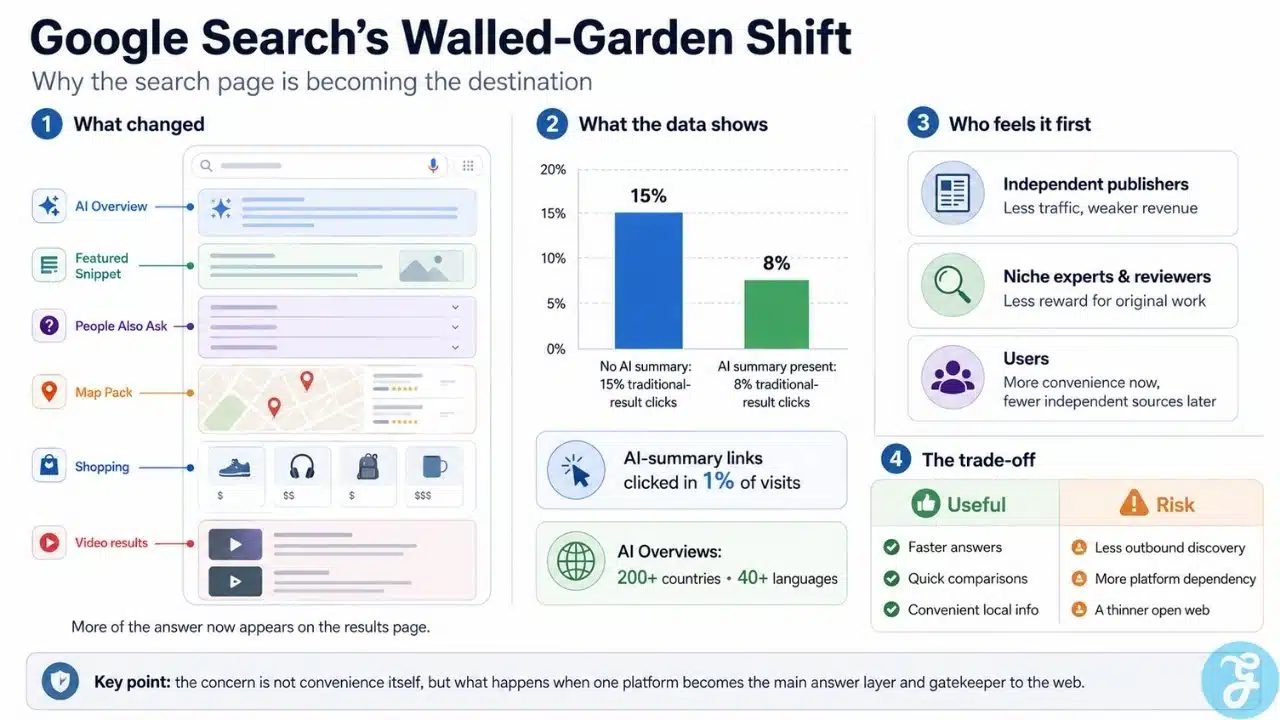
When you search for something today, you are met with an overwhelming array of internal features. AI Overviews summarize the topic, featured snippets pull direct quotes, People Also Ask accordions expand automatically, and Google Maps or Shopping boxes completely dominate the screen space. By the time you scroll past the sponsored ads and Google-owned properties like YouTube, traditional organic links feel like an afterthought.
The problem with the Google Search Walled Garden is not that these features are poorly designed. In fact, they are incredibly convenient for quick, transactional facts. You don’t need to read a 1,000-word article to know the current time in London or the score of a game. The trouble starts when this answer-first architecture expands into deeply nuanced, creative, or research-heavy topics, intercepting audiences before they can ever reach the creators who did the actual legwork.
How AI Overviews Redefine the Supply Chain
The introduction of AI Overviews has accelerated this ecosystem capture. While older elements like featured snippets were already causing a drop in click-through rates, they at least directly quoted a single source. AI summaries go a step further by synthesizing information from dozens of sites across the web, blending it into a neat paragraph, and presenting it as its own native answer.
This setup fundamentally breaks the economic loop of online publishing. A journalist spends days investigating a story, a mechanic films a detailed tutorial, or an independent reviewer spends hundreds of dollars testing products. Google’s AI crawls that collective effort, creates a condensed version, and presents it to the user.
If readers can get a “good enough” answer without ever leaving the search page, publishers lose the visits required to fund their work. Exposure and small footnote citations do not pay hosting bills or content creators. If the primary gateway to information starves the very sources it relies on, the entire digital supply chain begins to break down.
The Hidden Cost of the Zero-Click Internet
In SEO circles, a search that ends without a user clicking a link is called a zero-click search. What used to be a minor algorithmic quirk has become the deliberate framework of modern search engine optimization.
Large, established media brands can weather this drop in search traffic because they have direct channels, including dedicated mobile apps, email newsletters, and paid digital subscriptions. Independent creators, local businesses, and hyper-specific niche blogs do not have that kind of structural cushion. They rely entirely on open discovery to find their audience.
When visibility is restricted within a gated compound, the entire web begins to look homogenized. Corporate content factories optimize for predictability, using safe editorial templates that easily feed search algorithms. The quirky, opinionated, and hyper-focused perspectives that make the internet interesting get pushed out of sight. We are left with a search experience that feels incredibly clean, but fundamentally lacks depth and variety.
Building an Independent Path Beyond the Gates
Waiting around for major platforms to prioritize the financial health of independent websites is a losing strategy. The open web cannot compete on scale, but it can absolutely win on precision, unique data, and human personality.
To survive the pressures of a platform-dominated landscape, digital publishers have to stop acting like smaller, underfunded versions of corporate media giants. Trying to rank for massive, high-volume commercial keywords is a fast track to algorithmic invisibility. Instead, the strategy has to pivot toward hyper-specific niches, proprietary first-hand research, and deep community integration.
More importantly, relying on a single search engine as a sole traffic source is no longer sustainable. Building direct distribution through newsletters, podcasts, and owned communities turns casual searchers into loyal readers. Search traffic should be treated as a helpful bonus, not a foundational business model.
Ultimately, search engines have an incredibly difficult job filtering out the industrial volume of web spam and automated digital sludge. But safety shouldn’t mean turning the internet into a closed corporate directory. A healthy digital ecosystem requires a balance where new voices can break through based on the immediate quality of their ideas, rather than the size of their historical footprint. Until search platforms prioritize sending users back out to the human web, creators must focus on building spaces that audiences actively choose to visit directly.





















