
Starting a business can be exciting but also challenging. Many startup founders face difficulties finding the right guidance and tools to succeed. Developing a strong entrepreneurial mindset while understanding growth strategies is essential for making your venture thrive.
Thankfully, there are excellent entrepreneurship courses that can help. From top schools like Harvard University to programs by Y Combinator, these courses teach essential skills for creating a solid business model or attracting venture capital firms.
They even offer flexible schedules for busy founders.
This blog highlights the 10 best entrepreneurship courses for startup founders. You’ll discover options suited for every stage of your journey as an entrepreneur. Let’s explore these opportunities!
Entrepreneurship Essentials by Harvard Business School
Harvard Business School’s Entrepreneurship Essentials offers a focused four-week program. With a time commitment of 6-8 hours per week, it is ideal for busy startup founders. The course explores creating strong business models and understanding growth strategies crucial for building successful startup companies.
Participants receive practical insights into venture capital funding, market positioning, and decision-making processes.
The program includes four detailed modules and awards a Certificate of Completion upon finishing. Students completing three entrepreneurship courses earn an additional Certificate of Specialization.
Available start dates in 2023 include March 26, May 7, and August 27. Costing $1,850, this flexible schedule makes it accessible to entrepreneurs seeking structured learning paths without sacrificing quality content or results.
How to Build a Startup by Udacity
Steve Blank teaches this free course to startup founders on Udacity. Spanning four weeks, it focuses on essential skills like creating business models and identifying customer segments.
It guides users through value propositions, revenue models, and building strong customer relationships. Entrepreneurs learn practical growth strategies for their startup company within a flexible schedule.
Over 31,500 participants have taken advantage of its engaging content. Rated 4.6 out of 5 by 24 reviews, the course serves both beginners and experienced entrepreneurs who want to understand strategic management deeply.
Many users gain insight into landing pages and approaches that improve sales performance for a start-up in competitive markets.
Entrepreneurship Specialization by Wharton School
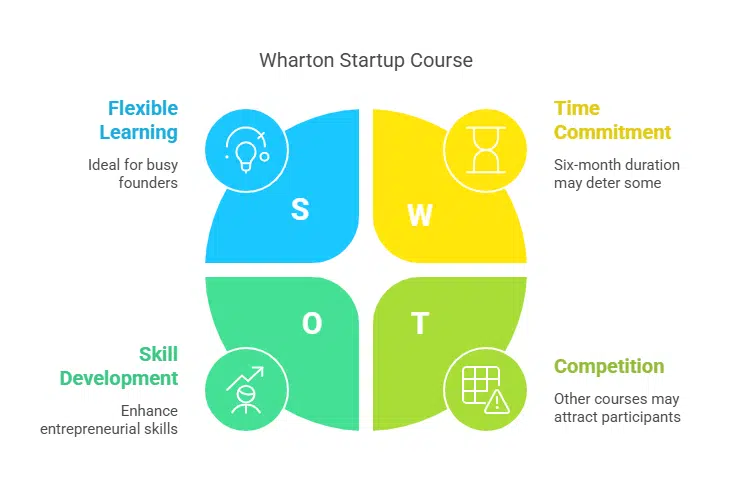
The Wharton School offers a free online course designed for startup founders. Spanning about six months, this five-course series focuses on developing innovative business models and launching successful startups.
Participants enhance their growth strategies by working on a capstone project to create a compelling pitch deck.
This specialization is ideal for those looking for flexible schedules while learning venture capital basics and improving sales techniques. From brainstorming new ideas to scaling businesses, the program covers essential entrepreneurship concepts thoroughly.
Technology Entrepreneurship: Lab to Market by Harvard University
Karim R. Lakhani and Vish Krishnan guide this course to help startup founders transform cutting-edge technologies into market-ready products. With a flexible schedule, participants commit 2-4 hours per week over five weeks, completing the program between October 4, 2023, and October 2, 2024.
The $149 enrollment fee provides access to a verified certificate for those seeking credentialed proof of achievement.
This entrepreneurship course uncovers steps for taking innovations from laboratories directly to customers. Participants explore growth strategies by analyzing business models and understanding venture capital (VC) fundamentals.
It’s ideal for entrepreneurs focused on tech ventures or sellers aiming to enhance sales with science-based advancements in artificial intelligence or other fields.
Essentials of Entrepreneurship: Thinking & Action by Coursera
This course, offered by the University of California, Irvine on Coursera, provides practical tools for building a business model. It costs $49 per month and takes about five hours to complete.
Designed for beginners with busy schedules, it offers flexible learning options. Participants can gain peer feedback on assignments to refine their ideas.
The program is aimed at startup founders seeking practical growth strategies without heavy time commitments. A verified certificate adds value upon completion. Whether you’re exploring venture capital or improving your sales approach, this course provides essentials in entrepreneurship while keeping your workload manageable.
Y Combinator’s Startup School
Y Combinator’s Startup School offers a free seven-week program for startup founders. Participants dedicate just 1-2 hours per week and gain access to valuable tools, including aco-founder matching platform with over 100,000 successful matches.
Key features also include a weekly update tool that helps refine your business model and track growth strategies.
Prominent instructors such as Michael Seibel, Carolynn Levy, Kat Manalac, and even Mark Zuckerberg share their expertise. Alumni like Tony Xiao (Collections) from YC 2012 and Curtis & Matthew (Whalesync) from YC 2021 have praised the course’s impact on their ventures.
Disruptive Strategy by Harvard Business School Online
Disruptive Strategy by Harvard Business School Online teaches startup founders how to reshape business models and gain a competitive edge. This six-week course, starting on April 2, 2025, demands only 5-6 hours per week of your time.
Participants collaborate with peers and industry leaders like Bill Hambrecht and Eric Schmidt while engaging in group exercises for real-world application.
The course costs $1,850 and provides a Certificate of Completion upon successful completion. The curriculum focuses on identifying growth strategies through innovative approaches in the evolving market landscape.
An individual final paper tests your ability to apply learned concepts effectively.
Launching Tech Ventures by MIT OpenCourseWare
MIT OpenCourseWare’s “Launching Tech Ventures” helps founders turn ideas into real businesses. The program focuses on applying discoveries to solve problems and create value.
Participants explore core topics like business models, venture capital, and growth strategies through the courses 15.390 New Enterprises and 15.S21 Nuts and Bolts of Business Plans.
The impact of this program shows in numbers. MIT alumni have started over 30,000 active companies, generating $1.9 trillion in annual revenue and creating 4.6 million jobs worldwide.
Notable startups like Dropbox, Akamai, iRobot, A123 Systems, and InVivo Therapeutics trace their roots to MIT’s entrepreneurial teachings. It is a valuable resource for startup founders looking for free courses with flexible schedules focused on tech-driven ventures!
Entrepreneurial Marketing by Stanford University

Stanford University offers the Global Entrepreneurial Marketing (MS&E271) course for startup founders. This online program, led by instructors, lasts 10 weeks. Participants commit 9-15 hours per week and gain 3-4 academic credits upon completion.
Tuition fees range from $4,542 to $6,056.
Designed for entrepreneurs aiming to refine growth strategies, it focuses on business models and venture capital insights. Students learn practical tools for scaling startups while earning an official Stanford transcript.
Advanced Business Strategy: Gaining a Competitive Edge by Coursera
Advanced Business Strategy by Coursera helps startup founders sharpen their growth strategies. This online course focuses on creating strong business models and gaining a competitive edge through actionable insights.
Designed for advanced learners, it offers case studies and tools to refine decision-making processes.
Led by expert instructors, the program combines flexibility with practical skills important for entrepreneurs. Participants explore sales techniques, venture capital concepts, and scalable strategies vital for thriving in competitive markets.
It’s an ideal resource for founders aiming to accelerate business success while managing a flexible schedule.
Takeaways
Building a startup takes both knowledge and effort. These courses offer valuable lessons for founders aiming to grow their businesses. From Y Combinator Startup School to Harvard’s programs, there’s something for everyone.
Stay curious, keep learning, and apply these insights to shape your venture’s success!
FAQs on Entrepreneurship Courses For Startup Founders
1. What are the best entrepreneurship courses for startup founders?
The best entrepreneurship courses help startup founders learn growth strategies, develop a strong business model, and understand venture capital. Programs like those from Harvard Business School or Y Combinator stand out.
2. Are there free online courses available for entrepreneurs?
Yes, some platforms offer free courses on topics like sales techniques and building startups. Many also provide flexible schedules to fit busy routines.
3. How can these courses help with growth strategies?
Entrepreneurship courses teach practical methods to scale businesses, attract investors, and refine products based on market needs.
4. Do any of these programs include lessons about venture capital?
Yes, many startup-focused courses cover venture capital basics, helping founders secure funding and manage investor relationships effectively.
5. Can I take these classes while working full-time as a founder?
Most online entrepreneurship classes offer flexible schedules so you can balance learning with running your business or other commitments.