

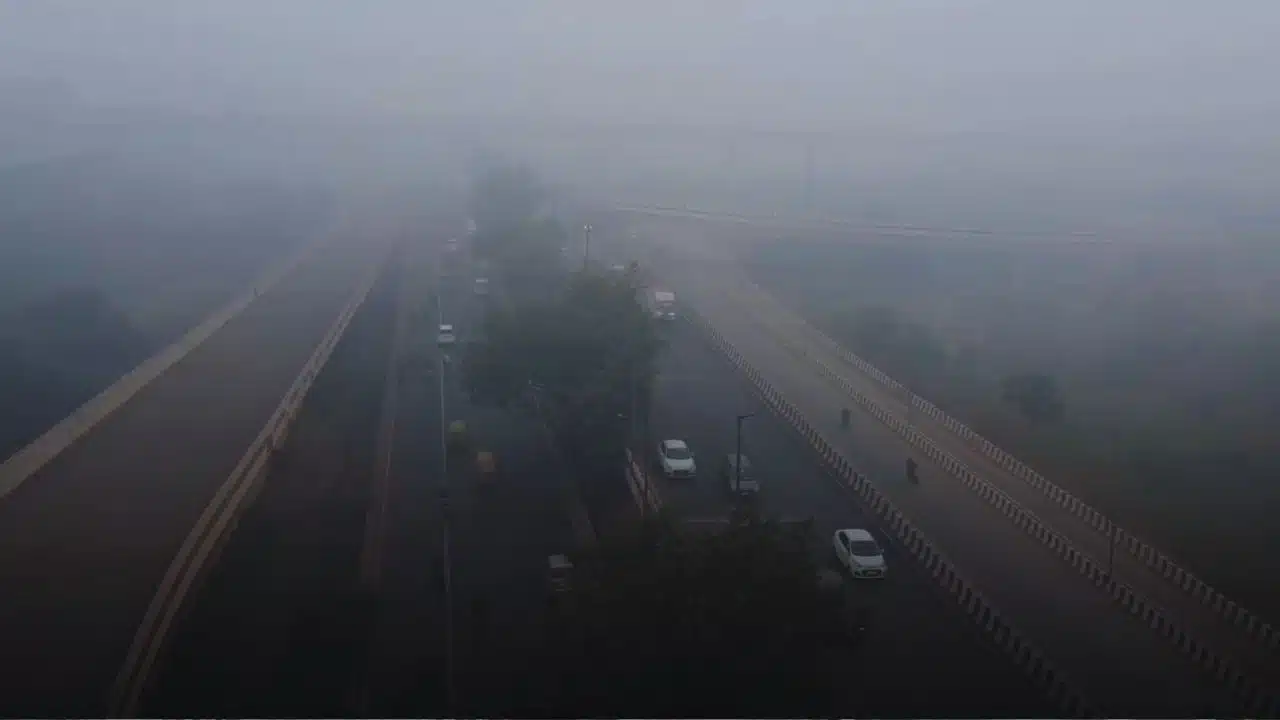
Delhi’s dense fog orange alert conditions returned to Delhi early Saturday (Dec 20, 2025), with dense fog cutting visibility in key areas and adding to travel disruption risks while the city’s air remained in the “very poor” range.
Delhi’s fog situation today: what residents experienced and what the data shows?
Delhi began the day under a thick winter haze that quickly turned into dense fog during the early morning hours. This kind of fog is not just an inconvenience—it directly affects road safety, airport operations, and everyday movement across the city and NCR.
Weather observations for December 20, 2025 show that visibility dropped sharply at major observing stations, which are closely watched because they reflect conditions near aviation and high-traffic corridors.
Key visibility and weather observations (morning of Dec 20, 2025)
| Station/Area (Delhi) | Lowest visibility reported | Time window noted | Temperature snapshot (reported in bulletin) |
| Palam (near IGI airport region) | 350 metres | From 4:00 am IST onwards | Max 18.1°C; Min 7.9°C |
| Safdarjung | 200 metres | From 3:00 am IST onwards | Max 22.2°C; Min 6.1°C |
| Lodi Road | — | — | Max 22.1°C; Min 6.6°C |
Alongside poor visibility, the bulletin indicates that minimum temperatures fell by about 1–3°C, and maximum temperatures fell by about 4–6°C over the past 24 hours—conditions that often make fog more persistent, especially when winds remain light.
IMD’s outlook for Delhi also points to cold day conditions at a few places, which typically means daytime temperatures are low enough to affect comfort and health, even if a formal cold-wave threshold is not met.
Fog intensity in Delhi can shift quickly within short distances—one stretch of road may appear manageable, while another becomes dangerously opaque. That’s why advisories often focus on the time window (late night to early morning) and the likely persistence (several days in a row) rather than a single moment.
Travel disruptions: flights, roads, and rail movement under low visibility
Dense fog can disrupt travel even when cities remain fully “open.” The disruption usually comes from safety protocols: slower movement, longer braking distances, and tighter spacing rules between vehicles and aircraft.
Airport operations and flight delays
Delhi’s Indira Gandhi International (IGI) Airport typically activates low-visibility procedures when fog intensifies. Even if runways remain operational, fog can still cause delays and diversions because:
- Landings and take-offs may require instrument-based approaches.
- Only certain aircraft and trained crews can operate under the lowest visibility limits.
- Flight schedules become fragile: when one morning wave is delayed, the effect cascades into afternoon and evening departures.
Fog also affects how quickly aircraft can taxi and line up. In low visibility, ground movement becomes slower and more carefully sequenced, which reduces the number of flights that can be handled per hour.
What travelers should do today?
- Check flight status before leaving for the airport.
- Expect the biggest impact in early morning time slots.
- Keep extra buffer time for connections, especially domestic-to-international transfers.
- If you’re picking someone up, plan for extended waiting due to shifting arrival times.
Road safety: why fog mornings are high-risk?
On roads, dense fog sharply reduces reaction time. The risk rises further because winter mornings often combine fog with smoke or haze, creating a “white-grey wall” effect under streetlights and headlights.
Common hazards include:
- Sudden slowdowns near flyovers, underpasses, and open fields.
- Rear-end collisions when drivers follow too closely.
- Two-wheeler accidents due to limited visibility and slippery patches caused by condensation.
Practical driving guidance
- Use low-beam headlights (high beam can reflect off fog and worsen visibility).
- Drive slower than usual and increase following distance.
- Avoid sudden lane changes; indicate early.
- If visibility becomes dangerously low, pull over safely and wait rather than pushing forward.
Rail services and station delays
Fog can also affect rail movement because trains may be required to operate at lower speeds in low visibility stretches. Even modest delays can disrupt long-distance schedules, particularly on routes connecting Delhi to north and east India during peak winter fog season.
For passengers, the key point is that fog-related rail delays can build gradually through the day. A train that starts the morning behind schedule may continue to accumulate delays as it crosses multiple fog-affected zones.
Air quality remains very poor: why winter fog and pollution worsen together?
Delhi’s winter fog often overlaps with poor air quality because the atmosphere becomes “stable.” In a stable atmosphere, the air near the ground does not mix well with air above it. That means pollutants from vehicles, construction dust, industrial activity, and biomass burning can remain trapped closer to breathing level.
This also explains why visibility and air quality often deteriorate together:
- Fine particles (PM2.5) and larger dust particles (PM10) scatter light and reduce visibility.
- Calm winds prevent pollutants from dispersing.
- Colder nights strengthen the near-ground temperature inversion, which acts like a lid.
In recent days, official actions were escalated in response to sharply rising AQI trends. A formal order invoked Stage IV of the Graded Response Action Plan (GRAP) across Delhi-NCR, citing a rapid increase in AQI and unfavorable weather conditions that can trap pollutants.
AQI trend cited during the Stage IV escalation (as documented in the order)
| Time (IST) | AQI reading recorded in the order | Category noted |
| 10:00 AM | 401 | Severe |
| 4:00 PM | 431 | Severe |
| 5:00 PM | 436 | Severe |
| 6:00 PM | 441 | Severe |
| 7:00 PM | 448 | Severe |
Even when Delhi’s AQI is labeled “very poor,” it can hover close to “severe” levels and swing quickly—especially during nights and early mornings when dispersion weakens.
What GRAP Stage IV changes on the ground?
GRAP is structured to trigger stronger restrictions as pollution worsens. Stage IV is among the strictest sets of measures and is meant to prevent “severe+” conditions from becoming prolonged.
Key public-facing measures emphasized under Stage IV (high-level summary)
| Area | What residents may notice | Why it matters |
| Truck entry and goods movement | Tighter checks and restrictions on certain categories of trucks entering Delhi | Heavy vehicles add pollution and congestion; restrictions aim to cut emissions quickly |
| Older vehicle restrictions | Enhanced enforcement on older petrol/diesel categories in Delhi and select NCR districts | Targets higher-emitting vehicles during emergency pollution periods |
| Construction and dust-generating activity | Wider curbs or stricter controls on activities that generate dust | Dust contributes to PM10 and worsens respiratory exposure |
| Diesel generator usage | Stronger oversight to prevent DG sets from being used as routine power sources | DG sets can be high emitters and worsen local pollution hotspots |
| Institutional steps | Temporary operational adjustments in schools or offices may be considered in severe conditions | Reduces exposure for children and cuts commuting emissions |
Because GRAP measures can be tightened, modified, or enforced differently across agencies, residents often feel the biggest impact through transport checks, increased enforcement drives, and advisories about exposure—especially for children and older adults.
What the forecast suggests: how long fog may last and what will change day to day?
The immediate outlook indicates that fog risk remains elevated for the next few mornings. While daytime conditions often improve as temperatures rise and sunlight strengthens, the most difficult period is usually late night through early morning.
IMD’s multi-day forecast points to:
- Partly cloudy conditions in the near term
- Dense to very dense fog in the morning hours on at least one of the following days
- Gradual moderation later as winds strengthen and temperatures trend upward
Delhi-NCR forecast snapshot (next few days)
| Date | Expected sky and fog pattern | Temperature range (°C) mentioned | What it means for daily life |
| 20 Dec 2025 | Partly cloudy; shallow to moderate fog at night | Max 16–18 (forecast range in bulletin context) | Fog risk later tonight; slower morning commute likely |
| 21 Dec 2025 | Partly cloudy; dense to very dense fog at a few places in morning | Max 20–22; Min 7–9 | Highest risk window for airport delays and dangerous road visibility |
| 22 Dec 2025 | Partly cloudy; moderate fog at many places; dense at isolated places | Max 21–23; Min 9–11 | Fog continues but may vary by locality; mornings still tricky |
| 23 Dec 2025 | Mainly clear; shallow to moderate fog in morning | Max 23–25; Min 9–11 | Gradual improvement; fog becomes more localized |
| 24 Dec 2025 | Mainly clear; shallow to moderate fog in morning | Similar trend | Better daytime conditions, but early hours still need caution |
Weather shifts in December can be subtle. Even a small change in wind speed can improve visibility and reduce pollution concentration. But when winds remain calm, the opposite happens—fog lingers and pollution builds up faster.
Residents should also watch for:
- Evening haze thickening after sunset
- Morning visibility dips around 2–7 am
- Slower clearing on days when the sky stays partly cloudy and wind is weak
What residents should do now and what to expect next?
Delhi’s current spell highlights a familiar winter pattern: fog reduces visibility, and the same weather setup can trap pollution close to the ground.
Here’s what matters most over the next 48–72 hours:
- Morning travel will remain vulnerable—especially for flights and highway commutes.
- Air quality may fluctuate between “very poor” and “severe” depending on winds and night-time stability.
- Public advisories and enforcement linked to GRAP can intensify quickly if pollution trends worsen.
For families, commuters, and outdoor workers, the safest plan is to treat early mornings as a high-risk period:
- Limit long outdoor exertion when the air feels heavy and visibility is low.
- Use masks if you’re sensitive to pollution or have respiratory conditions (especially during commutes).
- Keep contingency time for travel plans and check updates before leaving.
If weather conditions improve with stronger winds and clearer skies, both visibility and pollution can ease. But until that shift becomes consistent, Delhi should expect fog-prone mornings and periodic disruption through the next few days.





















