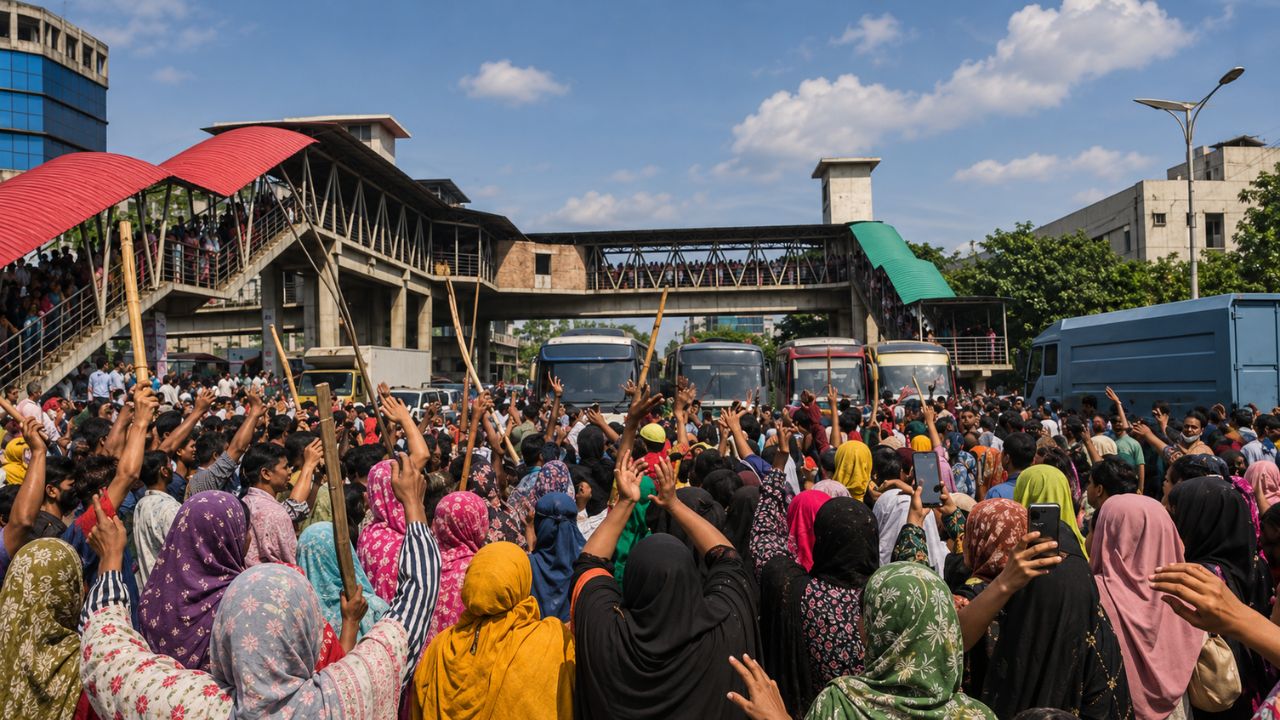
Garment workers across Bangladesh have staged protests demanding that the monthly minimum wage rise from Tk 12,500 to Tk 30,000. The demonstrations disrupted production in major garment hubs, led to temporary factory closures, and prompted the government to form a new Minimum Wage Board.
As of November 6, the board had agreed that a revised wage structure would take effect in December, with the first revised salary expected in January 2027. However, it had not decided the most important figure: the new minimum wage. Workers, employers, and neutral representatives are expected to submit written proposals at the board’s second meeting on November 9.
The Bangladesh garment workers’ wage protest is therefore about more than a 140% wage demand. It reflects the widening distance between workers’ earnings and the cost of rent, food, transport, medicine, and education.
A garment worker’s monthly budget does not wait for wage-board negotiations to finish. When essential expenses rise faster than income, families borrow, reduce food spending, postpone healthcare, or depend on overtime to cover basic needs.
The dispute matters far beyond the industrial areas where demonstrations have taken place. The garment sector has been central to Bangladesh’s economic transformation over the past five decades and remains the country’s largest source of export earnings.
Part 1 examines what triggered the protests, what workers are demanding, and how the government and factory owners have responded. Part 2 will examine the harder economic question: who can afford to pay for a substantial wage increase?
Why the Bangladesh Garment Workers’ Wage Protest Began
Demonstrations spread across major garment-producing areas, including Dhaka, Gazipur, Savar, Ashulia, and Narayanganj. Workers blocked roads, factories suspended operations, and clashes broke out in several locations.
Police used tear gas and sound grenades, while reports also described attacks, vandalism, and damage to factories and vehicles.
By November 5, production had resumed in much of Gazipur, Narayanganj, Mirpur, and Savar. Ashulia remained the main center of tension, with workers continuing to demand a definite wage announcement.
Reports gave different factory-closure figures because they covered different jurisdictions and reporting times. Some counted factories that formally declared holidays, while others included units where workers left after reporting for duty.
The broader picture was more consistent: most factories had reopened, but the wage dispute was not settled.
The unrest also carried a serious human cost. A garment worker died after being attacked while recording violence in Gazipur. Reports differed on some details, and the circumstances remained under investigation.
Violence against workers, police, bystanders, or factories requires accountability. It should not be used to erase the economic grievances behind the protests.
The dispute also raises questions about the wider state of labor laws and enforcement. A legal wage floor has limited value when workers do not trust the process used to revise it or the system meant to enforce it.
What Garment Workers Are Demanding
The central demand is a Tk 30,000 monthly minimum wage. Workers and labor representatives have also raised concerns about unpaid salaries, dismissals, blacklisting, and working conditions.
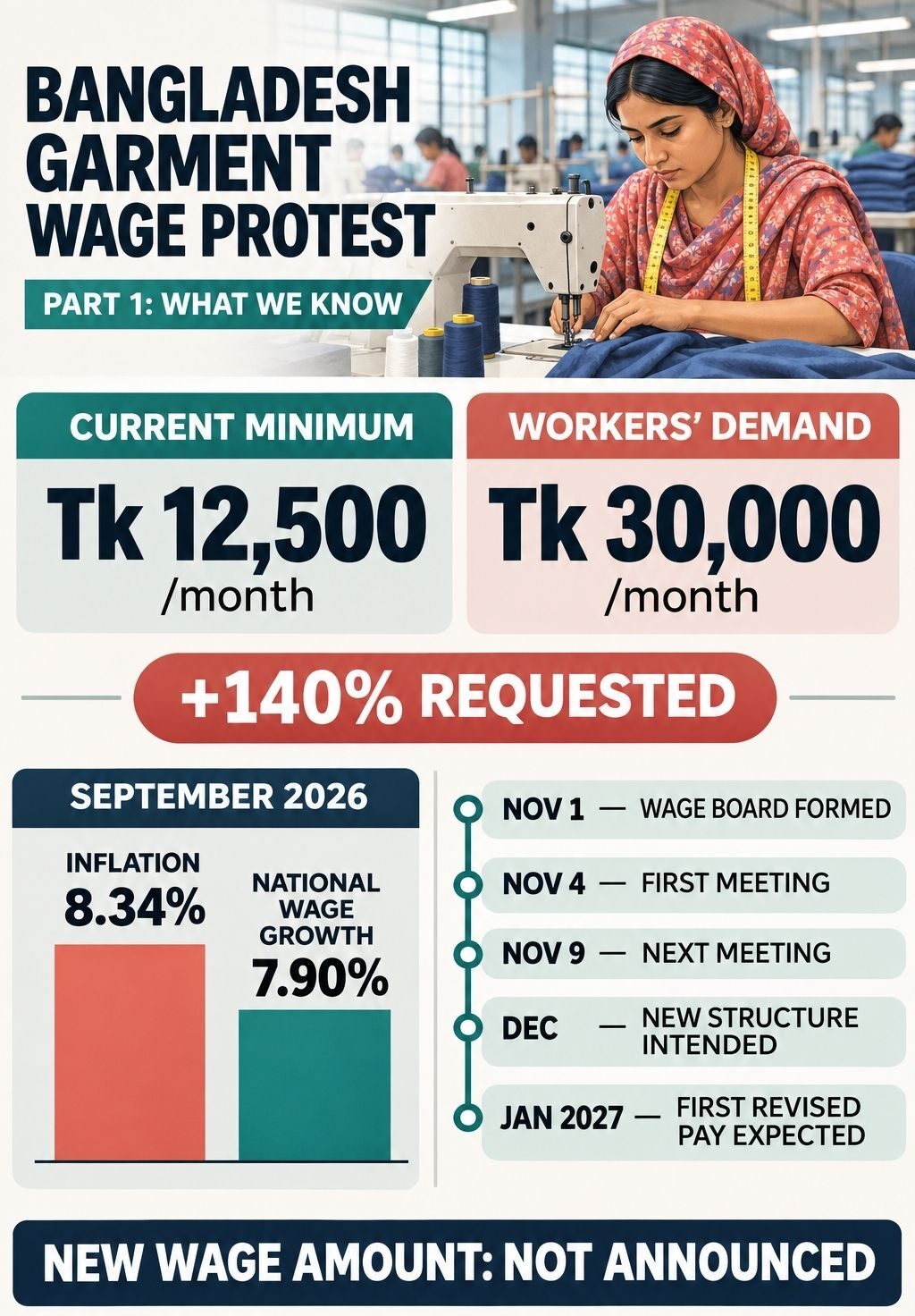
These additional demands vary among factories, worker groups, and labor organizations. The requested wage increase is substantial. Moving from Tk 12,500 to Tk 30,000 would be an increase of Tk 17,500, or 140%.
That percentage needs to be considered alongside the low starting wage and the rise in household expenses, rather than viewed in isolation.
| The Wage Question | Position as of November 6, 2026 |
|---|---|
| Existing minimum wage | Tk 12,500 per month, set in 2023 |
| Workers’ demand | Tk 30,000 per month |
| Difference | Tk 17,500 per month |
| Percentage increase requested | 140% |
| Government response | Six-member Minimum Wage Board formed |
| New wage amount | Not yet announced |
| Intended timing | New structure from December; first revised salary expected in January |
The demand is part of Bangladesh’s wider workers’ rights debate. A minimum wage establishes what an employer must legally pay. It does not automatically show whether a worker can afford housing, food, healthcare, transport, and education on that amount.
Worker Accounts Show the Pressure Behind the Number
For many workers, the demand begins with a simple calculation: what remains after paying for a place to live, food, transport, and children’s needs?
A female garment worker in Gazipur told bdnews24.com that she sometimes had to borrow money to support her family, even when she worked overtime. “That is why our wages need to rise,” she said.
The outlet identified her as Lucky and reported that she earned Tk 21,900 a month, including overtime. Another worker, Md Shakil Ahmed, told the same outlet that higher prices had made it harder to support his family. “If our salary is Tk 30,000, we will be able to meet our basic needs,” he said.
These are previously published accounts, not interviews conducted for this analysis. They do not represent every worker’s salary or household expenses. They do show why workers connect the wage demand to daily survival rather than treating it as an abstract labor negotiation.
Overtime is also an important part of the discussion. A worker’s total monthly income may be higher than the legal minimum because of overtime, attendance bonuses, or other payments.
But when overtime becomes necessary to cover basic needs, the official wage floor does not tell the whole story.
Why Inflation Matters to the Wage Protest
Bangladesh’s point-to-point inflation stood at 8.34% in September 2026, according to Bangladesh Bureau of Statistics figures. Food inflation was 7.22%, while non-food inflation reached 9.30%.
Those figures do not mean every household’s expenses increased by exactly the same amount. Low-income families can feel a different level of pressure because necessities take up most of their earnings.
A rent increase, a higher transport fare, or the price of medicine can force an immediate cut elsewhere in the household budget.
National wage growth was 7.90% year over year in September, below headline inflation. The wage index covers occupations across agriculture, industry, and services, so it is not a garment-worker-specific measure.
It does, however, show the wider problem: prices were rising faster than wages across much of the economy. The Tk 12,500 garment minimum was introduced in 2023. Its structure included Tk 6,700 in basic pay, Tk 3,350 for housing, Tk 750 for medical expenses, Tk 450 for transport, and Tk 1,250 for food.
The annual increment was later increased from 5% to 9%, effective from December 2024. That increment helps workers who remain employed long enough to receive it. A newly hired worker can still enter at the Tk 12,500 floor. This distinction helps explain why workers continue to focus on the minimum itself.
What the Wage Board Has Decided So Far
The government formed a six-member Minimum Wage Board on November 1. It includes representatives of workers and employers, a neutral member, and a chair.
At its first meeting on November 4, the board agreed that the revised wage structure should take effect from December, with workers receiving their revised December salary in January 2027.
However, the amount of the new minimum wage was not decided. According to Reuters reporting on the board’s first meeting, further meetings would be needed to determine the new structure.
The second meeting is scheduled for November 9. Worker, employer, and neutral representatives are expected to submit written wage proposals for discussion.
The distinction between a timetable and a decision matters. Workers have been told when the new structure is intended to begin, but they still do not know the amount, how it will be divided between basic pay and allowances, or how it will apply across job grades.
A credible decision should answer several practical questions:
- What household-cost evidence did the board use?
- How will the new wage apply across different worker grades?
- How will overtime and annual increments be calculated?
- What happens if a factory delays or refuses payment?
- How can workers report violations without risking retaliation?
Without clear answers, even a higher headline figure could produce new disputes during implementation.
What the Government Has Said
The government says it recognizes workers’ concerns and created the wage board to reach a revised minimum through discussions involving workers and employers.
On November 3, Home Minister Salahuddin Ahmed said the board should consider living costs and recommend a wage that could improve workers’ standard of living. He also warned against attempts to use the unrest to damage industrial activity.
Labor and Employment Minister Ariful Haque Choudhury urged workers to return to their workplaces while the wage-setting process continued.
From the workers’ perspective, however, the central question remained unanswered: what amount would the board recommend?
Calls for workers to return to factories may help restore production, but they cannot substitute for a clear wage decision. The process will gain credibility only if workers can see how their living costs were considered and how the final figure was reached.
What Garment Owners’ Associations Have Said
Leaders of the Bangladesh Garment Manufacturers and Exporters Association and the Bangladesh Knitwear Manufacturers and Exporters Association said the board had started its work quickly. They urged workers to return to factories and allow the review to continue.
BGMEA President Mahmud Hasan Khan and BKMEA President Mohammad Hatem said owners would implement the revised structure within the wage board’s deadline. They also warned that continued disruption could affect workers, factories, export orders, and the wider economy.
BKMEA proposed action against arbitrary rent increases in industrial areas, along with rationing facilities or family cards, affordable healthcare, and worker housing.
These were proposals from the association, not confirmed programs already available to workers. The proposals recognize an important point: wages are only one part of a worker’s living costs. Yet housing or food support should complement an adequate wage, not become a reason to hold the wage floor below what workers need.
What Remains Unclear
Several important facts were still unsettled as of November 6:
- The wage board had not announced a proposed minimum amount.
- The distribution between basic pay and allowances remained unknown.
- It was unclear how quickly every factory could implement the final structure.
- Workers had not received detailed assurances about dismissals, blacklisting, or unresolved salary complaints.
- Investigations into violence and the death of a garment worker were continuing.
These uncertainties explain why reopening factories did not end the argument. Production can resume before trust returns.
The wage process will need more than an announcement. Workers must be able to understand the final structure, verify their pay, and challenge violations. Employers also need a clear implementation timeline that applies consistently across the sector.
The Next Question Is Who Pays
Part 1 establishes why the Bangladesh garment workers’ wage protest emerged and why Tk 12,500 no longer carries the value it had when the wage was set.
Workers want a wage that reflects household costs. Factory owners warn that disruption threatens orders and employment. The government is asking both sides to rely on the wage-board process.
The remaining argument is economic. If wages rise sharply, can factories absorb the increase? Will international buyers pay more for each order? Could higher wages weaken Bangladesh’s price advantage, or would a more stable workforce strengthen the industry over time?
Those questions connect the current protests to the longer struggle for safety and fair pay among garment workers across South Asia. They also lead directly to Part 2, which examines factory margins, buyer pricing, international competition, and how the cost of a fairer wage could be shared.