
A recent study conducted by Microsoft researchers suggests that generative AI tools, such as Bing Copilot and large language models (LLMs), are more likely to replace white-collar and desk-based jobs than manual labor roles. The findings indicate that professions built around information delivery, advisory support, writing, and teaching are at significantly higher risk of being automated, thanks to the capabilities of AI systems that can simulate language and decision-making tasks.
This research, though not yet peer-reviewed, was based on the analysis of 200,000 anonymized user interactions with Microsoft Bing Copilot. The researchers developed an “AI applicability score” to measure how relevant and adaptable AI is to different occupations. The score considers how frequently AI is already being used in a role and how effectively it performs those tasks.
High-Risk Jobs: Writers, Translators, Historians, and Customer Support Roles
Occupations that require writing, answering queries, translating languages, and delivering knowledge-based assistance were found to be most vulnerable. These include:
-
Translators and interpreters, whose work involves converting content between languages, something LLMs like GPT-4 can do in seconds with reasonable accuracy.
-
Writers and authors, especially those focused on general content, blogging, or commercial copy, where AI tools are increasingly being used to generate bulk text.
-
Historians and political scientists, surprisingly, were also flagged due to the high textual demands of their work—even though these fields often depend on deep domain knowledge and interpretive skill.
-
Sales representatives and customer service agents, whose workflows often rely on scripted dialogue, which AI can now replicate or even improve in certain scenarios.
Jobs that are largely language-driven or dependent on the structured transfer of information are currently the easiest for generative AI to mimic. This is largely because LLMs are trained on massive corpora of text and can respond to prompts with speed, context, and growing levels of fluency.
In sectors like customer support, AI chatbots are already being deployed to handle common inquiries, complaints, and service requests. These systems are improving so rapidly that many businesses are actively reducing headcount or restructuring teams around AI efficiencies.
Low-Risk Jobs: Manual Labor, Physical Tasks, and Human-Driven Work
On the other end of the spectrum, roles involving physical movement, direct human interaction, or manual effort were considered the least likely to be affected by generative AI. These include:
-
Heavy machinery operators and motorboat drivers, where physical interaction with machines is essential.
-
Housekeepers and dishwashers, who perform tasks that require physical effort and dexterity in dynamic environments.
-
Massage therapists and roofers, whose work requires physical proximity, tactile skill, and a high level of adaptability.
These occupations are insulated from AI disruption largely because current AI technologies—and even advanced robotics—still struggle to function effectively in unpredictable, real-world environments. The work performed by individuals in these roles often requires fine motor skills, real-time judgment, and emotional intelligence, all of which are challenging to replicate with code and hardware.
This reinforces broader research from institutions like MIT, McKinsey Global Institute, and OECD, all of which predict that AI is likely to augment rather than replace most physical jobs—at least in the short to medium term.
AI Still Has Major Limitations in Replacing Full Occupations
While the study’s applicability score offers useful insight, the researchers were clear about the limitations of their findings. Their data does not suggest that AI can perform 100% of the responsibilities associated with any one job. Rather, it shows how AI is already being used for specific tasks within broader roles.
For example, a translator might find that AI tools like DeepL or ChatGPT can draft initial versions of a document, but still require human oversight for tone, accuracy, and cultural nuance. A writer might rely on AI to create headlines or outlines, but still take charge of shaping the narrative or embedding strategic goals into the piece.
Furthermore, different professionals use LLMs in different ways, and the study’s dataset does not fully capture the complexity and diversity of how each occupation operates. In practice, many professionals combine creative, interpersonal, and critical thinking tasks—areas where AI still lags behind human cognition.
Accuracy Concerns: AI Hallucinations Still Undermine Trust
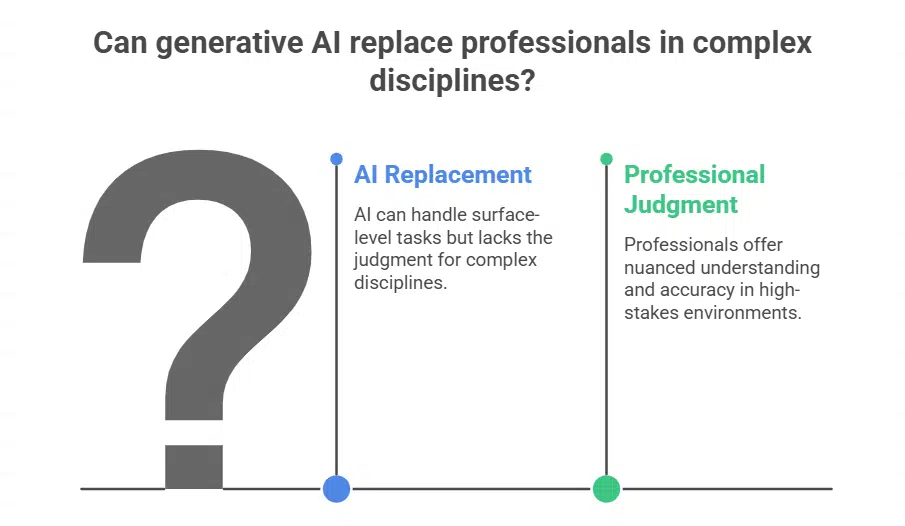
Another critical challenge with generative AI is its tendency to “hallucinate”, or generate false or misleading information. Despite advances in AI model accuracy, no generative model can currently guarantee factually correct outputs, especially when dealing with nuanced, emerging, or contradictory subjects.
This limitation casts doubt on the technology’s readiness to replace professionals in historical analysis, journalism, legal writing, and scientific research, where even minor inaccuracies can have major consequences. These errors not only compromise the quality of AI-generated work but also limit its reliability in high-stakes environments.
Therefore, while AI might be capable of completing surface-level tasks, it is far from being able to replace full-spectrum professional judgment, especially in complex disciplines.
Economic Bias and Overestimation of AI’s Capabilities
It’s also important to acknowledge Microsoft’s financial stake in the AI industry, including its multibillion-dollar partnership with OpenAI. The company has strong economic incentives to portray AI as powerful, transformative, and already widely applicable. This could lead to optimism bias in how the study frames AI’s potential.
The researchers themselves acknowledge this, warning that AI’s applicability does not equate to guaranteed replacement. Just because AI can assist with a task does not mean it will eliminate human workers in that field. Historical examples like automated teller machines (ATMs) support this point. ATMs reduced some bank teller tasks, but they also lowered operating costs, leading banks to open more branches and hire more tellers focused on customer relations.
Tech Executives Are Still Pushing for Automation
While Microsoft’s research tries to maintain a balanced view, others in the tech industry have been more direct. Sam Altman, CEO of OpenAI, recently said that entire job categories may be eliminated by AI, particularly in areas like customer support, which are built around repetitive scripts and FAQs.
Similarly, Elijah Clark, a CEO and AI consultant, shared that he has already laid off employees due to AI automation. He also noted that many CEOs are eager to implement AI across operations to cut costs and boost productivity—a trend that could accelerate job displacement in the near future.
These real-world decisions demonstrate that while AI may not replace an entire profession overnight, company-level adoption of the technology is already reshaping employment in major ways.
Transformation, Not Just Replacement
Microsoft’s study concludes by emphasizing the need to rethink how we define job roles in the AI era. As generative AI becomes more integrated into daily workflows, there is a pressing need to understand which tasks will be automated, which will be augmented, and which will remain exclusively human.
The researchers stress that this report offers only a snapshot of a rapidly evolving landscape. As generative AI tools advance, new job roles will emerge, old ones will be redefined, and education systems and policy frameworks will need to adapt accordingly.
The ultimate takeaway is that while AI is a powerful tool, its impact on jobs will vary widely, depending on industry, adoption rates, regulation, and public trust. A measured, evidence-based approach is essential to navigating this transition.