

Australia’s agricultural sector is the backbone of the nation’s economy, providing food security and contributing significantly to exports. However, this vital sector is under constant pressure from unpredictable weather patterns, soil degradation, and the increasing frequency of pest outbreaks. These challenges not only reduce crop yields but also threaten the long-term sustainability of farming practices. In response to these challenges, biodiversity in Australian agriculture emerges as a powerful solution.
Biodiversity involves integrating a wide range of plant, animal, insect, and microbial species into farming systems to create balanced ecosystems that are productive and resilient. It’s about moving away from monoculture and embracing practices like crop rotation, agroforestry, and native plant integration. These methods improve soil health, reduce pest dependency, and enhance climate resilience.
By harnessing biodiversity in Australian agriculture, farmers can adapt to evolving environmental challenges while ensuring sustainable growth and food security for future generations. This article explores how biodiversity can transform Australian agriculture, addressing both the challenges and opportunities it presents.
Biodiversity in Australian Agriculture: The Key to Sustainable Farming
What Is Biodiversity in Agriculture?
Biodiversity in agriculture refers to the variety of life forms in farming systems, including plants, animals, insects, and microorganisms. It encompasses practices like crop rotation, agroforestry, and the integration of native plant species to create diverse ecosystems that benefit farming.
Key Examples of Agricultural Biodiversity:
| Biodiversity Practice | Description | Benefits |
| Crop Rotation | Alternating crops in a sequence | Improves soil health, reduces pests |
| Polyculture | Growing multiple crops together | Diversifies income, reduces risk |
| Agroforestry | Combining trees with crops or livestock | Enhances soil fertility, conserves water |
| Native Plants Integration | Including local plant species in farms | Supports native pollinators, reduces erosion |
By incorporating biodiversity into farming, Australian farmers can enhance productivity while maintaining environmental balance.
Challenges in Australian Agriculture
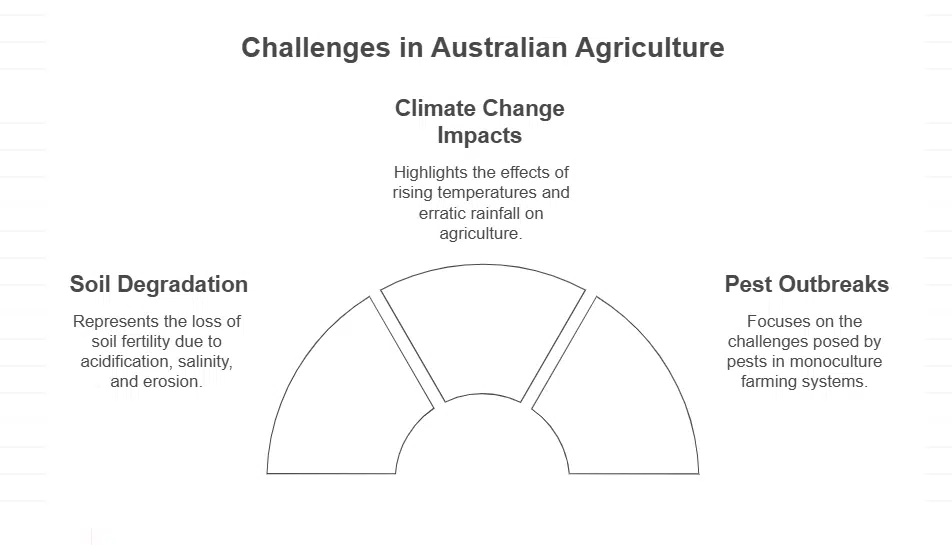
Australian agriculture is uniquely affected by environmental and economic pressures, making biodiversity essential for sustainable growth. Here are some of the key challenges:
- Soil Degradation:
- Approximately 58% of Australia’s agricultural land suffers from soil acidification, salinity, or erosion.
- These issues lead to reduced soil fertility and lower crop yields.
- Climate Change Impacts:
- Rising temperatures and unpredictable rainfall patterns increase the frequency of droughts and floods.
- Crops struggle to adapt to extreme weather events.
- Pest Outbreaks:
- Monoculture farming often results in the proliferation of pests, leading to higher pesticide use.
- Over-reliance on chemicals damages ecosystems and raises farming costs.
Challenges Overview:
| Challenge | Impact on Farming | Possible Solution Through Biodiversity |
| Soil degradation | Lower yields, reduced fertility | Diverse crop systems, cover crops |
| Climate change | Crop failures, water scarcity | Climate-resilient biodiversity |
| Pest outbreaks | Higher costs, environmental damage | Natural pest control via biodiversity |
Biodiversity offers a path to address these challenges effectively.
Benefits of Biodiversity in Australian Agriculture
1. Improved Soil Health
Diverse plant species contribute to soil health by:
- Fixing nitrogen through legumes.
- Preventing soil erosion with deep-rooted plants.
- Increasing organic matter, which enhances water retention.
Example: Farms in Queensland have reported a 20% increase in soil fertility after introducing diverse cover crops.
Impact of Biodiversity on Soil Health
| Biodiversity Practice | Soil Health Benefits |
| Cover Crops | Reduces erosion, boosts organic matter |
| Legume Rotation | Fixes nitrogen, reduces fertilizer need |
| Perennial Grasses | Improves soil structure |
2. Pest and Disease Management
Biodiversity reduces reliance on chemical pesticides by:
- Encouraging natural predators like ladybugs and birds.
- Diversifying crops to break pest life cycles.
Example: Farmers in Victoria saw a 30% reduction in pest damage by incorporating hedgerows and wildflower strips.
Natural Pest Control Methods
| Method | Benefit |
| Hedgerows | Habitat for pest predators |
| Companion Planting | Distracts pests, improves crop health |
| Pollinator Habitats | Supports pollination, reduces pests |
3. Climate Resilience
Biodiversity enhances resilience to extreme weather by:
- Providing a buffer against droughts through diversified root systems.
- Supporting crops with varying tolerance levels to heat and cold.
Example: Mixed cropping systems in New South Wales reduced drought losses by 15% compared to monoculture farms.
Biodiversity for Climate Resilience
| Practice | Climate Benefit |
| Mixed Cropping | Reduces drought impact |
| Agroforestry | Provides shade, conserves water |
| Native Grasslands | Adapts to local climate |
4. Increased Crop Yields
Implementing biodiversity practices has consistently shown higher yields due to:
- Improved pollination.
- Healthier soil and reduced pest damage.
Example: A study in Western Australia demonstrated a 25% increase in wheat yields when crop rotation and cover crops were used.
Biodiversity and Crop Yields
| Biodiversity Strategy | Yield Increase |
| Crop Rotation | 10-20% |
| Native Plant Integration | 15-25% |
| Polyculture | 20-30% |
Success Stories in Biodiversity in Australian Agriculture

Several Australian farmers and initiatives have successfully integrated biodiversity into their practices:
- Case Study: Agroforestry in Victoria
- Farmers planted eucalyptus trees alongside crops.
- Results: Improved soil quality and reduced wind erosion.
- Case Study: Native Grasses in Western Australia
- Incorporating native grasses in grazing systems increased pasture productivity.
Table: Australian Biodiversity Success Stories
| Location | Practice | Results |
| Victoria | Agroforestry | Reduced erosion, healthier crops |
| Western Australia | Native grasses | Higher pasture productivity |
| Queensland | Cover cropping | Improved soil organic matter |
Steps to Implement Biodiversity in Farms
Farmers can adopt biodiversity with these actionable steps:
- Plant Diversification:
- Rotate crops to maintain soil nutrients.
- Include legumes for natural nitrogen fixation.
- Enhance Pollinator Habitats:
- Plant wildflowers and native shrubs.
- Avoid excessive pesticide use.
- Adopt Agroforestry:
- Combine trees with crop or livestock farming.
- Use native species for better adaptation.
Steps for Biodiversity Implementation
| Step | Description |
| Crop Rotation | Alternates crops to boost soil health |
| Pollinator Habitats | Supports biodiversity, improves yields |
| Agroforestry | Adds shade and soil protection |
Policy Support and Funding Opportunities
The Australian government and organizations offer various programs to promote biodiversity:
- Landcare Program:
- Provides resources for sustainable farming projects.
- Carbon Farming Initiative:
- Rewards farmers for practices that reduce emissions and increase biodiversity.
Funding Opportunities for Biodiversity
| Program | Support Offered |
| Landcare Australia | Grants for biodiversity projects |
| Carbon Farming Initiative | Payments for emission reductions |
| National Soil Strategy | Funds for soil health improvements |
Challenges and Limitations of Biodiversity Practices

While beneficial, biodiversity practices come with challenges:
- Initial Costs: Setting up diverse ecosystems can be expensive.
- Knowledge Gaps: Farmers may lack awareness of biodiversity techniques.
- Market Pressures: Demand for high-yield crops can discourage biodiversity.
Challenges in Implementing Biodiversity
| Challenge | Solution |
| High costs | Access government grants |
| Knowledge gaps | Provide farmer education programs |
| Market pressures | Promote consumer awareness |
Future of Biodiversity in Australian Agriculture
The future of biodiversity in farming looks promising, with advancements in:
- Technology: Precision agriculture tools to monitor biodiversity impacts.
- Research: Studies on native species’ benefits for Australian crops.
- Policy Support: Strengthened government initiatives for sustainable farming.
Trends in Biodiversity Farming
| Trend | Description |
| Precision Agriculture | Tracks soil and crop health |
| Native Plant Research | Identifies optimal species for farms |
| Policy Enhancements | Expands funding and support |
Takeaway
The future of Australian agriculture lies in embracing diversity—not just in markets or policies, but in farming practices. Biodiversity in Australian agriculture offers a sustainable path forward, addressing key challenges such as soil degradation, pest outbreaks, and climate change impacts. By enhancing soil health, reducing reliance on chemical inputs, and increasing resilience to extreme weather, biodiversity provides tangible benefits for farmers and the environment alike.
Moreover, the adoption of biodiversity is not just an ecological solution but an economic one. Case studies across Australia demonstrate that biodiversity-driven farms often see higher yields, reduced input costs, and healthier ecosystems. Beyond the farm gate, these practices contribute to food security, environmental conservation, and a more sustainable agricultural sector.
As we look to the future, adopting biodiversity in Australian agriculture is more than an option—it’s a necessity. Policymakers, farmers, and consumers must collaborate to promote biodiversity through incentives, education, and awareness. By making biodiversity the cornerstone of Australian farming, we can secure a productive and resilient agricultural landscape for generations to come.
























