
Search engine optimization feels tougher than a year ago. Brands publish quality content, yet clicks slide as Google’s AI Overviews answer queries directly. Navigating this disruptive shift requires a strategic approach to AI in SEO to reclaim lost search visibility.
While automated overviews reduce traditional organic click-through rates, the underlying technology simultaneously provides an ultimate toolkit for immediate traffic recovery. Elite platforms—including ChatGPT, Frase, Semrush, MarketMuse, Clearscope, Perplexity, and Gemini—enable digital marketers to analyze user intent with incredible precision. Utilizing these advanced systems makes it much easier to tighten strategic content relevance, sharpen competitive keyword targeting, and uncover hidden technical and structural flaws before they harm live site performance.
Succeeding in this modern ecosystem requires moving far past yesterday’s basic best practices. Long-term search survival depends entirely on deploying automated data insights to build authoritative, deeply comprehensive web resources. By shifting focus to high-value semantic optimization, websites can successfully stabilize organic traffic and continuously thrive alongside future algorithmic changes.
The Role of AI in Modern SEO

AI now shapes both sides of SEO: how search engines understand pages and how teams create, improve, and monitor content. Machine learning and natural language processing help search systems read meaning, relationships, and user intent far better than simple keyword matching ever could.
Transition from traditional SEO to AI-driven strategies
Traditional search engine optimization still matters, and it matters a lot. In a U.S. seoClarity study published in 2025, more than 99% of AI Overviews cited at least one page from the top 10 organic results, which tells you something important: ranking fundamentals still feed AI visibility.
What changed is the workflow. Instead of building a page once and leaving it alone, teams now use ai-powered tools for competitor analysis, content creation, refresh cycles, and predictive analytics that show which pages are starting to decay before traffic drops hard.
- Use ChatGPT to brainstorm angles, objections, and plain-English explanations before you draft.
- Use Frase to review top-ranking pages and pull together a faster brief around user intent and content relevance.
- Use MarketMuse or Clearscope to spot missing subtopics, weak coverage, and thin sections before publishing.
- Use Semrush to compare your online visibility against competitors in both classic search and AI-driven search surfaces.
Classic SEO did not disappear. It became the entry point for AI citations.
AI’s impact on search engine algorithms
Google explains that its ranking systems weigh factors such as the words in the query, page relevance, page usability, expertise of sources, location, and search settings. That means content quality is only part of the picture. Your page also needs to be easy to crawl, easy to use, and easy to trust.
Google Search Central also makes an important distinction about E-E-A-T: it is not a single ranking factor you can toggle on. It is a framework for helpful content, and trust matters most. For your site, that usually means showing real experience, clear authorship, current facts, and a page structure that answers the question fast.
- Add a clear author or reviewer line on pages that make recommendations or explain technical topics.
- Show when a page was updated, especially on topics affected by changing search algorithms or tool features.
- Open with a direct answer near the top of the page so AI systems and readers find the main point quickly.
- Keep technical SEO clean, especially mobile speed, internal linking, canonicals, and indexability.
Key Changes AI Brings to SEO
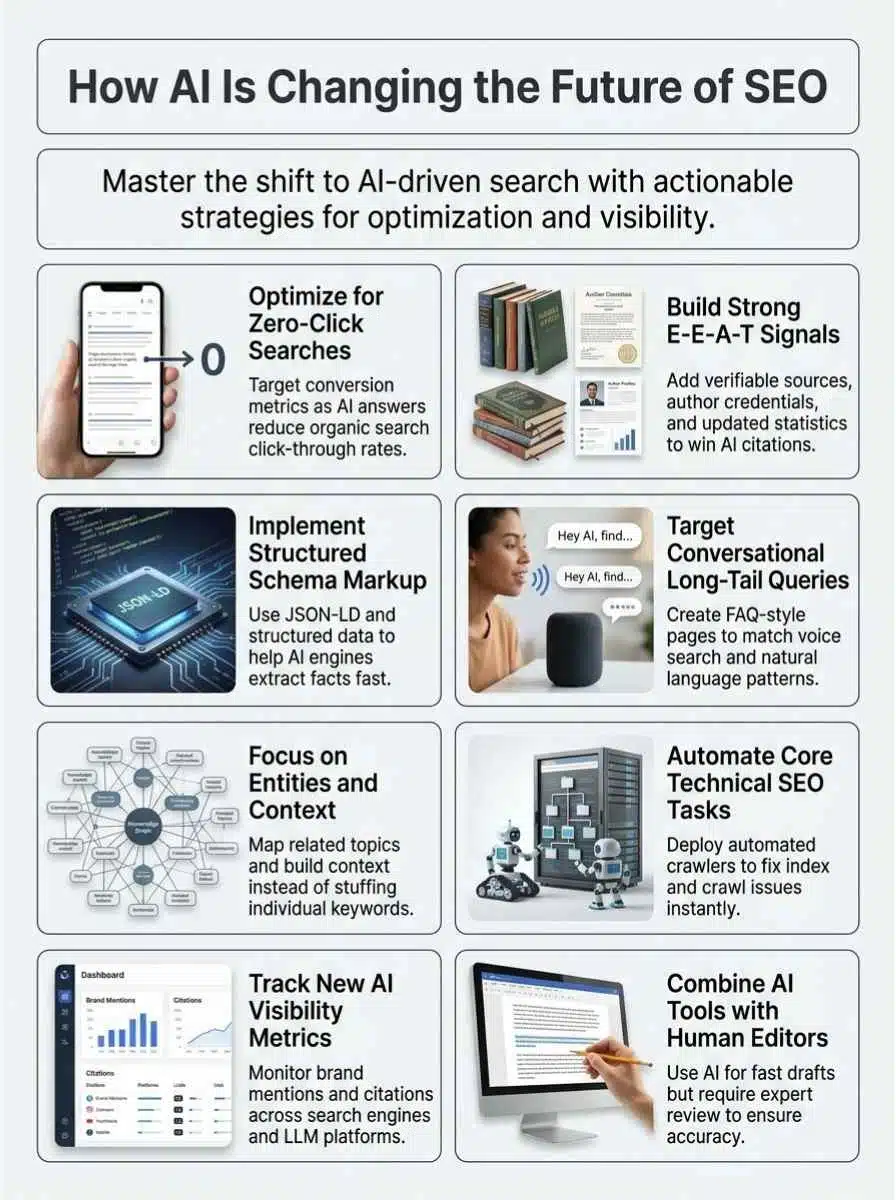
AI is pushing SEO away from raw keyword repetition and toward context, entities, and answer quality. It also changes how success should be measured, because impressions and brand mentions can rise even while organic traffic falls.
Rise of zero-click searches
One of the clearest shifts is the rise of zero-click behavior. Pew Research Center found that in March 2025, U.S. Google users clicked a traditional result 8% of the time when an AI summary appeared, compared with 15% when no AI summary appeared.
That does not mean your content has no value. It means you need to separate visibility from visits. A page that earns an AI Overview citation can still shape the buying decision, support branded search, and drive better clicks from readers who want more than a summary.
| Old SEO view | Better AI-era view |
|---|---|
| Clicks | Clicks plus assisted conversions and lead quality |
| Ranking position | Ranking position plus AI mentions and source visibility |
| Sessions | Engaged sessions, form fills, calls, and sales |
| Impressions as a side note | Impressions as proof that your page still enters the consideration set |
In the AI Overviews era, being seen and being clicked are no longer the same win.
Focus on entity and context over keywords
AI systems read topics in context. They look for the people, products, features, places, and ideas connected to a subject. That is why a page about content optimization performs better when it covers related entities like search intent, internal links, schema markup, author expertise, and content freshness instead of repeating one exact phrase.
This is also where tools become useful in a very practical way. Clearscope grades content by comparing it with the top-ranking pages on the results page, while MarketMuse lets you compare your page against leading competitors and identify missing subtopics. If your article misses the obvious supporting concepts, these tools expose the gap fast.
- Build a hub page around a core topic, then link to focused supporting pages.
- Name the tools, people, products, and features readers expect to see on that topic.
- Use examples, case details, and current numbers so the page shows real expertise.
- Update outdated statistics, because freshness matters more on fast-moving topics.
Conversational long-tail queries and voice search
Voice search and long-tail keywords matter more because search behavior sounds more like a real conversation now. Google says AI Mode can break a question into subtopics and search for them at the same time, which means your page needs to answer follow-up questions, not just the main keyword.
There is another practical reason to write this way. Google began upgrading mobile Google Assistant users to Gemini in 2025, and Gemini started rolling into more voice-based surfaces after that. People are getting used to asking full questions out loud, and those phrasing patterns show up in typed search too.
- Turn major subheads into natural questions a reader would actually ask.
- Answer each question in the first sentence, then add detail below it.
- Use long-tail keywords that sound spoken, such as comparisons, costs, timelines, and best-for use cases.
- Test your copy aloud on a phone or smart speaker. If it sounds stiff, rewrite it.
AI-Powered SEO Tools and Services
AI tools save time, but the best ones do more than generate text. They help with content strategy, technical SEO, competitor analysis, and tracking how your brand appears in AI-driven answers.
Content creation tools like ChatGPT and Frase
Generative tools are strongest when you use them for planning and first drafts, then apply human editing for accuracy, tone, and judgment. Ahrefs reported in its 2025 marketer research that AI was used most often for brainstorming, outlining, and improving existing content, which matches what works best in practice.
Each platform has a different strength, so it helps to match the tool to the job instead of expecting one app to do everything.
| Tool | Best use | Why it helps |
|---|---|---|
| ChatGPT | Ideation and draft support | Fast for outlines, examples, FAQs, and rewriting weak sections in plain English |
| Frase | Briefs and SERP research | Its SERP research is designed to analyze roughly 15 to 20 useful sources and surface question patterns quickly |
| MarketMuse | Content strategy and optimization | It measures topical depth and shows what competitors cover that your page misses |
| Clearscope | On-page refinement | It grades content against top-ranking pages so writers can improve coverage before publishing |
| Semrush | Competitor analysis and AI visibility | It combines search data with newer visibility reports for generative search platforms |
Technical SEO automation tools
Technical SEO automation pays off when it protects the pages that already earn impressions. Search Console still matters here because it shows clicks, impressions, queries, and page-level performance, while a crawler helps you catch index problems, redirect chains, broken links, and missing metadata.
Some tools now close the loop instead of just pointing at the problem. Frase’s Content Guard, for example, can monitor articles for decay, apply approved fixes, and send updated drafts back to common CMS platforms like WordPress and Webflow. Siteimprove also launched an SEO Intelligence Suite in 2025 that ties SEO, keyword intelligence, and AI-driven content planning together with MarketMuse.
- Run weekly crawls on your most valuable sections, not just the whole site once a quarter.
- Prioritize pages with high impressions and weak CTR, because small improvements there can lift traffic quickly.
- Automate low-risk fixes such as title tag updates, broken internal links, and metadata checks.
- Keep human review for claims, pricing, compliance language, and brand voice.
Tracking AI visibility metrics
Ranking reports alone no longer tell the full story. You also need to know whether ChatGPT, Gemini, Perplexity, and Google surfaces mention your brand, cite your page, or ignore you completely.
That is why new measurement layers matter. Semrush launched its AI Visibility Toolkit in 2025, seoClarity added AI Overviews and AI Mode tracking, and Frase now offers AI search tracking across multiple platforms. The useful metrics are simple: mentions, citations, prompt coverage, share of voice, and whether those mentions support the action you want a reader to take.
| Metric | What it tells you |
|---|---|
| Mentions | How often your brand appears in AI-generated answers |
| Citations | Whether the AI system links or attributes an answer to your pages |
| Prompt coverage | Which questions trigger your brand versus a competitor |
| Assisted conversions | Whether AI visibility supports leads or sales later in the journey |
How AI Enhances User Experience in SEO
Good SEO has always been tied to user experience. AI just makes that connection more obvious. If your page is easier to understand, easier to trust, and easier to act on, it stands a better chance of ranking, getting cited, and converting.
Personalization of search results
Google states that it can use location, language, device type, and sometimes past activity to make results more relevant. Even with personalization reduced, those context signals still shape what a user sees, especially for local seo, mobile queries, and time-sensitive searches.
That gives you a clear action plan. If you serve a specific place, say so plainly. If you ship only in the U.S., make that obvious. If your service is mobile-first, write and design for phone users before desktop users. Context helps both the reader and the search engine.
- Add city, state, service area, and availability details on local pages.
- Put pricing, booking steps, delivery windows, or response times near the top when they affect the decision.
- Use clear headings so readers on mobile can scan fast.
- Match calls to action to the likely device, such as tap-to-call for urgent services and short forms for mobile leads.
Faster, more accurate content recommendations
AI can help you decide what to update next, which is often more valuable than writing something brand new. Platforms like Siteimprove and MarketMuse are built to surface weak pages, missed topic opportunities, and content gaps with stronger commercial intent.
A good refresh queue usually beats a random publishing spree. Start with pages that already have impressions, then improve the answer, the structure, and the conversion path. That is usually where AI-supported content strategy creates the fastest return.
- Pull pages with solid impressions but poor CTR from Search Console.
- Check whether the intro answers the main question in plain language.
- Add missing comparison points, examples, or common objections.
- Refresh statistics, screenshots, and product details so the page feels current.
- Strengthen internal links to related pages that deepen the topic.
Adapting to AI-Driven SEO Trends
The sites that adapt best are not the ones publishing the most. They are the ones that make their pages easier for machines to interpret and easier for people to trust.
Importance of structured data and schema markup
Structured data helps search systems understand what a page is about, which pieces of information matter most, and how different elements relate to each other. For business sites, the most useful types are usually Article, Product, Review, Breadcrumb, Organization, and Local Business markup in JSON-LD format.
There is one detail many businesses miss: Google Search Central says FAQ rich results are now limited mainly to well-known government and health sites. So if you run a regular business website, FAQ schema can still help organize content internally, but you should not expect it to unlock a rich result by itself.
- Use JSON-LD because it is easy to maintain and audit.
- Match every structured field to visible on-page content.
- Prioritize Product, Article, Breadcrumb, Organization, and Local Business markup before adding extras.
- Validate your pages with the Rich Results Test before publishing.
- Monitor Search Console for markup errors after deployment.
Trust is the strongest part of E-E-A-T, and that matters even more in AI search. A page is easier to cite when it clearly shows who created it, why the information is reliable, and what firsthand experience or original evidence supports the advice.
You do not need to sound academic. You do need to sound real. Add expert reviewers where appropriate, show update dates, use original screenshots or case examples, and keep claims specific. Google has also said that AI-generated content is not disqualified just because AI helped produce it. What matters is whether the final page is helpful, reliable, and people-first.
- Add author bios or reviewer lines on pages that guide decisions.
- Use original examples, test results, customer questions, or internal data when you can.
- Link related articles into topic clusters so your expertise is easier to see site-wide.
- Replace vague claims like “best” or “powerful” with a clear reason, feature, or number.
- Review older pages on a schedule so facts, screenshots, and dates do not drift out of date.
AI citations usually go to the page that is easiest to verify, not the page that shouts the loudest.
Future Trends in AI and SEO

Search is moving toward direct answers, follow-up questions, and multimodal results that blend text, images, voice, and live context. That does not kill SEO. It changes where SEO creates value.
The growing influence of generative search engines
What Google once tested as Search Generative Experience has turned into a broader AI search experience that now includes AI Overviews and AI Mode. In the latest update from Google in May 2026, AI Mode had already passed 1 billion monthly users. A year earlier, Google said AI Overviews were already used by more than 1 billion people.
That scale matters because it changes user habits. People now expect a fast summary first, then a deeper path if they need proof, comparison, or action. That is also why search generative experience and answer engine optimization are now part of the same conversation as classic seo.
SEO strategies for staying visible in AI-powered search
The pages most likely to keep winning organic traffic are the ones that give readers something an AI summary cannot fully replace: original data, firsthand experience, strong comparisons, useful tools, or a clear next step.
- Refresh your highest-value pages first, especially pages tied to leads, demos, bookings, or product sales.
- Write short answer blocks under key headings so AI systems can extract the gist without losing your context.
- Build topic clusters around core services, then support them with detailed pages for comparisons, pricing, and common questions.
- Track how your brand appears in ChatGPT, Gemini, Perplexity, and Google search features, then update pages that are close to winning mentions.
- Invest in original material such as surveys, benchmarks, screenshots, calculators, or customer patterns, because this is the kind of content AI cannot easily flatten into generic copy.
- Protect the basics: crawlability, internal linking, structured data, mobile speed, and clear conversion paths still decide how much value visibility turns into.
Final Thoughts
Search engine optimization is still worth doing. It just rewards different habits now. AI favors pages that answer quickly, prove trust, and offer more depth than a summary box can provide. If you focus on content optimization, stronger authority signals, and clean technical SEO, you give your site a much better shot at keeping visibility as AI Overviews and generative search keep expanding.
Pick one page this week, improve the answer, tighten the structure, add the right markup, and measure what happens. Small updates stack up fast.
Frequently Asked Questions (FAQs) About AI in SEO
1. What is the role of AI in seo (search engine optimization)?
AI reads data fast, spots patterns, and points to terms users search for. It helps shape content, technical fixes, and ranking tests.
2. How will AI change content creation for seo (search engine optimization)?
AI drafts ideas, suggests headlines, and finds gaps in topics. It works like a power tool, it speeds the build, but humans still craft the message.
3. Will AI replace SEO jobs?
No, it will take routine tasks, not strategy. I asked a marketer once, “Is the robot taking my job?” She laughed, and said, “Not a chance.”
4. How should businesses start using AI for seo (search engine optimization)?
Start small, pick one task, run a short test, measure results. Keep a human in the loop for facts and tone, and scale what works.