

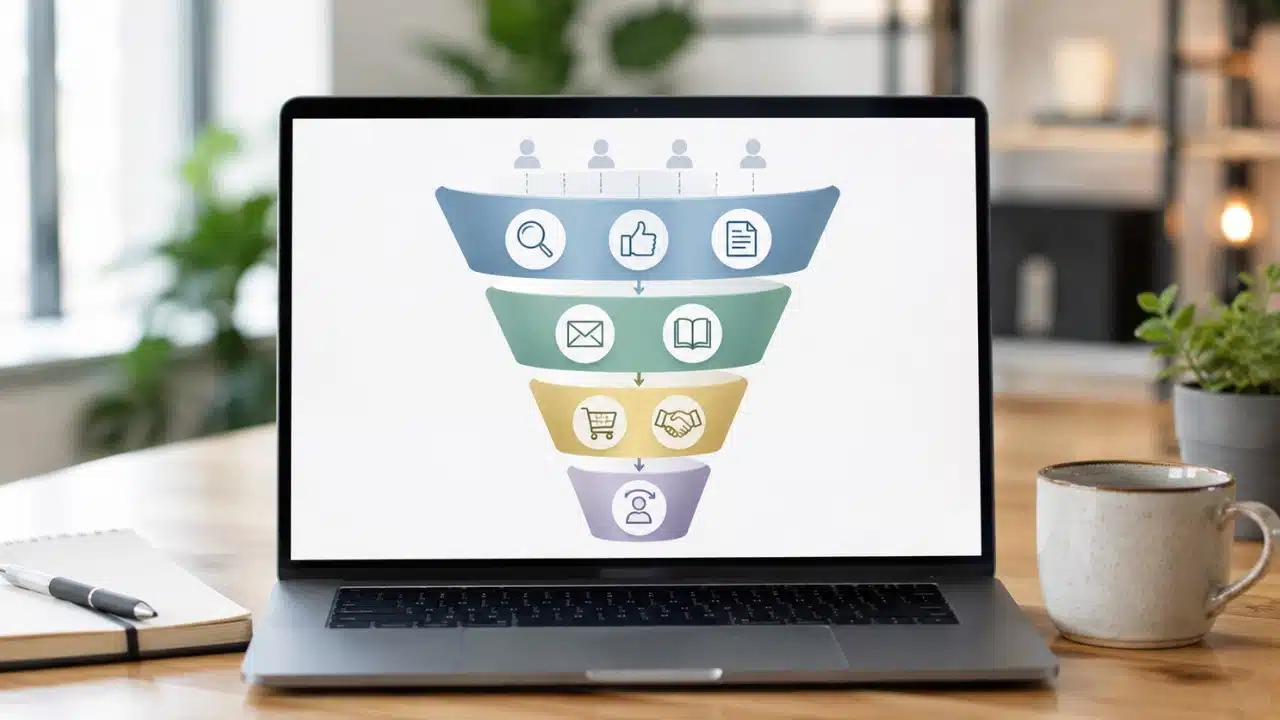
If you have ever published great blog posts that generated traffic but zero revenue, or run ad campaigns that sent cold buyers straight to a checkout page with terrible conversion rates, you already know the pain of an unmapped customer journey.
A marketing funnel is simply the structural path people take from discovering your business for the first time to actually buying what you sell—and sticking around afterward.
People don’t usually land on a website and hand over their credit card on a whim. They experience a problem, look for answers, compare options, hesitate, and finally make a choice. If your content and sales channels don’t match that natural progression, you end up leaking potential customers at every turn. Building a clear funnel connects your blog posts, emails, ads, and landing pages into a single, cohesive engine.
Breaking Down the Stages of the Customer Journey
While different industries use various acronyms like TOFU or MOFU, the underlying progression remains the same whether you sell enterprise software or direct-to-consumer apparel. People move through distinct phases of awareness and decision-making.
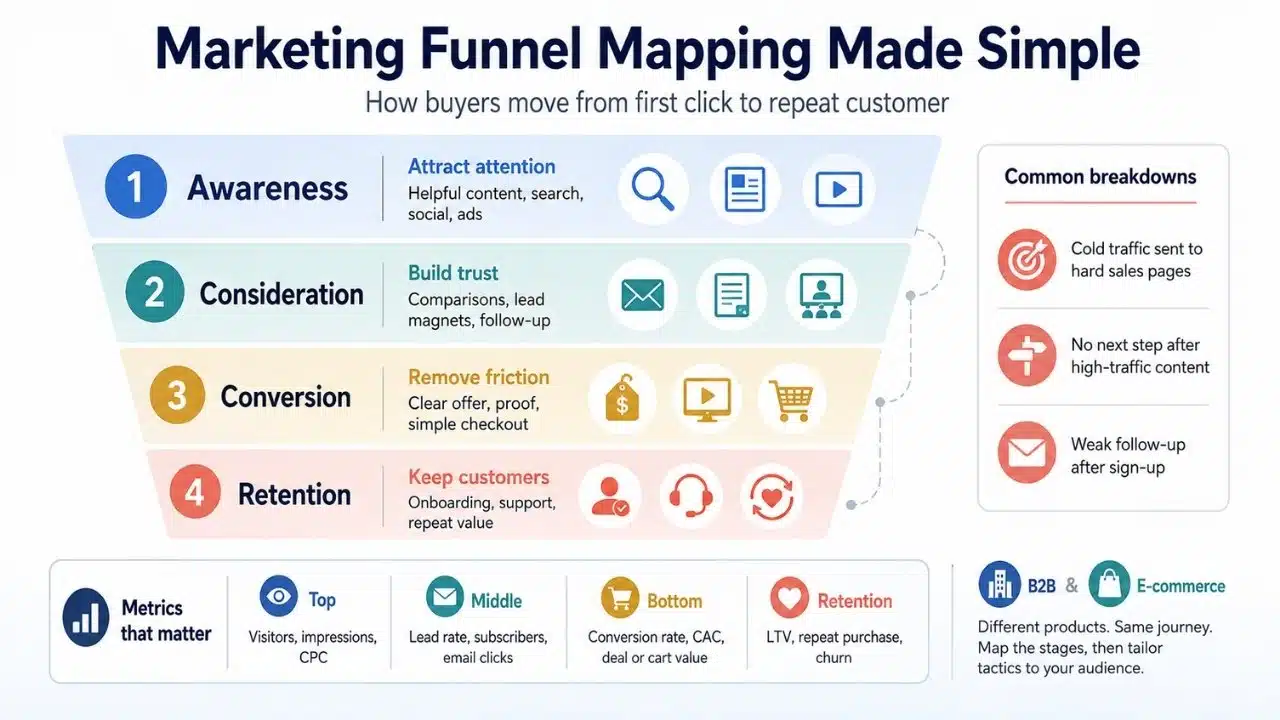
1. Capturing Attention at the Top (Awareness)
At the very beginning, prospects are dealing with a frustrating problem or symptom, but they might not even know your product category exists yet. They aren’t looking to buy right now; they are looking for answers.
If you run a payroll software company, your future customer isn’t searching for your brand name. They are typing things like “why are my remote employee tax filings taking so long” into a search bar.
Your goal here is entirely educational. You want to show up where they are searching, answer their immediate questions honestly, and introduce your brand as a helpful authority. This is where organic search guides, explanatory videos, podcasts, and broad social content do the heavy lifting.
2. Earning Consideration in the Middle
Once people understand their problem, they move into evaluation mode. They know what kind of solution they need, but they are figuring out the right approach. Should they hire an agency, buy a tool, or try to build an internal workaround?
During this phase, buyers are actively comparing approaches and collecting resources. They want comparison guides, honest breakdowns of pros and cons, downloadable templates, or deep-dive webinars.
This is the critical bridge where you capture contact information—turning an anonymous website visitor into an email subscriber or lead whom you can continue to educate over time.
3. Closing the Sale at the Bottom
By the time a lead reaches the bottom of the journey, they are ready to make a financial decision. They have narrowed their choices down to a short list of vendors, and now they are trying to minimize risk.
Their internal monologue sounds like: “Is this tool actually worth the price?”, “What happens if implementation goes sideways?”, or “Do they have reliable customer support?”
This is where you remove every ounce of friction. You provide transparent pricing, case studies from similar companies, live product walkthroughs, clear return policies, and frictionless checkout flows or booking links.
4. Protecting Post-Purchase Retention
Old-school marketing frameworks treated a purchase as the final destination. In modern business, that is where the real work begins.
Acquiring a brand-new customer costs significantly more than keeping an existing one. If your onboarding process is messy or your product fails to deliver immediate value, customers will churn within the first 60 days. Mapping the post-purchase phase means designing automated onboarding sequences, customer success touchpoints, and loyalty triggers that turn a one-time buyer into a repeat advocate.
Where Funnels Usually Breakdown in the Real World
Designing a clean funnel on a whiteboard is easy; keeping it running profitably is where companies hit walls. Most struggling strategies suffer from a few predictable operational mistakes:
-
Treating cold traffic like warm buyers: Sending people who have never heard of your brand straight to an aggressive “Book a Demo” or “Buy Now” page rarely works unless your product is an impulse buy under twenty dollars. Skipping the education phase burns ad budgets fast.
-
Creating dead ends: Publishing high-traffic blog posts or YouTube videos that answer a question brilliantly, but offer no clear next step. If a reader finishes a 2,000-word guide and sees no relevant lead magnet or inline call-to-action, they close the tab and vanish forever.
-
Expecting a straight line: Real humans do not move through a funnel in a neat, chronological sequence. Someone might read an article on their phone during a morning commute, see a retweet two weeks later, search for your brand on desktop a month later, leave without buying, and finally convert via an email link three months down the road. Your funnel shouldn’t be a rigid railroad track; it should be a safety net designed to capture and guide non-linear behavior.
How to Map Your Funnel Step-by-Step
If you want to build or fix your marketing funnel, avoid overcomplicating it with complex automation logic on day one. Focus on mapping out a clear, functional path.
-
Clarify the triggering event: Figure out what specific problem or pain point causes a buyer to start looking for a solution this week. What are they typing into Google, and what alternatives (including doing nothing) are they considering?
-
Audit what you already own: Put together a simple spreadsheet of your existing assets—your top blog posts by traffic, active ad campaigns, landing pages, email sequences, and sales decks.
-
Plug your assets into the journey: Look at your inventory and see where each piece fits. If 90% of your content is top-of-funnel blog posts and your only bottom-of-funnel asset is a generic contact form, you’ve found your bottleneck: you are driving traffic but giving people no intermediate step to build trust.
-
Anchor your calls-to-action: Make sure every single page has one primary job. A top-of-funnel article should point to a downloadable guide or newsletter list. A consideration guide should invite readers to a pre-recorded demo or calculator. A pricing page should lead directly to checkout or a sales call. Don’t clutter pages with five competing distractions.
-
Watch the drop-off points: Use your analytics dashboard to find where users disappear. High traffic combined with a tiny opt-in rate means your lead magnet isn’t compelling. High opt-in rates combined with terrible email engagement mean your follow-up sequence isn’t delivering value.
Comparing B2B and E-Commerce Funnel Realities
The mechanics of a funnel change dramatically depending on what you sell and how much it costs.
In an enterprise B2B software model, the journey is long and deliberate. A company selling a $50,000-a-year platform might use organic search and whitepapers to capture attention, gated compliance checklists to build a lead list, live product demonstrations to satisfy technical stakeholders, and custom procurement reviews to close the deal over several months.
By contrast, an e-commerce retail brand selling apparel or consumer goods compresses that entire timeline into minutes. A short-form video on social media captures initial attention, a retargeting ad offering a first-order discount captures the email address, and an optimized mobile product page with customer reviews closes the transaction instantly.
Metrics That Actually Matter
Tracking fifty different vanity metrics in your analytics tool will only create confusion. Focus on the core numbers that tell you if your marketing funnel is healthy:
Top-of-funnel metrics: Unique website visitors, organic search impressions, and cost-per-click on acquisition ads.
Middle-of-funnel metrics: Visitor-to-lead conversion rate, total new email subscribers, and email click-through rates.
Bottom-of-funnel metrics: Lead-to-customer conversion rate, customer acquisition cost (CAC), and average deal size or initial cart value.
Post-purchase metrics: Customer lifetime value (LTV), repeat purchase rate, and monthly churn.
Final Thoughts
Mapping your marketing funnel is never a one-time project that you check off a list and forget about. It is an evolving map of how your business communicates with real people looking for answers.
Build out one solid, direct path from your best-performing awareness article to a useful lead magnet, follow it up with a few genuinely helpful emails, and clear the path to a frictionless checkout or booking page. Once that primary pipeline runs smoothly and predictably, you can expand outward.
Frequently Asked Questions(FAQs) on Marketing Funnels
How long does a marketing funnel take to work from start to finish?
It entirely depends on your price point and buyer complexity. A low-cost e-commerce purchase can happen in ten minutes on a smartphone, while a high-end B2B contract can take six to nine months of multi-touch nurturing and stakeholder approvals.
Do I need a huge team and expensive software to build a funnel?
No. You can run an effective funnel with a basic content management system, a simple email marketing tool, and a clear landing page builder. You don’t need complex multi-channel automation platforms until your volume demands it.
Why is my traffic high, but my sales are practically zero?
This almost always points to a broken transition between your top-of-funnel traffic and your middle-of-funnel lead capture. You are attracting the right eyeballs, but giving them no low-friction way to engage further before asking them to make a major buying decision.





















