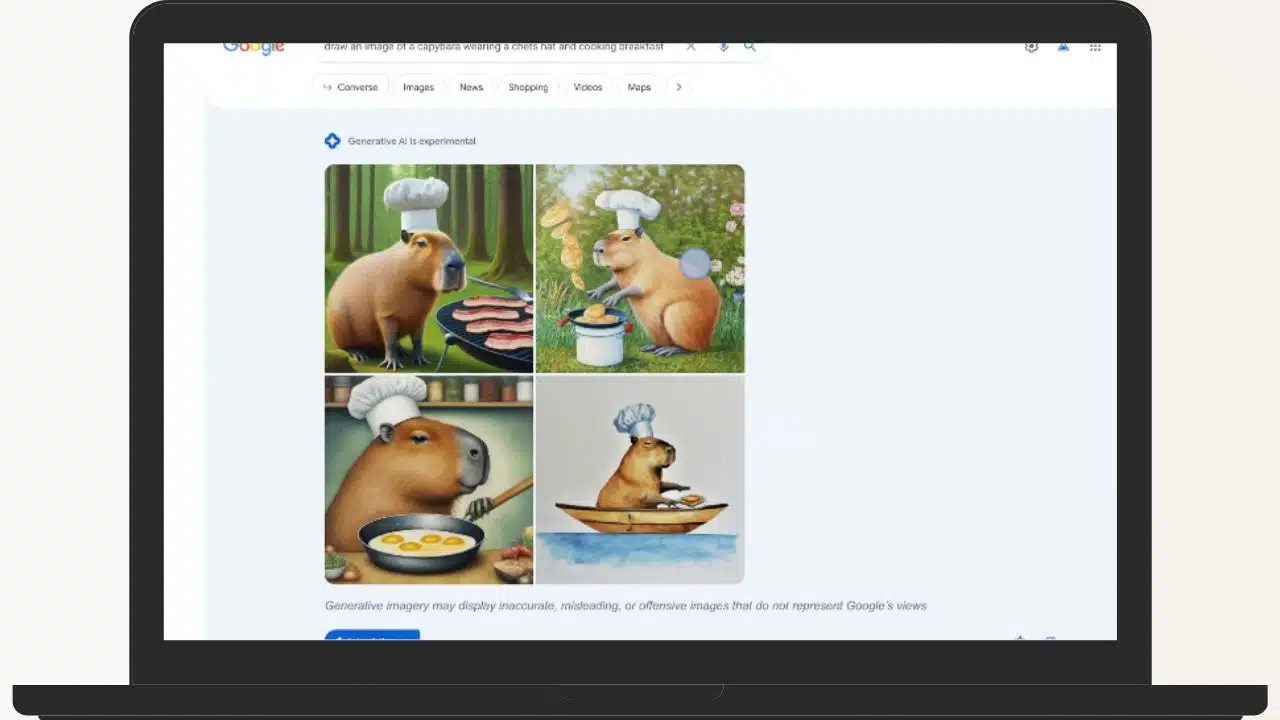
Google has added the ability to generate images and text drafts directly in Search results for some users through its Search Generative Experience (SGE) feature.
By typing a query, users can now get AI-created images or written paragraphs based on the search terms when SGE is enabled.
Text Prompts Produce Tailored Images
In Search, the image feature allows prompting the AI assistant to “draw” a queried scene or item. Users can refine the text cues to tweak results.
Google Images will also suggest creating AI images for certain searches, showing them in a sidebar. The tool leverages Google’s Imagen AI models.
Draft Texts Can Export to Docs
Similarly, SGE can now generate short or long written drafts in different tones around search topics. Users can export these AI texts to Google Docs or Gmail.
Google is utilizing a variety of large language models to power the text creation feature, though it did not specify them.
Google Aims for Responsible Rollout
Google stressed its generative AI limitations around harmful content, copyright, and misuse. Faces and public figures are prohibited currently.
Watermarks and metadata label AI creations. Access is restricted to those 18+ in this initial phase as Google evolves its approach.
Competition with Microsoft’s AI Search Features
The additions come after Microsoft enabled AI image generation in Bing using DALL-E models back in March. Google seeks parity.
Microsoft quickly ran into issues around harmful image content that Google seems keen to avoid by limiting capabilities initially.
Analysis: AI Will Transform Search, With Risks
Google’s new integrations begin unleashing AI’s creativity within search, but also create new content moderation challenges.
Huge Potential to Enhance Search Experience
Allowing interactive image and text generation directly from queries could make search far more engaging and multi-dimensional.
But it also makes Google responsible for monitoring a whole new class of AI-created content.
Regarding AI Content as First-Party Content
Treating AI outputs as first-party content penned by Google itself is prudent for legal and ethical reasons. This demands close oversight.
Google must continue limiting harmful applications until accuracy improves further. Transparency over data used for training is also key.
Risk Roadmap Requires Caution
This launch begins an unpredictable journey applying generative AI to search at scale. Google should proceed carefully and engage diverse stakeholders.
With thoughtful precautions, AI search augments human intelligence rather than harms it. But human guidance must lead the way responsibly.
Conclusion
By integrating AI image and text generation into search queries themselves, Google opens intriguing new possibilities for users to engage with information and flex their creativity.
However, big tech firms have struggled to moderate AI content, as Microsoft experienced with Bing’s image feature. Google is right to take an incremental approach as it navigates the inevitable challenges around generative search responsibly.