

Claude Hopkins tracked coupon responses when he wrote Scientific Advertising in 1923. A marketer today might test a landing page and still struggle to tell whether the campaign produced new customers or collected clicks from people who would have bought anyway. The tools changed. The question behind the test did not.
That is how I would approach the marketing books that aged well on this list. Each still helps with a decision marketers face in 2026, although its examples, channels, or broader claims may need a second look. The years below refer to the books’ original publication, not the newest edition. They run in chronological order, so start with the problem that resembles yours rather than treating the list as a ranking.
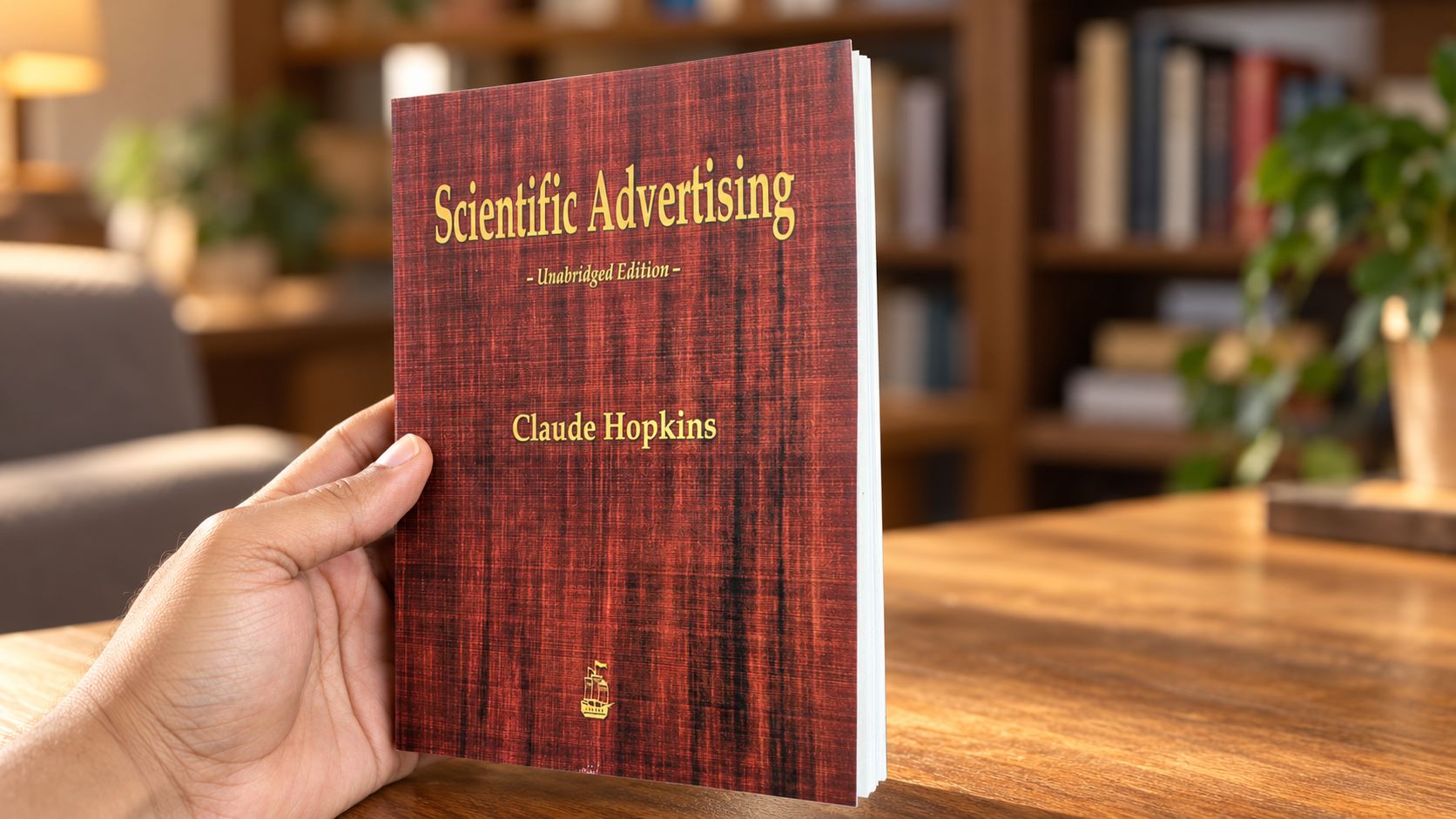
1. Scientific Advertising by Claude C. Hopkins (1923)
Hopkins worked with print advertising, samples, coupons, and mail order. What survives is his insistence that an ad make a specific case and that its results be examined. “People liked it” is a weak answer when a campaign was meant to win customers.
Suppose a software company has two ways to describe its product. One leads with a broad promise to save time; the other shows the exact task a user can complete. Hopkins would push the team to test the messages and learn which one changes the desired response. The useful modern addition is to choose that response carefully. A trial signup may be easy to count, while a qualified customer who stays is more valuable.
The book Scientific Advertising can also tempt a reader to measure only what produces an immediate, traceable action. A coupon was never a complete account of how advertising affected a brand, and a last-click report is not one today. Keep Hopkins’s habit of testing; use appropriate experiments and longer-term measures when the question calls for them.
2. Positioning: The Battle for Your Mind by Al Ries and Jack Trout (1981)
Before asking a copywriter for a better headline, ask what the buyer is meant to remember. Ries and Trout made that problem central: a brand has to find a credible place among the alternatives people already recognise.
Consider a hypothetical note-taking tool. “The complete AI workspace” says little about when to choose it. A position built around turning meeting notes into client follow-ups gives a buyer a clearer job to associate with the product, provided it actually does that job well. The wording can change; the decision about whom the tool serves and what it does best comes first.
The authors’ old battles between brands are interesting, but they are not a map of every market now. Their warnings about category leaders and brand extensions can sound absolute. Use the book to examine how buyers compare your offer with others, then check those assumptions with real customer and market evidence.
3. Ogilvy on Advertising by David Ogilvy (1983)
A striking campaign can attract praise while leaving the customer unsure what is being sold. Ogilvy’s most useful challenge is to make creative work accountable to the product and the buyer. Research the audience, communicate a benefit that matters, and give people reason to believe it.
Take an ad for a travel bag. An elegant photograph may establish a mood. A demonstration of how it opens, what fits inside, and how someone carries it can answer the questions that stand between interest and a purchase. The best choice depends on the campaign’s purpose; Ogilvy’s lesson is to make that purpose deliberate.
His discussions of print and television preserve a fascinating view of advertising practice. They should not dictate the length of a mobile video or the design of a current product page. The lasting discipline is to ask what the customer needs to understand and whether the creative work actually helps.
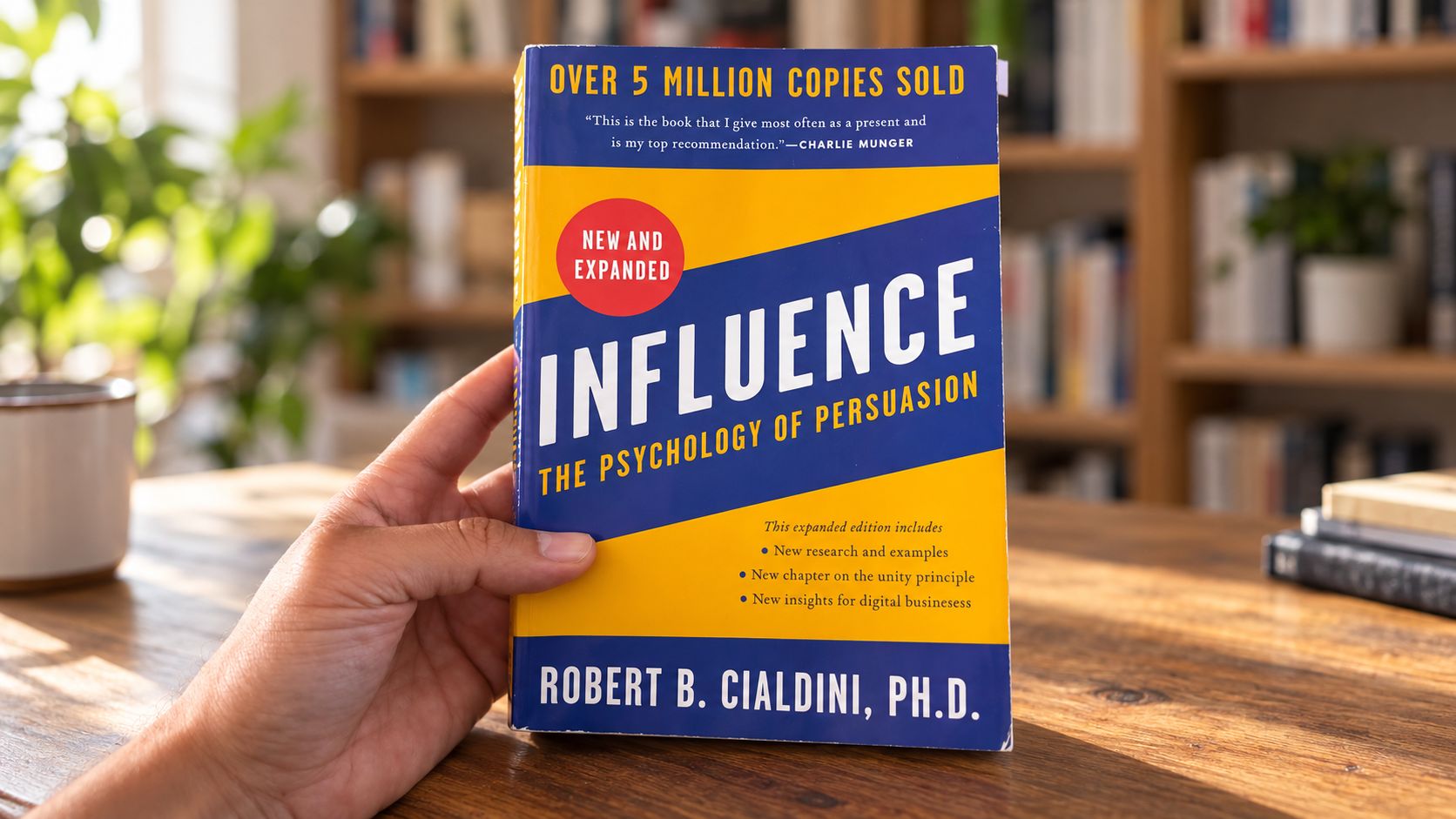
4. Influence by Robert B. Cialdini (1984)
Reciprocity, social proof, authority, and scarcity are now common marketing shorthand. Cialdini’s book is more useful when those words lead to questions about a real decision. What reassurance does this buyer need? Whose experience would be relevant? Is there a genuine reason to act soon?
A detailed account from a customer with a similar problem may answer more than a wall of anonymous five-star ratings. A qualified specialist can explain a difficult choice, but the qualification should be clear. If an offer has a deadline, it must be a real one.
This distinction has become sharper as fabricated reviews and countdowns are easy to produce. Cialdini explains why certain signals can persuade; he does not provide a licence to manufacture them. The 1984 book set out six principles. The 2021 expanded edition includes a seventh, unity, so an article or workshop citing “Cialdini’s seven principles” is describing the later framework.
5. Crossing the Chasm by Geoffrey A. Moore (1991)
An early user may tolerate rough edges because trying a new product is exciting. A team considering that same product for daily work will ask who supports it, whether it fits existing routines, and what happens when something goes wrong. Moore’s book is valuable because it treats that change in buyer expectations as a marketing problem.
Picture an AI tool that earns enthusiastic demos from individuals. To win a department, the team may have to explain review steps, onboarding, access controls, and how its output fits a real workflow. Moore calls attention to the “whole product”: the practical experience surrounding the promising core technology.
His model is most useful for innovative products moving beyond an enthusiastic early audience. It is not a timetable every launch will follow, and “build a whole product” is not a reason to add features without understanding the buyer. The 2014 third edition offers more recent examples than the original.
Read about the best books before starting a startup.
6. Permission Marketing by Seth Godin (1999)
Godin wrote about earning the right to keep talking to someone instead of repeatedly interrupting strangers. The principle has become easy to repeat and surprisingly easy to ignore.
Imagine a person signing up for a weekly guide to getting more from an app. If the next five emails are unrelated promotions, the company has kept an address but squandered the attention behind it. A useful welcome message, an honest description of what comes next, and an easy way to leave are small decisions that respect the relationship.
The book predates today’s mix of newsletters, messaging apps, privacy controls, and automated campaigns. Its title is a marketing philosophy, not a summary of every jurisdiction’s rules for commercial email. Follow the principle of sending wanted, relevant messages, and check the applicable requirements for the audience you contact.
7. Made to Stick by Chip Heath and Dan Heath (2007)
The Heath brothers ask why certain ideas remain clear in memory while others fade almost immediately. Their SUCCESs framework considers six qualities: simplicity, unexpectedness, concreteness, credibility, emotion, and stories. It is a tool for improving an idea, not a demand to cram all six into every headline.
The most useful move for many marketers is from abstraction to a detail the reader can picture. “Our system removes friction from approvals” makes the customer imagine the process. Showing the handoff where a request usually stalls, and how the system handles it, communicates more. Any promised improvement still needs evidence.
This is also where an older communication book can be misread. A surprising line is not useful if it hides the actual point; an emotional story does not repair an unsupported claim. The book helps make truthful ideas easier to grasp. It cannot make a weak offer strong.
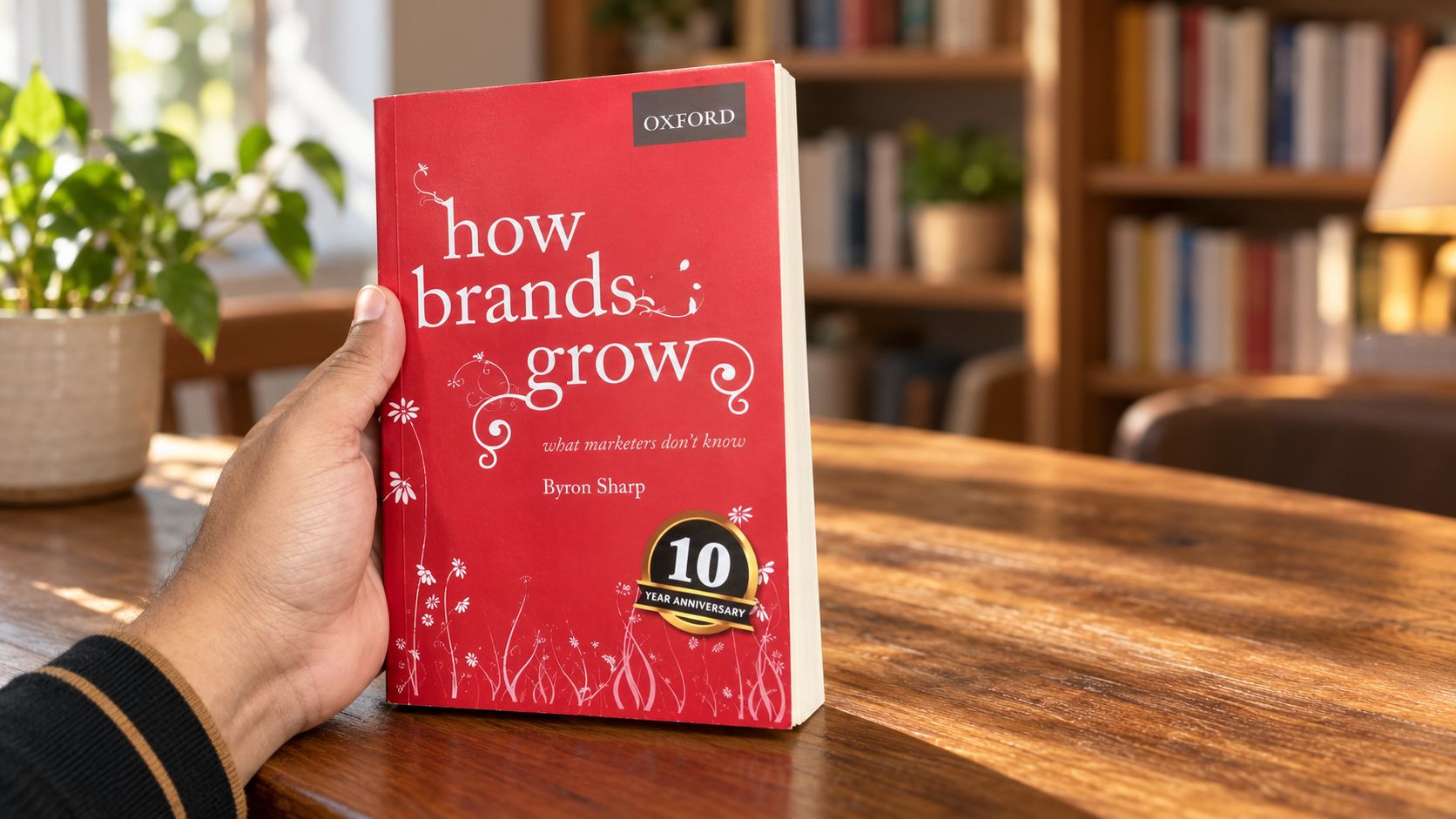
8. How Brands Grow by Byron Sharp (2010)
Sharp challenges the comforting idea that a brand can grow mainly by making a small group of current customers love it more. He asks marketers to consider the wider pool of category buyers and to make the brand easy to recall and easy to buy.
Those two kinds of availability can reveal different problems. A buyer may know a brand but fail to find the right product when shopping. Another may see it for sale yet never think of it when the need arises. Distinctive, recognisable brand cues and a purchase path that works both matter; neither is captured by counting the engagement of existing followers alone.
Read the book as a serious challenge to unsupported assumptions about loyalty and narrow targeting. Do not reduce it to “retention never matters” or apply the same spending plan to every category. Buying frequency, access, and economics still have to be examined in the market at hand.
9. Contagious: Why Things Catch On by Jonah Berger (2013)
Made to Stick helps explain why a message may stay with one person. Berger asks the next question: why would that person pass it to someone else? His STEPPS framework looks at motives that include practical value, triggers, and the stories people want to tell.
A checklist that helps a new manager prepare for a difficult conversation might be forwarded to a colleague because it solves a problem. A clever video may receive many shares without making its sponsor or product memorable. The difference matters if the goal is useful word of mouth rather than a large number on a social dashboard.
Berger’s platform examples have aged, and distribution is partly shaped by systems a marketer does not control. His work remains a way to examine what someone gains by sharing an idea. It is not a recipe that guarantees virality, and virality itself is not the business outcome.
10. Everybody Writes by Ann Handley (2014)
Handley treats writing as a marketing skill used across articles, emails, product pages, captions, and customer messages. The format may change, but vague claims and muddled thinking still reach the reader as vague, muddled words.
If I were choosing one book for a content team to discuss together, this would be near the top. Take a draft that says a tool “transforms collaboration.” What specifically happens between a brief and its approval? Who has to take the next step? What has been verified? Replacing the broad claim with those answers does more for the reader than trying to sound livelier.
The original includes platform references from 2014. Handley substantially updated the second edition in 2022, making that the more useful choice for current content work. Even then, no writing guide can supply original reporting, product knowledge or a careful editor. Its durable lesson is to make the words answer to the reader.
Read the books against each other
Moore’s focused starting market and Sharp’s advice to reach more category buyers may appear to conflict. They address different problems. A new technology product may first need a group whose needs it can meet convincingly. A brand trying to grow cannot assume that the same small circle of enthusiasts is its entire future market. Neither book can choose the right audience size without evidence about the product and category.
Hopkins and Sharp also push the reader toward different measures. A short test can show whether one offer produces more responses than another. It may say less about whether more buyers will remember the brand months later. Measuring immediate action and checking longer-term effects gives the team a better basis for the next decision.
Learn about the best productivity books here.
Which book should you read first?
| Your immediate challenge | Start with | What to take into the work |
| Buyers cannot tell what makes your offer relevant | Positioning | Define the comparison and the place you can credibly occupy. |
| Campaigns produce activity but little learning | Scientific Advertising | Test a specific claim against an outcome that matters. |
| A new product has fans but few routine users | Crossing the Chasm | Find out what practical buyers need around the core product. |
| Content reads like everyone else’s | Everybody Writes | Replace general claims with checked detail and a clear voice. |
| Growth relies on the same familiar audience | How Brands Grow | Examine reach, recall, and the ease of buying. |
| People see your content but rarely pass it along | Contagious | Give sharing a useful purpose for the audience. |
A classic is most valuable when it changes a real decision. Choose the book that helps with the problem in front of you, try the idea in context, and check what happened. Its age should make you curious about the principle, and alert you to the parts that need updating.
Frequently asked questions on the best marketing books that aged well
Are older marketing books useful for digital marketing?
Yes, when the book helps you understand buyers, shape a message, or measure an outcome. Use current documentation for platform settings, formats, privacy requirements, and reporting tools. A sound principle cannot tell you how a specific ad interface works today.
Which of these books helps most with content marketing?
Start with Everybody Writes for the quality and voice of the work. Made to Stick helps make an important idea clearer and more memorable. Contagious asks why someone would share it. Those are related questions, but they are not the same job.
Does the edition matter?
For some titles, yes. Cialdini’s 2021 expanded Influence adds a seventh principle. Moore’s 2014 third edition updates examples, and Handley’s 2022 second edition substantially revises her content guidance. Check the edition when someone recommends a specific example or framework.